
Here’s a new type of post you’ll see here occasionally—Cards. Every few weeks, I’ll pick a popular strategy tool and post its short but deep breakdown.
Today, we’ll talk about scenario planning. By the way, a few subscribers helped me choose this topic by sending in their questions. Thank you, my friends!
Feel free to send me your questions, too. I’ll do my best to answer all of them, one way or another.
At the end of the article, you will find the results of our previous vote. Very interesting, so make sure to read all the way through.

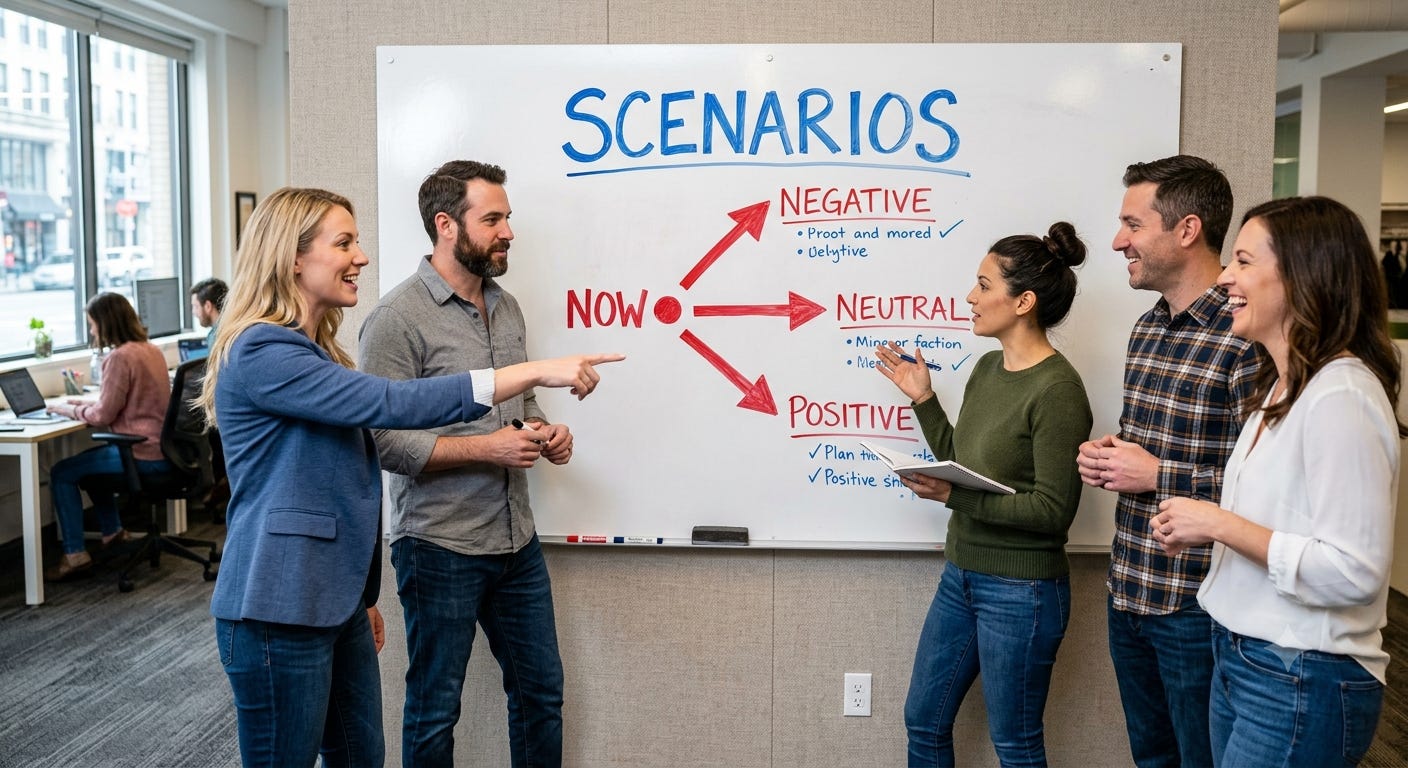
Scenario planning (SP) is a tool that helps you prepare your business for the unknown. A company maps out a few plausible future scenarios to stress-test its plans.
Instead of relying on just one scenario, you create a few and think in advance how you’ll react if they happen.
It’s not an attempt to predict the future. It’s a tool that helps businesses prepare for upcoming change and make better decisions today.
The RAND Corporation developed the method in the 1950s. They used it for military and political purposes. Royal Dutch Shell (now just Shell) was the first company to apply SP to business in the late 1960s.
In 1973, Shell turned out to be the only company to predict the sharp rise in oil prices.
Since scenario planning considers several possibilities instead of just one, it reduces the risk of making obvious mistakes. It forces many mid-sized companies think about future scenarios in the first place. Without SP, their strategies look like the world isn’t going to change at all.
Any structured tools for future thinking – SP, foresight, etc. – help you build future scenarios that are more plausible and complex.
It helps you see cause and effect within the company and the market and improves your management culture.
Alas, there are far more drawbacks of SP than benefits.
It isn’t enough to simply “imagine” a few future scenarios and try to guess the right one. This is not a TV quiz show. You need to make an action plan for each scenario. For a CEO who barely has the time and energy to think through even one scenario, this is a heavy burden.
For Royal Dutch Shell in the 1970s, scenario planning boiled down to just one question: “How much will oil cost?” Today’s CEOs must consider many more factors — from the labour market and Trump’s tariffs to competitors from the other side of the planet and new technologies.
Even 30 years ago, companies faced situations where, instead of the three carefully planned scenarios, a fourth, completely inconceivable one actually played out.
If a team tries to take every key external factor today and map out three scenarios for each — using AI, for instance, which I wouldn’t recommend — they’ll end up with an impressive but totally useless and contradictive palette of possibilities.
You might as well just say “anything can happen” and save tons of time.
If you play by the book, you take one scenario as a priority but constantly monitor the environment. If an alternative scenario is about to happen, you don’t want to learn about it from headlines.
You need to watch ‘weak signals.’
The problem with weak signals is that they are… weak. Imagine you’re executing a strategy based on one of your scenarios. So far, it’s going well. Then someone tells you a new weak signal has emerged — one that maybe, just maybe, indicates another scenario could play out.
Chances are, you’ll decide that this weak signal is too weak to act on. You won’t want to shift the whole strategy based on such insignificant evidence.
And then it will be too late.
I have made a short, four-minute video about what it means to “create customers”. Check it out here.
It takes too much resources, so it’s mostly used by large companies that can afford a dedicated strategy planning department.
You can’t do without future thinking. But you can use a variety of tools for the task.
For instance, you can follow Jeff Bezos’s advice and focus on what’s not going to change in the next ten years. Or you can go even further and create your own customers.
Neither approach lets you forget about future thinking. But you are buying an insurance policy against unexpected attacks on your customers. If you create your own customers, no competitor can steal them.
What you cannot afford, unfortunately, is to be ‘nimble’ and expect to adapt to every change on the fly. The more flexible a company is, the higher the price it pays in lost strategic focus.
In The Customer-Axis Framework we offer two-day foresight games. But we play them not to envision dozens of future scenarios – the more, the better. We play them to boost teams’ creativity and teach people how to think about the future.
When building a strategy, we use scenario planning in a radically simplified way. We focus on three or four forks in the road that might force the team to adjust the plans.
Then, for each fork, we identify a trigger: an event that could start an alternative scenario. For instance, a new law or a breakthrough in technology.
We assign people to monitor these triggers. For each one, we write a short action plan for the first 30 days in case it happens.
This 30-day plan buys the team time to figure out their next move if the scenario plays out.
For most teams, this is enough work to spot the most obvious scenarios and avoid getting caught off guard.
Below is another quick tip for paid subscribers. And if, for some reason, you haven’t upgraded yet (a huge mistake, if you ask me), simply scroll down.
Here’s a new poll, followed by the results of the previous one (with my comments). The more you vote, the better you will know what other club members—CEOs from all over the world—think!
Summer is half over, and autumn is near. My schedule for August and autumn is filling up. If you want to hire me to run a strategy retreat or a full strategy project, just reply this email. I’m also taking bookings for guest lectures and keynotes for autumn and winter.
If you like this newsletter and would like to support my work, just forward this email to other CEOs who would find it useful to join this club. And if you are the CEO someone shared this with, you can subscribe for free here:
Last week’s poll results. I don't fully agree with those who voted (read more below the picture).
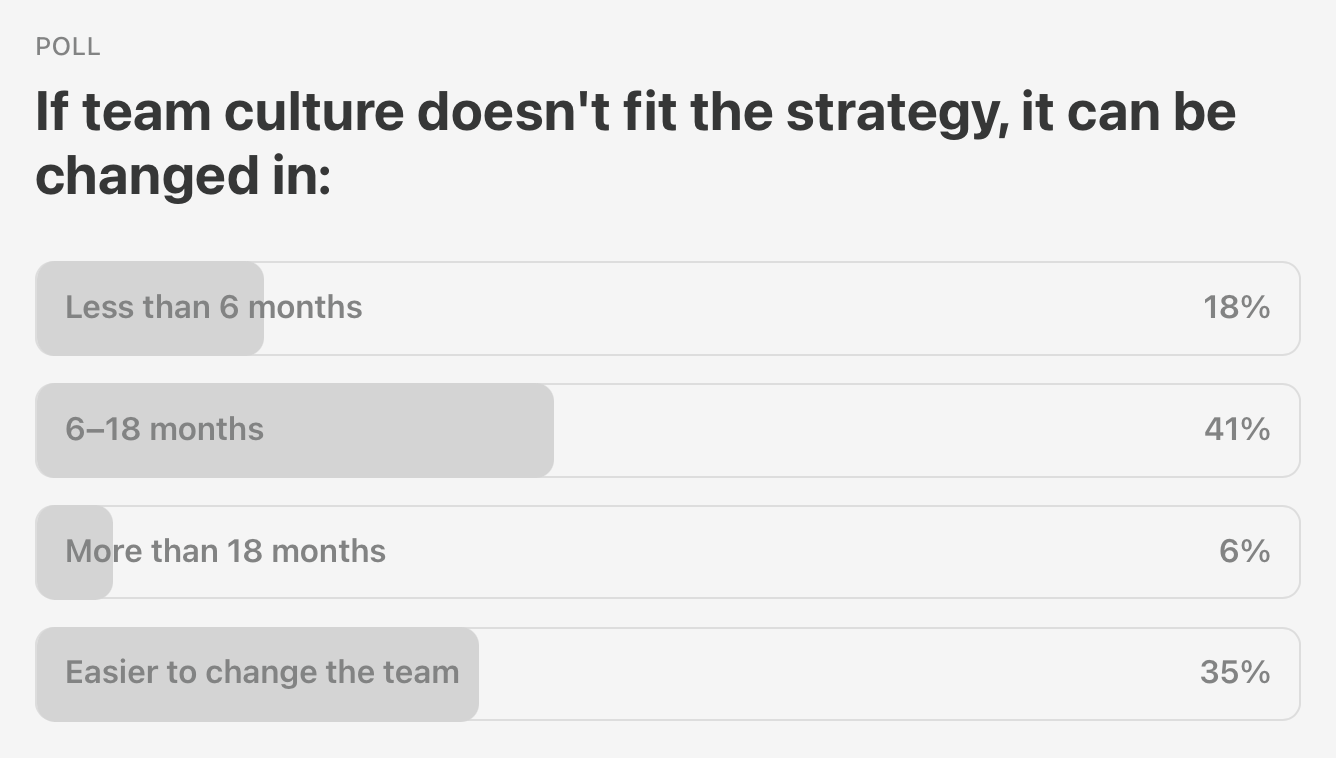
I am convinced that changing a team's culture takes at least two years, and replacing the team is by no means easier. Yes, a CEO sometimes has to take that step, but it is strictly a last resort.
If you want to share your personal opinion with me, reply to this email.
Comments
Nothing yet. Say the first thing.
Sign in to join the conversation.