
How attention to customer needs can turn a shrinking business around.

Survey data: CEOs face three main anxieties: staff shortages, digital transformation barriers, and macroeconomic challenges.
A deeper look reveals a completely different reality:
68% of companies overestimate how much customers value their products.
70% of bankrupt companies stuck to outdated strategies.
80% of companies believe they deliver unique value, but only 8% of their customers agree.
In plain English, most CEOs believe everything is ok with their products and strategies—until they are deeply in the red.
Somewhere out there, a competitor is growing right now who will steal your customers. But it’s still under the radar, so you miss it. For example, in 2010—a full 15 years after Amazon started—e-commerce had just 5% of the US retail market. So, traditional retailers arrogantly ignored it—until it was too late.
The company we are looking at today, Barnes & Noble, almost fell into that exact trap. Barnes & Noble is the largest bookstore chain in the US. By 2019, management’s main strategy was simply cutting back—reducing staff, closing stores, and shrinking retail space. Then a new CEO arrived, and everything changed.
I didn’t help Barnes & Noble develop their strategy (full disclaimer at the end). It is entirely the brainchild of CEO James Daunt and his team. However, their approach fits my Customer-Axis Framework so perfectly that it is worth analysing through this lens.
Just in case—here is the Customer-Axis Framework:
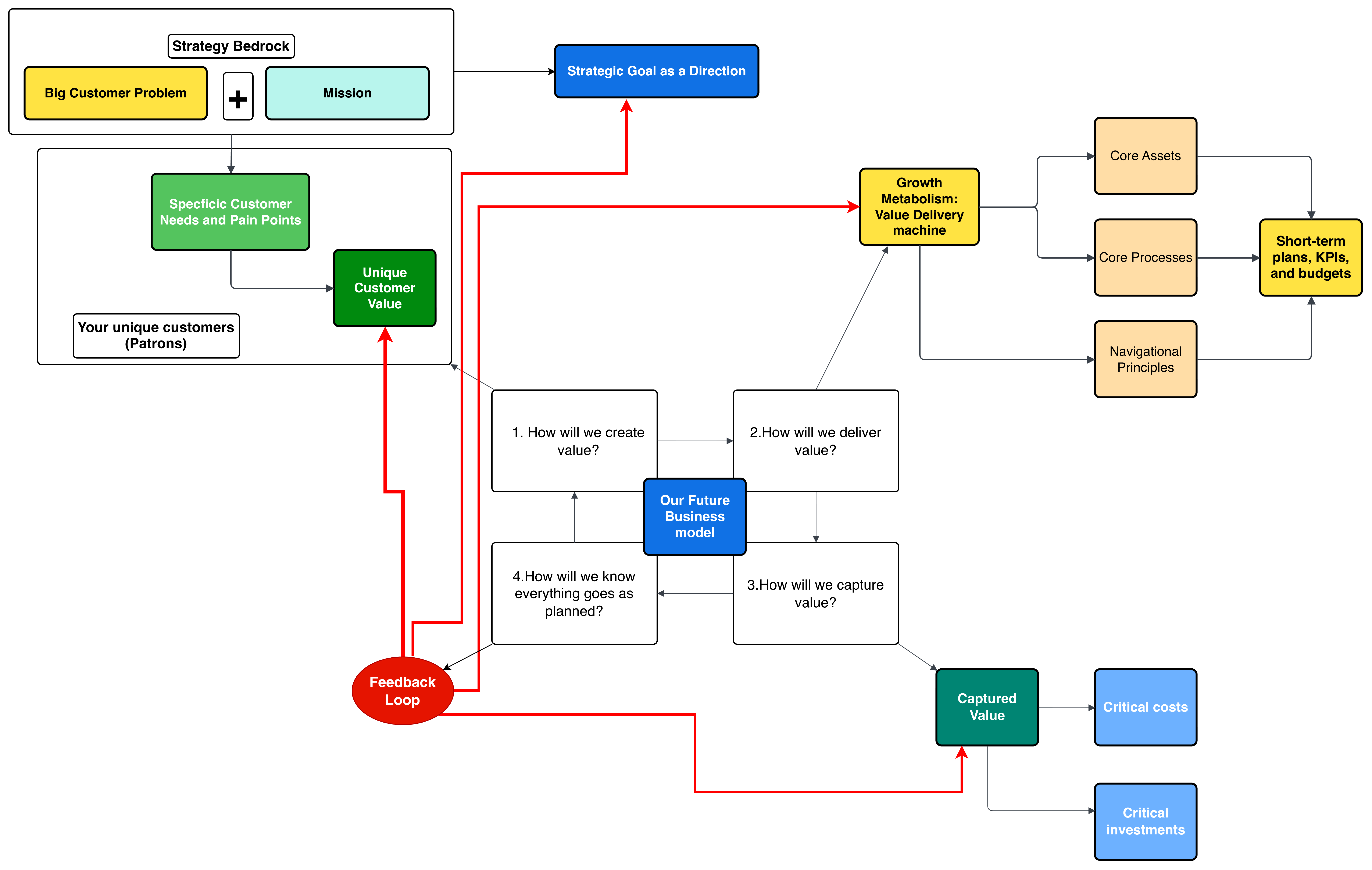
The Customer-Axis Framework is built on a simple truth: businesses have only one source of revenue—customers. So understanding customer needs and creating unique value for them is the highest priority for any CEO.
I always start crafting a strategy with the Big Customer Problem. The team needs to find a significant unsolved customer problem they intend to solve.
For example, for budget airlines, the Big Customer Problem is ‘flights are too expensive’ or ‘we can’t travel often’. For neobanks, it is ‘managing money through traditional banks is a real pain’. For streaming services, it is ‘we can’t watch shows whenever we want’.
In the 20th century, most bookstore chains, including Barnes & Noble, just sold books. Then, in 1995, Amazon changed everything. Suddenly, books were just a few clicks away—and traditional bookstores started losing revenue, profits, and customers.
Barnes & Noble tried many strategies, but none of them really worked. The company’s revenue steadily declined from $5.39 billion in 2012 to $3.48 billion in 2019. In 2019, the investment fund Elliott Advisors acquired the chain and brought in James Daunt as CEO. He had already successfully run Waterstones, a British bookstore chain also owned by the fund.
James Daunt knew you couldn’t beat Amazon just by selling books. So he rethought the Big Customer Problem that Barnes & Noble was solving. Today, it looks more like this: ‘We want to escape screens and algorithms, reclaim the tactile joy of browsing, and collect print books—but online shops and traditional chains don’t let us.‘
James Daunt turned Barnes & Noble from just a ‘bookstore’ into a place customers actually enjoy.
What Big Customer Problem does your company solve?
The Big Customer Problem can seem too broad and abstract. Framing it is important, but it’s hard to turn into actual products and services. So, when I run a strategy project, I help the team identify a few concrete customer needs to focus on. Then, we work out the unique value that will make customers happy and grow the business.
Barnes & Noble used to focus on a simple need—buying almost any book in any store. So a wide selection of books was its Unique Customer Value. Then Amazon effectively killed this advantage with its ‘infinite shelf’, the long-tail concept, and print-on-demand options. Oops.
In the 2010s, Barnes & Noble was a generic retail chain with identical cloned stores, each selling the exact same book list dictated by headquarters. But James Daunt didn’t think it was a great idea.
He didn’t believe readers in New York wanted to see the same selection of books on the shelves as people in Ohio or Minnesota. So, he ended the dictate from headquarters. Now, each store manager decides which books and categories go onto the shelves—and which don’t. They track sales, talk to customers in the store, and make their own decisions about what to stock.
Now, the Customer Need the chain focuses on is ‘seeing more books on the shelves that interest me’. The Unique Customer Value is ‘a store that listens to you and tries to get better for you’.
What Customer Needs do you focus on, and why?
What Unique Customer Value do you deliver to them?
Is it really unique?

Once you choose the Unique Customer Value you are going to deliver to your customers, the Customer-Axis Framework requires you to identify which assets and processes you need to develop. This is how you make that value real.
The biggest asset of B & N was its size. It gave the company economies of scale in purchasing. Barnes & Noble used to buy everything including furniture in bulk, using a single standard to save money.
But because Daunt shifted the focus from economies of scale to the customer, the chain needed new assets—like the knowledge, experience, and engagement of its store managers. They were no longer just cogs in a machine. Now, they were directly responsible for their stores’ business results.
The process of hiring, training, and engaging these employees also became strategically important. Of course, this doesn’t mean standard processes—logistics, purchasing, and marketing—are now forgotten. But developing store staff is now a top priority.
The chain is also actively developing its media assets, especially TikTok. But instead of one boring corporate page that nobody visits, store teams run their own accounts that are popular among local book buyers.
It is also interesting to look at the processes and assets Daunt chooses not to invest in. Of course, we can only judge by public information, but I haven’t seen any news about Barnes & Noble joining the AI hype.
The main Navigational Principle Daunt introduced is that store and ‘cluster’ managers can make many more day-to-day decisions on their own.
By the way, store designs are now different too—there is no single corporate style.
Do you have a list of the key assets and processes you need to focus on first to deliver value to your customers?
Are all your executives familiar with this list?
Do your short-term plans include developing these assets and processes?
Do you track the progress of these assets and processes every day?
If you want a corporate subscription for your team but don’t want to pay with credit card, just let us know and we will send you an invoice.
This section of the Customer-Axis Framework covers the value a company captures from its customers and turns into revenue and profit.
Paradoxically, until 2019, Barnes & Noble made its money from publishers, not book buyers. The lion’s share of the chain’s profits came from promotional fees. Publishers paid the chain to feature their books on display tables and endcaps.
This approach had two major downsides. First, publishers often pushed weaker titles simply to liquidate stock. As a result, when customers walked into a store, they didn’t see the most interesting books—they saw the ones that paid the most.
Second, it gave no one in the company a reason to think about the customer—as is often the case with profit-driven KPIs.
James Daunt put an end to this. Today, prime display space goes to the books that people actually ask for and buy. To compensate for the lost income from promotional fees, he took a more cautious approach to discounts and sales. Those who just want the cheapest book will buy it on Amazon anyway.
And it works. In a country where 70% of books are sold online, Barnes & Noble is growing and opening new stores—including in locations that closed before 2019. Amazon, by contrast, closed 68 physical bookstores it opened in 2015.
Barnes & Noble is a privately held business, so it does not share its financial results. But the growth and rising popularity of its stores show that the CEO has achieved his main goal—bringing customers back. And since book retail is as far from the AI hype as it gets, it’s hard to believe that investors are simply pumping money into a loss-making business just to sell it later.
How exactly do you monetise the Unique Customer Value you create (do not confuse this with the question, ‘how do we make a profit?’)?
How can you increase the value you capture by creating additional value for your customers?

It’s not enough to create and deliver Unique Customer Value once. You have to do it every single day. That’s why a feedback loop is a core part of the Customer-Axis Framework. It helps decision-makers get customer feedback quickly and firsthand.
We don’t know how information flows within Barnes & Noble. But we know for sure that the CEO made the feedback loop very short. By shifting decision-making from a distant headquarters to the stores—where staff actually talk to customers—he made the stores much more flexible. The ‘get feedback – take action – check results’ cycle became incredibly fast, and that is great for business.
Do you get customer feedback?
How often, and how regular is it?
Do all decision-makers get it?
How often do you discuss customer insights in your meetings?
James Daunt turned the business around from decline to growth without relying on shiny technology or ‘disruptive innovation’. In fact, much of what he did would fit perfectly in a 1980s business textbook.
Book retail was struggling because online stores, e-books, and audiobooks were stealing its customers. But Daunt created customers that neither Amazon nor other chains can easily steal. I explain how to create these kinds of customers in detail in my book Create Customers No Competitor Can Steal: The Strategy That Makes Market Uncertainty Irrelevant.
Eight times out of ten, when clients come to me, they say everything is fine with their product, value proposition, and market positioning. They think their problems lie in operations.
But most of the time, they are wrong.
A quick audit often shows that their customer value is far from unique in the eyes of their customers. And that means very difficult years ahead for them.
To avoid these difficulties, run this audit regularly. If you prefer an outside eye, I can run it for you. My schedule only allows for a handful of these audits a quarter, so I tend to be selective about the companies I look at. If you want to check my availability for a diagnostic, simply reply to this email.
Read more about how I work here or here.
And a quick reminder: some friends of mine built a tool to help you understand your customers better. Check it out here.
Next Tuesday, we will look at what AI can—and cannot—do for your business and your strategy. Stay tuned!
In the meantime, watch my new short video about the art of strategic reframing. Just click on the picture below or find it on my YouTube channel.
I have never worked for Barnes & Noble or any of its affiliates, nor have I provided any services to the company or its associated organisations. I do not personally know anyone who works there. This publication was not commissioned or requested by the company, and I have not received—and will not receive—any payment for it. All information used to prepare this text was gathered from public sources, which are listed below. It is not intended to promote Barnes & Noble or its products, and it expresses the views of the author alone.
Public sources used for this article: one, two, three, four.
Comments
Nothing yet. Say the first thing.
Sign in to join the conversation.