
Last week, officials confirmed a teleprompter operator for the White House is under investigation by the Commodity Futures Trading Commission for placing bets via Kalshi’s “mention markets.” That’s where people wager on whether President Trump, for example, mentions certain words or phrases in public speeches.
Like the teleprompter operator, those who follow Trump’s lead often are disgraced, even if later pardoned for their financial dealings, political fraud, or legal maneuverings. But when following the leader threatens the basics of a civilization itself, silence is complicity, even if the threat is to that of an enemy. Skillful action and speech are necessary to avoid contributing to further dysfunction.
Unfortunately, other political leaders in the U.S. are hard to follow: They’re not providing good examples of skillful action or speech, whether about the upcoming midterm elections, favoritism to a billionaire donor who owns North America’s busiest international crossing, or the ongoing war with Iran. Their words often remind me of the last line in the refrain from a Rod Stewart song:
Some guys have all the luck
Some guys have all the pain
Some guys get all the breaks
Some guys do nothing but complain….
But whether at the federal, state, or local level, it is more dangerous to a civilization when following the leader means ignoring reasonable arguments altogether or creating so much chaos that, for example, past presidential crimes such as Watergate would be today no more than “a 12-hour news story,” and so respond to legitimate concerns with nothing more than silence.
Local and state officials where I live are “following the leader” — ignoring / chaos / silence — and ending that behavior takes relentless commitment to staying on topic. It’s a kind of preventative action against future disasters, but to be effective it takes a community of people joining in.
No One Is Above The Law, Apparently
White House staff had been warned against such “insider trading” earlier this year, with further reporting that federal prosecutors were “exploring whether such prediction market bets trip insider trading laws.”
At the intersection of the prediction market industry and Trump world is Donald Trump Jr., the president’s eldest son. He is both an investor in and an unpaid adviser to Polymarket, and a paid adviser to Kalshi, the two biggest prediction markets. And he is a director of the Trump family’s social media company, [Truth Social,] which recently announced it would start its own platform called Truth Predict.
— The New York Times, 15 January 2026
As expected, a White House spokesperson said President Trump believed it was “unfortunate” and a “disgrace” that the teleprompter operator used his position for personal financial gain. But several reporters pointed to the many ways Trump and his family have used Trump’s position to increase private wealth, including hosting an “orgy of corruption” as Senator Elizabeth Warren put it, referring to a May 2025 dinner Trump held for top investors in his meme coin.
Indeed, the same day the White House teleprompter operator was reported as being placed on administrative leave without pay, Trump’s Truth Social company was reported to be pitching Wall Street firms faster access to Trump’s posts because what Trump posts “move markets.” Further reporting over the weekend said Truth Social plans to charge firms up to “$100,000 per month” for that faster access, so those who’ve paid for the access can make their own trades before the rest of us learn what Trump posts.
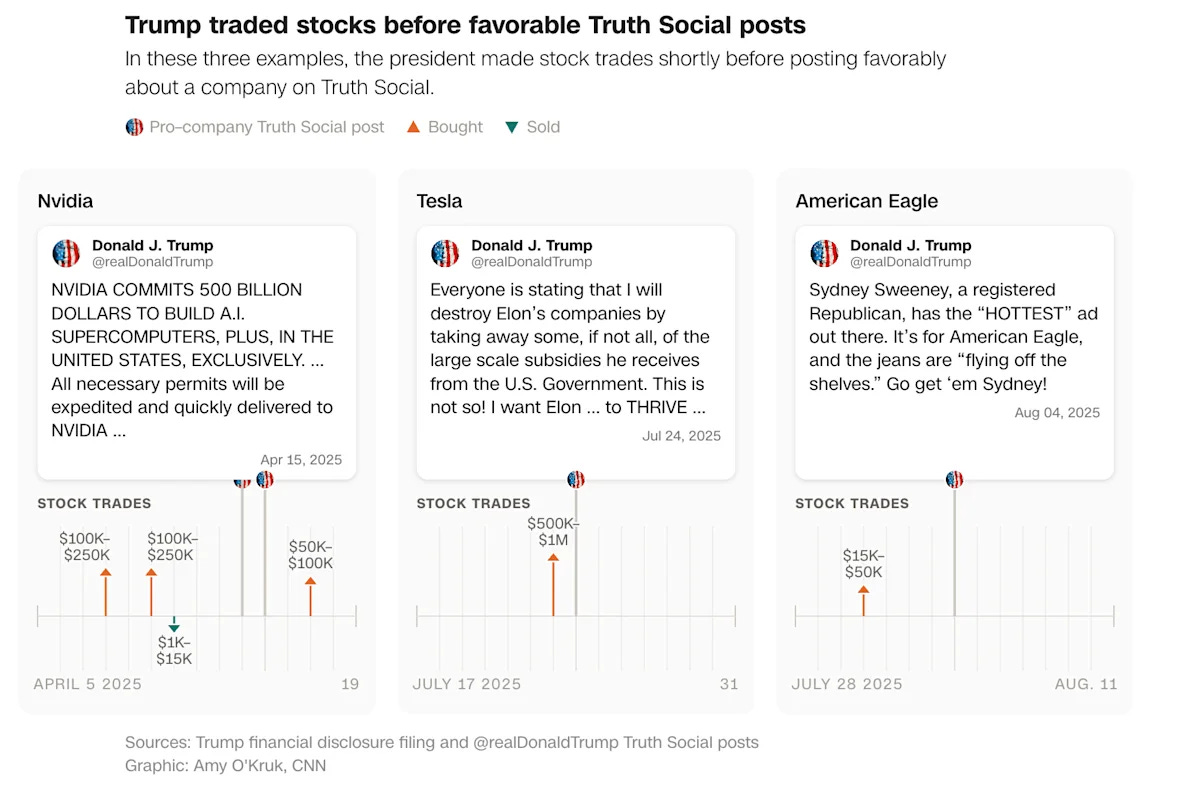
So Trump wants to further capitalize on what he himself does, as he has regularly capitalized on his position’s power to move markets, making stock market trades prior to posting on Truth Social.
Following Bad Leadership
Fyodor Dostoevsky’s novel Crime and Punishment explores whether a person can will themselves to rise above the law, pointing to Napoleon Bonaparte as an example of someone to follow despite Napoleon having done atrocious things for the supposed betterment of his society. A modern retelling of the story might have included President Nixon’s famous quote from his interview with David Frost: “When the president does it, that means that it is not illegal.” That statement was revealing of Nixon’s thinking at the time. But in a 6-3 majority, the Supreme Court gave Nixon’s statement a nod in its 2024 decision (Trump v. United States), separating only the president’s official / unofficial acts: “he is entitled to at least presumptive immunity from prosecution for all his official acts. There is no immunity for unofficial acts.”
But in her dissent, Justice Sotomayor wrote:
…. When he uses his official powers in any way, under the majority’s reasoning, he now will be insulated from criminal prosecution. Orders the Navy’s Seal Team 6 to assassinate a political rival? Immune. Organizes a military coup to hold onto power? Immune. Takes a bribe in exchange for a pardon? Immune. Immune, immune, immune.
Let the President violate the law, let him exploit the trappings of his office for personal gain, let him use his official power for evil ends. Because if he knew that he may one day face liability for breaking the law, he might not be as bold and fearless as we would like him to be. That is the majority’s message today.
Even if these nightmare scenarios never play out, and I pray they never do, the damage has been done….
Dostoevsky’s Crime and Punishment answers ‘no’ to the question about whether a person can will themselves to rise above the law. Anyone can commit crimes, yes, but in the novel the true punishment—which may or may not come from the law—comes from a person’s own consciousness: “The man who has a conscience suffers whilst acknowledging his sin. That is his punishment—as well as his prison."
There’s little point to discussing the conscientiousness of President Trump and whether he suffers any psychological punishment for his acts, as Dostoevsky’s character did. Several psychologists have discussed Trump’s character (including his being a solipsist rather than a narcissist, and what that means). But no matter how compelling their arguments, it makes little difference to those who cover Trump’s chaotic actions extensively and so have now chronicled many examples of what Justice Sotomayor previously termed “nightmare scenarios.”
So, to move forward — past the Supreme Court’s majority nod to the President being above the law for “official” acts — the American Civil Liberties Union argues for preventative action: “we must resist encroachments on our rights and liberties, criminal or otherwise, before they happen — through civil lawsuits, the ballot box, and in the halls of power across the country.”
Preventative Action: Up in the Air
We Americans don’t do prevention very well, including preventative medicine (like healthful diets and getting vaccines), preventative maintenance (such as for cars, boats, motorcycles), preventative protective measures (wearing pads or helmets for certain sports), preventative policies (environmental, healthcare, homelessness, COVID…) et cetera.
Watchdog journalism could be one form of effective preventative action, but not how it is practiced here in these United States.
Named “watchdog” after a dog’s job to alert people of intruders, watchdog journalism — at least in the U.S. — is more akin to the legend of a St. Bernard carrying a cask of brandy around its neck: locating stranded stories, keeping them warm, and reviving them with their licks. Is it useful? Yes, in the way that comforting the afflicted is useful and really, who doesn’t love the idea of a comforting St. Bernard carrying a cask of brandy? But that kind of watchdog reporting attends to such stories only after people are harmed.
Stories about vague harms such as
harms to the rule of law
are rarely pursued or published.
Such is the case of this award-winning multi-part journalism story about the air pollution in the Cicero neighborhood of Chicago. Despite the Koppers chemical company having a spotty environmental record — with Illinois Environmental Protection Agency reports dating back 50 years — journalists in the multi-part story reported in 2024 only that “new alleged violations of environmental laws … have made their way to the state attorney general’s office.”
The idea behind that story is that the award-winning, multi-part story about the air pollution may have led to the state attorney general’s office attention.
But did those violations continue beyond 2024? Yes. And last month—June, 2026—the Illinois Attorney General filed a lawsuit “over the alleged continued environmental and human health effects from Koppers’ chemical manufacturing facility.” The reporters also provided context: since the year 2000, “The Illinois EPA has referred more than 3,500 civil enforcement cases to the state attorney general’s office….”
So in addition to documenting:
decades’ worth of environmental violations,
referrals for civil enforcement, and
lawsuits,
the multi-part journalism story also reports on the health effects to long-time residents (real harm to people!) as well as a local elected leader questioning the journalists’ patriotism over what the journalists have reported in public meetings.
“Our job is to inform residents in a town that has long operated without a lot of transparency,” said Irene Romulo, one of the newsroom’s co-founders. “Unfortunately, a lot of Cicero residents feel intimidated to speak up but we want to make sure people get involved even if their views are different from the establishment’s.”
But rare has been the establishment’s view to lift ”an ounce of prevention” to spare “a pound of cure.” In sum, the watchdog reporting comforted the afflicted, but hasn’t prevented the company from continued violations (or changed the culture of polluting, with the Illinois EPA referring more than 3,500 civil enforcement cases to the state attorney general since 2000).
Overcoming Ignoring / Chaos / Silence: Taking a Preventative Step
It could be decades from now before it’s possible to point to the health effects of various pollution sources (real harm to real people that will come if things continue as they are) to long-time residents of the Piedmont Triad region of North Carolina, named for the three largest cities of Greensboro, Winston-Salem, and High Point.
But it would be a shame if nothing was done about it until reporters—decades from now, documenting what is currently a foreseeable harm—re-examined documents that are publicly available today.
Indeed, there’s been little to no response to preventative watchdog reporting on, for example:
past public records requests surrounding a bad development deal that appears not to follow state-level rules designed to protect the watershed, so the high-density development project is still going forward;
privately supported testing for PFAS that shows the extent to which these forever chemicals are in local water supplies, or
capping recently placed stormwater drains that allow contaminated brownfield sediment into the local water ways.
Perhaps it’s because communities are distracted by the other chaos at the local, state, regional, national, and international levels, and so aren’t prioritizing their own local environments?
Or perhaps it’s simply because individuals believe they are protected because they are filtering their own water, or are buying water that they believe do not contain these toxins?
So what about filtering or avoiding the (local) air?
In 2021, the city of High Point, North Carolina received a notice of violation regarding exceeding the amount of acrylonitrile emissions from the Kersey Valley Landfill, which were 390 lbs/year. State’s regulations set the limit at 0.4 lbs/day, or 146 lbs/year.
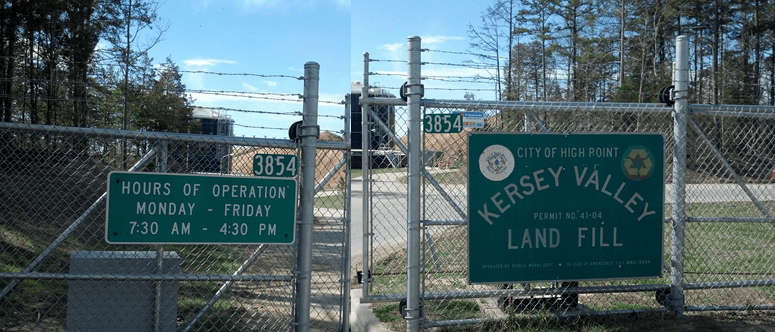
The chemical is important to the furniture industry that dominates the Piedmont Triad, and especially dominates the city High Point. But in a follow-up inspection report of the Kersey Valley Landfill by the NC Department of Air Quality (January 20, 2022), acrylonitrile emissions were reported to be so high only because of an “incorrect reference.” So new modeling for how acrylonitrile is emitted by the landfill was “anticipated to demonstrate compliance” with state law.
However, in a cover letter by consultants with Smith+Gardner Inc. accompanying the Kersey Valley Landfill’s 2021 permit application, the new permit for Kersey Valley Landfill would also exempt the facility from all state-level toxic and hazardous air emissions regulations. That’s because the facility’s new permit would put them under the stricter federal regulations for municipal landfills that accept asbestos.
The executive summary of the Kersey Valley Landfill permit modification makes it clear: accepting asbestos is part of the path to avoid future violations, with state law specifically mentioning the asbestos-related exemption (40 CFR Part 61).
The purpose of this modification is to respond to the notice of violation [NOV] issued to the City of High Point on July 7, 2021, by the North Carolina Department of Environment Quality [DEQ] Division of Air Quality [DAQ], alleging exceedance of toxic air pollutant emission rates requiring a permit. In response, the City of High Point requests to incorporate into the Title V permit the National Emission Standards for Hazardous Air Pollutants [NESHAP] for Asbestos [40 CFR 61 Subpart M]. The landfill is an active disposal site for asbestos-containing material.
The state law exemption regarding accepting asbestos makes sense. It avoids double-regulation: Any facility accepting asbestos is catalogued by the U.S. Environmental Protection Agency and must follow more stringent federal regulations regarding hazardous/toxic emissions.
But subsequent DAQ inspection reports on the Kersey Valley Landfill (e.g., 12/13/2022 and 11/16/2023) included reporting that the facility’s superintendent “stated that the facility has not accepted any Asbestos containing waste and has no plans to accept any in the foreseeable future.” That’s even though these inspection reports also state “the facility’s subjectivity to 41 CFR 61 Subpart M [National Emissions Standards for Asbestos] allowed them to be exempt from NC Air Toxics regulations.”
So the statement from the executive summary of the August, 2021 permit re-application — “The landfill is an active disposal site for asbestos-containing material” — is false.
By 2024, the inspection report (12/4/2024) was more nuanced: it states the Kersey Valley Landfill “is subject to this [41 CFR 61 Subpart M] regulation if (emphasis added) asbestos-containing material has been deposited within the last year.” But then goes on to report “the facility does not accept any asbestos containing waste and has no plans to.”
Those statements are repeated in the most recent inspector’s report (10/14/2025), which also has an additional sentence at the end sitting all by itself that says, simply:
“The facility is subject to 40 CFR Part 61, Subpart M ‘National Emission Standards for Asbestos.’”
So…
…either there appears to be a legal loophole between NC and federal law because NC state law exempts a facility from state-level emissions violations whenever a facility is subject to the National Emission Standards for Asbestos but federal monitoring the facility’s toxic air emissions doesn’t appear to happen unless the facility actually starts accepting asbestos (so the remedy is for state legislators to eliminate that loophole)…,
…or this is a serious misinterpretation of the National Emissions Standards for Asbestos (see particularly section 64.140 Applicability), in which case it may be worth doing an audit of every report/facility that is permitted to accept asbestos as well as an audit of every municipality consulted by Smith+Gardner Inc. to see whether the company has made similar false statements — about other facilities accepting asbestos when they aren’t — or their having identified other loopholes to avoid triggering violations for hazardous/toxic emissions.
But either way, it seems—at best—Kersey Valley Landfill is benefitting from the (perceived) loophole. At worst, the facility is exploiting it.
And recently, emissions have gone up dramatically.
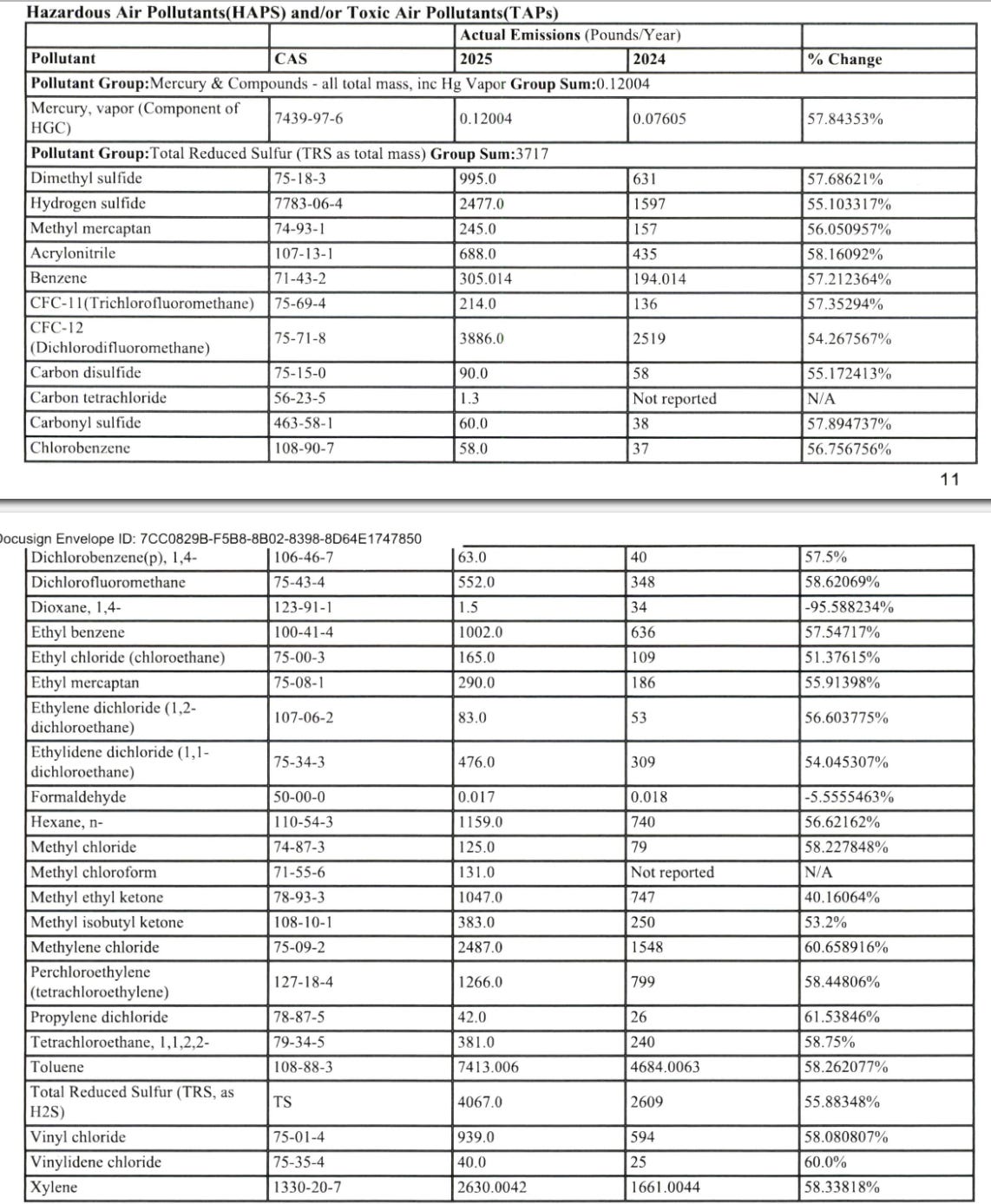
Every year since 2021, when Kersey Valley Landfill received a violation for exceeding the emissions rate for acrylonitrile, the air emissions inventory for Hazardous Air Pollutants and Toxic Air Pollutants showed an increase of a few percentage points, typically no more than 5%.
Acrylonitrile, for example, went up 2.5% from 2021 to 2022, up 2.4% from 2022 to 2023, and up 2.35% from 2023 to 2024.
But the latest air emissions inventory report (filed 6/17/2026) shows emissions of acrylonitrile from 2024 to 2025 went up 58%. There was a similar percentage increase in the emissions of most every one of the hazardous/toxic air pollutants emitted by Kersey Valley Landfill.
So I asked via email for a conversation with the inspector, Robert Barker, who wrote those reports in 2024 and 2025.
In reply, I heard instead from Shawn Taylor, Public Information Officer (PIO) with the NC Department of Environmental Quality, who was very helpful. But among Mr. Taylor’s replies was this statement:
Kersey Valley Landfill’s current air permit subjects it to the National Emissions Standards for Asbestos, regardless of whether the landfill actually accepts asbestos waste or not.
— March 3, 2026 email from NCDEQ’s Shawn Taylor, PIO
After seeing the latest emissions inventory — and the enormous increase in hazardous/toxic emissions — I followed up with the NCDEQ’s General Counsel, Daniel Hirschman, as to whether this interpretation of federal law was also his view. It resulted in the following brief reply, quoted in total:
Mr. Frederick,
Thank you for your email. The General Counsel’s Office for the Department of Environmental Quality (“DEQ”) provides legal counsel and advice to the Secretary, leadership, and the various DEQ Divisions. Unfortunately, we are not able provide legal advice or guidance to the public.
— July 16, 2026 email from NCDEQ’s Daniel Hirschman, General Counsel
I wrote back immediately — to the attorney and the PIO office — but have had no further reply. So I went back to examine further the data and previous correspondence.
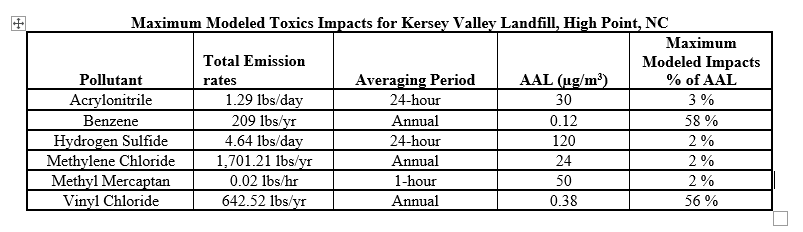
The Public Information Officer had listed the most concerning emissions from the Kersey Valley Landfill, which included more than acrylonitrile. As shown in the table below, all of these chemicals were re-modeled in 2022 (after the “incorrect reference” was discovered).
As you can see, the “Maximum Modeled Impacts % of A[cceptable] A[mbient] L[evels]” were all well below 100%.
In other words, at/over 100% is bad. So the Kersey Valley Landfill facility demonstrated in 2022 — through air dispersion modeling (reported 2/14/2022) — that its emissions are well below the concentration of air toxic pollutants (that is, off-site, or at the border of the landfill facility) that would exceed health-based limits.
But critically, the 2022 modeling report itself includes this caveat:
This compliance demonstration assumes the listed sources modeled, point and area source parameters, and pollutant emission rates used in the dispersion modeling analysis are correct.
As of 2025, they no longer are.
From the report posted online 6/24/2026,
For acrylonitrile:
the 2022 modeling emission rate of 1.29 lbs/day yields 470.85 lbs/year;
the 2024 actual emissions reported were 435 lbs (OK because less than modeled amount);
the 2025 actual emissions reported were 688 lbs (46% HIGHER THAN THE MODELING EMISSIONS RATE (688/470.85 = 1.46…)).
(I'll spare you the calculations/conclusions for these others, but you can clearly see the 2025 actual emissions reported are higher than the modeled amount.)
For benzene:
the 2022 modeling emission rate is given as 209 lbs/year;
the 2024 actual emissions reported were 194.014 lbs;
the 2025 actual emissions reported were 305.014 lbs.
For hydrogen sulfide:
the 2022 modeling emissions rate of 4.64 lbs/day yields 1693.6 lbs/year;
the 2024 actual emissions reported were 1597 lbs;
the 2025 actual emissions reported were 2477.0 lbs.
For methylene chloride:
the 2022 modeling emission rate is given as 1701.21 lbs/year;
the 2024 actual emissions reported were 1548 lbs;
the 2025 actual emissions reported were 2487.0 lbs.
For methyl mercaptan:
the 2022 modeling emissions rate of 0.02 lbs/hour yields 175.2 lbs/year;
the 2024 actual emissions reported were 157 lbs;
the 2025 actual emissions reported were 245.0 lbs.
For vinyl chloride:
the 2022 modeling emission rate is given as 642.52 lbs/year;
the 2024 actual emissions reported were 594 lbs;
the 2025 actual emissions reported were 939.0 lbs.
But again, given the NCDEQ (mis?)interpretation of the EPA’s National Emissions Standards for Asbestos, it ultimately doesn’t matter how much of these — or any other — hazardous/toxic substances are emitted by the Kersey Valley Landfill. That’s because the (mis?)application of law means Kersey Valley Landfill is exempted from state-based emissions levels that would prompt state-baed violations. And because the Kersey Valley Landfill hasn’t accepted asbestos, the EPA isn’t really monitoring the facility, either.
Following This Leader
Just before the 4th of July, President Trump pardoned 9 people who were convicted of having violated the Clean Air Act.
Last week, he exempted 20 more polluting facilities in addition to 50 exempted previously from new national clean air regulations meant to protect people from exposure from toxic air pollutants, including the aforementioned benzene and vinyl chloride (the chemicals with the highest AALs mentioned in 2022 modeling of Kersey Valley Landfill, and now have emissions much higher than those modeled).
The EPA itself estimated that its new (2024) national toxic air pollutants rule—which would have gone into effect earlier this month—would reduce toxic air pollution by more than 6,200 tons, reducing cancer and other community-wide exposure risks from toxic air in communities near regulated facilities by 96 percent. But those emitters — from Michigan, Virginia, Alabama, Texas, Illinois, Florida, North Carolina, et cetera — “now have a free pass to continue to pollute and put communities at risk for an additional two years.”
Join In: Effective Preventative Watchdog Reporting Takes Community Involvement
The Kersey Valley Landfill is operated by the city of High Point, NC, but the closest population center is Jamestown: as the wind blows, it’s less than 3 miles to Jamestown’s Town Hall.
It’s easy to ignore the emails and phone calls of a single journalist. It’s much harder to ignore an entire community, at least so long as that community stays on topic.
So if you're a resident of the area, consider contacting the City Manager’s office of High Point as the legally responsible official for the Kersey Valley Landfill. Reaching out to get further responses from the NCDEQ Department of Air Quality may also be useful. Or reporting all this to the NC State Auditor may also be an avenue forward, though you’ll have to use email/phone contact information because “High Point,” for some reason, isn’t listed among the cities/municipalities available on the NC state auditor’s anonymous reporting form.
What sustainability projects might you focus on in your habitat that would benefit both you and your neighbors (and our states / countries / planet, over time) by working together?
Appreciate this post but are thinking “No, I do not need another subscription, another newsletter, another micropayment to keep track of”? I get it. Please consider getting me a virtual coffee or contributing to my virtual tip jar. Thanks for your consideration.
No posts
Comments
Nothing yet. Say the first thing.
Sign in to join the conversation.