
EPA spokesperson Alan Stout had his email set to automatic reply when the U.S. Environmental Protection Agency (EPA) announced it was rescinding its own Endangerment Finding. That key finding in 2009 required the EPA to regulate carbon dioxide and other greenhouse gases as pollutants. The finding came only after a 2007 Supreme Court ruling that the EPA had that authority “because greenhouse gases fit well within the Act’s capacious definition of ‘air pollutant.’”
Stout was the only person listed as a point of contact on the 436-page formal repeal of the EPA’s Endangerment Finding (now available via Wayback Machine). But, immediately after writing him on February 13, 2026 — the day after the EPA’s rescission announcement — I received his automatic reply that he would be “out of the office through Monday, March 2. I will respond to your message at my first opportunity.”
I wrote Mr. Stout because I had reviewed the 335-page document that responded to the approximately 572,000 public comments about the EPA’s rescission (now available via Wayback Machine) and, in that document, saw many tell-tale signs of it having been drafted by Artificial Intelligence.
So I asked Mr. Stout:
Are you able to confirm that it was, or able to refer me to a person who could comment on how this response-to-comments document was made on this short timeline, please?
My reason for saying it is a short timeline is because the EPA took quite a bit more time and issued a more thorough response to the far fewer comments -- 380,000 comments -- regarding the 2009 Endangerment Finding itself.
Thank you for your consideration. I look forward to your reply.
There’s an increasing frequency of the phrase “did not respond to a request for comment” in journalism. Public relations professionals have boiled down the reason for that trend as due to a shift in media relations, whether because of the sheer volume of requests, the timing of them, or the capacity of most anyone to bypass journalists to publish on their own by issuing a statement, buying an advertisement, or posting on social media.
But the best stories in journalism aren’t driven by deadlines. So there’s time to wait days, weeks, months, or even longer. Silence for that long, though, often reveals the best stories, especially which Artificial Intelligence can perform the illusion of intelligent speech with a simple prompt. But the kind of journalistic practice it takes to reveal such stories is rare because it’s more than expensive: It requires journalists, sources, and even audiences to resist the commodification of information itself.
It’s been now several months since I last heard from Mr. Stout, and I updated the February 16 SustainLab post (“Reckless Endangerment”) last on March 23.
But at this point, I don’t expect to hear from Mr. Stout again, his last reply on March 9 saying “I’m not sure if we will be able to get back to you with any kind of response to your questions, but I’ll see what I can do.”
So, months ago, I passed along my discovery and subsequent correspondence to a journalism colleague at The New York Times, as it’s more of an international or national story whether the EPA uses A.I. to justify reckless decisions that ultimately endanger human life on Earth.
Plus, I made the decision a long time ago that covering sustainability—including teaching others to do so—means finding local stories and zooming out from there, doing enough reporting to cover “why” and “how” as well as “now what” for for journalism audiences to act.
So that leads to this continuation of a developing story.
What-A-Mess: Silence, then Noise from Whataburger
Erin Brockovich or Julia Roberts might guess why Whataburger never broke ground for a new restaurant at the edge of Greensboro, North Carolina.
Whataburger’s Taylor Clark hasn’t confirmed it, though.
Mr. Clark is Whataburger’s Group Director, Corporate Communications, who replied without confirmation on June 24, 2026. That was more than a month after an initial inquiry to another Whataburger employee (and several follow-up emails). The initial inquiry was because the company’s January 13, 2026 notice of termination to the North Carolina’s Department of Environmental Quality (NCDEQ) lacked detail.
The person who signed that notice of termination, Wesley Williams—Whataburger’s New Unit Project Manager, Real Estate Development—had listed “Other (please specify),” with the reason given as “Project has been canceled and never broke ground. Project close-out documents for erosion control portion is attached.”
The reason erosion control matters is because the lot where Whataburger was to build its new restaurant is a brownfield.
Of the various chemicals detected in that brownfield, one of them —hexavalent chromium — was made famous by the 2000 film “Erin Brockovitch,” played by Julia Roberts.
According to the U.S. National Institute of Environmental Health Sciences, “hexavalent chromium exposure occurs through breathing it in, ingesting it in food or water, or direct contact with the skin” and that exposure is to be avoided because exposure is associated with various forms of cancer.
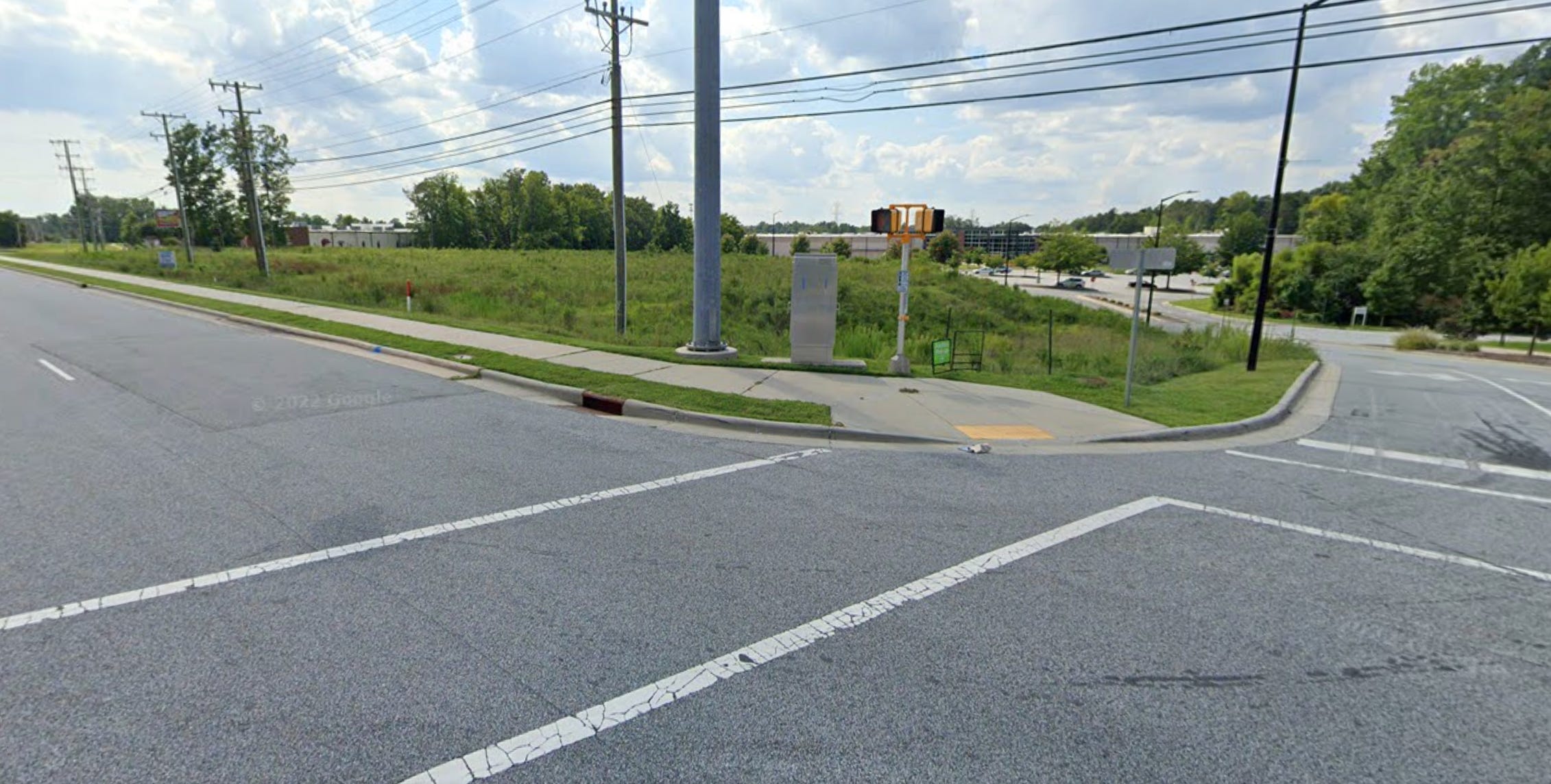
So in initially writing Mr. Williams, who issued Whataburger’s notice of termination, I was trying to confirm what I’ve already heard from another source: that Whataburger terminated the restaurant project because of company concerns over the soil contamination, and particularly because of hexavalent chromium.
I expected the company would want to confirm that.
Mr. Clark, though, did not, writing on June 24:
Hi Robert. Sorry for the delay. The following quote can be attributed to a Whataburger spokesperson:
“We regularly conduct a business review of our locations so that we’re maximizing opportunities for growth and keeping Whataburger strong in the communities we serve. Sometimes, that means adjusting plans and not moving forward with additional restaurants. We are proud to be part of Jamestown and made the decision that the other three locations already established are serving the community well.”
Although this particular Whataburger project was referred to as “Project Jamestown,” after Jamestown, North Carolina—a small town between Greensboro and High Point—Whataburger’s termination of the project meant no presence in Jamestown. So Mr. Clark’s statement, “We are proud to be part of Jamestown,” made no sense given the nearest Whataburger location to Jamestown’s Town Hall is nearly 5 miles as the crow flies. The cancelled project would have been 1.5 miles from Jamestown’s Town Hall, and be the only burger option in close proximity to a Chick-Fil-A, Jersey Mike’s, Chipotle, Starbucks, etc., all across the street (a natural ridge, and not on brownfields).
Pointing that out to Mr. Clark, however, whose office is in Texas, yielded no reply by the end of yesterday, June 29, the timeline by which I asked him to respond. In other words, Whataburger’s Mr. Clark “did not respond to a request for comment.”
One Brownfield, Two Different Environmental Reports
Also not responding to a request for comment are:
a representative from Terracon Consultants, whose geologist, F. Christopher Driscoll, P.G., prepared the Brownfield Assessment Report for the proposed Whataburger project, and
the person that Terracon’s Brownfield Assessment Report was sent to, NCDEQ’s Brownfields Project Manager Joshawa Billiot.
Terracon’s geologist actually completed two Brownfield Assessment Reports, one for Whataburger, and one for Panda Express, which also had proposed a restaurant project on the same brownfield.
Terracon’s two reports for the two different companies, both submitted to the NCDEQ on March 25, 2025, differed in one extremely significant way: groundwater testing.
For Whataburger, Terracon’s brownfields assessment report included testing groundwater in addition to soil and soil vapor. For Panda Express, Terracon’s brownfield assessment report only included test results of soil and soil vapor.
Weeks after inquiring, I have yet to hear back from Terracon about the reason for the difference in the reports, particularly given the exact same concerns are—verbatim—in the Executive Summary of both reports:
The on-site concern consists of the possibility of undocumented releases to soil and risk of vapor intrusion into new construction in association with documented releases from the former northeast adjacent textile manufacturing facility, Burlington Industries.
Groundwater testing—in the Terracon report for Whataburger—revealed a significant presence of hexavalent chromium (using EPA method 7199).
But because Terracon conducted no groundwater test for the Panda Express project, Terracon’s contracted lab used a different chemistry test that resulted in lesser amounts of hexavalent chromium (using EPA test combination of test 3060A to extract hexavalent chromium present in the soil and then test 7196A to find the concentration of any hexavalent chromium).
Whataburger canceled.
The Panda Express project went forward and opened March 31, 2026.
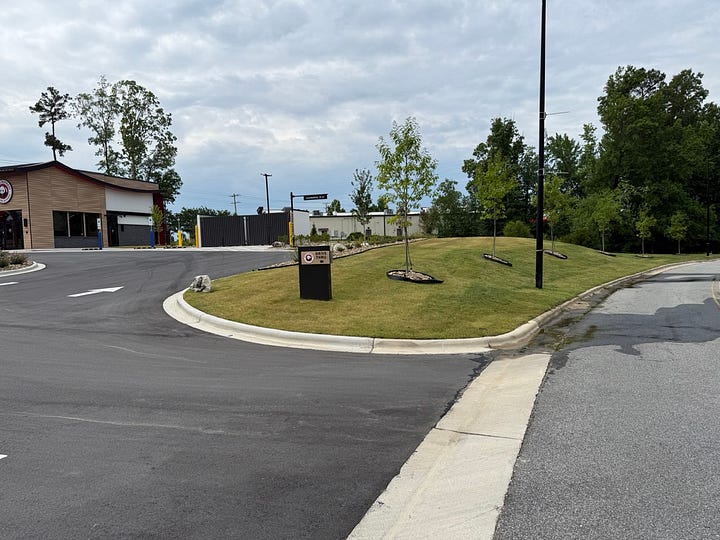
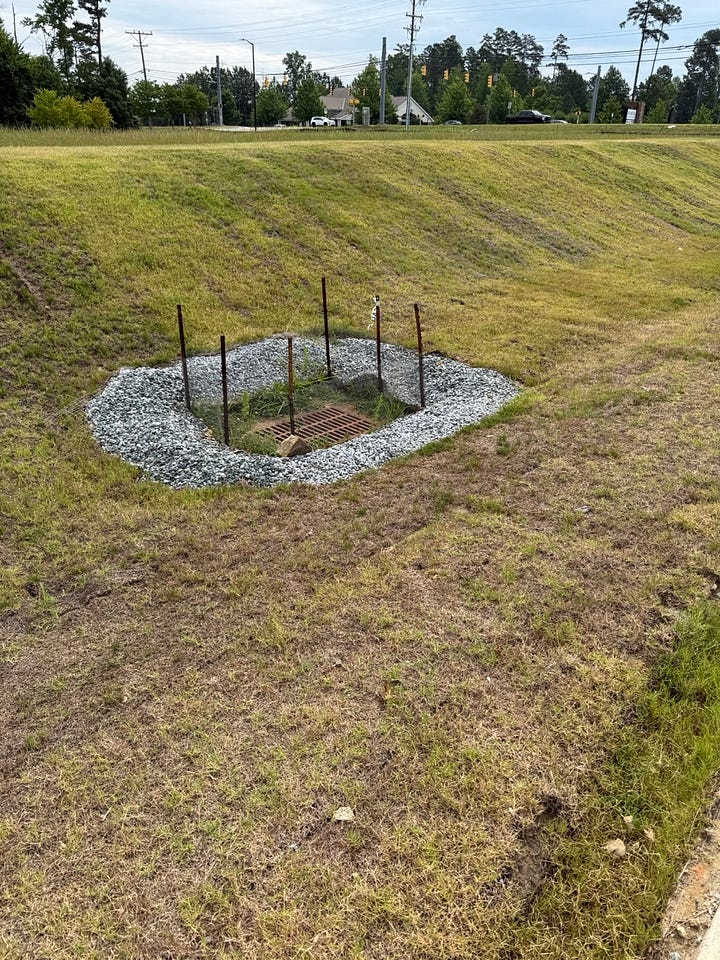
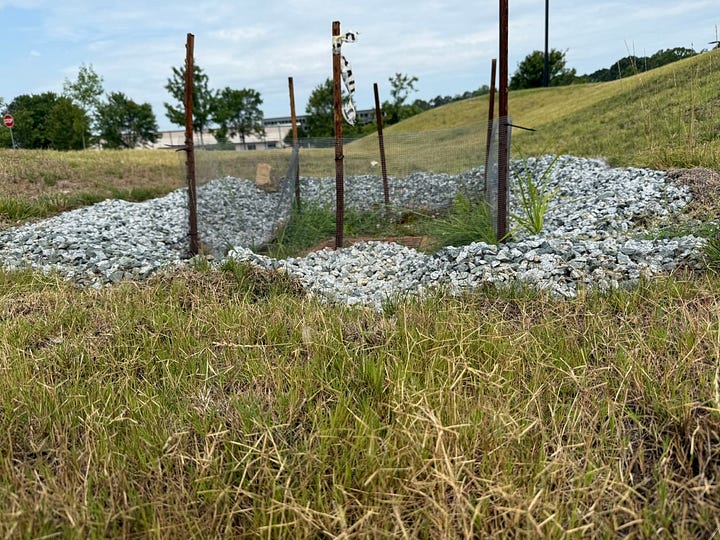
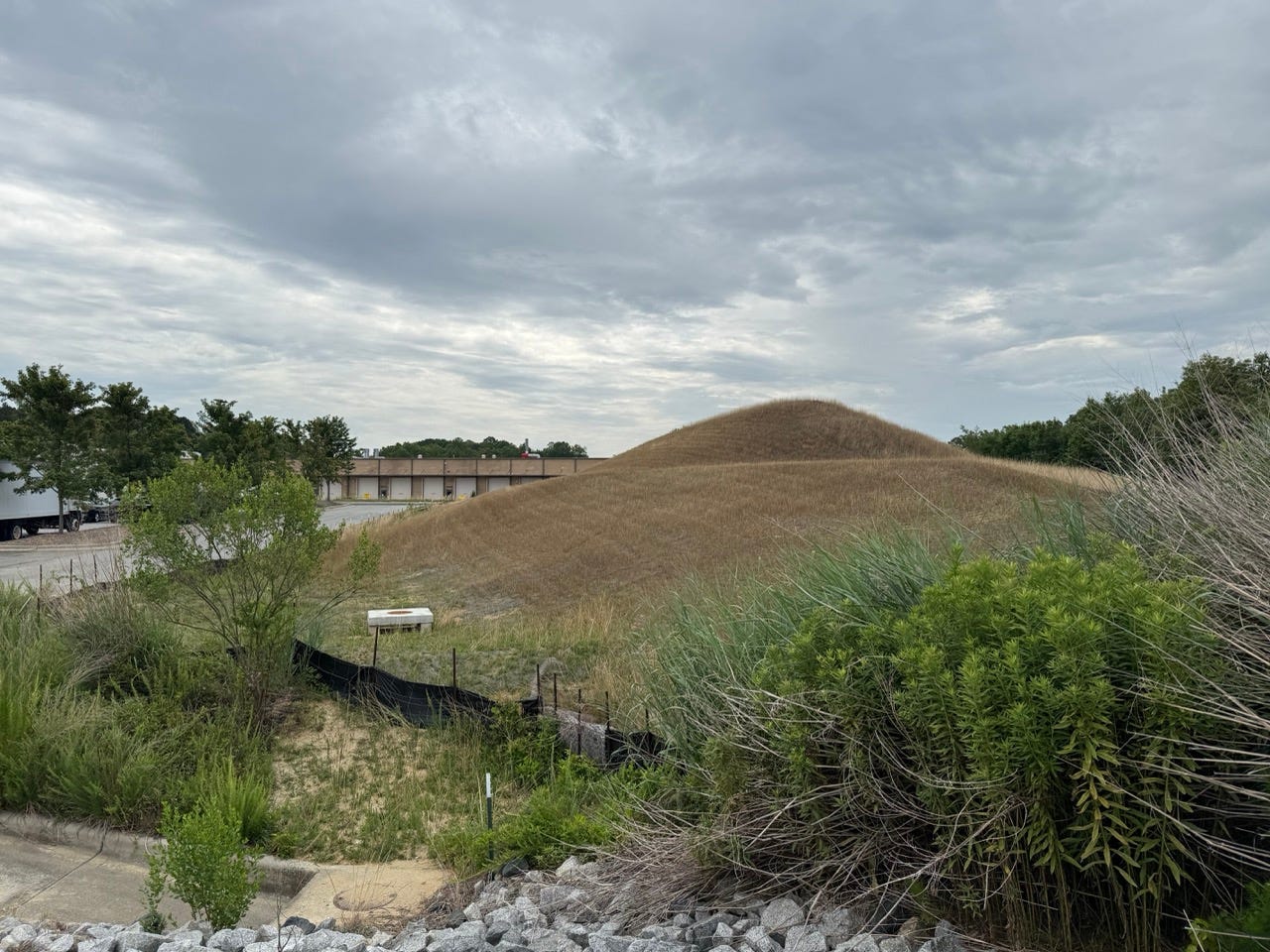
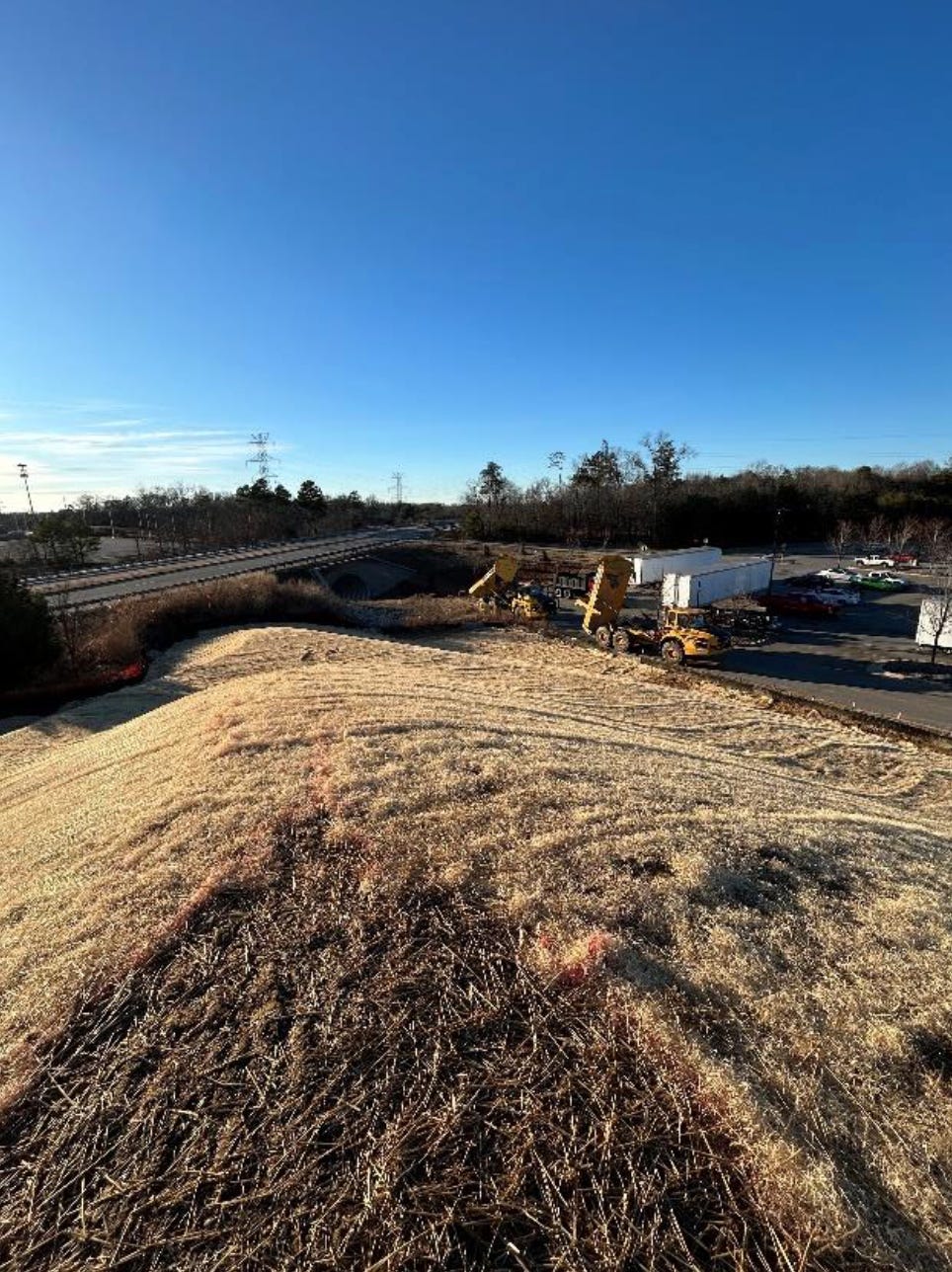
Construction of the Panda Express meant removing a lot of the brownfield’s dirt. But because of waste management rules surrounding brownfields, the dirt was simply moved elsewhere on the same property, stockpiled to make the aforementioned brownfield hill.
Still To Answer
The decision to go forward with the Panda Express project wasn’t made locally. All Panda Express locations are owned by the company — they’re not franchises — so the important question to answer locally is the extent to which the local store manager and employees know, including what to look for regarding short term health effects given “risk of vapor intrusion into new construction in association with documented releases from the former northeast adjacent textile manufacturing facility, Burlington Industries” as both of Terracon’s Brownfield Assessment Reports put it. But the corporate owners of Panda Express may want to review the Brownfields Assessment Report Terracon put together for Whataburger, instead. After all, the final grade report from Terracon (4/13/2026) also used the same soil tests as before, so they again did not test groundwater for Panda Express.
Until there’s proper testing of the groundwater—or a reasonable explanation as why it wasn’t tested—there’s only speculation about the extent to which there is vapor intrusion into the Panda Express by the chemicals in the dirt beneath the restaurant.
But that a brownfield was considered a place to build a restaurant in the first place suggests people in other communities may want to review whether these or other corporations have placed restaurants on brownfields, and whether those brownfields were properly assessed.
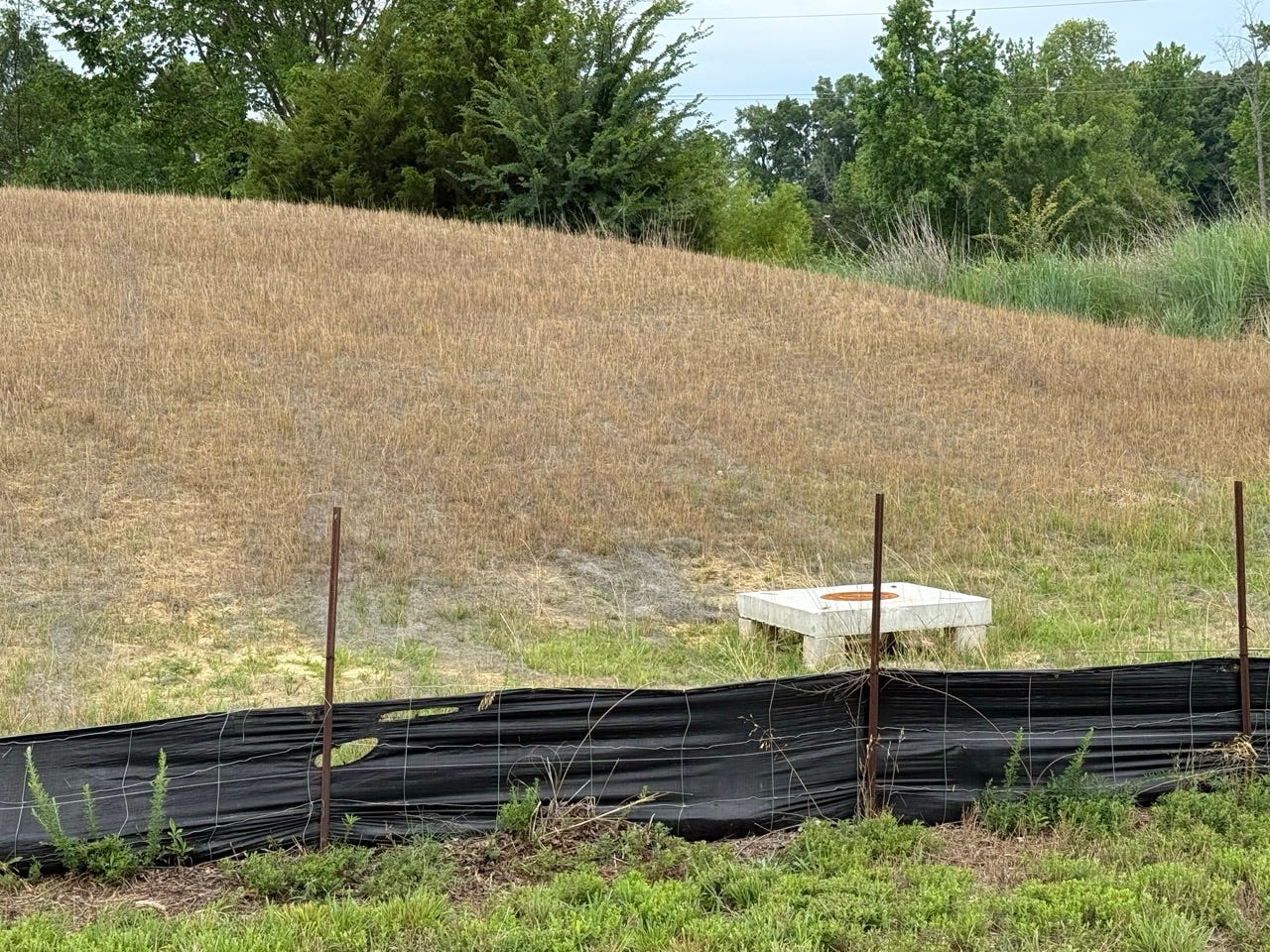
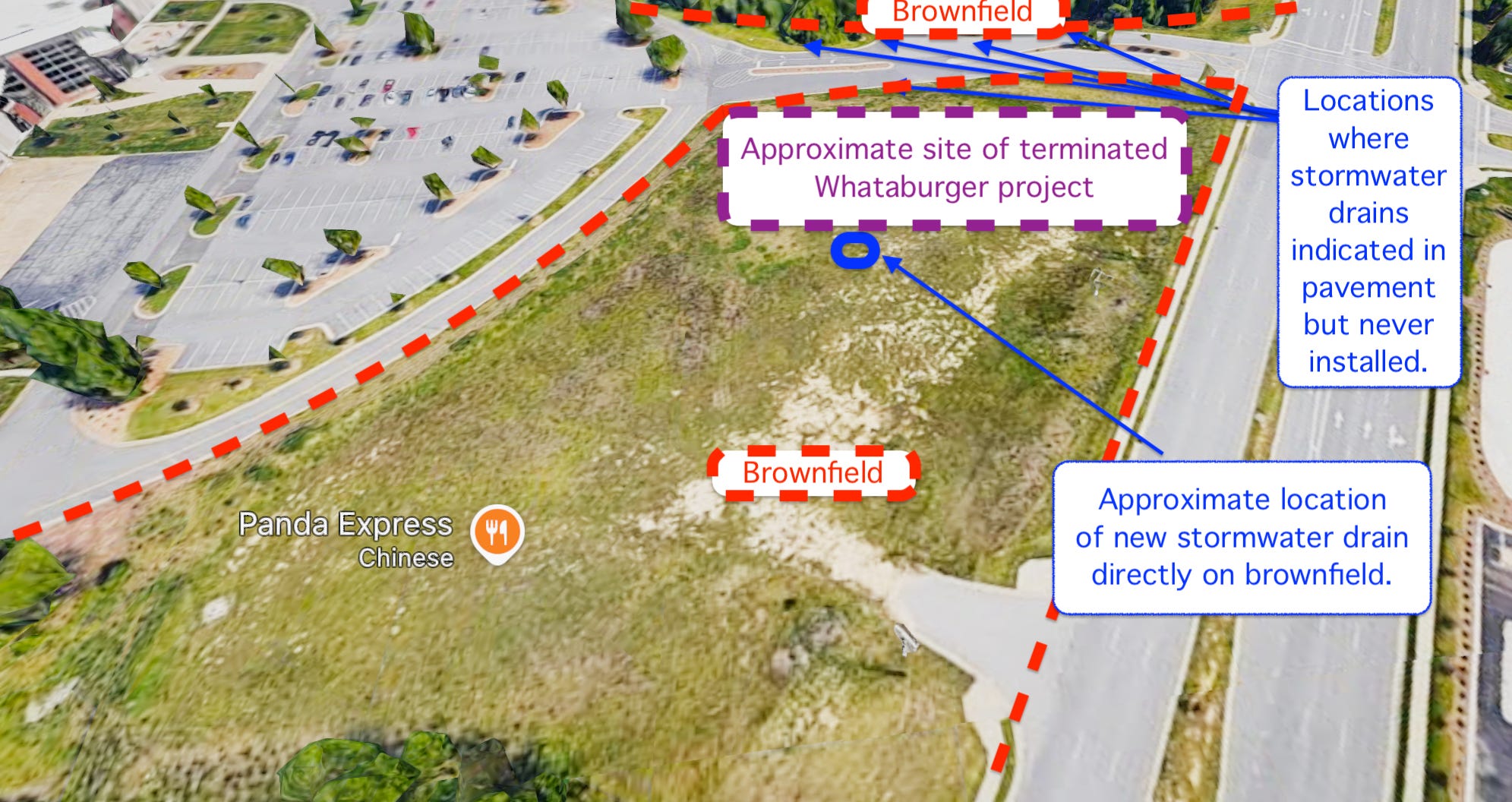
Also still to answer locally is the party responsible for approving the placement of that stormwater drain at the bottom of the “brownhill.” First, was talk of jurisdictional authority, with Guilford County representatives saying it was the Town of Jamestown. But the Town Manager of Jamestown said it was the Land Quality Section of the NCDEQ in Winston-Salem. But the representative in the Land Quality Section said it wasn’t. Then came apologies from Jamestown’s Town Manager and that it was, instead, the NCDEQ’s Brownfields Project Manager Joshawa Billiot, who replied only on June 9, 2026.
Hi Robert,
Thank you for bringing this to my attention. I’m looking into this right now and will get back to you as soon as I have some more information.
So far, though, no one appears to have taken any steps to plug the stormwater drain, or, if they have, then they’ve not made it known that no one should remove the plug. Every time I go by, it’s wide open.
And then, only when revisiting this story and walking around the whole property did I find the additional stormwater drain on the brownfield itself.
Trusting News
It’s been challenging to know when to publish this news. In part, that’s because it’s taken months to find, contact, and hear from (or not) those involved. But the reason for publishing now—instead of waiting further or contacting Panda Express (contacting them last purposefully, with the idea of having heard first from Terracon about why the company didn’t test the groundwater for Panda Express despite testing it for Whataburger)—is because in walking around the property last week I discovered a public notice.
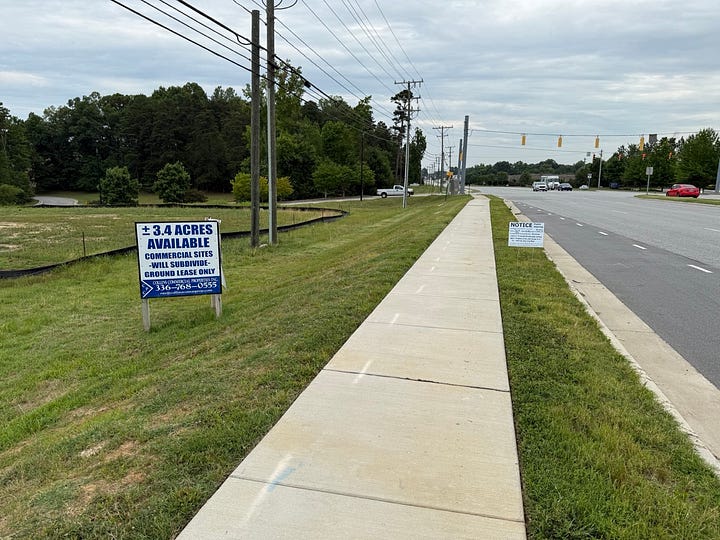
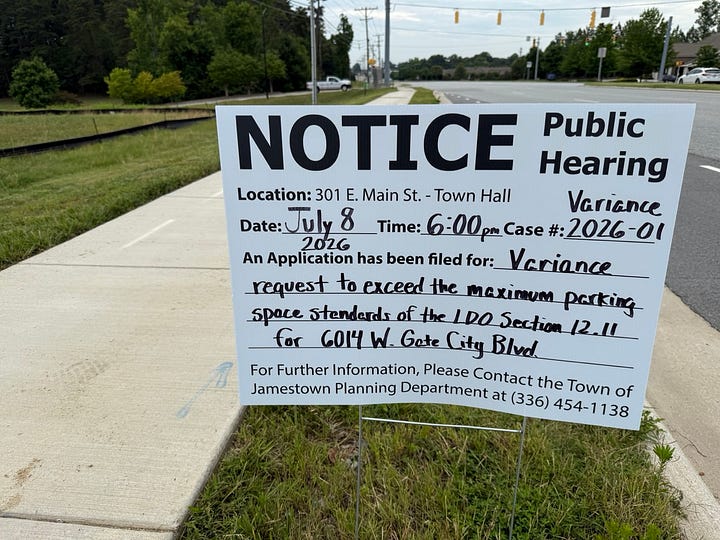
On July 8, Jamestown’s Planning Board is to consider a variance request to exceed the maximum parking space standards. It’s apparently for the Panda Express parking lot, but the exact information is not yet available on Jamestown’s website. So it’s time to report to the public about the information collected about these stormwater drains, and to continue this developing story again once there are more answers.
So this is a continuing, developing story.
What sustainability practices or standards might improve sustainability in your habitat, field, university, institution, or business? How could you implement them? Does doing so mean resisting the commodification of information itself, like this reporting does? How will you afford to do it, then?
No posts
Comments
Nothing yet. Say the first thing.
Sign in to join the conversation.