
Hello and welcome, once again, to our ten-week slow read of the first book in the Darling Dahlias series. This week, we are reading Chapters 22 and 23—with the final chapter left for next week. You can find the full reading schedule here, with links to my author commentary on the readings—and our discussions—for Week One through Week Nine. This book is widely available in libraries, bookstores, and online bookstores, in print (new and used), digital, and audio. Some readers tell me that audio isn’t the best experience for a slow read, because it’s difficult to return to passages that you want to comment on. But it’s also easily available, and Peggity Price, the narrator for this series, is exceptionally good.
Thanks for being here! And now, on to Week Nine!

Chapter 22. When they’ve finished their separate investigations in Monroeville, Verna, Lizzy, and Myra May meet in front of Buzz’s Barbeque. They’re surprised when they spot Ophelia Snow pulling up in the Snows’ Ford at the railroad depot, across the street. With her: Lucy Murphy and a tall, awkward woman in an old-fashioned slat bonnet. “Lucy’s cousin,” Ophelia tells them, here to board the train. Ophelia’s obvious nervousness sharpens Verna’s suspicions, and when Lucy and the mysterious woman hurry toward the train, she follows. As the woman boards the train, a gust of wind pulls the bonnet off, and the “cousin” is exposed as a bald-headed young man in disguise.
Over supper at Buzz’s, Lucy and Ophelia explain that Lucy has been sheltering the escaped convict, after discovering that he is a boy, imprisoned for stealing a chicken and brutally abused by other inmates. Legally, Lucy knows she has broken the law. Morally, she insists she has done the decent thing. The Dahlias quietly close ranks around her. As far as they’re concerned, Lucy has merely helped an unfortunate boy buy a train ticket and make a fresh start.
With that secret safely tucked away, the women turn to the mysteries they have been pursuing. Myra May reports that Imogene Rutledge believes that Mr. Johnson created the bank troubles by making unsecured loans to his wife’s family, and that she is willing to tell the bank examiner what she knows. Verna reports that Bunny Scott lied to Mr. Moseley and that Moseley now knows it. Lizzy provides the key connection: Dr. Harper, the Monroeville dentist, knew Bunny well, and Fred Harper—the man who claimed his brother’s car was stolen—was almost certainly the man who took the compromising photograph of Bunny in her teddy, with that very car.
The next morning (Chapter 23), Lizzy and Verna confront Mr. Moseley in his office. They show him the photograph of Bunny, the deposit book with the payments into her account, and the letter from Moseley that they found in Bunny’s room. Moseley is embarrassed and grateful for the letter, but Lizzy and Verna haven’t come just to protect him. They want him to act as their intermediary with Sheriff Burns, who is unlikely to take two women’s detective work seriously. To protect their identities, Verna hires him as their lawyer, turning the conversation into a confidential attorney-client matter.
The plan works. Moseley takes the evidence to the sheriff, who obtains a statement from Dr. Harper, gets a search warrant, and finds the .22 revolver hidden in Fred Harper’s sofa. Confronted with the evidence, Fred confesses to killing Bunny Scott. His motive: She was blackmailing him after learning that he had stolen money from bank accounts, first in Monroeville and then at Johnson Savings and Trust. The stolen money is recovered, Alice Ann is cleared and promoted, and Miss Rutledge’s testimony forces Mr. Johnson to address the unsecured family loans that endangered the bank.
Every mystery needs a denouement—literally, an untying of the knot)—that end-of-story unwinding where the tangled threads are sorted, the evidence is laid out, and everybody sees how the pieces fit. In a traditional detective story, this often happens in one grand scene: the clever detective gathers the suspects, explains the clues, names the murderer, hands him or her to the constabulary, and restores order. Hercule Poirot does it almost every time.
But the Dahlias do it differently: they arrange their denouement in two parts.
The first part belongs to the women having supper at Buzz’s Barbeque. Verna, Lizzy, and Myra May have each been investigating a different piece of the puzzle, and now they sit down together to compare notes. But before they can explain what they’ve learned, they intersect with another mystery: Lucy Murphy’s “cousin” in the green slat bonnet. When the bonnet blows off and reveals the convict’s shaved head, the women have to decide what kind of truth matters here.
Legally, Lucy and Ophelia are outlaws. Morally, they are obeying another, higher law. So the Dahlias make a silent but unmistakable choice. As far as they’re concerned, Lucy has helped a poor cousin buy a train ticket. This is a different kind of resolution: not legal justice but moral rescue.
Then the investigators can share what they’ve found. Myra May reports Imogene Rutledge’s knowledge of the bank’s unsecured family loans. Verna reports Bunny’s Monroeville history. Lizzy brings the decisive connections: Dr. Harper, Fred Harper, Bunny, the stolen car, the photograph, the gun, and the blackmail payments. Around Buzz’s wooden table, over pulled pork sandwiches, fried okra, and cabbage slaw, the women assemble the case.
But they need help. The second part of the denouement belongs to the official world. Lizzy and Verna can’t simply march into Sheriff Burns’s office and expect him to believe them. Their work has to be translated into a form the male authorities recognize. So they hire Mr. Moseley — quite literally, with Verna’s twenty-five-cent retainer — and send him to the sheriff with the evidence. It’s a scene with comic overtones, but it’s also serious. The “pretty ladies” have done the hard thinking; the lawyer is the acceptable male to manage the legal machinery.
Then things happen quickly. Fred Harper confesses. Alice Ann is cleared. Mr. Johnson forces repayment of the family loans. The male officials restore public order, but only because the women showed them what they needed to do.
That’s what I enjoyed most when I was writing this denouement. It doesn’t merely answer the questions “Who killed Bunny Scott?” and “What happened to that escaped convict?” It also shows how justice works in Darling: through gossip, observation, loyalty, moral courage, female friendship, and just enough clever manipulation of the official system to make the truth count.
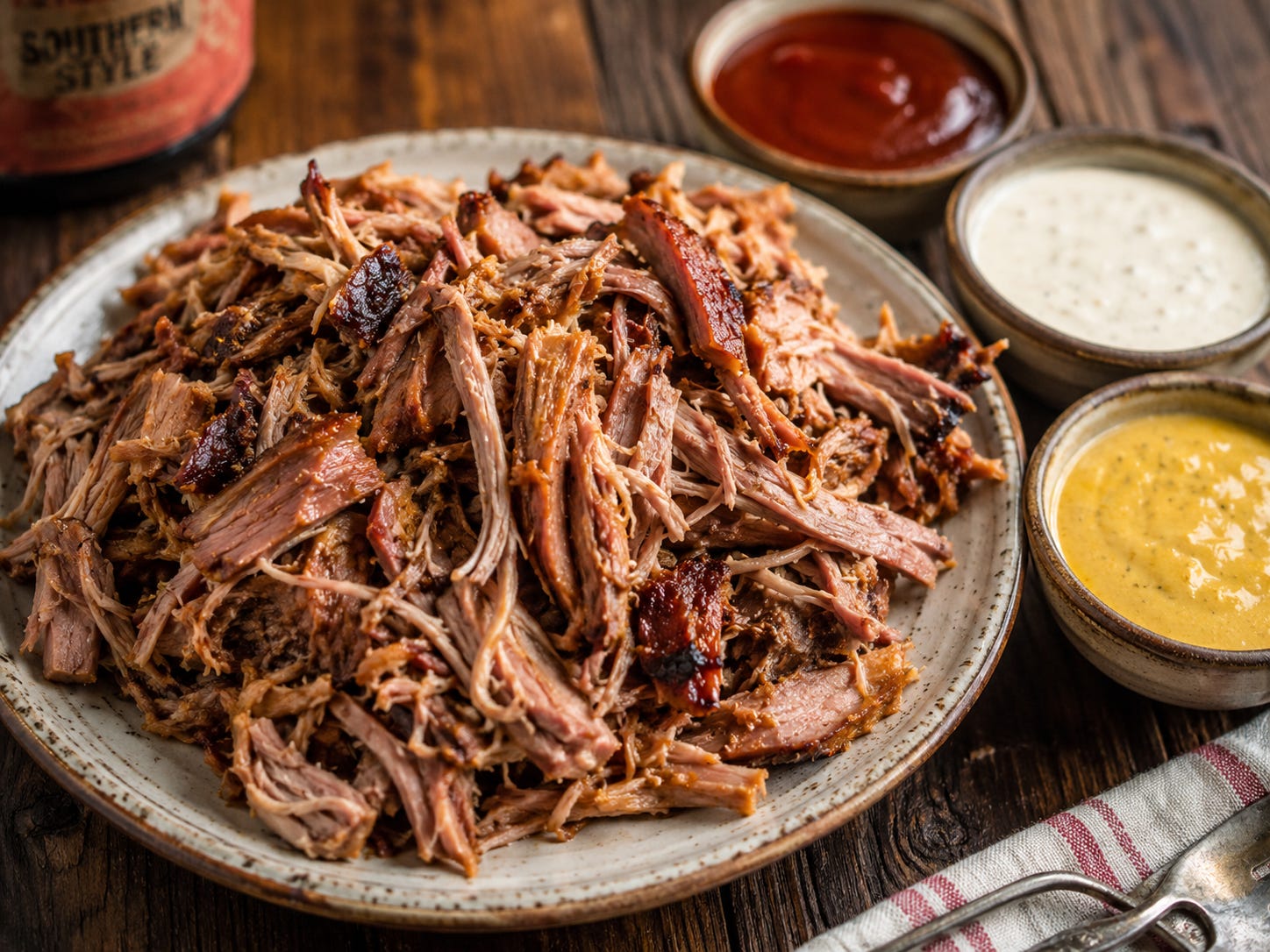
By the time Verna, Lizzy, and Myra May meet at Buzz’s Barbeque in Monroeville, they have earned their supper. So it feels entirely right that they get together at a barbecue shack across from the railroad depot, where Buzz is roasting a whole pig over a hickory fire and pulled pork is on the menu.
Pulled pork is one of those foods that looks simple on the plate and turns out, when you start tugging at it, to be almost as tangled as a good mystery. In the American South, whole-hog barbecue became a public, communal food: pork cooked slowly over wood or coals, served at gatherings, political events, church suppers, courthouse days, and roadside stands.
But its origins aren’t simple, and certainly not exclusively “Southern.” The story reaches back through Indigenous cooking practices, African and African American foodways, Caribbean and Spanish colonial traditions, and European habits of smoking and preserving meat. Culinary historian Michael W. Twitty has written that barbecue “co-evolved in the New World,” carrying strong West and Central African marks while also taking shape through the foods, animals, labor systems, and landscapes of the Americas.
That larger history matters here, because Buzz’s pit is both ordinary and deeply local. He is not serving “heritage cuisine” as an exhibit; he is feeding hungry people getting off the train. His place may look rickety from the outside, but the smell of hickory smoke does the advertising. In these chapters, barbecue functions almost like a democratic table. The women sit down together—Verna, Lizzy, Myra May, Ophelia, and Lucy—and while they eat pulled pork with Alabama white sauce, grilled chicken, cabbage slaw, and fried okra, they sort out the truth.
That white sauce also has an interesting history. The fictional “Buzz” is said to have learned it from the real Big Bob Gibson, who invented it around 1925 in Decatur, Alabama. That detail places this little scene very precisely in Alabama food geography. Most American barbecue sauces run red, brown, sweet, hot, or vinegar-sharp, depending on region. But Alabama’s favorite sauce is white, traditionally made with mayonnaise, vinegar, pepper, and seasonings. It belongs especially to northern Alabama, where it is often served with chicken but has also found its way onto pork and almost everything else.
Pat Willard’s Pork Tales
My friend and fellow author Pat Willard, whose book America Eats! explores the WPA foodways project of the 1930s, writes beautifully about American regional food traditions, with a focus on communal meals. In America Eats! she follows a pulled-pork story set in Boalsburg, Pennsylvania. Slow-cooked pork may be strongly Southern, but not exclusively.
On her Substack, Pat writes about her Brooklyn butcher, Oscar, and about learning to make pernil, a Puerto Rican-style pork shoulder marinated with garlic, oregano, adobo, sofrito, sazón, and oil, then roasted. Pernil’s slow-food kinship to Alabama pulled pork is easy to feel: pork shoulder, time, heat, seasoning, patience, and the pleasure of feeding a crowd. And in Pat’s case, the pleasure of being tutored by a butcher.
Since most of us are not going to roast a whole pig over hickory coals behind a tin-roofed shack, a slow-cooker pulled pork recipe is a tasteful modern translation. RecipeTin Eats offers a practical version with pork shoulder, barbecue sauce, and a slow cooker. It won’t give you Buzz’s hickory smoke or the whistle of a 1930s steam locomotive. But it will give you tender pork to pile on buns, serve with slaw, and pass around the table. It might even tempt you to add a plate of spicy hot fried okra.
Oh, and that slat bonnet? My Missouri grandmother had several, all of them handmade. They looked like this. I wore one once, as a kid. It gave you tunnel vision. But nobody could see your face—which is why Lucy gave it to the boy to wear.
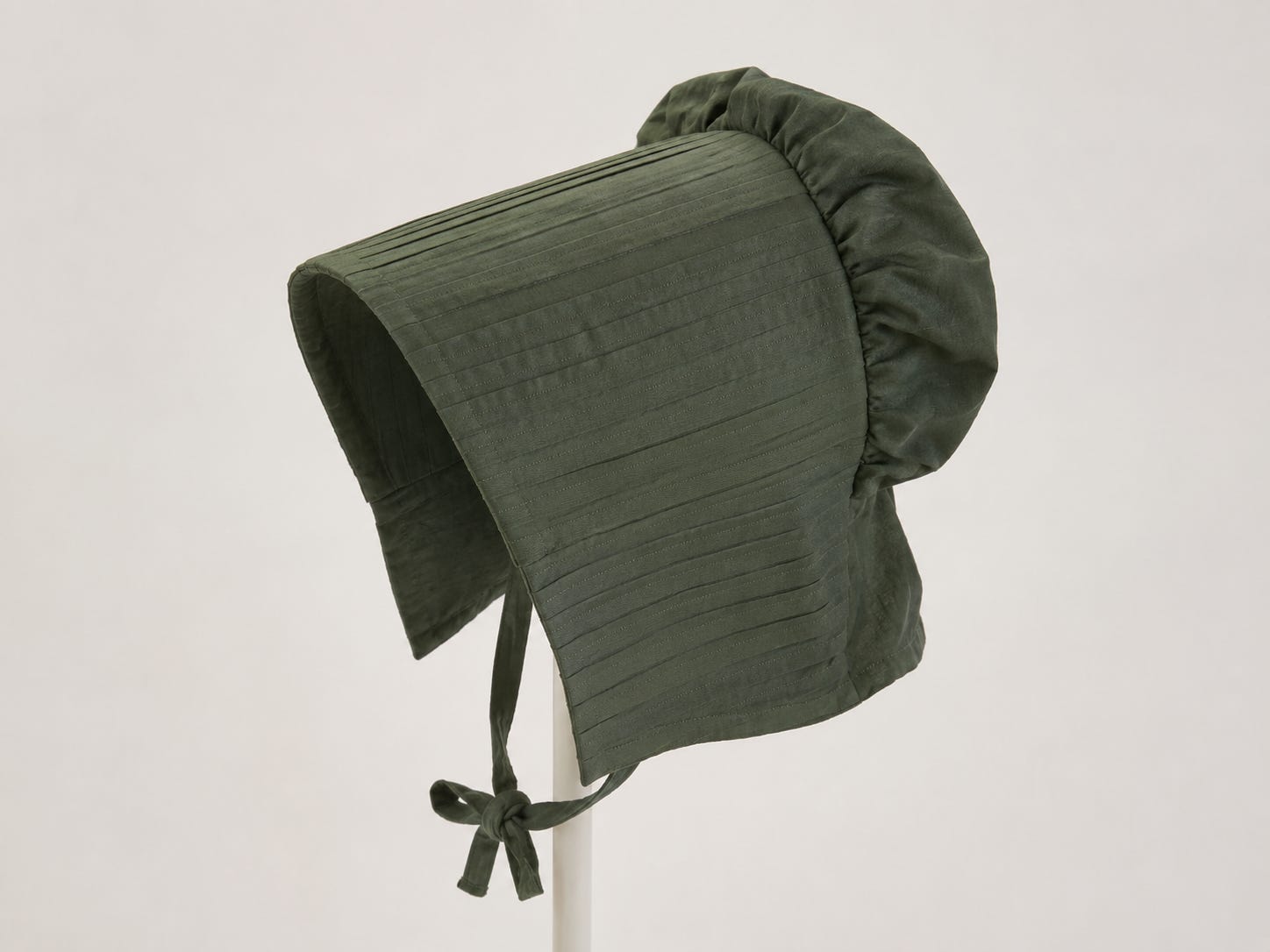
The green slat bonnet hides the convict’s face, but the way he walks in the pumps is the giveaway. Could you picture that scene—especially the bonnet? When did you see through the disguise?
Mr. Moseley’s first reaction to Bunny’s photograph is shock and embarrassment at seeing her underwear, while Verna reminds him (and us) that the photograph is evidence. What does this tell us about Mr. Moseley’s relationship with Bunny? What happens when an investigation intrudes into a personal relationship?
Lizzy often uses tact, softness, and “honey” to manage difficult men, while Verna prefers direct pressure. How do their two styles work together in the scene with Mr. Moseley?
The bank plot ends with “nobody lost a dime,” but only after theft, cover-up, family favoritism, and quiet pressure from Imogene Rutledge. Does the resolution feel like justice, damage control, or something in between?
Spoiler note: The bank will continue to be an important thread throughout the series, especially as the Depression deepens. The Dahlias have to contend with FDR’s gold seizure, the bank failure, the bank purchase, and a new manager who becomes much more important to Verna than she expects.

Thanks for reading, everyone! I hope you’ll join me next Thursday, July 7, for The Dahlias Plant Their Sign (Chapter 24, Making Do, and the recipes ) of The Darling Dahlias and the Cucumber Tree. I’ll post an author commentary, a few questions, and some thoughts about the series. (Here’s where you can always find the chapter assignments and links to these posts.)
In the meantime, you might want to browse through the extras I’ve posted on the Dahlias index page for this slow-reading project. That’s where you’ll find songs, radio shows, and films that were available in the early 1930s—as well as some of the research I used when I was writing this series.
Please note: Several new subscribers have asked me to rerun this series, so I’m planning to do that beginning Thursday July 23 and concluding Thursday Sep 24. The comment space will be open and I’ll be participating.
Comments
Nothing yet. Say the first thing.
Sign in to join the conversation.