
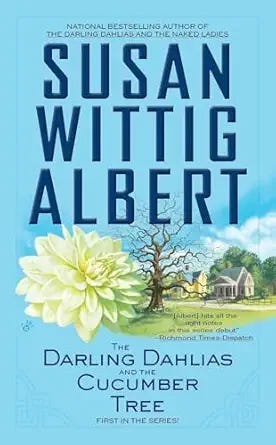
Hello and welcome, once again, to our ten-week slow read of the first book in the Darling Dahlias series. This week, we are reading Chapters 20 and 21. You can find the full reading schedule here, with links to my author commentary on the readings—and our discussions—for Week One through Week Seven. This book is widely available in libraries, bookstores, and online bookstores, in print (new and used), digital, and audio. Some readers tell me that audio isn’t the best experience for a slow read, because it’s difficult to return to passages that you want to comment on. But it’s also easily available, and Peggity Price, the narrator for this series, is exceptionally good.
Thanks for being here! And now, on to Week Eight!

On Wednesday morning (Chapter 20), Ophelia Snow impulsively decides to call on Lucy Murphy. Thinking of spending a companionable day sewing and getting better acquainted, she packs fabric, a blouse pattern, sewing supplies, soda bread, cookies, and a jar of Lizzy’s raspberry jam. But on the way to Ralph’s farm, the Ford blows a tire, forcing Ophelia to walk the last half-mile. When she arrives hot, tired, and thirsty, she discovers Lucy in the kitchen with a bald-headed young man in prison overalls: the escaped convict! Acting on instinct, Ophelia hurls the jam jar at him and knocks him flat.
Ophelia’s heroic rescue, however, turns out to be a terrible misunderstanding. The “convict” is Joey, a frightened boy of fifteen, who has been hiding with Lucy and the boys since his escape from the prison farm. Sentenced for stealing a chicken, he had been sent to the adult prison farm when the juvenile home was full. There, according to Lucy, he was overworked, starved, whipped, and subjected to abuse so terrible she won’t describe it. Scooter and Junior had found him hiding in the swamp, helped him evade capture, and brought him home after dark. Lucy has been nursing him ever since. Ophelia is shocked, ashamed, and increasingly sympathetic.
Lucy now reveals that she cannot keep sheltering Joey: Ralph will be home soon, and every additional day increases the risk that someone will find the boy. She has a plan to get him to safety, but she needs Ophelia’s car. Ophelia is horrified at the thought of aiding an escaped prisoner—and even more, of keeping the secret from her husband. But Lucy, no longer sounding sweetly helpless, takes charge. She dismisses the Ford’s flat tire as a minor inconvenience: she can change a tire, and Ophelia ought to learn how. By the end of the chapter, the reluctant mayor’s wife has been swept into Lucy’s dangerous plan, and Lucy has revealed herself as a strong, bold, and morally decisive woman.
Meanwhile (Chapter 21), Verna, Myra May, and Lizzy drive to Monroeville in Myra May’s old green Chevrolet, Big Bertha, in an attempt to resolve three tangled questions: Bunny Scott’s real history; the identity of the man who took the photo of Bunny in her teddy, posed on the green Pontiac; and Imogene Rutledge’s actual connection to the missing bank money.
They split up. Verna begins at Dawson’s Drugstore, where Bunny once worked, and learns from the soda jerk that Bunny did indeed grow up in Monroeville with her mother. At Bunny’s old neighborhood, Verna learns that Mr. Moseley had been there that very morning, asking the same questions and discovering the same lies.
Myra May’s question takes her to Imogene Rutledge, whom Miss Rogers suspects not only of owing a library fine but of stealing The Further Chronicles of Avonlea. But Imogene turns out to be blunt, practical, and not at all sinister. She explains why she took back the Maud Montgomery book, which she had donated. More important, she gives Myra May a lead that points away from Alice Ann and toward Mr. Johnson himself: unsecured loans to his wife’s family may be the cause of the bank trouble.
Lizzy, posing as a Dispatch reporter, uses the photograph of Bunny in her teddy on the hood of the Pontiac to break through Dr. Wayne Harper’s denials. He admits he knew Bunny, under her real name, Eva Louise. He gave her the pearl earrings, but he didn’t take the photo. He finally has to accept the fact that his brother, Fred—to whom he had given his .22 revolver—took the photo. When Lizzy tells him that Eva Louise is dead, killed with a .22, Dr. Harper collapses in grief.
By the end of Chapter 21, all three situations have shifted sharply: Alice Ann looks less guilty, Fred Harper looks much more dangerous, and the Dahlias’ informal ensemble investigation has become unexpectedly effective.
One of the craft challenges in an ensemble mystery is keeping several plot lines moving at once without letting the story become tangled. By this point in the book, there isn’t just one mystery to solve; there are a half-dozen. There’s the escaped convict, Bunny Scott’s death, the question of who drove or used the green Pontiac, the missing money at the bank, Alice Ann’s possible guilt or innocence, and the ominous ghost with a shovel. For a writer, that’s a lot of story to manage without befuddling your reader—and to judge from your comments earlier in our discussion, you’ve read books where you’ve gotten lost among multiple story lines.
The trick, at least for me, is to give each character a job to do—and give the reader enough clues to make it easy for her to follow the action. Chapter 21 actually makes these assignments visible. For instance, on the drive to Monroeville, Verna jots down the questions they want to answer:
Which of the stories about Bunny is true? Was she really her widowed mother’s only child or the abandoned daughter of a runaway mother?
Fred Harper’s brother (Dr. Wayne Harper, a dentist) owns the green Pontiac that Bunny was supposed to have stolen. Did he know Bunny? Did he take the photo of her sitting on his car in her teddy?
Did Imogene Rutledge have anything to do with the money problem at the Darling bank? Could she have taken the money Alice Ann is suspected of taking?
(p. 241)
And then Verna has another idea:
Instead of all three of them trying to answer all three questions at once, why not split up? She was the one who was most interested in Bunny’s background—she could look into that. Lizzy had brought the photo of Bunny sitting on the car, so she could talk to Dr. Harper. And Myra May had already spoken to Miss Rogers about Imogene Rutledge (at Aunt Hetty Little’s suggestion), so she could look up Miss Rutledge.
This little planning moment is useful for the women, but it is just as useful for the reader—and for the writer, who doesn’t want to get lost, either. It hands us the map before the three threads of the plot begin to separate into three distinct paths. What’s more, each one of the three women carries one strand of the mystery, and each strand moves forward because the right character has been matched with the right kind of problem.
Here, the matching is doing real craft work. Verna is skeptical, observant, and not easily dazzled, so she is the right person to discover that Bunny’s sad story about her childhood wasn’t true.
Myra May is the one who thought of Imogene Rutledge and began to wonder if she might have had something to do with the bank’s problems. She is bold, practical, and socially flexible, which makes her the logical person to knock on Imogene Rutledge’s door and revise her opinion when the facts don’t fit the rumor.
Lizzy, with her Dispatch experience and her talent for careful language, can pose as a reporter and ask Dr. Harper questions in a way that gradually breaks through his denials.
And Ophelia, who goes to visit Lucy with soda bread, sewing supplies, and good intentions, finds herself forced into a kind of moral action she has never imagined.
That last point is especially important. Ensemble work is not just a way of distributing plot. It is also a way of revealing character under pressure. Opie doesn’t set out to be brave; she just wants to be kind. But when kindness walks into danger, or what she believes is danger, it becomes action. Her jam-jar assault is comic, but it is also revealing. Lucy’s response is even more revealing. Up to now, Lucy may have seemed helpless, lonely, or dependent. Here, she becomes the strongest person in the room: decisive, protective, morally clear, and entirely unwilling to let Ophelia retreat into conventional obedience.
This is why ensemble mysteries can be so satisfying. The solutions aren’t handed out by a single brilliant detective standing at the edge of the story. They are the work of many kinds of intelligence moving through the story world at the same time. Domestic intelligence, social intelligence, practical intelligence, moral intelligence, legal intelligence, and plain old curiosity all have work to do. The Dahlias are not professionals, and they don’t always know what they are doing. But they know people, they know their town, and they know how to ask questions.
By the end of these chapters, none of the mysteries has been solved, but every major thread has been moved a little further toward resolution. Alice Ann looks less guilty. Fred Harper looks more dangerous. Bunny’s invented past has begun to unravel. Lucy’s hidden courage has come into the open. Ophelia has crossed a line she did not expect to cross. And the women’s separate efforts are beginning to point toward the larger pattern we’ll watch come into focus over the final three chapters.
That’s the craft pleasure of this kind of storytelling: the threads are still separate, but the reader—and the writer can feel them drawing together.
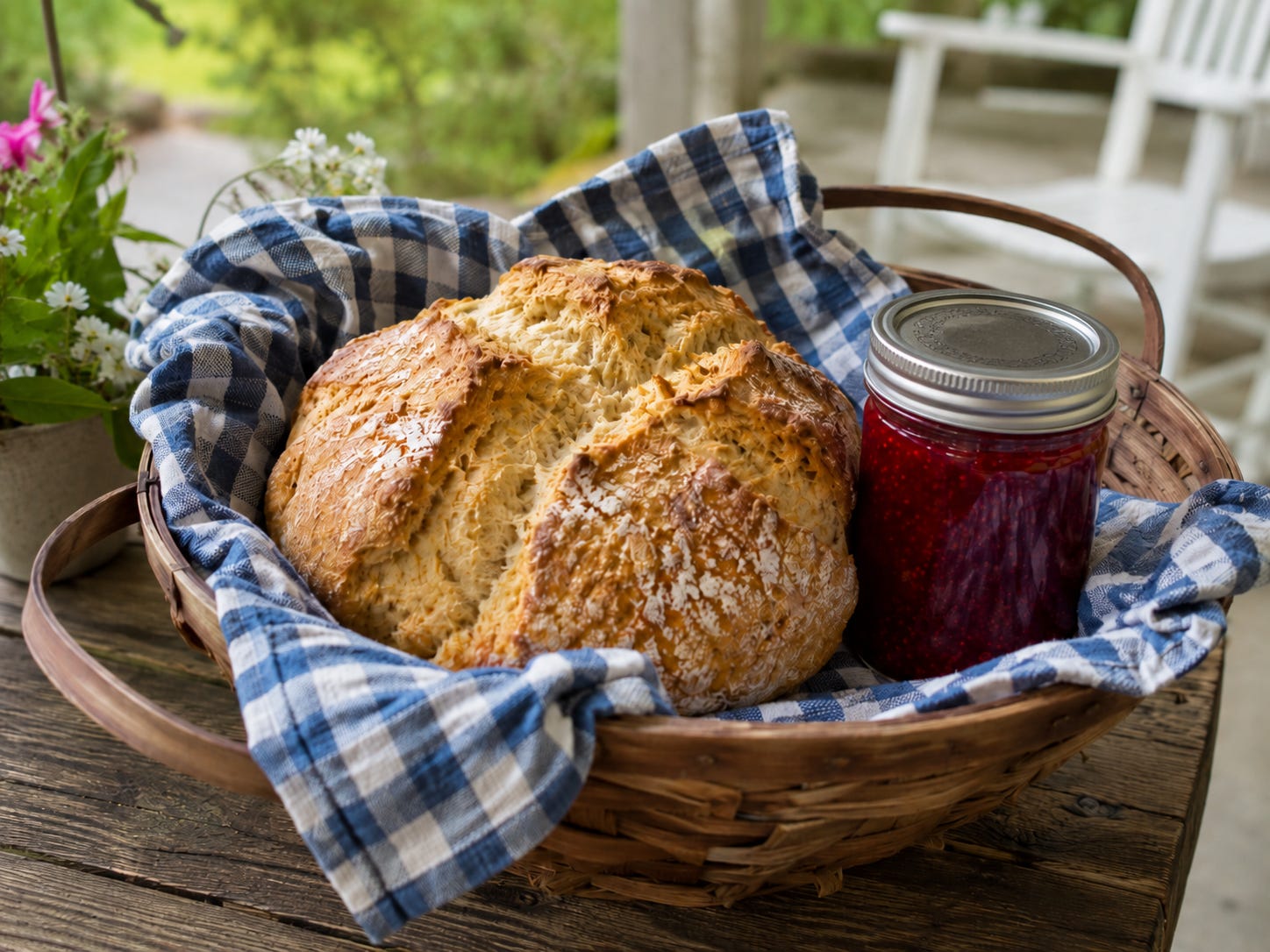
When Ophelia Snow sets out for Lucy Murphy’s house, she does not go empty-handed. Along with her sewing supplies, cookies for the boys, and Lizzy’s raspberry jam, she takes a loaf of Florabelle’s soda bread. To Opie, this is simply good manners. Her mother taught her that a woman never went visiting without taking something to eat, and Opie—dutiful, domestic, well-trained in the customs of neighborliness—does what she’s been taught.
Soda bread belongs to the large family of “quick breads,” breads that rise not with yeast but through a chemical reaction. Before commercial baking soda became widely available, early American cooks used alkaline leaveners such as potash and its refined form, pearlash, made from wood ashes. By the 1840s, many cooks were using saleratus, a term that first referred to potassium bicarbonate and later often referred to sodium bicarbonate—what we know as baking soda. Grocers sold it in bulk or in convenient paper envelopes printed with recipes. Both pearlash and saleratus worked on the same basic principle: when the alkaline ingredient met something acidic in the dough or batter, it released carbon dioxide bubbles that helped the bread rise.
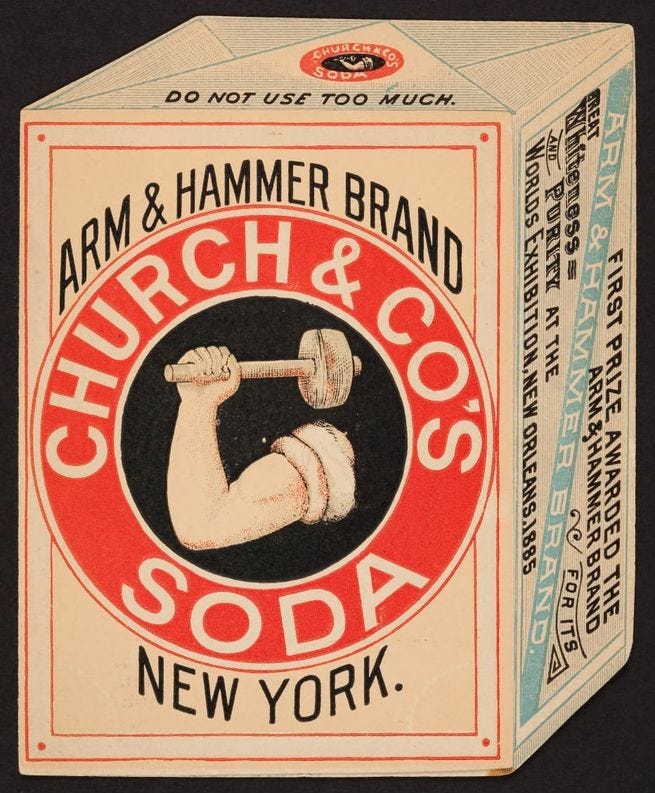
And then in 1846, commercially packaged baking soda—sodium bicarbonate—came along. That was the year Austin Church and his brother-in-law John Dwight began packaging bicarbonate of soda, turning a chemical compound into an everyday kitchen staple. The Church baking soda was eventually marketed under the now-familiar image of a raised arm with a wooden mallet, a recognizable symbol for skilled trades, craftsmanship, and artisan work.
Baking soda didn’t just change home baking. It also changed the rhythm of women’s daily work. It made bread-making faster, more dependable, and easier to fit into a day already crowded with washing, ironing, gardening, child care, sewing, and cooking.
So that loaf of soda bread is not just a loaf of bread. It is domestic courtesy, Southern hospitality, women’s inherited training, and modern kitchen chemistry, all wrapped together in a napkin and tucked into a basket. And later in this chapter, the basket itself becomes wonderfully comic and consequential. Opie arrives bearing food, fabric, flowers, and good intentions—and before she knows it, one piece of that domestic cargo has knocked an escaped convict flat on Lucy Murphy’s kitchen floor.
Click here for a traditional recipe and baking instructions. Or check out Florabelle’s updated Soda Bread recipe, in the recipe section at the back of the book. If you’re puzzled about the use of both baking soda and baking powder in Florabelle’s 1930s recipe, this Smithsonian article will tell you all about the “great uprising.” And if you want to make a few jars of red raspberry jam, here’s a recipe for that.
Thanks for reading, everyone! I hope you’ll join me next Thursday, July 2, for Clearing Up the Mysteries (Chapters 22, 23, 24) of The Darling Dahlias and the Cucumber Tree. I’ll post author-thoughts about the reading, writing, and publishing process, a few questions, and another “material witness.” (Here’s where you can always find the chapter assignments and links to these posts.)
In the meantime, you might want to browse through the extras I’ve posted on the Dahlias index page for this slow-reading project. That’s where you’ll find songs, radio shows, and films that were available in the early 1930s—as well as some of the research I used when I was writing this series.
And I’d love to hear what you noticed in the reading for this week—on the surface or just beneath it. If something caught your attention, puzzled you, or stayed with you, please add your thoughts to the conversation in the comment space (open to all). And please, do browse through the comments. Important questions often crop up there, and I try to answer all of them as fully as I can, which sometimes leads to extended discussions of issues that don’t come up in my author notes.
Comments
Nothing yet. Say the first thing.
Sign in to join the conversation.