
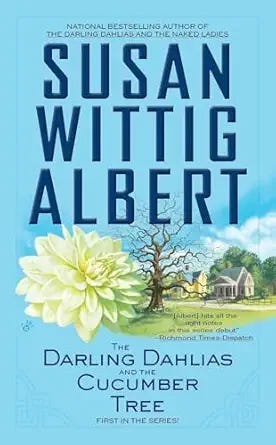
Hello and welcome, once again, to our ten-week slow read of the first book in the Darling Dahlias series. This week, we are reading Chapters 17, 18, and 19. You can find the full reading schedule here, with links to my author commentary on the readings—and our discussion—for Week One through Week Six. This book is widely available in libraries, bookstores, and online bookstores, in print (new and used), digital, and audio. Some readers tell me that audio isn’t the best experience for a slow read, because it’s difficult to return to passages that you want to comment on. But it’s also easily available, and Peggity Price, the narrator for this series, is exceptionally good.
Thanks for being here! And now, on to Week Seven.

Myra May has the four-to-midnight shift at the Darling switchboard (Chapter 17), which means she is perfectly placed to hear what is happening in town. She is trying to read The Secret of the Old Clock, with its bold young sleuth Nancy Drew, but she can’t concentrate: she’s worried about Alice Ann Walker, accused of stealing bank funds. From the calls she connects, Myra May learns that the bank is in serious trouble and that Mr. Johnson and the bank examiner are preparing to blame Alice Ann. Furious at this, Myra May calls Alice Ann to reassure her that the Dahlias don’t believe the accusation.
Alice Ann is frightened, exhausted, and helpless, with no idea what evidence the bank has against her. Myra May offers some practical help: supper. Working by phone, she organizes the Dahlias to assemble a dinner-in-a-basket for Alice Ann and Arnold. And from Aunt Hetty Little, Myra May learns about Imogene Rutledge, the sharp-tongued former cashier who abruptly left the bank, moved to Monroeville, and bought a new car.
Meanwhile (Chapter 18), Lizzy and Verna settle down to supper at Lizzy’s house and compare what they have learned about Bunny Scott. Lizzy tells Verna what Mr. Moseley said about Bunny, including Bunny’s story of a hard childhood on a Monroeville farm. Verna is skeptical, since Bunny told several Dahlias a different tale.
Then Lizzy notices something important in the photograph she inadvertently took from Bunny’s room. Dressed only in her teddy, Bunny is posing with a green Pontiac that looks like the wrecked car Lizzy saw in the ravine. She phones Charlie Dickens, the newspaper editor, who confirms that the license plate in his notes is the same one Lizzy sees in the photo. Bunny was supposed to have stolen the Pontiac, but the photograph suggests that Bunny already knew the driver well enough to strip down to her teddy for his camera.
When Myra May calls Lizzy to ask about Imogene Rutledge, the separate investigations converge. The next day’s expedition to Monroeville now has several purposes: to learn more about Bunny’s real past, to check on Imogene Rutledge, to locate the elusive Maxwell Woodburn, and to find out more about the dentist who owns the Pontiac.

At Magnolia Manor (Chapter 19), Bessie Bloodworth and her residents spend a quiet evening listening to the radio, playing games, and knitting. Near midnight, they are awakened by the sound of digging in the Dahlias’ garden. The women gather in the hall, and Roseanne reveals a darker version of the Cartwright ghost story. Bessie is fascinated by this “tale not often told” but not distracted. Armed with a shotgun, she confronts the digger and wounds him with birdshot as he flees. Bessie Bloodworth has “bagged her ghost.”
One of the pleasures of writing a series is knowing that its world will have room to grow. In a standalone novel, every setting has to earn its place quickly. But in a series, a place can begin quietly, almost modestly, and then become more important as the books unfold. Magnolia Manor is one of those places. In Chapter 19, we meet it as Bessie Bloodworth’s old family home, now turned into a boarding house for older women who need a way to get by. As the series continues, the Manor becomes something larger: a sisterly enclave, a listening post, a memory house, and one of Darling’s most important centers of female knowledge.
That phrase “get by” is important here. As Bessie lets us know, old age before Social Security could be frighteningly precarious, especially for women. Bessie’s father’s Civil War pension had helped support the household, but when he died, that pension died with him. Bessie responded with a practical intelligence: she turned what she had — a large old house — into a way to survive. The other residents are also piecing together their lives from whatever resources they possess: a son’s monthly check, a few library dollars, a widow’s pension, unreliable rental income, domestic labor traded for room and board. Magnolia Manor may appear cozy, but it exists because the alternatives are grim.
One of those alternatives is the poorhouse, which Roseanne quite reasonably fears. County poorhouses were not picturesque refuges. They were the last stop for people who had no money and no family able or willing to take them in. So when Bessie thinks about old-age pensions, she is not indulging in abstract politics. She is thinking about survival. Her admiration for Huey Long belongs to that context. Long was a political firestarter, a populist, a demagogue to some and a champion to others, and exactly the sort of figure who could ignite fierce hopes in a volatile time. His career is followed throughout the series, up to his death in the last book, The Darling Dahlias and the Red Hot Poker.
That little political note also helps us hear the 1930s gathering force beyond Darling’s boundaries. We are still in a cozy mystery, of course, so the storm enters in manageable ways: a newspaper story, a radio speech, a passing comment, a frightened thought about the poorhouse. But the storm is there. The bank is in trouble. People are losing jobs and homes. Elderly women are improvising systems of mutual aid because the national safety net has not yet been created. The Manor fills a desperate need, yes, but it is also a local, makeshift answer to a national challenge.
The chapter is braided with period-defining details: the backyard chickens, the goat whose milk tastes like old socks, the quart of fresh cow’s milk, the coal and electricity bills, Bessie’s urgent, unanswered letter to her senator. Then there are the evening rituals: Parcheesi, pinochle, canasta, checkers played with cardboard money, quilt-piecing, knitting caps for poor children, Bessie working on her history scrapbook. These details tell us what a shared evening feels like at Magnolia Manor: what women do with their hands, what they listen to, what they worry about, how they spend the hours between supper and bed.
The radio is especially important. That Crosley five-tube table model is both a luxury and a portal. It brings music, comedy, product advertising, and political arguments to the Manor. The ladies hear familiar songs and radio shows, but they also hear Huey Long. And in that sense, radio changes the scale of their lives. They are sitting together in Darling, Alabama, but the nation is suddenly intruding into their quiet room. The modern world arrives as a voice, a song, a sales pitch, a political promise, a volume knob Miss Rogers would like someone to turn down. Throughout the series, radio invites itself into this older world, especially when Darling gets its own station, WDAR, launched by a couple of teenage boys with a used fifty-watt transmitter and an antenna on top of the water tower.
Tension between the old quiet and the new noise runs through the whole scene. Bessie remembers a time when somebody could sit on the porch and hear children, dogs, horses’ hooves, perhaps the daily train in the distance. Now there are automobiles, trucks, motorcycles, airplanes, and jazz from across the street. Modernity isn’t just visual here; it is noisy. It coughs smoke and rattles windows. It drowns out birdsong. It interrupts memory.
And Bessie isn’t wrong to mourn the change. That’s one of the useful complexities of historical fiction. The past isn’t simply quaint, and progress isn’t simply good. Cars bring mobility, independence, speed, and new kinds of freedom — including the freedom that allows Myra May, Verna, and Lizzy to drive to Monroeville. But cars also bring noise, smoke, expense, disruption, danger. The radio brings entertainment and political imagination, but it also disturbs the household’s equilibrium. Modernity gives and takes at the same time.
The chapter also establishes Magnolia Manor as a place of memory. Bessie’s scrapbook, her friendship with Dahlia Blackstone, the gap in the cherry laurel hedge, and the view of the cucumber tree all connect the Manor to the older history of Darling. Bessie and Dahlia Blackstone shared local history and gardening knowledge; now that Dahlia is gone, Bessie carries that memory forward. The Manor looks across at the cucumber tree, and the cucumber tree looks back.
And then the ghost story intrudes. The sleeping household is awakened by the clink of a shovel, which opens a hole in the past. What the white ladies have heard as a formulaic tale of hidden silver, lost shoes, and a ghost, a Black woman knows as a tragic story of forbidden love, racial violence, a buried baby, suicide, and a lynching. Roseanne’s plea—“Oh, Miz Bessie, you gots to leave that po’ lady be! She lookin’ for her chile!”—reveals a history that has long been blurred, softened, or buried.
That, too, is world-building. A fictional town becomes real not only when we know where the bank is, whether Euphoria is baking chocolate meringue or peach pie at the diner, or that Lizzy has just bought a Monitor refrigerator while Ophelia still has an ice box and an orange tabby named Rudy Vallée (because he was a vagabond lover).
It becomes real when it has layers: public history and private history, white memory and Black memory, gossip and fact, legend and evidence, what people say happened and what may actually have happened. Throughout the series, Magnolia Manor gives us a place where those layers can be seen and explored.
That’s why I love writing these quiet scenes. They may pause the plot, but they give the fictional world its density. They let readers settle into the lived reality of the place. They show how people survive, what they fear, what they remember, what they prefer not to remember, and what they do when the night is suddenly disturbed by the clank of a shovel against stone.
As a writer, I’ve always worked best when I can link my imagination to something real: an actual landscape, a building, a photograph, a household tool, a courtroom, a garden, an old automobile. I’m not copying these things into the fiction, exactly. I’m borrowing their reality — their physical presence, their textures and proportions, their weather and history — and using that borrowed reality to give the invented world a body.
I did this in the Cottage Tales, where real Lake District places like Near Sawrey and its surrounding landscape helped shape my imaginary landscapes, and Bill and I made it a central feature of the Robin Paige mysteries, where real people and their real stories are braided into the fictional lives of Kate and Sir Charles. The imagined story takes on more weight, I think, when it is built of things that readers might have seen, touched, remembered, or recognized. Big Bertha, Myra May’s green 1920 Chevrolet Touring car is one example, just like the real Chevrolet in the photo below. That’s how Lizzy, Verna, and Myra May plan to drive to Monroeville—a town with a history. And a famous story.
A really famous story.
Monroeville enters these chapters first as a place on the map: close enough for an evening expedition, far enough to feel like an expansion of the Dahlias’ world. It’s where Bunny Scott may have grown up, where Imogene Rutledge moved after leaving the bank, where the owner of the mysterious Pontiac lives, and perhaps where Maxwell Woodburn can be traced. Monroeville isn’t just a next-door neighbor. It’s the next place to look for answers.
For me (and I hope for some readers), Monroeville carries another resonance. Thirty years after the time of this story, this south Alabama town would become famous as the childhood home of Harper Lee, and as the real-world place behind Lee’s Maycomb, the fictional setting for To Kill a Mockingbird. The 1903 courthouse, shown here in the 1930s, stood at the center of town life, just as the courthouse stands at the center of Darling. In buildings like these, towns conducted their public business: elections, tax matters, land records, trials. They became the symbol of justice—and, in real life and fiction—of injustice.
That makes Monroeville an appropriate mirror for Darling. Like Maycomb, Darling is an invented Alabama town assembled from real Southern materials: courthouse squares, boarding houses, drugstores, banks, beauty parlors, family secrets, racial hierarchies, gossip networks, and memories nobody quite wants to disturb. Both Maycomb and Darling are fictional, but they have real heft. They borrow their substance and their authority from the real places that stand behind them.
The difference is genre. Maycomb is shaped by the tragic moral architecture of To Kill a Mockingbird: its central public space becomes the stage for a Southern tragedy, and the courthouse is the place where the town’s racial injustice is most plainly exposed. Darling belongs to a different kind of fiction. As a town in a cozy mystery, it has to remain companionable: an assemblage of gardens, meals, needlework, church suppers, practical women, and neighborly rescue. Its darkness has to be carried differently.
But “lighter” does not mean innocent. Chapter 19 reminds us of that when Roseanne tells the hidden story of Cornelia Cartwright, her lover Adam, their dead baby, and the cucumber tree. This is the first hint of what will become a shadowtheme in the series, for under Darling’s flowers and porch talk lies an older history of slavery, forbidden love, racial violence, suicide, secrecy, and white forgetting. The cozy surface of the story doesn’t erase that history. It covers it, sometimes uneasily, until somebody starts digging.
Magnolia Manor is both a refuge and an economic necessity for the older women who live there. How does knowing about old age before Social Security change the way you read this story? Does your family history have a Social Security chapter—a story of what happened (or didn’t) when that safety net finally materialized in 1940?
Bessie thinks admiringly of Huey Long’s old-age pension ideas, even though many people feared him and FDR came to consider him one of the most “dangerous” men in America. What does this brief political moment tell us about the fears and hopes of people living through the Depression?
Bessie remembers a quieter Darling of horses, porch talk, and children’s voices, while the present brings automobiles, trucks, airplanes, radios, and jazz from across the street. Do you have memories of a quieter era? What do you find most intrusive now? What’s the tradeoff?
Roseanne’s version of the Cartwright ghost story exposes a darker history beneath Darling’s cozy surface. How does this moment change your understanding of the cucumber tree, the garden, and the town itself?
Thanks for reading, everyone! I hope you’ll join me next Thursday, June 25, for The Girls Take Charge (Chapters 20-21) of The Darling Dahlias and the Cucumber Tree. I’ll post author-thoughts about the reading, writing, and publishing process, a few questions, and another “material witness.” (Here’s where you can always find the chapter assignments and links to these posts.)
In the meantime, you might want to browse through the extras I’ve posted on the Dahlias index page for this reading project. That’s where you’ll find songs, radio shows, and films that were available in the early 1930s—as well as some of the research I used when I was writing this series.
And I’d love to hear what you noticed in the reading for this week—on the surface or just beneath it. If something caught your attention, puzzled you, or stayed with you, please add your thoughts to the conversation in the comment space (open to all). And please, do browse through the comments. Important questions often crop up there, and I try to answer all of them as fully as I can, which sometimes leads to extended discussions of issues that don’t come up in my author notes.
Comments
Nothing yet. Say the first thing.
Sign in to join the conversation.