
So much of gardening is about planning for the future: when the tomatoes are ready for sauce; when the beans are ready for freezing; when the onions are ready for storage. But there is another side to gardening that is easy to accommodate and just as fulfilling to create: A Grazing Garden.
This sometimes happens by default. We simply start nibbling here and there as we tend to the garden chores. But making grazing a feature instead of an afterthought changes how you approach garden chores and garden design.
If you want to shift your thinking from maintaining the garden until the harvest is ready to what can I eat from the garden today - then this post is for you.
A grazing garden is pretty much the opposite of a harvest garden. Grazing is about finding food to add to your daily meal, while harvest gardening is about generating food to sustain you now and through the winter, or provide extra for sale.
Because I am concerned about supplying as much of my own food as I can, and thereby bypass the industrial food systems as much as possible, I tend to focus my writing and attention on harvest garden.
But my reality is different. My garden does provide me with daily additions to my meals from early spring until winter closes the garden for good.
An ideal way to create your grazing garden is to think about the pathway you walk each day from your kitchen to your garden. What foods and snippets can be planted along the way to the garden, and in or around your main harvest beds, that provide you with daily additions to your meals?
A grazing garden is an eat-as-you-go model or a meal collection pathway that lets you head out to check on your garden and come back to the house with your meal prep foods in hand.
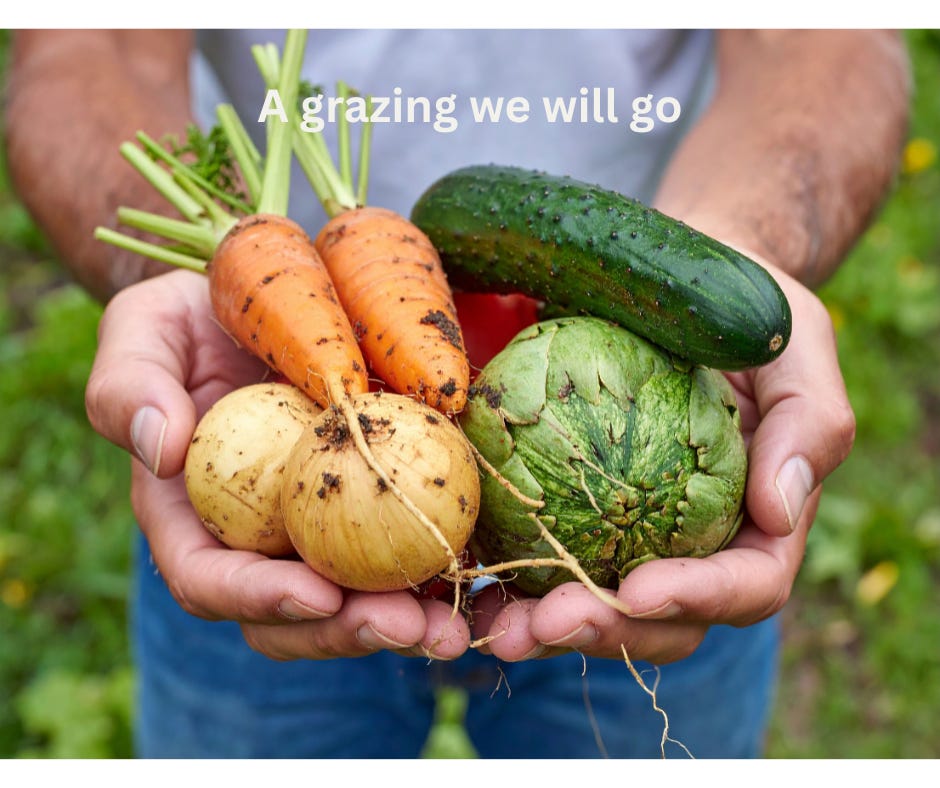
Your walking path to the garden and your trek around your garden provides your meal items.
Closest to the house, or along the main garden pathway creates convenience.
Seasonally robust plant options including herbs, berries, greens, and treats like asparagus, rhubarb, snap peas, or your favorite color variation of cherry tomatoes, small peppers, and more specifically plants along this route.
This is a walk and harvest approach - if you raise chickens or ducks - make them part of the loop as you gather eggs too.
To summarize, the key features of your grazing garden are:'
Walkable
Closest to the house or garden path edges
Seasonally robust
Turns chore time into meal prep time
Creating a grazing system for yourself can follow a few basic rules. The closer to the kitchen you plant, the easier it is to pop out and grab what you need in a hurry. The harder it is for you to whip out and nip some leaves or herbs for dinner, the less likely you are to truly take advantage of the foods you have available.
Think about what you use daily. For me, this is where a succession of berries wins every time. I have red currants, raspberries and blackberries as main features in my garden that are right beside my main pathway. Whether I am snacking while moving a sprinkler or grabbing a bowlful to have with breakfast, this feature is something I cherish about my garden. I can’t visit my garden without walking right by those tasty treats - lucky me!
And the final thing to think about in your grazing garden is that last 2 to 4 feet of every garden bed can be planted out to daily meal features like salad greens or cherry tomatoes, herbs, and so on. The main harvest blocks of food can take up the central part of any and every row, but those row ends are primed for grazing!
That may mean a re-think on where your salads and snackables grow. . . . Not a salad row (or not only a salad row) . . .but a lunchables border! I’m getting hungry just thinking about this today as I am about to head out and start preparing beds for planting.
Gardens are rarely ever just one thing. I think the best part of gardening is creating a spill-over design that lets your food plants escape out of their designated pen and into the rest of your landscape.
Grazing gardens can be included in any part of your yard, not just inside the bounds of what you call the garden. This gets tricky for me because I have a LOT of deer who like to help themselves. But herbs work perfectly for this. In the bricks around the base of my mini-greenhouse, I’ve planted a mixture of herbs and flowers: chives, creeping thyme, lemon thyme, a wild arugula on the corner, parsley and dill along the back section. It works in terms of use of space, but also means that as I hop out to check and water the greenhouse I have foods to bring back for a meal. (Note that my mini-greenhouse is located close to my house, not out in my garden! - Easy wins).
Daily harvests help make the wait for the main crops more interesting. And from a health perspective, every time you can grab something fresh for your plate or bowl, you are getting the maximum benefit of growing your own food. Fresh from the garden to your kitchen gives you the highest return of vitamins and antioxidants - better than any pill or supplement.
It really takes one simple shift in your mindset to get started:
The question is not “what should I plant?”
The real question is “how often do I want to eat from land?”
That shift will let you find the balance between your grazing garden and your harvest garden.
What’s your favorite grazing garden food?
Keep on growing!
S

As we work with plants, soil, and seasons, we’re invited to notice how our bodies respond, how our breath shifts, how presence quietly returns. These moments of awareness don’t stay in the garden. They travel with us — into our kitchens, our choices, and the way we meet the world.
This week, I invite you to step outside, not with a basket, but with empty hands.
Walk your usual path—the one you take to check the garden.
But this time, slow down.
Brush your fingers through some thyme or oregano - catch the scent. Pluck a pea from the vine and eat it right there in the garden.
If you garden is still just starting, like mine, then walk the pathway and imagine the tasty treats that could grow right along way. Imagine where a well placed berry bush could provide a moment of delight.
Notice what happens when your garden isn’t something you work on, but something you eat from—daily, casually, without ceremony or timeline.
Let that be your shift this week:
Not “what needs doing in the garden?”
But—“what’s ready for me today?”

Comments
Nothing yet. Say the first thing.
Sign in to join the conversation.