
For years I've long wanted to visit Asthall Manor, on the edge the Cotswolds. Finally my schedule and their open days aligned and I made the drive down narrow single-track lanes that make you pull tight into the hedge and hope. Parking in a field opposite the house, I already felt my spirit rise in a sort of anticipation for what I’d encounter. It was a warm, blustery day, the sun out and the wind working through everything, the big trees heaving and turning up the pale undersides of their leaves, and I stood looking out into the valley half expecting Mary Poppins to come down out of all that moving air and land on the verge with her carpet bag and her certainty.
From the moment I crossed the threshold at the gate, with the house cat on guard (or welcoming me) and started up the drive, I felt it. Enchanted. Utterly enchanted. The house is Jacobean and gabled, the honey-colored stone gone gold in the light, and the roses had climbed the walls and scrambled as though no one had ever told them to behave. The borders ran deep and a little unruly. The peonies past their prime, lay at bended knee having gone over as if giving way to the next flush of blooms. The lawns loosened into wildflower and then into woodland, with the slow green of the Windrush valley somewhere below.
I stood there in the wind and felt the thing I had not felt at that pitch in a long while, the sense that the garden was not only in front of me but somehow opening, that the heaving trees and the reckless roses were all, for a moment, lit from inside.
I take a moment to notice and record a voicenote what I am feeling, seeing, experiencing and take out my notes to record the moment:
Past the garden, wild rebellious roses climbing high into a willow.. there is a single poppy among the daisies and the clover.
Butterflies and birdsong, delighting, claiming the gentle breeze for their own.
Warm sun, blue sky, English pastoral, a church tower just over the trees.
Chairs and tables nestled into thoughtful spots through the garden.
Pathways cut through weeds and wildflowers.
A hammock strung between two trees in the shade.
The peonies and the delphiniums give way to foxgloves and hollyhocks.
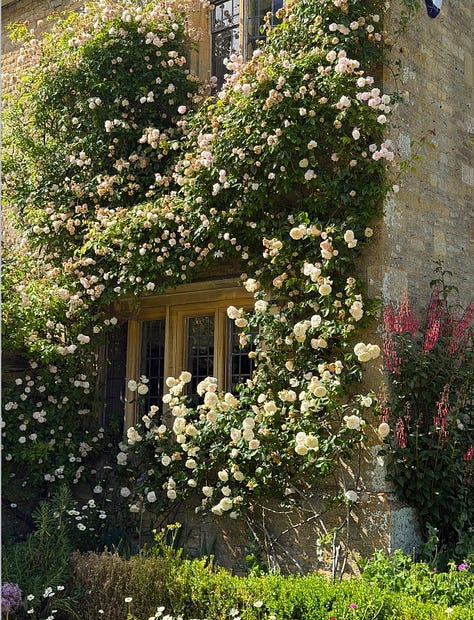
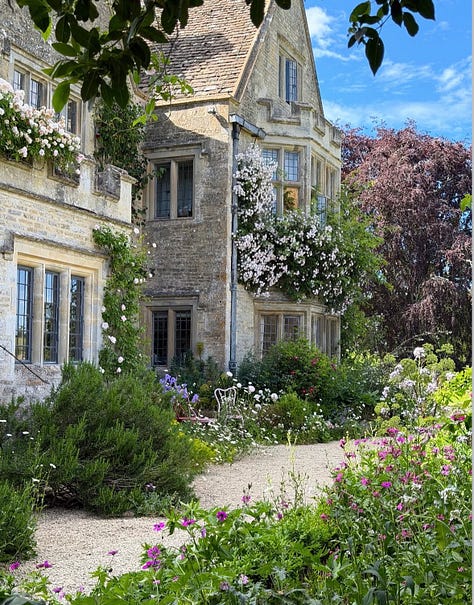

I look back towards the house and consider who lives here… and who once lived here. The Mitford girls grew up in this house a century ago, in rooms that must have been loud with reading and quarreling and girlhood. I thought about the childhood that could have been had in a place like this.. and honestly you can still feel, standing in that garden.
The beauty makes my eyes burn, makes my whole soul ache with longing, longing to feel at home somewhere, to have a sense of place that is mine. A space where I could let the wild stay wild, where I could watch the moon rise on long summer nights, a place I would not have to leave. It’s obvious this garden has been tended lovingly, thoughtfully. I get a sense that it gives a person permission to grow old and go wild. You can see the care in everything, the whole place held with tenderness. The roof sags. Moss grows on the slates. What a child I would have been here, the stories I would have told, my imagination let loose to run. And to think it is tucked just off the road between Oxford and London, down a single-track lane on the way to nowhere. After seven days of rain, the sunshine feels like a christening. The breeze carries a sweetness with it, the scent of all the blooms. I feel my pulse slow and my body let go.
These are the places that inspire me. The places I feel I belong to. The places I bring people to, across an ocean, to give them this exact moment, where the wild is allowed to go free. It is not manicured. It is not arranged. It is not a show, and it is not performing. It is thriving on its own terms. That is this garden.
I continue making my way along the back side of the house and garden. Two women ahead of me, perhaps in their seventies and eighties, meander slowly along the flagstones, taking in the flowers, commenting on each one, asking questions. Curious. I love that they are curious. At the slow descent of life and still wondering, still making the time to stop and look, and where there is beauty they meet it with astonishment. As they finish their slow tour, it ends the way it always seems to with English people at this hour. “Right. Shall we get a cap of tea.” It’s a statement more than a question. They go and join two men, clearly their husbands, who have already claimed a table and their cups of tea.
Driving home, I kept circling a thought: There was once a time when we had entire days were filled with this, with daydream and reverie and a sense of enchantment, and most of us were too young, or too unhurried, to notice we were rich in imagination. The luscious half-lit wandering of the mind while you lie on the floor of a childhood bedroom and watch the dust turn gold in a falling blade of afternoon light.
There was once a great deal of room for that. Room between breakfast and the school bell. Room in the back seat on a long drive, your forehead against the window, the trees and countryside blurring into one green thought. Room in waiting rooms and church pews and grocery store lines and the suspended hour before sleep claims your mind. Room in the pauses, before it occurred to anyone that a pause was a thing to be filled with endless scrolling and entertainment. I remember how I used the long bus rides to and from school to day dream. If I wasn’t head in a book, I was head against the window imaging my life looking differently.
We didn’t know the empty spaces were doing something. We thought we were bored or thought we were wasting an afternoon. But the mind knew where it was going. Left alone for a little while, it went back to its oldest and most necessary work, which is the making of meaning, the gathering of fragments, the subtle rehearsal of hope and the turning over of sorrow until some hidden shimmer rises off the surface. The mind, when it is quiet, is not vacant or numb. It is building worlds and narratives.
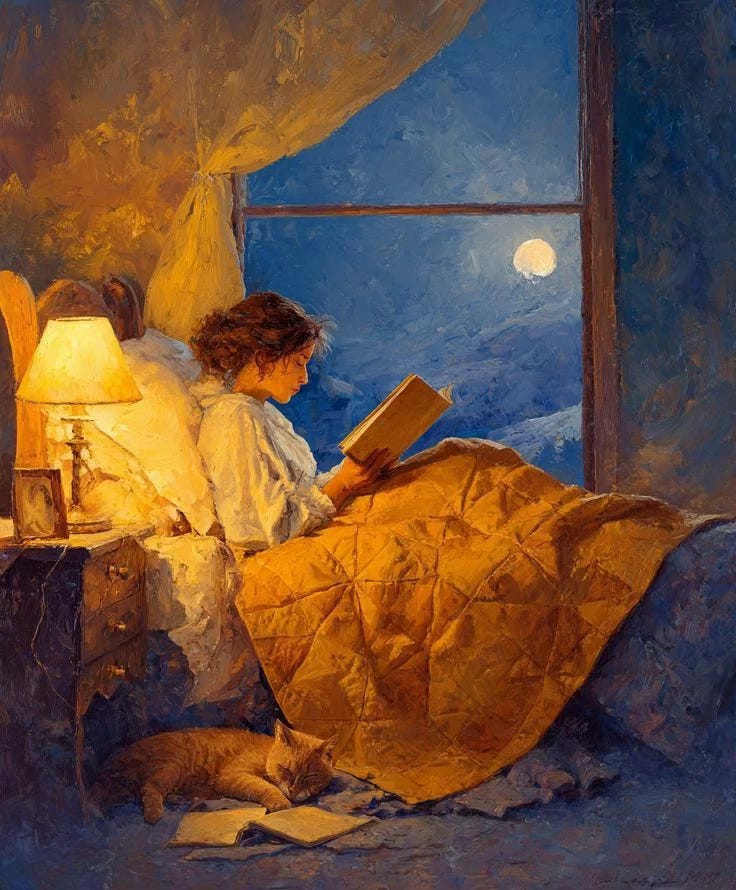
Lately I wonder what has been waiting inward all this time. What rises when the mind is not being instructed. What memory comes back when the phone is turned off. What old longing makes itself known on a walk taken without anything in your ears. There is a science underneath this, when the brain stops working on a task and drifts instead into memory, into imagination, it does not idle. It enters one of its most metabolically alive states. The neuroscientists call it the default mode network as it confirms what poets, children, and the long line of restless mystics always suspected: that what looks like nothing is often the most patient kind of labor.
This is why the idea arrives at the kitchen sink and not at the work desk. Why grief loosens its grip somewhere in the second mile of a long walk. Why a sentence you gave up on returns to you under the running water of the shower. Why the memory of someone you loved and lost surfaces, without warning, while you are bent over the blue hydrangeas in the morning border. The researchers have a phrase for this, something about incubation and undemanding tasks, it’s the way an answer comes when you stop chasing it and go do the dishes. I believe them. But I knew it first as a child, lying on the carpet in the middle of my bedroom, doing what every adult in the house would have called nothing at all.
We are not machines awaiting input. We are old houses and childhood bedrooms, full of memory and emotions, and most of the important things happen in the rooms we are not standing in.

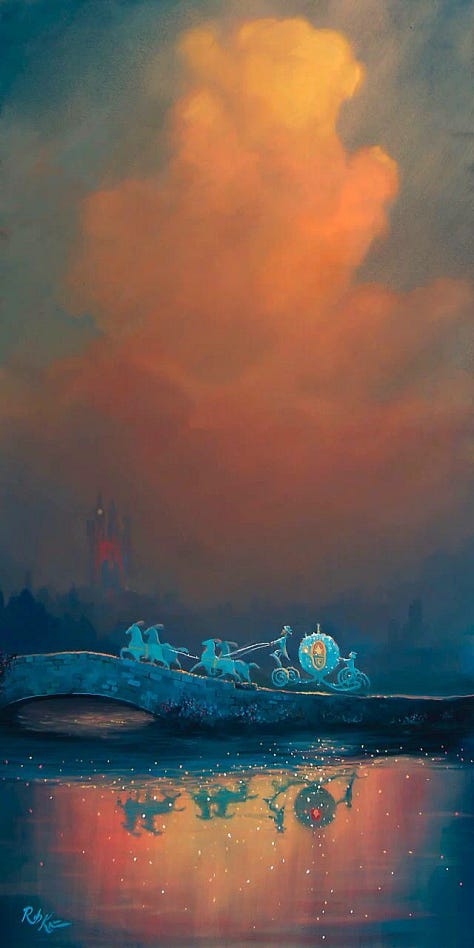
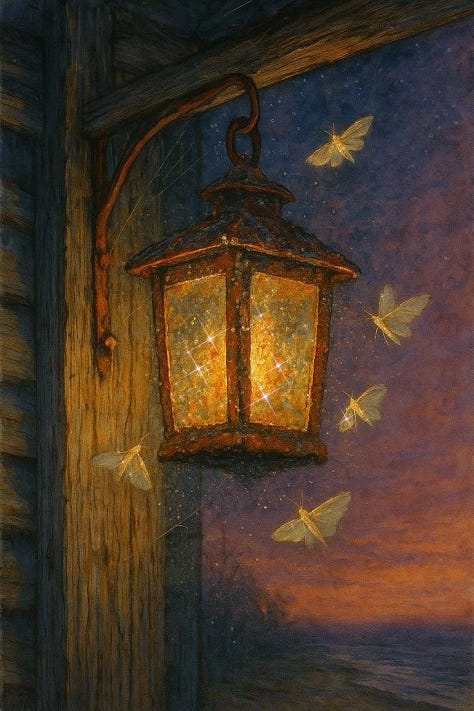
The world we have built keeps asking us to live as though the inner life is negligible and boredom were a fault in the engineering… and as if the purpose of every empty minute were to be filled, optimized, monetized, documented, improved. We have grown suspicious of the unmeasured life, and enchantment has always lived in the unmeasured… in the ordinary thing left long enough that it begins to glow..
It’s easy to turn this into a sermon against screens, and the truth is more complicated and less satisfying than a sermon. The research on what all this stimulation is doing to us, especially to children, to the pace and emotional register of what they watch and how they come to expect the world to move, is still young and still arguing with itself. I am not certain of the verdict, and I distrust anyone who is. What I can speak to is harder to graph. The modern world is loud and capable, and a great deal of the time it leaves me feeling overstimulated and underfed at once. It assaults the senses and often avoids the depths. It gives speed without mystery.. and an endless scroll of images with almost nowhere to dwell.
Perhaps that is why so many people I love describe a loss they cannot quite name, a homesickness for something they are not sure they ever had. I don’t think the past was better. Nostalgia turns dishonest the moment it pretends the old world was innocent, and the old world was never innocent. But there was, in the slower parts of it, more privacy around becoming. More shadow… more delay and much more anticipation. We had more room to gather our inner world in the dark before anyone asked to see it. There was time to be haunted by a thing before you were expected to caption it.
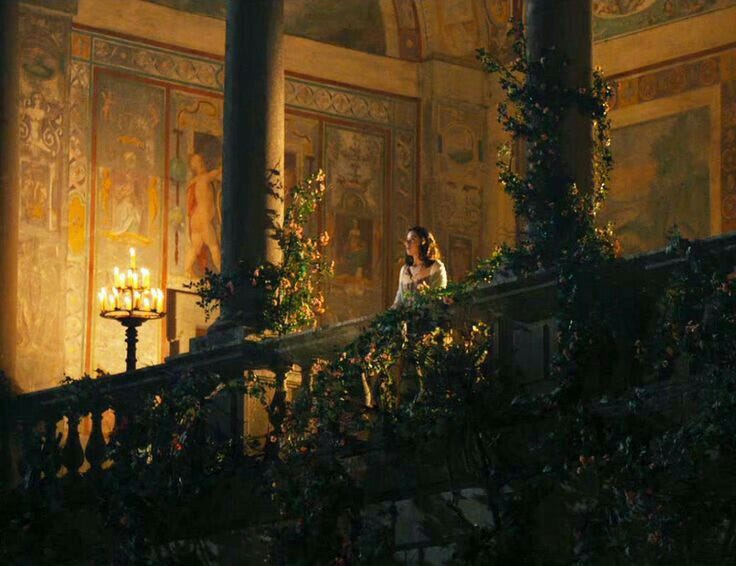
As a child, I disappeared into my imagination constantly. I went somewhere else mentally. I went into books, into films, into whole atmospheres. I remember goblins painting rainbows. I remember Anne Shirley in a horse carriage passing under a long tunnel of apple blossom, her face turned up at all that white. I remember Lady Aurora dancing in the woods with her fairy godmothers and the forest animals, the lighting seems to glow. I remember Fantasia, music made visible, pastel colors and deep feeling poured straight into me. I remember Juliet leaning out over her balcony into the dark, holding on for one more goodnight from her young lover. I remember last unicorn, and a boy in a dusty attic with a book of magic with a captivating symbol and a door that opened onto somewhere else. I remember the coffee-table books of the most beautiful villages in England, and an essay collection about a year in Italy, the pages thick with somebody else’s golden afternoons. None of it instructed me. All of it invited me. Every one of those things set off a daydream that could run for days, and I went under willingly. I was captivated. I was spellbound. I was, to use the word and mean it, enchanted.
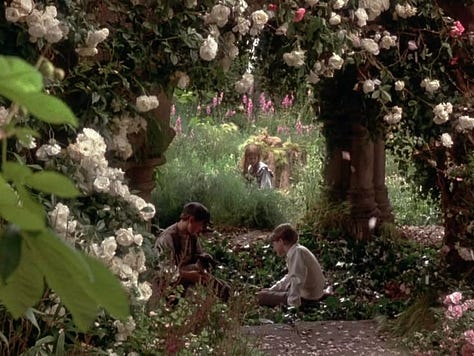
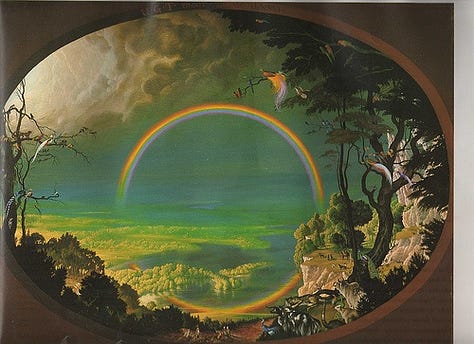
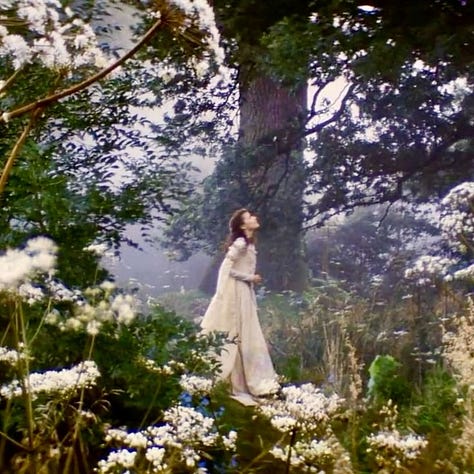
When I went back to those same books and films as an adult, I expected to find sweetness and a little softness around the edges, the gauze of nostalgia. Instead I found something far more serious than most of what is now made and marketed to me as an adult. The best children’s stories were never shallow rather they knew about loneliness, cruelty, grief, exile, and death. They understood that a child is not protected from the dark simply because the adults in the room decline to name it. What they also understood, and what we seem to have forgotten, is that darkness can be held inside beauty without shattering it. A hidden garden can grow up out of years of neglect. A cold attic can become a kingdom if the child shut inside it still has the key to her own imagination. A wardrobe can open. A forest can be more than a forest. These stories were soft enough to carry hard things, the way a daydream can metabolize what a busy mind cannot. We have not become too dark. We have become too flat.
A book, after all, is not a lesser version of the world. It is not pretending to be the lane or the kitchen or the sea. It is real in another way entirely, a parallel country, a collaboration between the mind of the writer and the hidden life of whoever is reading. This is why there can be two Prince Edward Islands and no contradiction at all. There is the actual island, green and wind-bright in the Gulf of St. Lawrence, with its red roads and its weathered houses and the salt coming in off the water. And then there is the Prince Edward Island of L. M. Montgomery’s mind, no less true, only differently true, a place made of atmosphere and girlhood and faith and grief and the ache of a woman who seemed to feel how thin the veil was between the visible world and whatever lay just behind it. She didn’t describe a place. She revealed its interior world. She gave us not geography but enchantment made habitable.
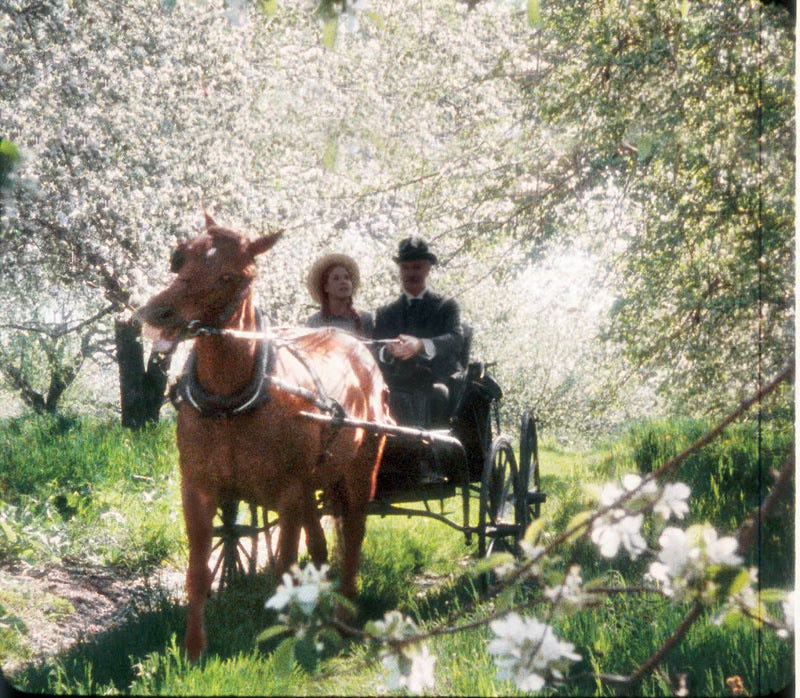
Montgomery wrote about this directly, through Emily of New Moon, who is forever experiencing what she calls the flash, although Emily knows even as a girl that the word is too small for the thing. It is the moment when the world, without warning, deepens. A field at dusk, a kitchen fire glimpsed on a dark night, a word arriving at exactly its right moment, the dark lace of branches against a far-off sky, any of these might suddenly become a doorway. The curtain stirs in a wind she cannot account for. The air changes. Something ordinary goes briefly charged with meaning, and then it passes, and she is left breathless with a delight she can neither summon nor explain. It is, I understood only later, the name I had been missing for what happened to me in the wind at Asthall.
I have known moments like that. Walking alone in the woods. Standing up on the moors with the wind moving in long combs through the heather and gorse. Looking out a train window at the fields going dark. These moments will not come when called.. that is part of their holiness. They arrive and leave like a storm front and you cannot make them perform. But they leave a brightness on the inner self, a residue of the conviction that life, in spite of everything, in spite of all the evidence some seasons hand you, still contains a persistent and unreasonable beauty.. and magic.
Maybe daydreaming is one of the ways we stay permeable to the flash. It keeps the veil thin. It lets the mind wander out near the borderlands, where memory and imagination and grief and hope start speaking to one another again in low voices. A busy mind can function. A still mind can receive.
As children, we knew all this without being told. We believed in thresholds. We believed wardrobes might open and attics held secrets and that a certain tree, a certain rock, a certain bend in the road might belong to another world if you approached it with enough seriousness and stood very still. We did not need the world to announce its magic. We assumed the magic was already there, and that our only real task was to find the entrance.

I think often of Narnia in this way, and not only of the snow, the lamppost, and the fur coats giving way to fir branches. I think of the stranger, quieter country at the heart of The Magician’s Nephew, the Wood Between the Worlds. That green, silent place full of still pools, each one a way down into somewhere else. Digory calls it rich, rich as plum cake, and rich is exactly the right word, because the wood seems at first to be a place of absences, no birdsong, no wind, almost no sound, and then you understand that these are not absences at all. They are signs that the wood works differently. It is not a destination. It is a threshold, a place that holds other places, a hush before becoming. It is one of the most perfect images I know for the interior life.
And there are whole seasons of a life that feel like that wood. Childhood is one of them. Adolescence is another. Grief is a third, and falling in love, and wrestling with your faith, and leaving a house you thought would always be there, and beginning again at an age when you were promised you would already arrived. Thresholds are not the empty stretches between the parts that matter. They are places in themselves, vast, atmospheric, and capable of changing you, even when they take up almost no room at all. A doorway.. an unmarked county border crossed in the dark. The silence after the music fades. The few minutes at the edge of sleep when the day loosens and the bedroom becomes the threshold to the dream.
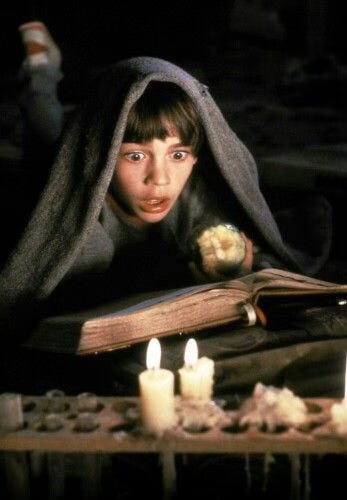
Childhood may be the first of these realms, and the one we carry longest. Not a drawer of memories so much as an atmosphere we keep inside us, a country with its own ecosystem, with a weather that follows us into our adult lives and ambushes us when we least expect it. The smell of a particular house. The peculiar safety of lamplight against a window with the dark pressing in. The old terror of a hallway. The feeling of being small beneath very large trees. We do not only remember childhood. We cross back into it, through a book or movie, through a song, and when we do, we are not being sentimental. We are returning to one of the original landscapes of the self.
This is what I think we have most underestimated in our hunger for constant stimulation. We have treated the imagination as decoration, or maybe as entertainment, as something to be outgrown. But the imagination is not childish. It is the organ by which we perceive depth. It is how we take in mystery and how we survive the things that cannot be solved, only borne. A child sitting in the wardrobe with her eyes shut, pushing at the back of it, hoping for the give of snow, is not escaping reality. She is practicing a profound form of attention. She is learning that the visible world may not be the whole of the world, which is the beginning of wonder, and wonder, it turns out, does not belong only to children.
It comes back in adolescence wearing different clothes. For some of us it arrived through music, through the used record shop on a weekend and the sacred labor of finding a band before anyone you knew had heard of them. Through thrift-shop clothes and homemade strangeness worn like a code, a password, a small flag run up so that the others like you might know you across a crowded room. Through late nights in underground places and the genuine conviction that a song could change the atmosphere and energy of the air. Before everything was instantly searchable, taste had to be pursued and you had to walk toward it: A band, a book, a film, a leather jacket found in a dingy back room of a vintage shop, none of these were content. They were clues. They were keys to hidden rooms, and finding them took time, and the time was the point. There was a privacy to discovery then, and a tenderness in it. You did not immediately convert every experience into proof that it had occurred. You could find a beautiful thing and simply keep it. Tell one friend. Play the song in your bedroom with the door shut. Let it work on you for a while before anyone else had an opinion to lend.
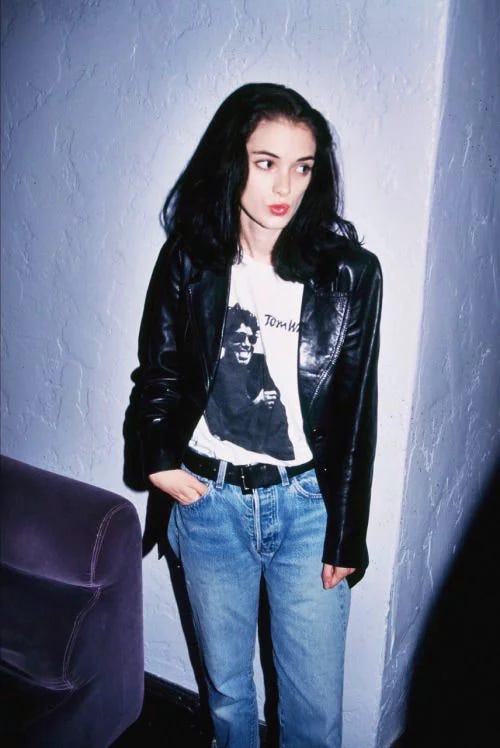
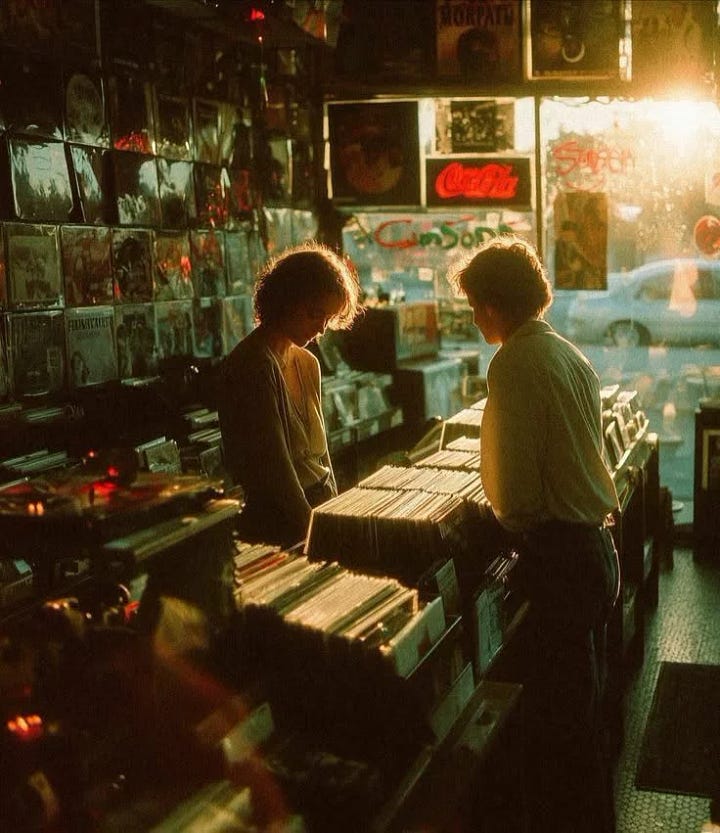
We felt no need to tell the world. We were too busy building our own.
That, I think, is what I miss most, and it is not the past itself but the unbroadcast life. The life allowed to gather its atmosphere before it was named and ranked and turned outward to the light. The self formed slowly… through books and walks and late nights and longing and good music, instead of performed continuously under the flat fluorescence of the feed. A culture of total exposure leaves almost no room for enchantment, because everything is explained too fast and consumed too fast into a takeaway, a trend, a caption, a list. We no longer sit inside an experience long enough for it to become interior, and interiority is the only place enchantment has ever consented to live. Enchantment requires duration … boredom along with silence and repetition. It requires a book reread until it stops being a story and becomes a house you know how to move through in the dark. It requires a stretch of unclaimed time in which the mind, finally relieved of its assignments, remembers how to wander off down the lane.
In art school I spent whole days in the darkroom, standing in the red light over a tray of developer, watching an image rise up out of nothing. That is not a figure of speech. You slide the blank paper into the chemical and you wait, and for a while there is only white, and then a grey ghost of something, and then, all at once, the photograph arrives, the light you caught weeks before surfacing up through the grains of silver as though it had been there the whole time, waiting to be called. The first time it happens it is indistinguishable from magic. So is the hundredth.
None of it was instant, and that was the whole of it. Out in the world I had to be there, completely, in the half second the picture lived, the thing Cartier-Bresson called the decisive moment, when everything in the frame briefly agreed and then fell apart again. I pressed the shutter on faith. There was no screen to check, no way to know what I had, only the feel of it that told me something had happened. Then the waiting. The film could be lost a dozen ways before I ever saw it. I loaded it onto the reel by touch in the pitch dark, developed it by the clock and the smell of the chemistry, made a contact sheet, and bent over those thumbnail frames with a loupe for the first tantalizing hint of whether I had got it. And then the long, exacting work at the enlarger, the developer, the stop bath, the fixer, the paper moved through each tray in the dark, until at last there was an image in my two hands.
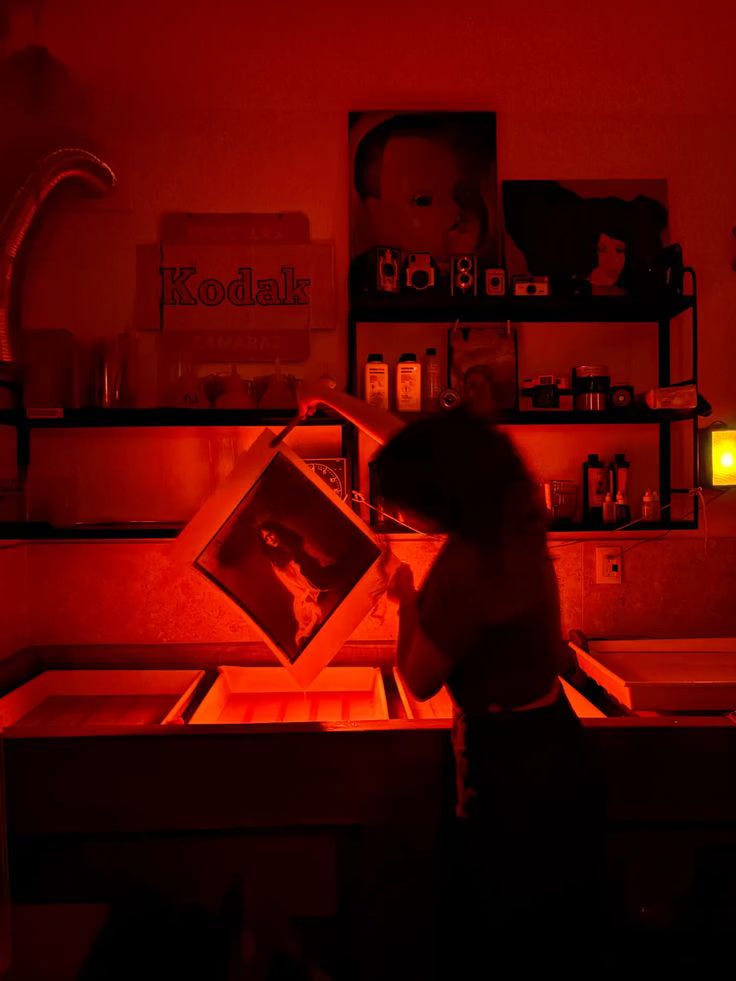
It was process, tons of patience and a lot of not knowing. It was gut and trust and craft and feeling and anticipation all at once, and underneath every frame the same held question: when the film came back, would there be one, even one, that held the thing I had felt while standing in a place I was no longer standing in, an atmosphere already gone, already turning to memory, and maybe, if I had been good enough and lucky enough, kept alive in silver. That question, and the wonder of it when the answer was yes, was the thing I loved most about the work.
Then digital arrived, and it gave us everything and shockingly took the process out from under us. I am not ungrateful for it. But we let go of something in that trade whose size I do not think we measured. We no longer had to trust our instinct completely because we could fire off forty frames and sort them later. I take pictures on my phone like everyone else. I have not forgotten what the older way asked of me, or what it handed back. But I have lost something in the exchange.
None of this is a renunciation. I am not asking anyone, least of all myself, to throw the machine out the window. I am grateful for a great deal of it, for the way it lets me find people I love across whole oceans, lets me work from an old house at the end of a country lane. These are real and strange miracles, and I would not give them back. I only want to know what I am handing over when I hand my attention across the counter without counting it. I do not want to lose the simple capacity to stare out a window. I do not want my imagination to grow so dependent on borrowed images that it forgets how to make its own.
What pulls me back, over and over, what fuels very nearly everything I make, is the chance to be re-enchanted with the world. Not the idea of it.. but the thing itself. I spend a great deal of my life now in the landscapes I only dreamed of as a kid, the ones with castles in them. I can put my hand flat on the cold stone. They were never only make-believe. They are the imagination carried all the way out into the world and left standing, and to walk into one as a grown woman is to find that the place you built under the covers at seven years old has an address, and weather, and a particular smell of damp and age and woodsmoke.
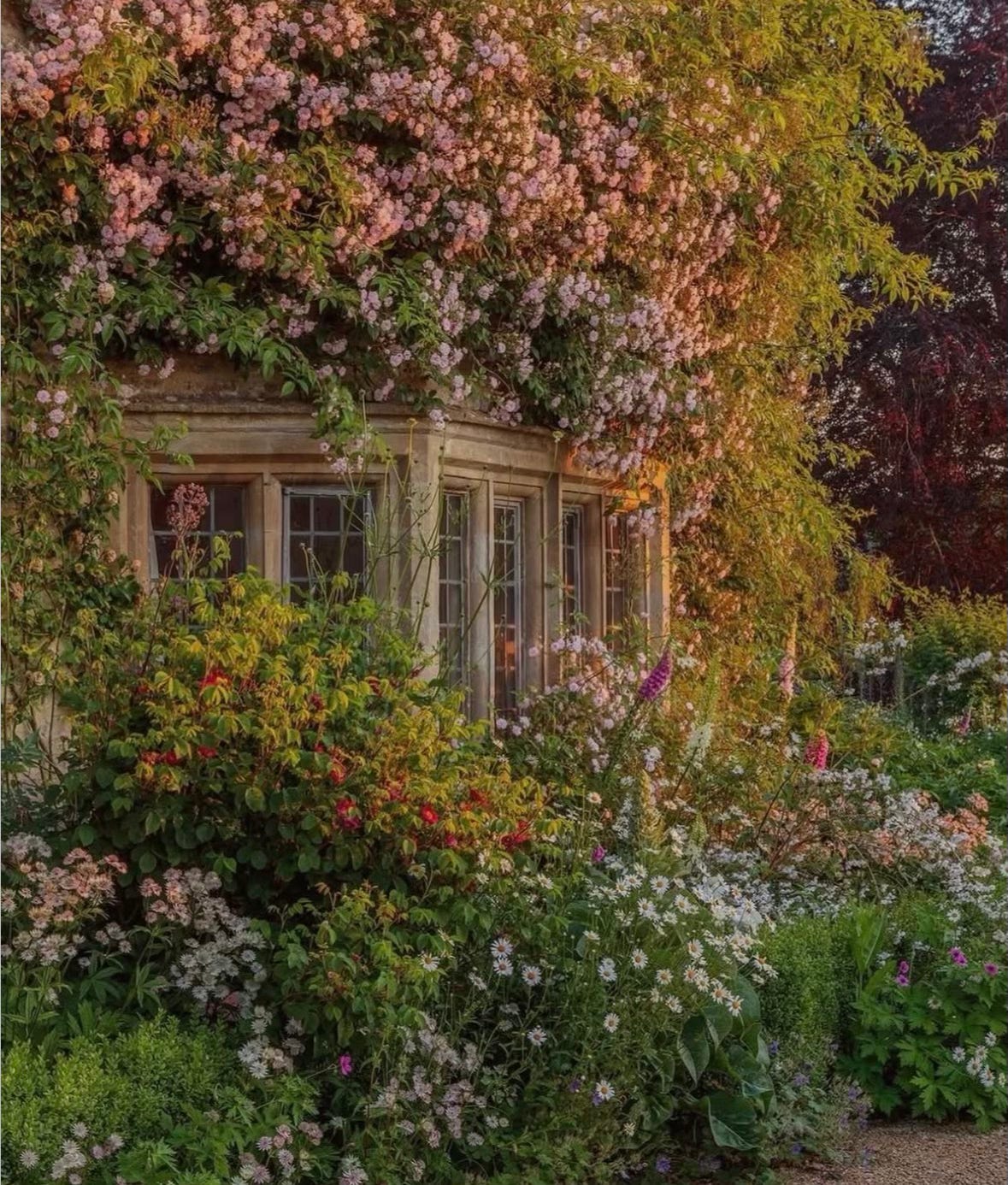
I think of wandering the ruins of an Elizabethan manor, the roof long gone, open sky where the great hall used to be, and feeling my imagination simply unclench and stretch out into all that room. There is no ping there. None of the wired clamor I grew up inside of, an ocean away, in another life. There is birdsong. The sudden ratchet of a pheasant breaking cover. Long stretches of silence with real weight in them. The sound of my own footsteps on flagstones worn smooth by five hundred years of other feet. It is, more than almost anywhere I know, a place to be enchanted back into daydream.
Or it is plainer than that. It is sitting on the coach with my head against the window, watching the green country slide past, daydreaming about what it might be to live in a stone cottage with roses going up the front of it. I watch people do the same on every trip. I watch them stop dead at a village storefront, in front of the estate agent’s cards, reading the particulars, doing the arithmetic in their heads. Could I live here. Do I happen to have seven hundred thousand pounds for a cottage at the edge of an English field. They are not really pricing a house. They are standing inside a daydream that has, for once, taken on stone and glass and a real front gate, and they do not want to step back out of it.
That longing is the most human thing I know, the wish to be enchanted again instead of jaded, to feel wonder and awe and space, to be reminded that the world can still raise all three in a person who was fairly sure she had aged out of them. I have made a working life out of walking people back across that threshold, and I have never once found it sentimental. It is the most clear-eyed thing I do. And once you give a person that much room and quiet, there is no telling where the mind will go.
Maybe it goes back to a person you loved and have not thought of in years. Maybe it begins assembling a sentence. Maybe it imagines a room you have not yet lived in, in a life you have not yet had the courage to begin. Maybe it loosens the grip of an old sorrow by a single, almost imperceptible degree. Maybe it does nothing you could ever measure, except remind you that you are still here, alive and porous, underneath the noise.
That would be enough. I have come to think that the lost art of daydreaming is really the lost art of crossing over. Into memory. Into wonder. Into that third country between the world as it is and the world as it might be felt, the place where the imagination does not deny what is real but stands beside it and makes it deeper.
The enchanted life was never a life untouched by sorrow. The old stories knew that better than we do. The fairy tales knew it, and Montgomery knew it, and Lewis knew it, and every good book I read under the covers with a torch knew it. They held grief and cruelty and exile and death and loneliness and beauty all in the same two hands, and they did not flinch, and they did not protect us from the dark. They did something braver. They gave us a world large enough to hold it.
That, finally, is what enchantment does. It does not make the life easier. It makes it more spacious. And I think that spaciousness is what so many of us are aching toward now, without quite the words for it. Not escape, not nostalgia, not a passage back to some perfect country that never existed, but a way of standing in this actual world that restores depth to ordinary things. A way to feel again the mystery moving under the surface of an afternoon. A way to remember that we were not put here only to consume and optimize and react and produce.
We were put here to wonder. To stand at the edge of a wood and feel something stir that we cannot name and do not need to. To read one sentence and find a door swinging open in a wall we had walked past for years. To hear an old song and become, for the length of it, every version of ourselves we have ever been. To let the mind drift and discover, after all that worry, that it was never wasting our time.
It was building worlds.
And maybe those worlds are not gone. Maybe they are only waiting, patient and unhurried, the way they always were, in all the rooms we forgot to leave empty.
I hope you are daydreaming.
About the Author
Welcome - I’m Kyle, the soul behind Sudden Journeys. I’m a writer, photographer, and founder of Sudden Journeys. I’ve spent the last few decades exploring: guiding travelers, leading tours, living abroad, and paying close attention to what landscapes, rooms, and encounters awaken in us. I write about place and belonging, hospitality and gathering, the practice of attention through journaling, and the home life between departures. Originally from a small town south of Nashville; I divide my time between the English countryside, London, and wherever the road takes me next.
Stay a While
If this piece resonated, you’ll find more long-form essays, reflections on journaling and home life, notes on gathering and hospitality, and lived travel writing here on Substack. Paid subscribers receive deeper essays, photography notes, and more intimate reflections.
Let’s Connect
Ask me a question, submit feedback or suggest a topic here.
💬 Come say hi on Instagram or LinkedIn
🎙️ On the Echoes of Elsewhere podcast, exploring place, migration, and belonging
📞 Have questions about travel? Book a travel planning consultation or email me at kyle@mysuddenjourneys.com
🪩 If you feel moved to like, comment, or share, it helps this work find its way to others who might need it.♥️
Thanks for reading Sudden Journeys! This post is public so feel free to share it.
Comments
Nothing yet. Say the first thing.
Sign in to join the conversation.