

The flight from Athens to Karpathos takes less than an hour. We were in a tiny plane that made me slightly anxious but I had a window seat at sunset. Somewhere over the Aegean I struck up a conversation with the man beside me and soon forgot about the small plane and turning stomach.
He was German, gay, retired early from dentistry. I learned he plays piano, obsessive about his health and every year he spends a few weeks island-hopping alone before meeting friends on Crete, a ritual of solitude followed by reunion. I love that. We talked for the entire flight. We instantly connected. By the time we landed on an island I’d only heard of a few weeks before, we had already made plans: he didn’t have a car, I did, and my birthday was in two days, and neither of us had anywhere to be for a week.
So we spent it together. Drove the coast roads in the late morning. Swam off a beach we discovered only because I took a wrong turn which led us to the most incredible secluded cove. Feasted on greek food, explored sleepy villages aimlessly and mostly we just talked and shared stories about our lives.
I couldn’t have planned any of it. More importantly: I didn’t. And I keep returning to that week, not for the beauty of it, though it was achingly beautiful and I long to return, but for what it clarified about travel and belonging. And about what technology can actually do for us, and where it runs straight into the wall of what makes us human.
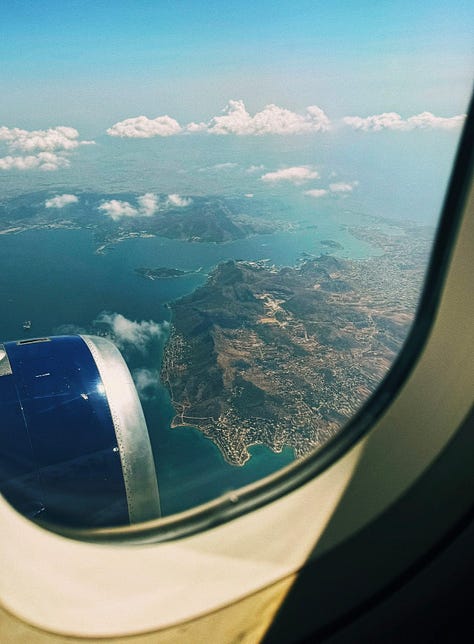
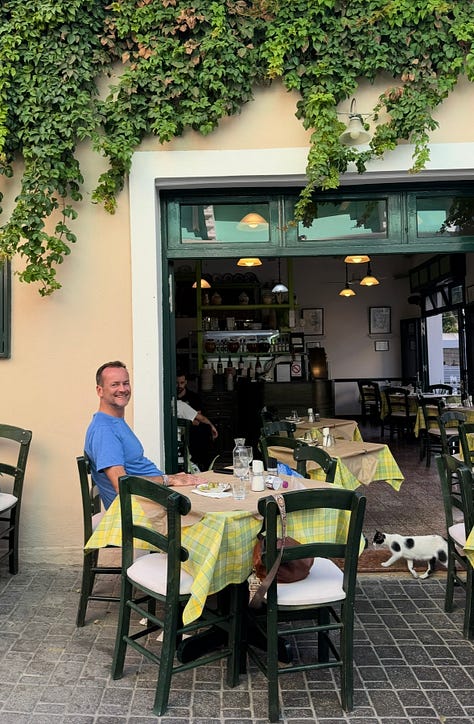
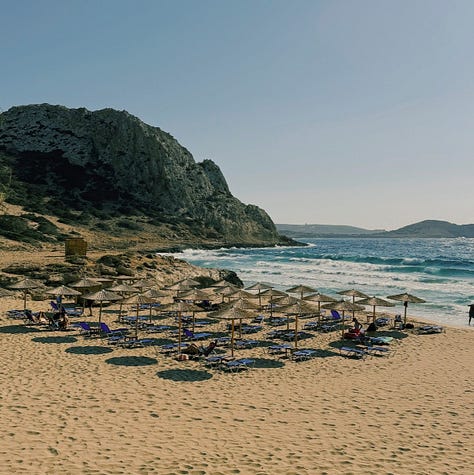
It’s easy to call out the algorithm and make it the enemy. It’s not. I used one to find the villa. I compared flight prices, checked reviews, and let a search engine narrow a very large world down to a manageable set of choices. There’s nothing wrong with that. The logistics of getting somewhere: the flights, transfers, and reservations.. these things have always been a sort of scaffolding, and scaffolding, when it works well, becomes invisible. You don’t feel it. You feel the building.
What I’m interested in is what happens after the scaffolding disappears and what happens in the space between arrival and belonging. And my argument is that this space, this ungovernable interval, cannot be automated, not because the technology isn’t sophisticated enough, but because it is the wrong tool entirely.
Priya Parker writes in The Art of Gathering that when we focus on the mechanics of an event: the logistics, the setup, the details … we “inadvertently shrink a human challenge down to a logistical one.” She means this as a caution for hosts but I think it applies to the way we’re starting to talk about travel, and about belonging more broadly. We keep trying to optimize our way into connection, as if the right itinerary, the right hotel, the right curated experience, will reliably produce the feeling we’re actually chasing.
It won’t. Not because the itinerary doesn’t matter, it does, enormously, but because the itinerary is only ever the framework.. the outline. It determines what’s possible. It doesn’t determine what happens.
This is the distinction that gets lost in every conversation I hear about AI-powered trip planning, personalized recommendations, algorithmically generated experiences. These tools can get better and better at giving you what you’ve already wanted. What they cannot do is give you what you didn’t know you needed. They cannot give you the retired dentist on the plane to Karpathos. They cannot give you the restaurant owner who sees you eating alone and decides you should sit with family tonight.
Geoffrey Cohen, in his book Belonging: The Science of Creating Connection and Bridging Divides, argues that belonging is not primarily a quality of people but of situations. We think of ourselves as either the kind of person who belongs somewhere or not. Cohen’s research suggests this is almost entirely backwards. What actually determines whether we feel we belong is whether the situation around us has been shaped, consciously or accidentally, to make belonging possible.
He goes further: the brain registers exclusion and disconnection with the same urgency as physical pain. We are not wired for isolation rather we are wired, at the deepest neurological level, to find each other.
What troubles me about the algorithmically planned journey is not that it produces bad trips. That is an entirely different discussion all together. It often produces decent ones. What troubles me is that it tends to produce sealed trips… trips with no open seams.. no accidental evenings, no unscheduled hours in which a stranger might become something more. The situation is optimized for comfort and efficiency, and in being optimized, it closes off the very conditions under which belonging most readily occurs.
Decades before Karpathos, I was backpacking throughout Europe on an itinerary that’s really more of a general direction than a plan. I arrived at a hostel in Bruges where I shared a room with three strangers: an American woman, an Irish/Canadian man, a German teenager who couldn’t have been more than seventeen or eighteen. We were all traveling solo. We went to a British pub that night, which is a slightly absurd thing to do in Belgium. And there we talked for hours sharing our harrowing travel tales.
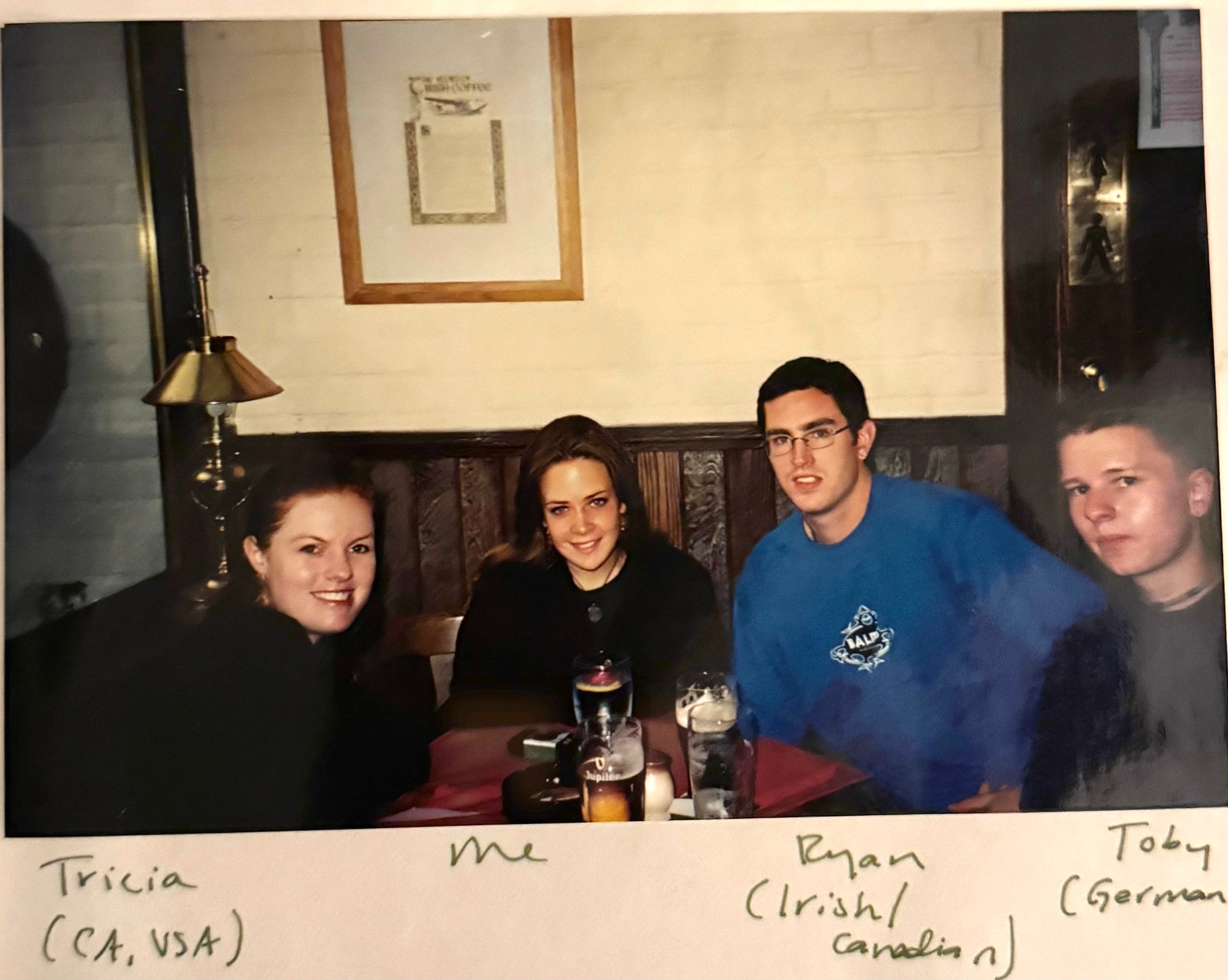
Two days later, we went to Luxembourg together. Luxembourg had not been on my itinerary. I had never considered going to Luxembourg. It didn’t make sense geographically, logistically, practically. But these four people had decided to go, and the question of whether it made sense on a spreadsheet became immediately irrelevant. What mattered was that we were going together and that we had found each other in the accidental way that only open-ended travel allows.
Luxembourg wasn’t anything extraordinary, it’s a lovely country, but so is everywhere when you’re young and slightly lost. It comes to mind now because it represents something I attempt to preserve in my work, and something I worry is being steadily engineered out of how we move through the world: The margin… the space in the plan that isn’t filled.
Anne Lamott writes that community is “a rough and beautiful quilt sewn of patches that don’t seem to go together at all, and then do.” She’s writing about spiritual community, about faith and showing up and tolerating each other’s foibles across decades. But I read it and think about four strangers in Bruges deciding to go to Luxembourg. About a retired dentist and a tour leader spending a birthday on an island neither of them had planned to care about. The patches don’t seem to go together. And then they do.
That’s not something you can engineer but you can create the conditions for it. You can leave the seams open. You can resist the impulse to confirm every hour of the journey in advance, to pre-validate every experience, to hand the whole thing over to an algorithm that will give you exactly what you asked for and nothing you didn’t know to want.
The brilliant David Brooks, in How to Know a Person, argues that the central skill of a healthy life is this: the ability to truly see another person, to make them feel witnessed and valued and known. He calls people who do this well illuminators. I love this. Illuminators. I want to be an illuminator. And what strikes me, reading that, is that illumination is not a thing you can schedule, book it in advance. You cannot have it delivered.
It requires, above everything else, presence. The kind of presence that is only possible when you are not completely optimized, not completely purposeful, not moving from one confirmed reservation to the next with no air in between. Something has to be left open for the stranger on the plane. Something has to be left empty for the unexpected invitation, the accidental conversation, the dinner that turns into a friendship.
This is not an argument against planning. I have spent twenty-five years planning travel, down to the timed entry at the manor and the cheese shop that only does business before noon. Good planning is an act of love toward the people who will move through the spaces you’ve designed. But there’s a difference between planning the conditions in which belonging can happen and trying to plan belonging itself.
There’s a danger in the current moment, which is that the tools are so good now that we’re forgetting what they can’t do. An AI can generate an itinerary in thirty seconds that is genuinely impressive, that accounts for opening hours and transfer times and dietary restrictions and the fact that you’ve said you want something ‘off the beaten path.’ It will produce something coherent… in fact, it might even produce something lovely.
But it will not know that you are arriving somewhere in the week of your former wedding anniversary, that you are secretly hurting that you might not be celebrated, that you have chosen this island specifically because you have never heard of it, because the unknown is the only thing that sounds like relief right now. It will not leave the margin for the man on the plane. It will not build in the empty evening that becomes the dinner invitation you remember twenty years later.
This is not a flaw that will be corrected in the next update, it’s structural. Algorithms are optimized to give you what you’ve told them you want. Belonging, almost always, requires something you didn’t know to ask for
I am a travel designer, a composer of encounter. Someone once called me an alchemist of atmosphere (which I am rather fond of ). I have spent years thinking about how to create the conditions for people to feel, by the end of a week, that they belong to each other and to the place they find themselves. This is harder and more precise than it sounds. It’s never really been about scheduling activities. And as much as I am a snob about the right restaurant, it’s really not about that either. It’s about the proportions of things: solitude and togetherness, motion and stillness, structure and open air. About knowing when to put a prompt in front of a group and when to get out of the way entirely.
Parker talks about what she calls generous authority, the idea that a good host takes responsibility for the room, creates and protects the conditions for connection, and then steps back and lets people find each other. That phrase has stayed with me because it captures something I believe about the work I do. You cannot manufacture the moment when two strangers decide they are, actually, friends. But you can create the circumstances in which such a moment might occur. You can leave the door open and you can hold space.
What I’m increasingly concerned about is a travel culture that conflates friction with failure, and that treats uncertainty as a bug to be fixed. And that wants every moment confirmed, every experience pre-validated, every encounter guaranteed. What gets lost in that optimization is exactly the thing we went looking for in the first place.
Brooks writes that “the act of seeing another person is profoundly creative.” I read that sentence and thought about Karpathos. About the moment when the man beside me asked where I was going and I said, truthfully, that I wasn’t sure. I had a car, a villa with a pool and a view, a week, and no plan. And he laughed and said “ Me too! well not the pool and the view”, and something opened up.
That opening is what this is all about. Not the itinerary, not the recommendations, not the five-star rating of the restaurant where the villa owners eventually fed me like one of their own.
The opening.
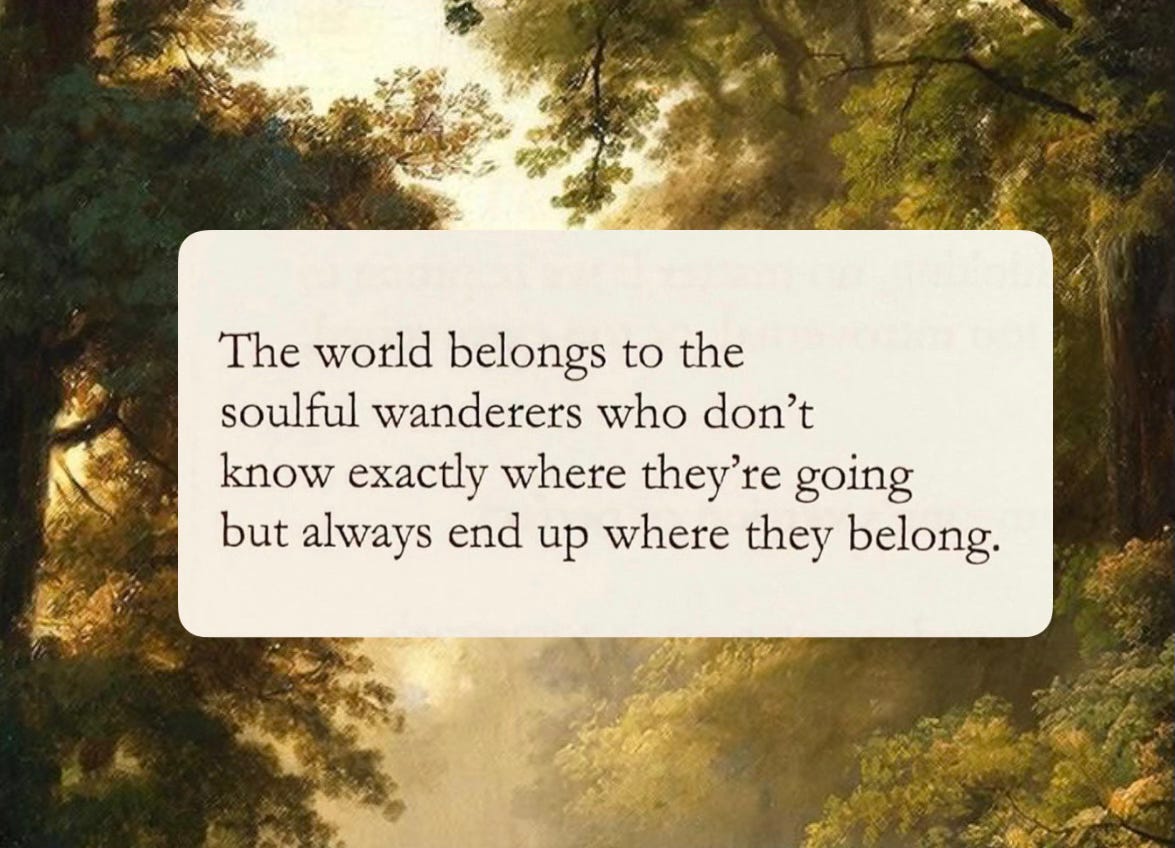
You can’t automate it. You can only leave room for it. You can choose, deliberately, to remain slightly unfinished, to travel toward what you don’t yet know, to leave the evening open, to sit down next to a stranger on a small plane over the Aegean and decide, for no reason except instinct and hope… and that we are all human together.. to say hello.
That decision is yours and it has always been yours. No algorithm, however brilliant, will ever be able to make it for you.
The logistics will keep improving. The itineraries will get more personalized, the recommendations more precise, the friction steadily reduced. That’s fine and really it’s a marvel to imagine! The scaffolding should be good.
But belonging is not a logistics problem. it’s a presence problem and it’s an attention problem. It is, at its core, a willingness problem, the willingness to leave space in your days for what hasn’t happened yet, to stay open to the stranger, to say yes to Luxembourg even when it doesn’t make sense on the map.
Parker says we shrink human challenges into logistical ones. Brooks says we have largely forgotten how to see each other. Cohen shows us that the brain itself aches for connection, that belonging uncertainty is not a personal failing but a situational one, and that situations can be changed. Lamott says community is patches that don’t seem to go together, and then do. I want to add only this: we have also started outsourcing the conditions for encounter, trusting that if we follow the algorithm far enough, belonging will be waiting at the other end.
It won’t be. It will be wherever you left room for it. Wherever you chose, against all optimization, to remain a little lost, a little open, a little available to the world.
That’s where it lives. That’s where it has always lived. And sometimes the best moments are the ones we never plan for.
About the Author
Welcome - I’m Kyle, the soul behind Sudden Journeys. I’m a writer, photographer, and founder of Sudden Journeys. I’ve spent the last few decades exploring: guiding travelers, leading tours, living abroad, and paying close attention to what landscapes, rooms, and encounters awaken in us. I write about place and belonging, hospitality and gathering, the practice of attention through journaling, and the home life between departures. Originally from a small town south of Nashville; I divide my time between the English countryside, London, and wherever the road takes me next.

Stay a While
If this piece resonated, you’ll find more long-form essays, reflections on journaling and home life, notes on gathering and hospitality, and lived travel writing here on Substack. Paid subscribers receive deeper essays, photography notes, and more intimate reflections.
Let’s Connect
Ask me a question, submit feedback or suggest a topic here.
💬 Come say hi on Instagram or LinkedIn
🎙️ On the Echoes of Elsewhere podcast, exploring place, migration, and belonging
📞 Have questions about travel? Book a travel planning consultation or email me at kyle@mysuddenjourneys.com
🪩 If you feel moved to like, comment, or share, it helps this work find its way to others who might need it.♥️
Thanks for reading Sudden Journeys! This post is public so feel free to share it.
Comments
Nothing yet. Say the first thing.
Sign in to join the conversation.