
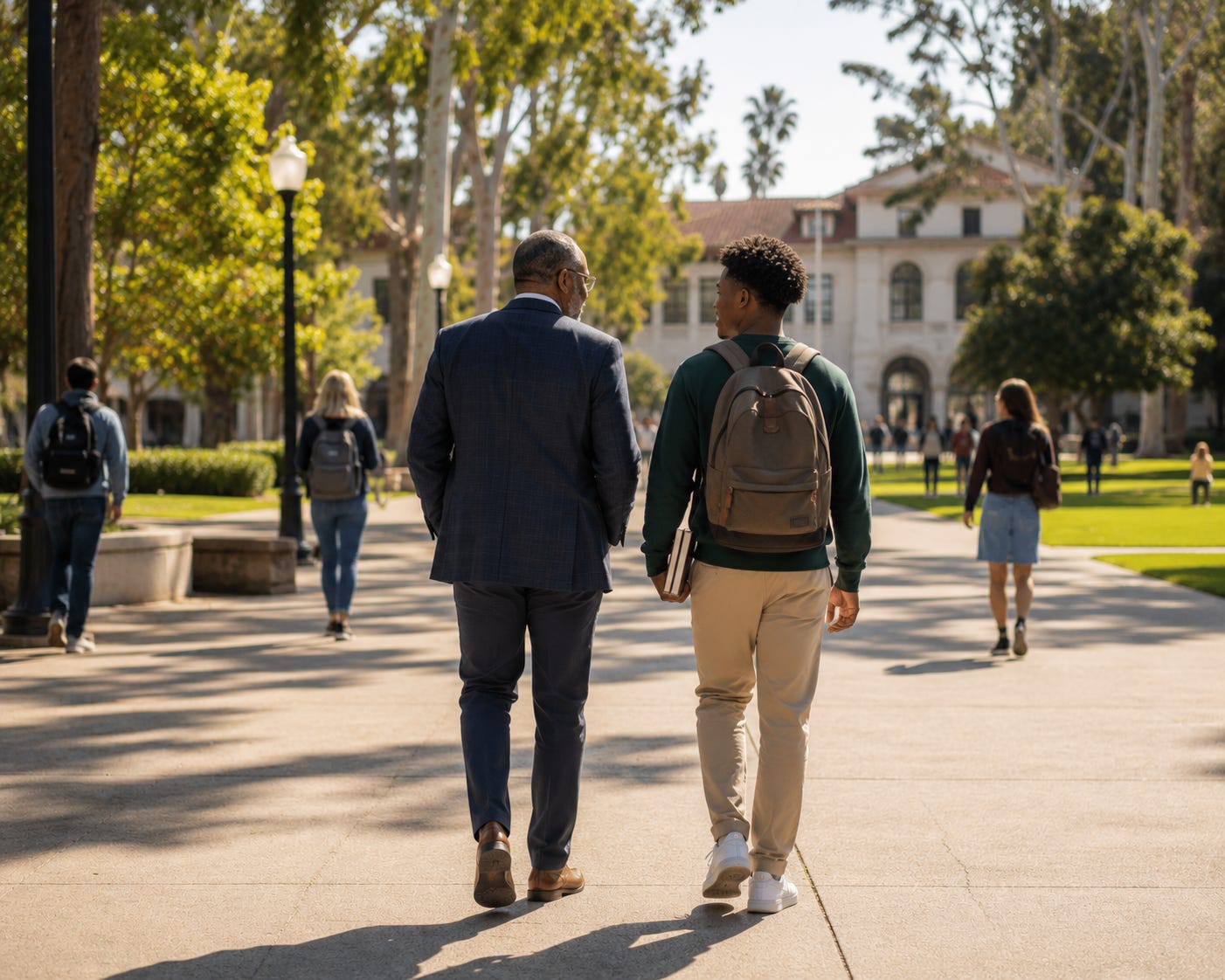
I’ve spent much of this summer reflecting and reading. One of the books I read this summer was Michelle Obama’s memoir Becoming. In that familiar and brilliant book is a scene that reminds me a lot of my own Chicago, Hyde Park, South Side upbringing. Later, while revisiting the 2020 Netflix documentary Becoming that highlights her 2018-2019 book tour, I was struck by the scene in which she meets students from her alma mater, Whitney Young High School, who share stores that are, in her own words, tragic and unsettling. She listens, then reframes those stories, not through a deficit lens, but rather as evidence of persistence, their sheer resilience and their capacity to survive. She tells them they already have what it takes to succeed. That wasn’t an isolated incident, years earlier, the First Lady welcomed a different group of students from Chicago at the White House before taking them to Howard University. They weren’t simply touring a campus, they were beginning envision themselves as college material.
She never calls any of this Cultural Trust. She was just doing it. As so many do.
I’ve spent this series trying to name something people who are good at this work have always known how to do without necessarily being able to define. Michelle Obama’s example finally answers the question that’s been an undercurrent for six essays: what does Cultural Trust actually look like when someone is doing it, in real time, in practice?
It starts with reframing, and belief without lowering the bar of expectations. Notice what Michelle Obama doesn’t do in that room. Neither does she deny their existence by saying their hardships don’t matter, or that it shouldn’t factor into how anyone sees them. She takes what many institutions and individuals, perhaps even some in their own lives, and turns it over to show the other side. Overcoming, learning from mistakes, and yes, survival demonstrate evidence of capacity, not the absence of it. That’s not lowering expectations. It’s refusing to let expectations be built on incomplete information or letting others’ biases and perceptions of you be the end of the discussion.
This is what it actually requires. Not the kind of performative care many demonstrate in the classroom, but the kind that gets not performed but felt by a student and is something a student can see. Michelle Obama doesn’t simply believe those students are capable. She says it out loud and affirms it front of them. That’s the difference between caring and showing it. A student doesn’t trust a feeling they can’t see. They trust what is spoken into existence, said out loud, in the room, directly to them.
I think about my own version of this, decades before I had language for any of it. I was nineteen, and someone in a position to know better told me I wasn’t college material. What actually changed my trajectory didn’t start with a speech. It started as a feeling, the quiet awareness that someone saw something in me I couldn’t yet see in myself. That awareness became a process as someone sat beside me and asked what I wanted, not simply highlighting what I lacked. The process turned into a plan. That plan became a purpose. Somewhere along the way, that sequence, that feeling, became action, and the action became a way of being. That’s Cultural Trust. Not a term I’d have for another twenty years, but something that was happening to me in real time, one stage at a time, long before it needed a name to be real.
I want to be honest about something else this series has taught me while I was writing it. Naming Cultural Trust hasn’t made it easier to practice. If anything, writing about it in public has made me more aware of every place I fall short of it, in my own classroom, in my own institution, in moments I’ve had to admit, in these very pages, that I reached for the easier explanation instead of the harder truth. That’s not a flaw in the framework. That’s what it means to take a framework seriously enough to hold yourself to it, instead of just using it to describe what other people get wrong.
Here’s what I keep coming back to. Cultural Trust was never something Michelle Obama invented as First Lady, and it wasn’t something I invented in a classroom after twenty years of teaching. It’s what a parent does the first time their kid comes home convinced they’re bad at math, and the parent doesn’t argue with the grade, they argue with the verdict, sitting down at the kitchen table until the kid sees something in the numbers they couldn’t see an hour before. Look at what a coach does with the player everyone else has already benched in their own head. It’s something millions of people have been doing, unnamed, in kitchens and gyms and classrooms, for as long as there have been people the world had already decided not to bet on, and other people unwilling to accept that verdict. What I’ve tried to do across these seven pieces isn’t discover something new. It’s give a name to something old enough that most of the people doing it best never needed a name for it at all.
My hope for this academic year isn’t that every educator adopts a new framework. My hope is that we remember what many of us have always known how to do. See students for who they are becoming, not simply who they are today. See, genuinely see, who they’ll be eight or nine months from now, not just the student standing in front of you in August, and certainly not the student the institution has already decided they are. Say it out loud, where it counts. Give that belief somewhere real to go.
Because people rarely become who they are capable of becoming alone.
No posts
Comments
Nothing yet. Say the first thing.
Sign in to join the conversation.