
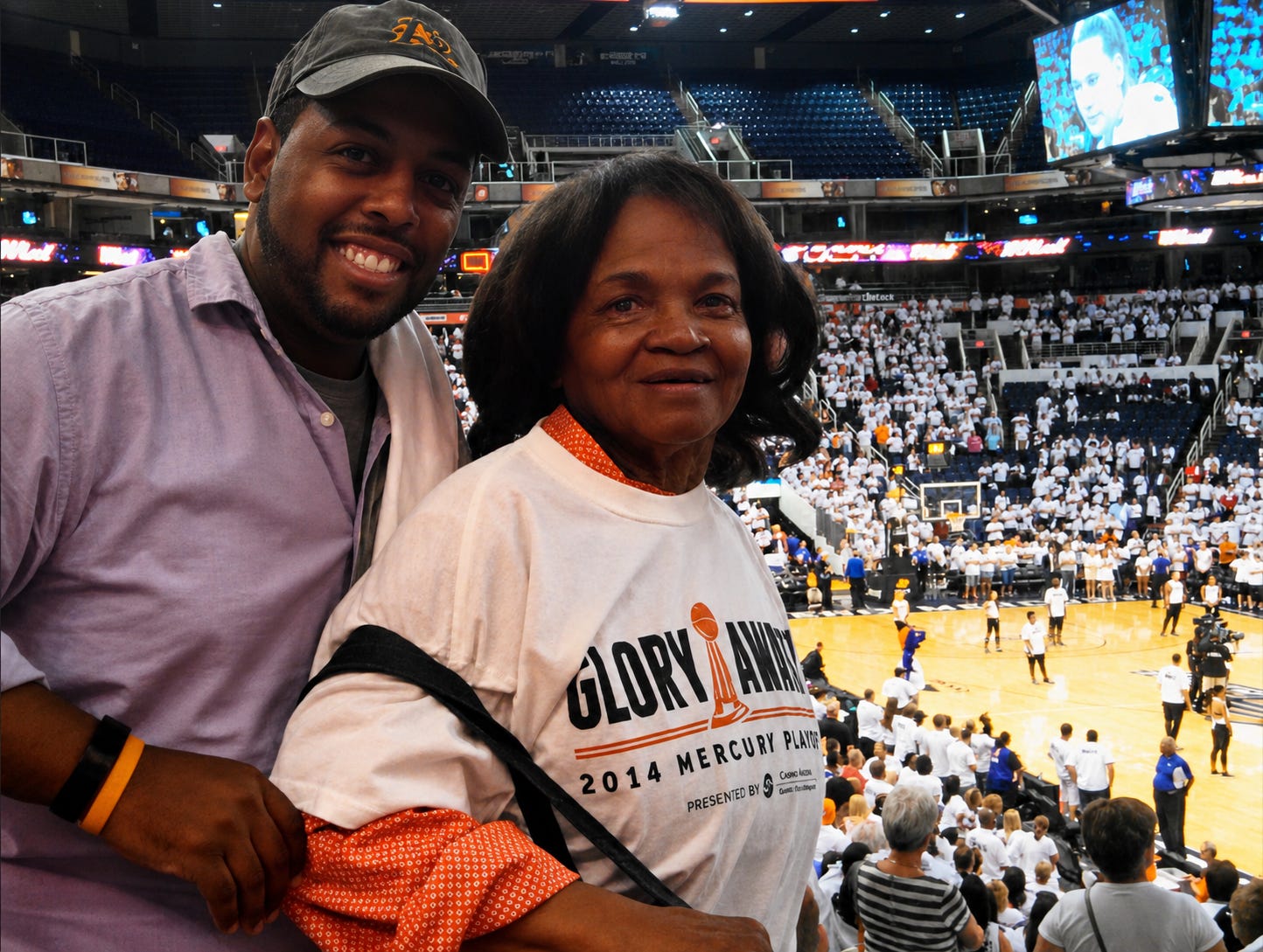
Women’s basketball was part of my life long before the 1996 Olympics. My middle school hosted the Chicago Hustle of the Women's Professional Basketball League in the early 1980s, and my mother and I watched women's sports whenever we could.
When professional women’s basketball returned to Chicago in 1998, my mom and I were there on opening night of the short-lived American Basketball League cheering for the Chicago Condors. She didn’t see women’s basketball as an alternative to men’s basketball. She simply saw great basketball. Looking back, I realize she was teaching me something long before I had language for it. She taught me to pay attention to people and institutions before the rest of the world decided they mattered.
I also think growing up with my mother shaped me in ways I didn’t fully appreciate until much later. I’ve spent much of my career working in nonprofits, education, and around women’s sports, often surrounded by strong women leaders. It never occurred to me to find that intimidating because leadership didn’t have a gender in my house. It had character. Competence. Integrity. Those were the qualities I learned to recognize.
I've thought about her often while watching the last few years of the WNBA unfold.
Most recently, a coach used a phrase during a game that, in her home country, is a fairly ordinary turn of expression, a way of saying someone is rare, someone the other team should be careful with. Very few people heard it that way. What many people heard was another slight directed at a young Black woman who has spent her career, even in its earliest chapters, absorbing exactly those kinds of moments. The league suspended her. Then a friend and fellow coach publicly defended her, trying to provide context and extend grace, only to find herself criticized as well.
The league also finds itself in a moment unlike any other in its history. New fans have arrived in unprecedented numbers, many drawn by a generation of remarkable young players whose popularity has expanded the audience in ways few imagined possible. That’s something worth celebrating. I’ve celebrated it myself. More people watching women’s basketball is something I never imagined I’d see at this scale. Two years ago, All-Star Weekend was in Phoenix. This year it’s back in my hometown of Chicago, and judging by ticket prices, demand has reached a level that would have seemed unimaginable for much of the league’s history. It’s hard to complain about higher ticket prices when they’re one of the clearest signs that people finally recognize the value so many of us believed was there all along. At the same time, longtime fans understand that this moment didn’t appear overnight. It rests on decades of work by players, coaches, executives, and fans who kept believing in the league when far fewer people were paying attention. Those aren’t competing stories. They’re different chapters of the same story.
The easy question is the one everyone has already been debating online. Who was right? Was the coach right? Were the fans right? Did the league overreact or underreact?
I don’t think that’s the most interesting question.
The more interesting question is how people build trust across communities that are watching the same event through entirely different histories.
Longtime fans carry decades of memories of being told the WNBA didn’t matter, that women’s basketball wasn’t worth televising, that the league would never survive. New fans arrived during a period of unprecedented visibility and growth. They don’t carry those same memories because they didn’t have to. Players carry their own histories as well, shaped by the women who came before them and the price they paid to make today’s success possible. None of these groups are wrong about what they’re seeing. They’re simply seeing the same moment through different histories.
Cultural Trust suggests that disagreements like this are rarely only about the facts. They’re about whether people believe their history, identity, and lived experiences are being recognized at all. Two people can watch the exact same clip and come away with completely different interpretations, not because one is dishonest, but because each is bringing a different history into the moment.
I don’t believe the coach intended her words to be harmful. I also don’t think that settles the matter. Intent and impact are different ways of measuring the same event. The people who heard something hurtful weren’t inventing a pattern out of nothing. They were recognizing one built over years of watching how Black women in this league, and in society more broadly, are often discussed when they succeed, speak up, or simply occupy space. At the same time, the coach who defended her friend wasn’t wrong for extending the kind of grace she’d hope someone would extend to her. What I think she underestimated was how much trust that grace would cost among people whose lived experiences have taught them to be cautious about giving it away too quickly.
This isn’t really a basketball problem. It appears anywhere people with different histories are asked to make sense of the same event. The instinct is almost always to argue harder, produce more evidence, or replay the clip one more time.
Trust rarely grows from better facts alone. It’s built through the slower work of helping people believe that their history has been heard, even when others experienced the same event differently.
Every time I walk into a WNBA arena, I still look around, almost expecting my mother to be there. Even if the seat beside me is occupied, she’s there anyway. I watch the game through my own eyes now, but I also watch it through hers. Maybe that’s why I watch differently than some people do. I see the strength of women who look like her, women who built this league when very few people cared, and women who continue carrying it now that millions do.
I think about what she would make of this moment, and I suspect she’d tell me what she told me about so many things growing up.
The disagreement was never really about the game.
To everyone traveling to my hometown of Chicago for All-Star Weekend, enjoy the city. Celebrate the players shaping the league’s future, but take a moment to appreciate the women, coaches, executives, fans, and communities who carried it here.
Happy 30th, WNBA.
No posts
Comments
Nothing yet. Say the first thing.
Sign in to join the conversation.