
Along with tens of thousands of others, I’m an avid follower of Grace Blakeley’s posts. Last week, belatedly, I finished her magnificent Vulture Capitalism. I then zoomed in to a great lecture by Jason Hickel, perused the latest paper by Ben Wood et al and an op-ed by George Monbiot before zipping up to London for the UPF Policy Forum at Imperial College.
What links all the above is the question of who is free, who isn’t and what’s to be done.
We’ll start with the first part…
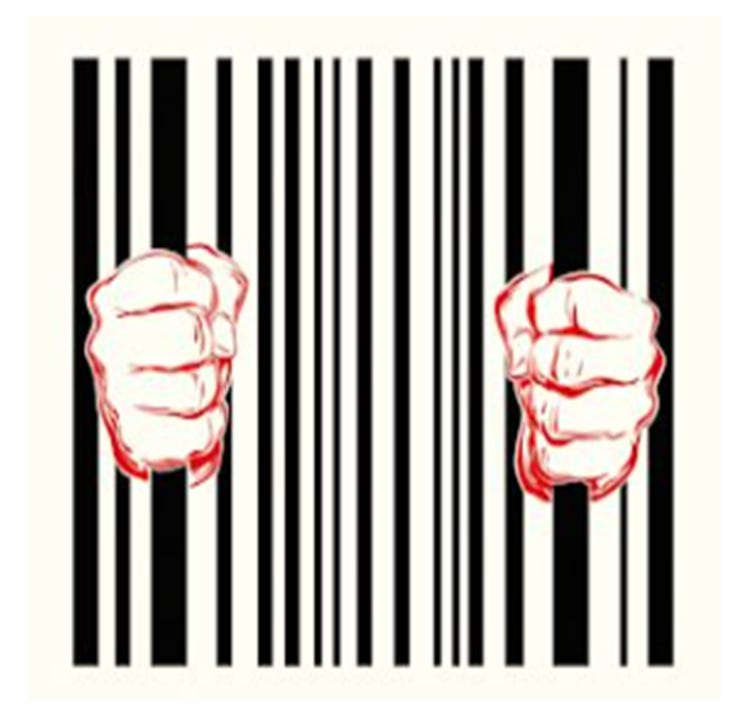
Blakeley starts by exploding the myth that twenty-first century capitalism was ever about free markets and our freedom. This is just a smokescreen. Capitalism is defined by the division between those who own all the stuff needed to produce commodities and those forced to work to produce those commodities. The former make the big decisions ‘about us, without us’ – and they remain unaccountable to the people they affect the most.
Reviewing her book through the prism of food, her arguments land every time. We have a food system in which a handful of ‘vast sprawling enterprises cooperate with one another and with states as much as they compete.’
Corporate behemoths get to set the wages and conditions of workers, the prices paid to suppliers and the prices paid by consumers. They no longer bother competing, as they no longer need to – they simply buy up competitors or erect barriers to their entry into the market. They have the power to block workers’ attempts to organize and – via myriad tactics – to infiltrate politics in order to block, delay or dilute any policy that may get in their way.
[For more on the multiple ways our agency is undermined, dig into Jennifer Clapp’s 2025 paper on corporate concentration in food systems]
Monopolisation is a central to capitalism as profit maximisation. As Blakeley says, markets now ‘resemble a crowded room in which one or two people have a megaphone’
In this world, profits aren’t channelled into new productive investment, they’re distributed to shareholders and executives, thus driving down productivity and driving up inequality. The cost-of-living crisis is really a cost-of-profit crisis.
Innovation is determined by the logic of profit – not public health or net-zero – which means it’s technological, not social.
Governments are often co-opted. There is no binary between political and corporate power. After half a century of neoliberalism, capitalism has become a hybrid in which the state has been re-tasked to enable profits to be privatised as the costs are socialised.
In Food Fight, I had a chapter ‘Do-Nothing Politics’ but the more you look, the more you see how political inertia is more than just ‘not-acting’ in the public interest. From the viewpoint of Big Food, it’s enabling.
In the UK, the government has raised ‘economic growth’ to such a hallowed place that it’s terrified of reining in Big Food (in its erroneous belief that it generates net wealth).
And yet it’s also wary of what the public are thinking – which means it’s beginning to realise many of us are getting seriously fed up with what we see.
We have a new imperialism in the 21st century. Empire now refers to the multiple ways in which the world’s most powerful capitalist institutions plan who gets what.
In his excellent IDS lecture, Jason Hickel describes how capitalism has generated a ‘double crisis’ in which the breaching of several planetary boundaries coincides with mass human deprivation.
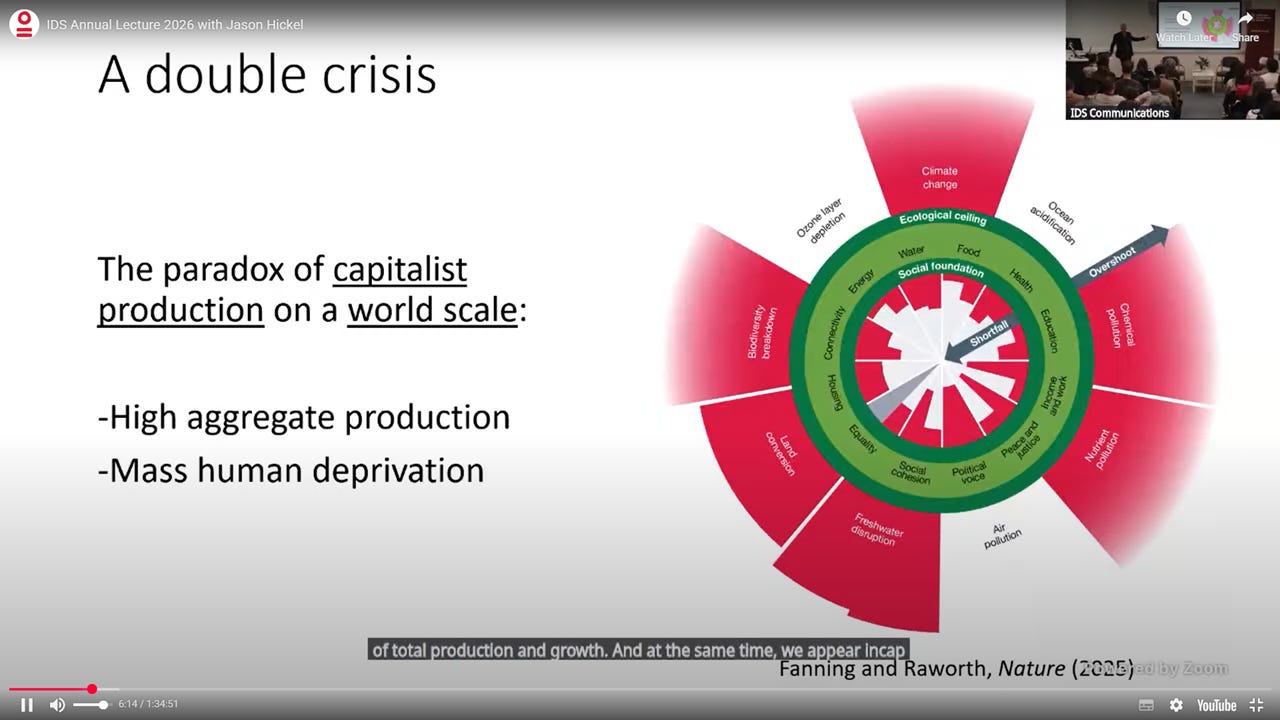
Most production occurs in global south but is controlled by the north via a massive appropriation of resources, including labour. We now have an excess production of unnecessary stuff coinciding with an insufficient production of necessary stuff.
People and planet sacrificed for plunder and profit.
Global multidimensional deprivation (as measured by the Decent Living Standards metric) is staggering with food insecurity and inadequate access to healthy diets among the worst indices.
Hickel then digs into the history of resistance and the pursuit of sovereign economic and social development. After the landmark Bandung conference of newly independent Asian and African states in 1955, the north – primarily the US and US-controlled organisations – hit back in three ways. Engineered coups, sanctions and structural adjustment programmes were all deployed to keep the south dependent on the north.
What lies behind our teetering food system are not just transnationals and governments. There’s a third layer of control, as Ben Wood and colleagues explore in this insightful paper.
Financial intermediaries that pool money from other investors (e.g. pension funds, insurance companies) into investment funds, which are then invested into a variety of asset classes in the form of shares of companies and corporations.
BlackRock, Vanguard, and State Street – the Big Three in the asset management world - manage close to US$25 trillion in assets, mostly in the form of corporate shares.
$25,000,000,000,000
More than 20% annual global gross domestic growth in the hands of 3 organisations.
In 2024, the Big Three held more than 20% of shares in 14 of the 40 largest corporations in health-harming commodity industries. Immense power…which they use to drive profit at any cost. Not one of 41 identified shareholder proposals relating to public health and other social and environment issues were successful – though seven of these may have succeeded if they had received the support of the Big Three.
Then there’s the ESG investment portfolios which are supposed to be…well, ESG…driven by environmental, social and governance concerns. With the Big Three though, this is a bit of a game. ESG-washing.
Nearly 40% ESG funds marketed by the Big Three included at least one leading corporation from harmful industries. Vanguard’s ‘Ethically Conscious International Shares Index Fund’, for example, included Coca-Cola and McDonald’s, two of the world’s biggest plastic polluters and no strangers to violations of other labour, human rights and environmental protection norms.
This op-ed in the New York Times uses a different word:
‘Financialization is a grift, a rarified form of bookmaking, of no net value to workers and consumers, the economy, or society as a whole. Let’s treat it accordingly. Economists and the news media can stop using the word “invest” in contexts where no investing occurs. “Speculate” or “bet” will do just fine.’
‘We live in capitalism. Its power seems inescapable. So did the divine right of kings. Any human power can be resisted and changed by human beings.’
[Ursula Le Guin, quoted by Grace Blakeley]
There are multiple examples through history of ‘intractable problems’ that we’re not supposed to be able to do anything about – like feudalism, slavery, women barred from voting, child labour. Centuries of coal-fired pollution in The Big Smoke (London) were seen as an inevitable consequence of industrialisation, back in the day.
Vultures thrive on apathy and hopelessness and a default setting of ‘it is what it is, it ain’t gonna change.’
So, the first thing is to ditch the doom and use our power.
In a recent post, Blakeley speaks of the power of imagination
‘The world-enders want us to spend all our energy worrying about the apocalypse. Imagining what a new world might look like – even if only in our own neighbourhoods – is a form of resistance.’
The escape from corporate capture requires the democratisation of our society by redistributing political and economic power.
As I wrote in Food Fight (p215), governments have three levers to address excessive corporate power:
Dispersion – the decentralisation and redistribution of concentrated corporate wealth and power using antitrust (competition law) to prevent and break up monopolies.
Democratisation in which corporate decision-makers are compelled to take into account the interests of all actors (e.g. via diverse stakeholder representation on corporate boards).
And third, if all else fails, dissolution – the complete revocation of privileges, if and when corporations fail to disperse or democratise.
Breaking up is not hard to do — it’s a political decision, that can be made by any government with teeth.
Here’s Hickel and Varoufakis in a recent piece:
‘The solution is staring us in the face. We urgently need to overcome the capitalist law of value and democratise our economy, so that we can organise production around urgent social and ecological priorities. After all, we are the producers of the goods, the services, the technologies. It is our labour and our planet’s resources that are at stake. And so we must claim the right to decide what is produced, how, and for what purpose.’
From a global ecological perspective, Hickel argues in his IDS lecture, this is about reclaiming and reorganizing productive capacities in the South and delinking from exploitation by the Northern. It’s about ‘a new law of value.’
No magic bullets and it won’t happen overnight, but there are levers to pull.
To deal with the Big Three and other aspirants in our financialised world, Woods argues for fiduciary duties to be established to ensure that private financial entities explicitly and systematically consider the impacts of their portfolios on the welfare of communities and the environment. Rules could also be put in place to ban financial intermediaries from voting unless under instruction from the ultimate investor.
The Guardian’s George Monbiot:
‘We know what needs to happen: break up the big corporations; bring the system under proper regulatory control; diversify our diets and their means of production; reduce our dependence on a handful of major exporting countries; build strategic food reserves, accessible to people everywhere. But there’s a problem, and it’s not just Trump. Almost all governments are beholden to corporate and financial power.’
Finally…for now, at least…there’s the local level. Here, there’s huge potential (and big challenges) in building alternative food systems from the ground up that reflect different values. Henry Leveson-Gower and Dil Green explore this in Taking the Die out of Diet where they propose a set of tools to escape the tyranny of Big Food.
‘The shift away from purely capitalist relationships in food is not an abstract ideal, but a practical, ongoing process’
I’ll return to the question ‘Are we transforming?’ in a later post…
The epitome of corporate food system capture is a tube of Pringles or an ultra-processed snack bar, wrapped in plastic, emblazoned with health claims and an unreadable list of ingredients, that’s available any time, any place.
Which brings us to the Ultra-Processed Food Policy Forum held on 24 March at Imperial Business School in London.
It was a lively meeting, full of great visuals, punchy summaries and updates of new findings, new opportunities, new directions. I was really pleased the organisers had invited Austin Frerick to highlight corporate capture, drawing on his mindblowing book Barons.
Here’s the summary report and video.
The forum started with an update on the evidence by Carlos Monteiro who succinctly addressed criticisms of UPF research, shooting down the ‘healthy UPF’ argument. We shouldn’t waste our time comparing one product against another, when what’s really driving harms is an aggregate dietary pattern in which there has been a near-wholesale replacement of minimally processed foods by UPFs. When what’s really driving harm is an entire system that has been, and continues to be, progressively tilted away from people and planet towards profit at all costs.
Monteiro concluded with a call for global action to reverse UPF production and consumption. Of course, research (especially on mechanisms) should continue but there’s no reason to wait for policy action.
As expected, the industry backlash didn’t take long.
Here’s one critique by the British Nutrition Foundation, an organisation that believes it’s perfectly fine to dismiss science on UPFs while happily taking funds from world-famous UPF manufacturers like Coca-Cola, PepsiCo, Nestle, Kelloggs, Tate and Lyle, Ferrero, Mars, Mondelez.
Such industry-funded counter-attacks have a long history, reaching right back to the middle of the last century when Big Tobacco realized its days were numbered. It could no longer hope to beat the science, so the next best thing was to buy it.
Even now, we still hear phrases like ‘the big debate about UPFs.’
What debate is this, I wonder?
Invoking ‘the big debate’ seems like another delaying tactic. The evidence is in, it’s clear. The real debate is why some are still calling it a debate (and who’s paying them)?
The proof behind this statement clinched last week’s verdict against Meta and Google.
At the UPF Policy Forum, the day before, Ashley Gearhardt spoke powerfully (and disturbingly) of another form of addiction – to ultra-processed foods.
Addiction is not about where something comes from...it’s about how a product is engineered. So, how do you engineer it? With four levers:
Dose - pack in more of the reinforcing agent
Speed (of the hit)
Sensory - engineer flavours that keep you coming back
Ubiquity - make it available everywhere, always
Big Tobacco successfully took a non-addictive plant, engineered nicotine delivery, optimised dose, speed, flavour and ubiquity to develop one of history’s most addictive products. Big Food then took a few basic ingredients and engineered ultra-processed products, applying the same principles, sometimes the same industrial techniques, to generate the global public health crisis we’re currently enmeshed in.
I wonder how the UPF industry is taking the recent verdict on Meta and Google?
This episode of Ways to Change the World where Krishnan Guru-Murthy speaks to Eric Schlosser (of Fast Food Nation renown) about the hidden economics of food, the political power of the industry and what meaningful reform of the food system might look like.
A Quick Bites webinar where Tim Lang discusses food system resilience with Anna Taylor, and the urgent need for a Good Food Bill in the UK.
A new paper by the Consortium of the Center to End Corporate Harm at the University of California, San Francisco on using internal industry documents to craft counter-strategies to corporate vectors of chronic disease.
A position statement by the Association of Directors of Public Health in the UK on the commercial determinants of health, on corporate tactics to dodge, delay or dilute government policy to rein in their power, and how to respond.
A fascinating new analysis of the legal status of a right to nutrition in Zambia by Kaaba and colleagues
A news release on Norway being one of the first countries to implement the WHO recommendation to ban the marketing of unhealthy foods and drinks to children. Regulations apply to traditional and digital advertising, covering sponsorship, influencer marketing, product placement and indirect branding.
All for now…see you in April!
Comments
Nothing yet. Say the first thing.
Sign in to join the conversation.