
Five hundred top public health, food and nutrition scientists and activists, in just two weeks, have signed an open letter to the UNU Institute for Water, Environment and Health (UNU-INWEH) calling for an immediate reversal of its decision to partner with Nestlé.
It was featured in today’s Lancet.
As readers of this and any other food or health newsletter know, Nestlé has a long and deep history of unethical marketing of infant formula. A history that led to another UN agency, the WHO, establishing the International Code of Marketing of Breast-milk Substitutes in 1981.
It also has a well-honed set of tactics and tricks to infiltrate policy and derail, dilute or delay public health regulation.
There’s also a deep irony, given Nestlé’s history of sucking out groundwater from drought-hit communities around the world (with its former Chair stating that water was not a human right.)
Five months ago, I wrote about the amazing ‘power map’ in Paper 3 in The Lancet Series on UPFs.
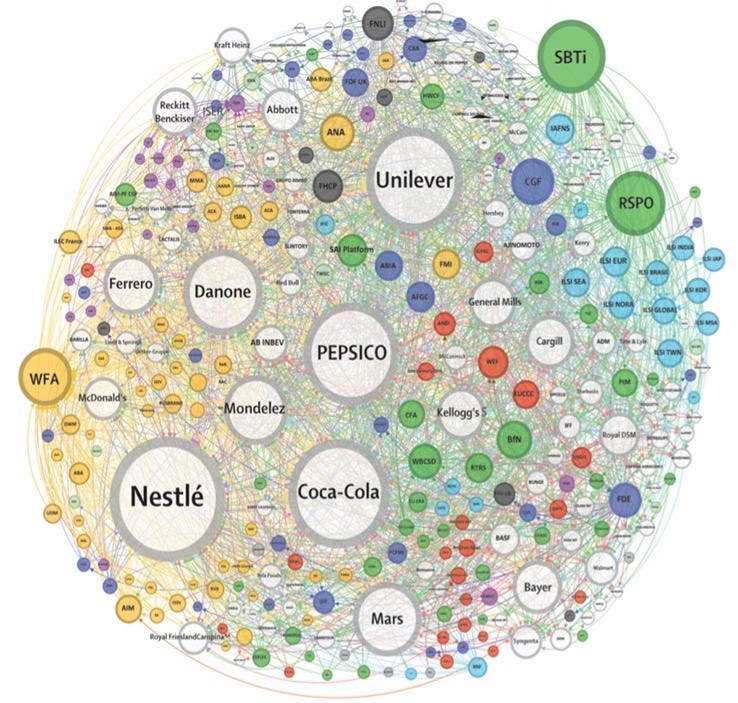
The map shows the interest group memberships of corporations, the largest of which, Nestlé, is a member of 137 of the 207 groups around the world.
I’m just going to drop that segment in here again, slightly abridged:
Nestlé is the world’s biggest food company with a long history – expanding from 80 factories in the 1920s to 340 factories across 76 countries in 2023, supported by 24 research and development centres serving 188 markets.
Let’s take a look at what it’s been up to in recent months.
A recent Public Eye investigation into sugar-boosted Nestlé products being sold in Africa found that 90% of 100 Cerelac samples in 20 countries in Africa contained added sugar. Similar products in global-northern countries contain no added sugar.
Here’s a recent paper on Nestlé and commercial determinants of infant health in Africa.
Nestlé sponsored the Africa Food Prize, an initiative of the Alliance for a Green Revolution in Africa.
Nestlé has supported the African Research Universities Alliance (ARUA) Centre of Excellence in Sustainable Food Systems, funding research on food and nutrition as well as hosting and mentoring postgraduate student
Nestlé co-funds an astroturf group (a fake grassroots organization) called ‘Americans for Ingredient Transparency’ whose goal is to lobby the US Congress to override new state laws, like California’s AB1264, which will ban the unhealthiest ultraprocessed foods from school meals.
Nestlé and Tufts University launched a new partnership last year.
Going global
Any response to corporate capture of markets and politics has to be global – just like the problem and the industry.
UN agencies have a big role to play – in developing technical guidance, integrating UPF-based metrics into surveillance systems and establishing global and national targets on reducing the dietary share of UPFs.
Paper 3 makes the case for an international policy framework – like a WHO convention – to empower national government regulators. UN human rights bodies could interpret treaty provisions in relation to UPF-related harms. Though the Lancet Series focused on human health, there are huge implications of our UPF-dominated food systems for unfolding biodiversity, plastics, and climate crises.
So how is the United Nations responding?
Is it actually united?
Well, the overarching UN Business Compact is limited. Why does it not include health in its list of criteria (along with human rights, labour, environment, anti-corruption, terrorism, crime, arms, pornography, gambling, tobacco)?
UN agency positions also differ.
UNICEF and WHO do not engage with Nestlé but UN Women, UNESCO do.
FAO’s guidelines contain exclusionary criteria including: ‘manufacturers of sugar-sweetened beverages and/or high in fat, sodium, and/or sugar foods’ but it’s not clear whether this precludes sharing platforms at policy conferences.
The Consultative Group on International Agricultural Research (CGIAR) is not immune – the Chair of its Board was a Board member of Nestlé for her full term.
UNICEF’s position – like that of Nutrition International – is unequivocal. Two beacons of light, highlighted here.
*
That was five months ago...
Another common feature of corporate reputation-laundering is the response when questioned.
In that there is none…just silence.
It was the same with UNU-INWEH and Nestlé…no comment.
Roger Mathisen puts it well:
This is a failure of institutional leadership. UNU has talented staff doing important work. They did not make this bad decision, but they will carry its consequences. Their research will face harder scrutiny. Their credibility will be harder to defend. That is the cost of a decision made above them…The way forward is straightforward. End the partnership. Strengthen due diligence frameworks. And recommit to the independence that gives UN institutions their value in the first place.
Of course, it’s not just Nestlé (…though they do seem to have a thing about the UN at the moment.)

The now-cancelled PAHO–Ferrero partnership is another case in point, as highlighted by Simon Barquera and colleagues.
In the context of financial cuts and rampaging authoritarianism, global nutrition and health governance is in jeopardy.
Like the UN Global Compact, WHO’s Framework of Engagement with Non-State Actors (FENSA) doesn’t go far enough – lacking clarity on engagement with UPF corporations.
The paper outlines a simple set of guardrails:
Exclusion criteria for partnerships with companies that undermine public health
Mandatory, transparent due diligence on corporate political practices and conflicts of interest
Public registries of all multilateral public-private partnerships and financial relationships
Independent oversight mechanisms to review and monitor engagements
Reduced reliance on corporate funding through strengthened public and pooled financing
Without this, how can the UN stay true to its founding principles?
In sharp contrast, it’s interesting to note how a separate UNU institute – the International Institute for Global Health is doing some great work on corporate accountability, as highlighted in an earlier post.
Which begs the same question…why isn’t there a joined-up approach?
Four candidates for UN Secretary General have this week been involved in dialogues. Among the myriad challenges confronting the winner, come 1 January 2027, strengthening governance and unity is surely non-negotiable.
The other week I attended a lively screening and panel discussion of the National Emergency Briefing, organised by my local Lewes Climate Hub.
If you haven’t seen the film, you should…basically. It doesn’t pull its punches, but crucially there’s enough on how to turn things around.
One of many great quotes, this from Hugh Montgomery: ‘you can’t confront an emergency with talk and homeopathy’
What’s the damage?
This is not new, but worth reiterating every now and again….
Every year, the global food system generates around $15 trillion in hidden costs, or >$41 billion/day. More than it contributes to the world economy.
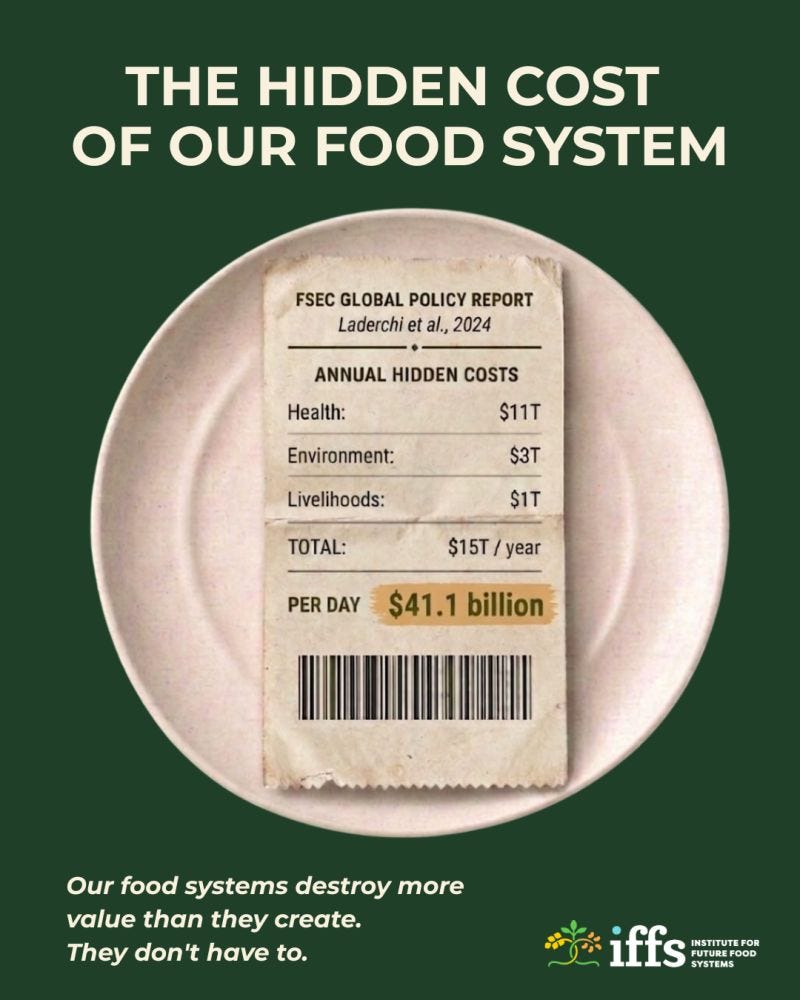
That’s $1.7 billion per hour, day and night, $28.5 million per minute or $475,000 per second. Choose your stat...
Check this excellent new review on the bidirectional effects of global food production on the environment. A few headlines:
First, from food systems —> climate crisis
Business-as-usual food emissions could breach the 1.5 °C, and even 2 °C, target on their own
52% of global irrigation is deemed unsustainable.
33% of soils are moderately-to-highly degraded.
Agriculture drives >90% of tropical deforestation.
Second, from climate crisis —> food systems
Under high-emissions pathway, the share of cattle exposed to dangerous heat jumps from 7% today to 48% by 2100.
Maize, soy, rice, wheat, cassava, sorghum projected to lose 5.5 × 10¹⁴ kcal/yr for every 1 °C of warming by 2100.
>90% of blue food production is vulnerable to anthropogenic environmental stress.
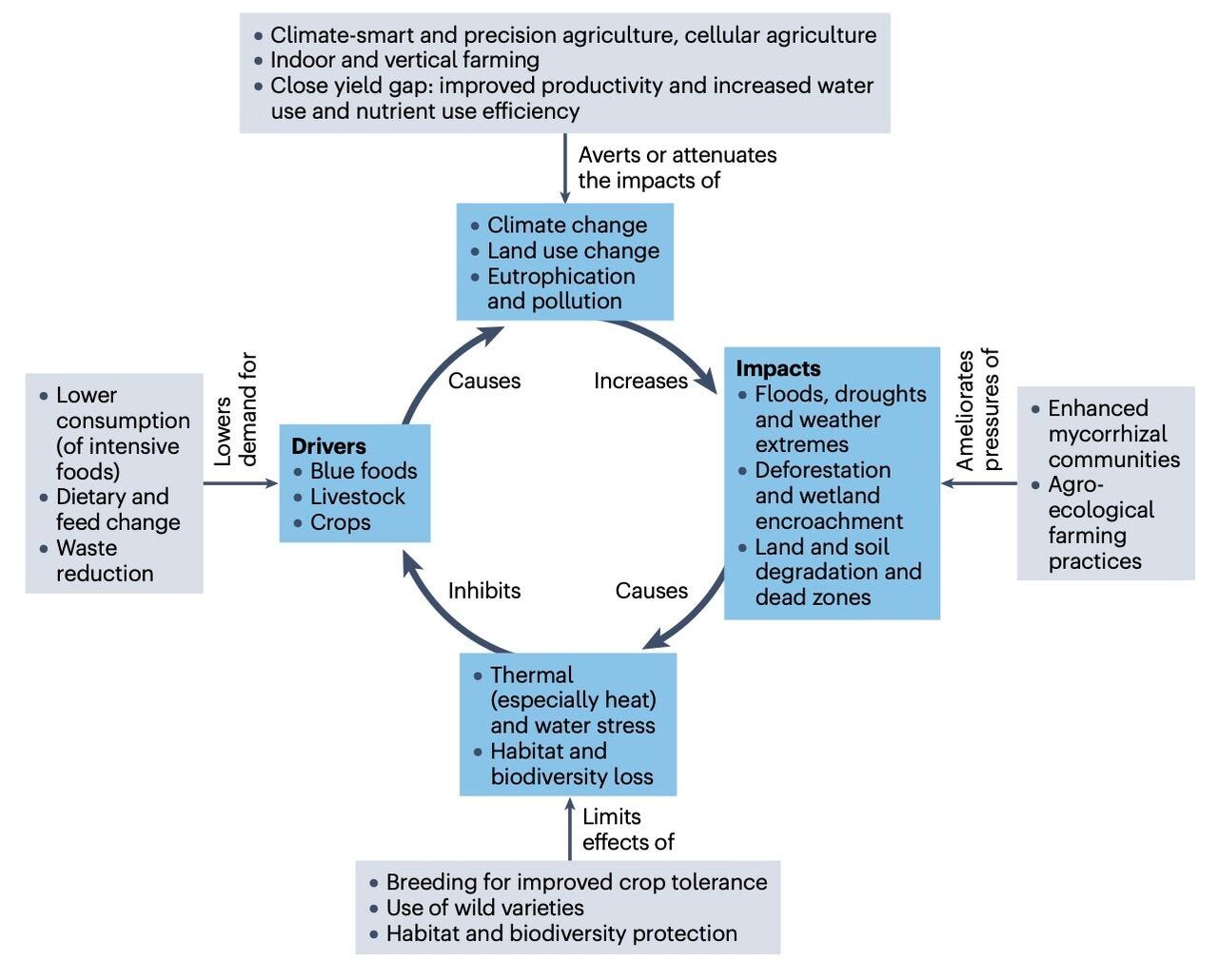
Options to respond:
Plant-sourced foods deliver calories with a slope 8× steeper than animal-sourced foods on the calorie-per-environmental-pressure curve.
Alternative proteins could cut GHG emissions by 88% and land use by 82%.
In Europe, a circular food system could cut per-capita land use by 71% and GHGs by 29%, while still feeding everyone.
Supply-side fixes need to be paired with demand-side shifts (dietary change, waste reduction).
‘It shouldn’t take a war for Britain to wake up to the need for food security’
Great article by Tim Lang in The Guardian, outlining 7 priorities for the UK to address food insecurity: i) politicians need to get real (we need more short, diversified chains, with incentives to primary producers to grow food domestically), ii) apply defence-strategy thinking, iii) regionalise food production, iv) address food inequality (social cohesion is preparedness), v) develop nutrition guidelines for resilience (incl planning what modern food rationing would look like), vi) rethink national and regional storage (incl. new powers to local authorities and mayors to ramp up public engagement) and vii) increase numbers of allotments (+ gardening organisations to help (re)skill consumers).
Lots of activity on school meals in the UK with deep-fried food to be banned and high-sugar items restricted in schools in England. The biggest challenge to fund this - which govt should help with - will be for smaller schools. More in this Food Foundation pod.
UPFs and plastic. Excellent paper by Rob Ralston et al on the embedded links between ultra-processed foods and the global plastic pollution crisis
Another on ‘cooking, gender, and ultra-processed foods: toward a public valorization of culinary knowledge’ by Patricia Jaime and Murilo Braga – pointing to the imperative for gender inequalities in food and care to be confronted in any food systems transformation. Brazil’s National School Feeding Program and solidarity kitchens show how cooking can and should be viewed as a public good.
And finally, huge congratulations to Sofía Monsalve Suárez on her appointment by the UN Human Rights Council as Special Rapporteur on the Right to Food.
See you next month!
Comments
Nothing yet. Say the first thing.
Sign in to join the conversation.