
Bit late with this…
I’ve been travelling, picking up a nasty virus before tearing a calf muscle while over-doing a run to celebrate recovering from said virus, etc…
But here are some eye-catching items that have risen to the surface:
First up was an essay in the New York Times by Jan Dutkiewicz and Gabriel Rosenberg. The headline (‘We Shouldn’t Want to Eat Like Our Great-Great-Grandparents’) and accompanying photo caption (‘Ultraprocessed, Industrial Food is Fine’) unfortunately set me off on the wrong foot. I wasn’t the only one.
I mean…how many more straw men and false binaries do we have to confront? Of course it’s meant to provoke, but this constant parade of ‘either/ors’ is getting a tad tedious.
Straw man/false binary number one:
Choose either to eat like your great-great-grandparents / chase a fantasy of Edenic premodern food…or choose the industrial food model.
What’s it to be?
I haven’t read the book Feed the People!: Why Industrial Food Is Good and How To Make It Even Better yet. It’s just come out and isn’t on sale in the UK (for some reason shipping from the US will take months!)
However, despite one of the authors telling me to ‘read the book or shut up,’ I feel (like 400+ in the NYT comments section alone) the need to say something about the essay itself.
The first chapter of the book has also been shared here. Here’s a quote from it:
‘Most food writers suggest that the modern food system needs to be discarded and replaced with one where consumers search for locally sourced, labor-intensive, and cooked-from-scratch options, supporting the small, alternative, and artisanal purveyors who represent a pastoral ideal of sustainable food.’
I wonder who these folk are? The vast majority of people I’ve run into, after far too long in this food world, fall into neither of these two camps.
A few more lines (and my thoughts) from the NYT essay:
‘Food that is local, organic and low-tech is vastly more expensive than food grown through conventional methods.’
Indeed, these are the conventional methods that have locked in an industrial system that sucks up huge upstream subsidies and generates more damage than value.
‘Many Americans simply don’t want to or don’t have time to cook all their foods from scratch.’
Agree…and it’s not just Americans. There are other ways to shape a food system to support access and affordability to diets that are healthy, sustainable...AND convenient.
‘Consumers should make better choices when they can and eat less of the obvious junk.’
A helluva lot of heavy lifting is being done by ‘when they can’ in this line.
Where’s purpose in all this, I wonder? The current ‘industrial model’ is driven by its core purpose…like most things are. Which is to maximise profit. The most profitable products are the most processed and the least healthy, for ourselves and the world we live in. We don’t need to debate this, we know it.
Apart from the FSEC global work and FFCC’s UK work on the downstream damage of this lumbering monolith, we have many hundreds of studies (including four out of four gold-standard RCTs) which show the harms generated by diets in which a high proportion of calories derive from its main output – ultra-processed foods.
To be fair to the authors, they seem to recognize this too.
As this FT review states
‘Belying Feed the People’s “why industrial food is good” subtitle, [it] catalogues a very long list of existential threats its production methods pose to the planet.’
So, to argue that everything is basically fine, we need to just tweak the system is, to my mind, deeply flawed. It will still be a system driven by the same purpose. If we want to improve our diets, our health, our planet – don’t we need a radical overhaul?
No return to a mythical Garden of Eden or to whatever ‘food system’ my great-great-grandparents relied on….we need to look to the future and forge a new food system that nourishes our grandchildren and their children.
Different purpose, different system, different outcomes.
Of course, it won’t happen overnight…but that’s another story.
More on framing and narratives from a recent paper by Leandro Rezende et al.
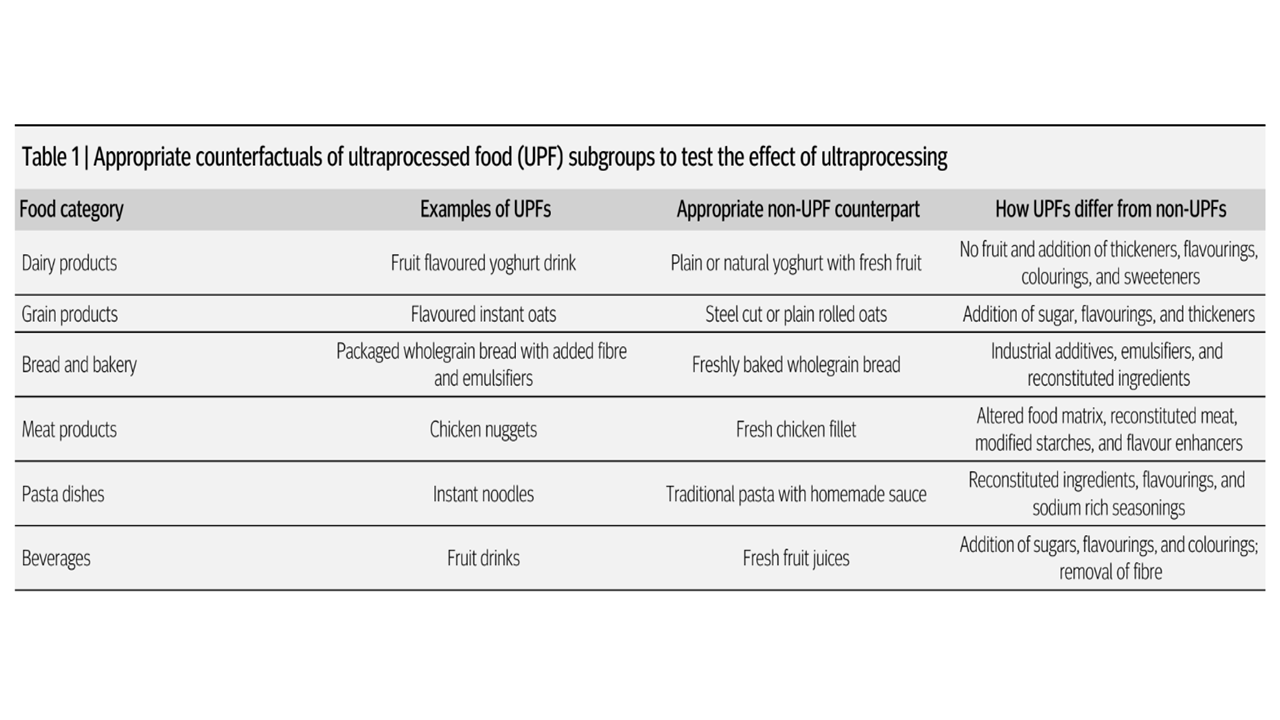
They argue that asking whether certain ultraprocessed foods subgroups are more harmful than others requires a proper counterfactual to test the effect of ultraprocessing. The real question is whether the health effects differ between the same food in its ultraprocessed and less processed forms (see table below).
Or not…
Check this interview with RFK Jr.
If you’d rather not, just read this quote from him, which pretty much captures it:
‘I’m not saying that we’re going to regulate ultraprocessed food…Our job is to make sure that everybody understands what they’re getting, to have an informed public.’
As expected, MAGA trumps MAHA
For updates on MAHA, I would heartily recommend Helena Bottemiller Evich’s Food Fix and Marion Nestle’s Food Politics.
Interesting piece by Eduardo Porter in The Guardian. If AI makes human labor obsolete, who decides who gets to eat?
‘If artificial intelligence grows as powerful as Silicon Valley’s oligarchs expect it to become, the only available strategy to keep us all fed in the world after work might be to go hat in hand and ask the moguls, politely.’
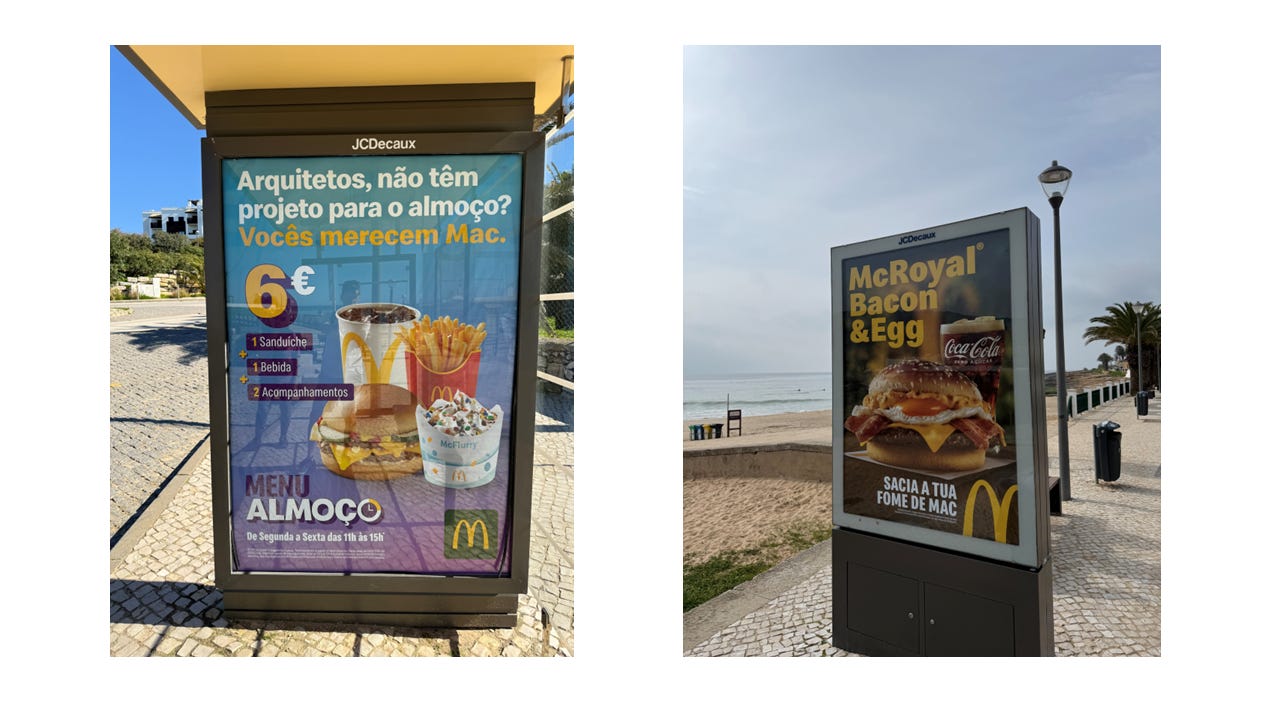
Last week, I was in Portugal – a country that has resisted predatory fast food marketing more than most European countries.
Which is why pretty much every bus stop I came across looked like this:
Treatment with GLP-1 drugs must not replace obesity prevention in low and middle income countries argue Kent Buse, Angela Carriedo and Simon Barquera in the BMJ.
The big risk of GLP-1 drugs for healthcare systems in lower-income countries is the political economy of their introduction – the risk that rollout of the drugs will entrench a ‘treatment first’ paradigm. Prevention has always been vulnerable to delay, dilution or defunding compared to medical treatments. Inequity in access remains a huge issue.
The authors propose a five-point agenda:
Public coverage of GLP-1s conditional on a minimum prevention policy package.
Ringfenced prevention funding floors established within NCD budgets.
Revenues from soda/junk food taxes earmarked for prevention and primary care.
Transparency and spending controls for GLP-1 drug procurement.
Firewalls against commercial interference established and information published.
Another great read on GLP1s comes from Nick Easen on Wicked Leeks, exploring their impact on what we eat and grow.
Here’s a really useful paper on the process of developing a conflict of interest policy. Ten years ago, at IFPRI we revised our institutional policy for engaging with the private sector. I know both how important this is and how it’s easier said than done!
But it’s critical, especially for multi-partner consortia (which is pretty much every new initiative). Which is why such guidance is great to see. A few years ago, there was the FoRK toolkit that addressed this too.
This new paper by Amber van den Akker and colleagues reminds us that CoI disclosure is simply not enough. A reflective case study approach was used to document the development and implementation of a COI policy. Embedding CoI policies in complex collaborations supports more robust research governance and helps safeguard the integrity of public health research.
Promising news from the UK where The Food Foundation, Sustain and Green Alliance have corralled more than 100 organisations (including supermarkets, food businesses and investors) to call for the introduction of a Good Food Bill.
This follows polling that shows:
69% of people think the government should be doing more to ensure everyone can afford and access healthy food
65% of people support a ‘Food Bill’ that would introduce duties and targets on government bodies to make healthy food more accessible and affordable
Big step forward….
Being a huge fan of Thin Lei Win and her lively newsletter, I was thrilled and honoured to be invited to discuss my book with her: A Food Fight Worth Having
Thin Ink is now five years old – there have been so many great posts…take a look here.
It was a wide-ranging chat. We discussed corporate capture and why we need to focus on purpose, power and governance in any discussions of change or transformation.
Thin started by asking me to choose three pivotal books from the last century. There have been many, but the one that always springs to mind first was pretty much the very first one I read on the ‘real reasons for world hunger’ back in 1976.
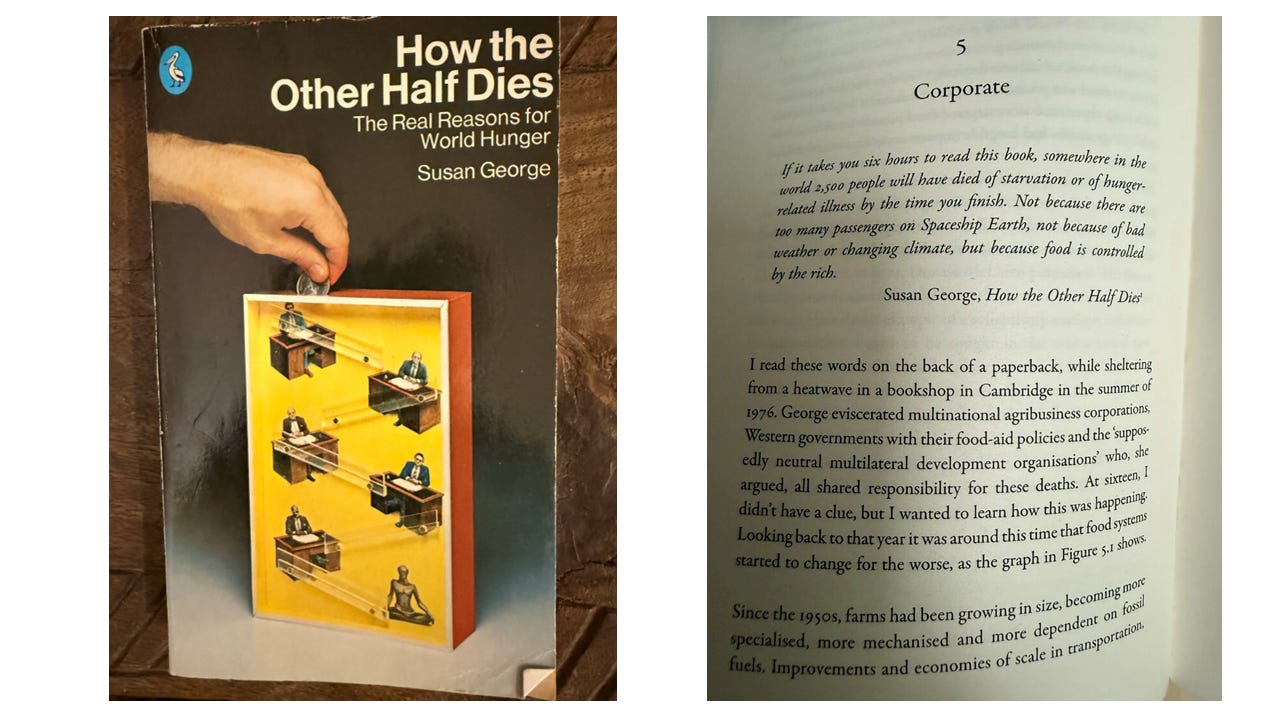
As we were discussing Susan George’s epic How the Other Half Dies, the news came through that she had just passed away, aged 91. She was a huge inspiration for me and for thousands of others. That book – which grew out of work for a counter-report to the historic World Food Conference of 1974 – changed my life.
In last month’s Food Fight Files, I linked to the re-issue of another seminal book: Fast Food Nation
A day later, the FT reported that fast food sales in the US are slumping ‘as the model breaks under the weight of labour shortages, beef price spikes, climate impacts, and falling real wages.’
I just noticed that the brilliant Raj Patel is on this platform now…which is great and a little daunting too, as everyone will have to up their game!
Errol Schweizer (‘The Grocery Nerd’) has been on for some time…championing access and affordability of healthy, sustainable foods in multiple pithy posts.
Raj and Errol are both members of IPES-Food which has just celebrated its 10th year!
Substack has its critics…but then so do most other platforms and outlets…
A recent Conversation piece posits a downward spiral in academic publishing. Growing commodification of research is shifting value from merit to marketability, as pay-to-publish journals proliferate. Quality declines as profit-driven models compromise peer review and oversight. With so many publications – including fraudulent journals spreading hoax papers and pirated content – it’s harder to identify authoritative work. Academics are stuck, the authors argue, as there’s a lack of credible alternatives.
‘Countering this trend demands interventions and the creation of alternatives. These include a reassessment of evaluation metrics, a reduced reliance on commercial publishers, and greater global equity in research.’
Food Fight is out in paperback on 9 April (with a new green cover!) This will be followed by an ‘in conversation’ event with D’Arcy Williams, CEO of Bite Back 2030 in Spitalfields, London on 16 April (more on this later).
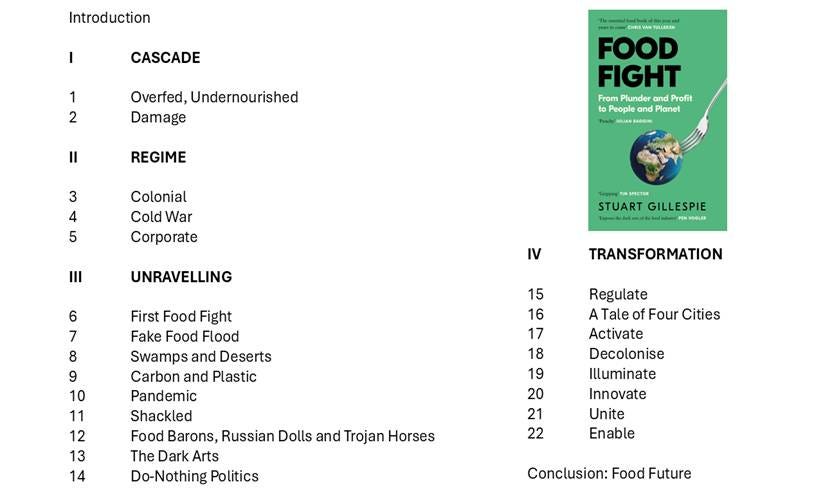
I have a few author copies available. If you’re interested, a student of food, nutrition or health, an NGO worker or activist and you’re in the UK, email me.
All for now…see you in a few weeks!
Comments
Nothing yet. Say the first thing.
Sign in to join the conversation.