
“Reality is that which, when you stop believing in it, doesn’t go away.” – Philip K. Dick
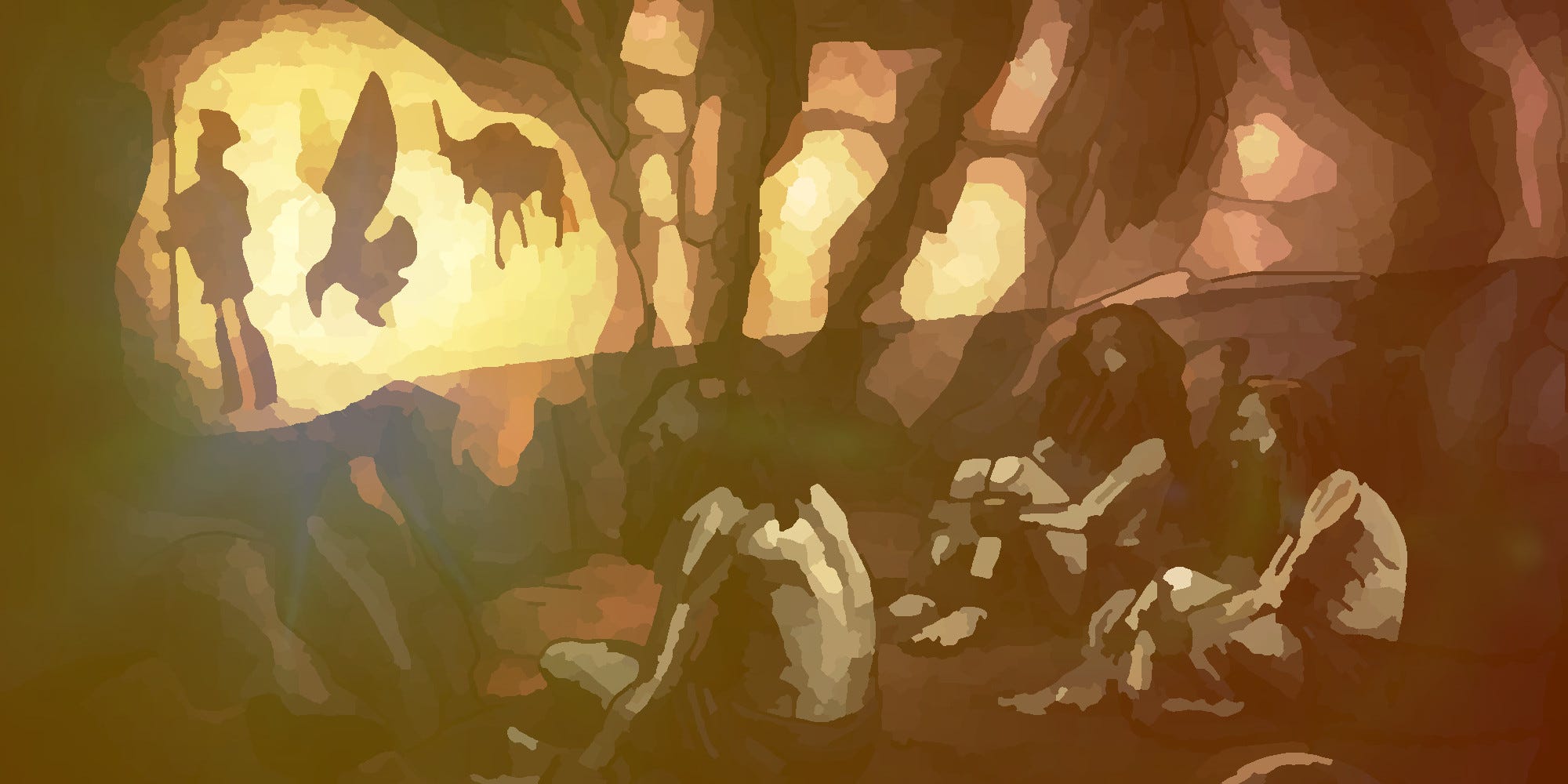
We all know what reality is, or at least, we are all adamant that we understand what is meant by reality. Reality is the domain of the real, the stuff that behaves predictably, the world ‘out there’ that we experience only indirectly through our senses. How curious it is, then, that this image of a real world ‘out there’ descends directly from Plato’s allegory of the cave, where the people in the cave treat the flickering shadows on the walls as what is real, and only the philosopher who escapes the cave knows the real existence of a world above, illuminated by the sun.
If our sense of what is real depends upon a metaphor that is two and a half millennia old, and if what people have believed was real has changed radically over that interval, why are we so wildly confident that we understand what reality is? We might equivalently ask: what did people consider reality to be prior to Plato’s allegory of the cave? You do not have to spend a great deal of time thinking about this topic to be forced into confronting the unreality of reality, the sense in which our certainty that we know ‘what reality is’ lacks both honesty and depth.
Faith in the real is universal. What constitutes the real is anything but. In 1826, a mere two centuries ago, aspects of reality included light traversing a luminiferous ether, flammable objects containing phlogiston, continents as immobile features of our planet, and a universe that was eternal and unchanging. Not one of these things constitutes reality today. Yet despite these evident and recurring revisions of the real, the vast majority of people today still stubbornly insist in presuming that ‘scientific truth’ (itself an ill-defined concept) provides the indisputable benchmark of reality.
The boondoggle that allows us to defend these preposterously untenable beliefs about the real runs something like this. My sense impressions and experiences are subjective encounters with the objective and real world ‘out there’. My subjective life is not real, but it is conditioned by the objectively real. It doesn’t matter that scientific beliefs change over time, because at any given time that specific collection of beliefs provides the best available models for understanding the objective world.
Now pause and consider this chain of reasoning carefully, for it conceals numerous dependencies and assumptions. It assumes for a start that ‘scientific beliefs’ are not tainted by the ‘mere subjective’ that supposedly makes our personal experiences unreliable. It presumes that subjectively modelling the objective world escapes the supposed limitations of subjectivity, even though nothing in this account provides a reason why this should be so. It papers over the ever-changing models that constitute scientific claims (and before that, natural philosophical claims) with the appealing wallpaper of ‘the best available’, thus entirely ignoring that ‘the best available models’ are necessarily elements of our subjectivity, which is precisely why they are liable to change over time.
In 2026 BC, the shared reality for Egyptians was that the Pharoah maintained the cosmic order and the Sun God Ra traversed the sky each day in his chariot renewing creation. In 2026 AD, the shared reality for nearly all of us is that scientists objectively discover the cosmic order. These situations are functionally analogous – each is a metaphysical model purporting to secure an image of what reality is and how it functions. You are free to assert that our contemporary metaphysics are superior... but as beliefs about what can be claimed as ‘real’ drift ever further from replicable empirical practice, there is plenty of evidence that our contemporary metaphysical model of reality is now causing more harm than good.
Reality is little more than the name we give to our unshakeable beliefs. It is not so much the name of a world ‘out there’, we just believe in the world ‘out there’ because we have millennia of habituation into doing so. Any unvarnished examination of what we mean when we say ‘reality’ must confront the inescapable fact that every attempt to stabilise the real by appealing to a higher authority, whether the sciences or the Pharoah, situates the real as little more than our shared habits of thought. Once we acknowledge that the sciences are a collective human framework for establishing what is real, it becomes impossible to deny that reality is always shared.
No posts
Comments
Nothing yet. Say the first thing.
Sign in to join the conversation.