
“The thing‑in‑itself is not a mysterious being behind the appearances, but a limiting concept which marks the direction of the unifying work of knowledge.” – Ernest Cassirer on Kant’s philosophy
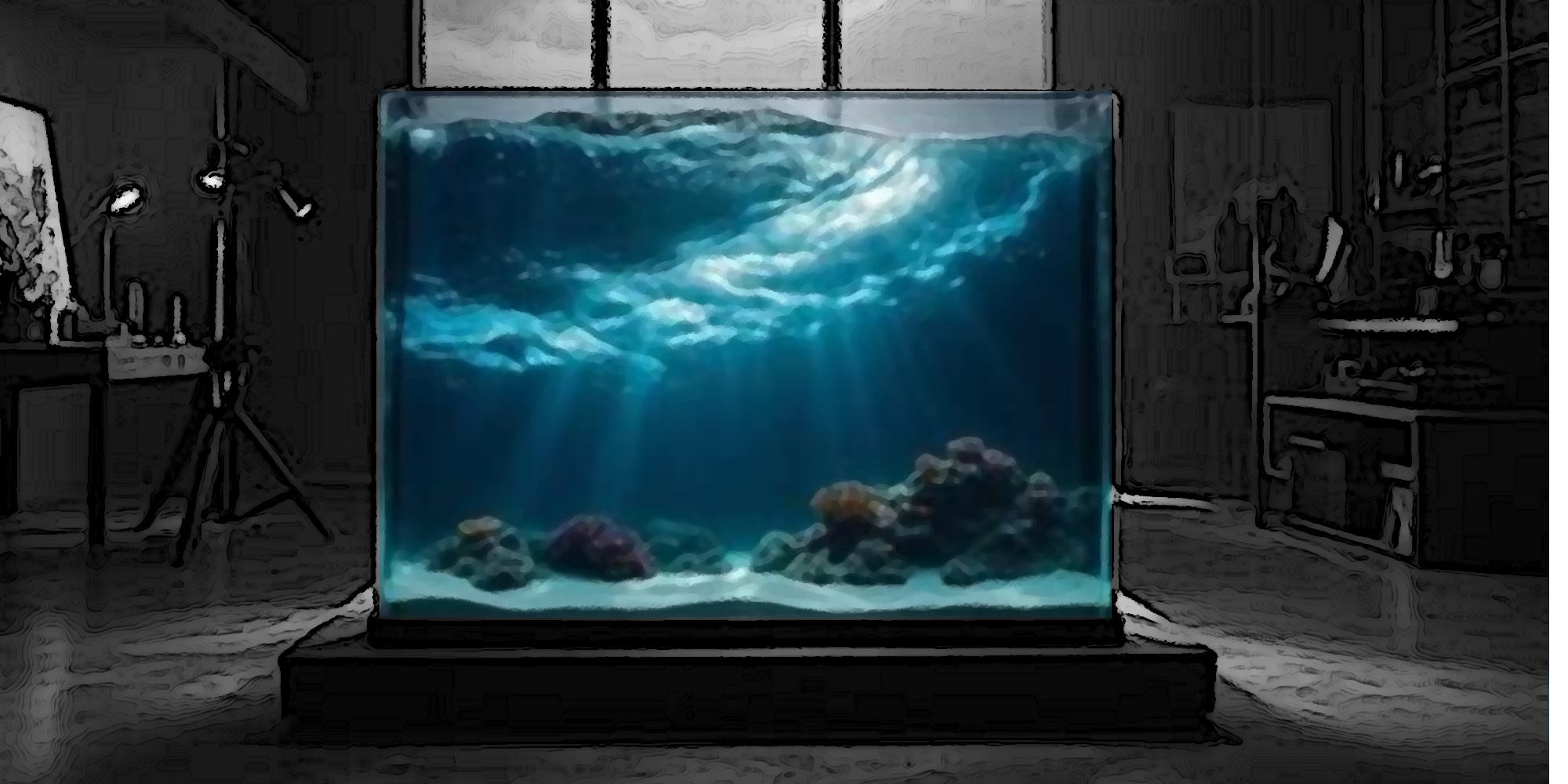
The idea that reality is shared is something that has become alien. It is now taken as a given that the experiences of any one individual are subjective, and consist of sense impressions and mere opinions about them, whereas the true state of a situation is objective, and transcends individual experience. This contrast between subjective and objective is a learned framework, one that cannot plausibly be considered ‘objective’ and yet one which we stubbornly refuse to recognise as ‘subjective’ in its own terms.
Here, in this confrontation with the tangible effects of philosophy upon experienced reality, lies everything required to recognise that reality is a shared endeavour... yet this will almost never go through in one step. The habit is too engrained, the hardening of thought patterns too inflexible. As Ludwig Wittgenstein (vit-gen-shtine). liked to say “a picture held us captive”, and there is no more captivating picture than the contrast between subjective and objective, the assumed grounding principle of scientific investigation. Yet ‘subjective’ is a term we use to describe those others while what is ‘objective’ is something we ourselves have magically acquired for ourselves. We are scientists, you are pseudoscientists, always and forever, for nobody could ever chose the label ‘pseudoscientific’ for themselves!
The trouble with cutting the onion in half to examine it like this is that if all you’ve ever seen is the brown outer skin, the interior looks nothing like an onion! Instead, we might have to patiently peel away one layer at a time, from the wrinkled skin of subjective-objective, to Bertrand Russell’s logical analysis versus sense-data, through the philosophical machinations of Victorian scientists, the pivotal contribution of Kant’s transcendental philosophy, and all the way back to Plato’s cave where we started.
The path between Plato and where we are now, trapped in a picture of ‘the subjective’, passes inevitably though Immanuel Kant’s Critique of Pure Reason, a monumental rethinking of ancient philosophy that was required reading until at least Einstein’s time. After World War II, however, neither Kant nor philosophy were considered ‘necessary’, and if I cannot prove that this in itself might explain the degradation of the sciences since, it is still noteworthy that the breakthroughs in physics happened amidst a generation trained on Kant, and little has progressed since.
It’s not necessarily to fully comprehend Kant’s transcendental philosophy to appreciate how it served as a waystation for where we ended up. The core idea behind his project was to investigate the a priori conditions for knowledge, that is, to work out the qualities of our mental capabilities that constrain our capacity to know. Kant proposed that what we experience must necessarily be shaped by the cognitive structures of our own minds. As such, he drew a Plato-like distinction between appearances (phenomena) and the thing-in-itself (noumena) that remain forever unknown for us.
In the intervening centuries, this distinction between appearances and the thing-in-itself became a “dualism of worlds”, as Ernst Cassirer put the matter, the subjective world of appearances, and the objective world of true objects. But Cassirer understood that this was not Kant’s conception at all: the purpose of drawing the distinction was to make it clear that we do not have access to the thing-in-itself and that it therefore represents a limit case upon what we can know. If you squint, you can see how this decayed into the subjective-objective distinction, largely by throwing out Kant’s key point: if knowledge of the thing-in-itself is what we call ‘objective knowledge’ then we never possess objective knowledge, only subjective knowledge that aims to approximate the objective.
Calling the entirety of the things-in-themselves ‘reality’ would be admitting there is no reality for us. Rather, we live in shared realities, and the thing-in-itself is what the sciences strive to model within our human limitations. Sadly, in the centuries after Kant, philosophy of science squirmed itself free from Kant’s limits to reality by creating excuses to ignore it. Now, we live within a shared reality where billions of people’s experiences are shaped by a faith in objectivity that has finally devolved into simply denying Kant’s insights. The difficulty in accepting this situation is that the picture still holds us captive. It will continue to do so as long as we treat the realm of the scientific as magical rather than methodical.
No posts
Comments
Nothing yet. Say the first thing.
Sign in to join the conversation.