
Thanks for reading! This post is public so feel free to share it.
Members of the All-India Muslim League whose political efforts and vision culminated in the Lahore Resolution of 1940, laying the foundation for the creation of Pakistan.
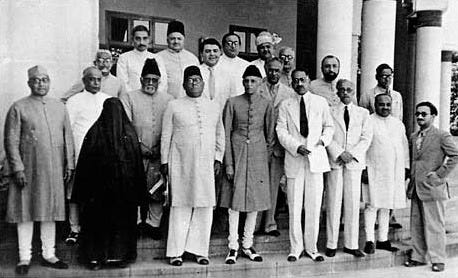
Image: All India Muslim League Working Committee, Lahore, 1940. Source: Wikimedia Commons/Public Domain.
Leaders of the Pakistan Movement gathered following the Lahore Resolution, alongside a modern view of Minar-e-Pakistan, commemorating the historic demand for an independent Muslim homeland.
23rd March, known as Pakistan Resolution Day, is a defining moment in South Asian history, marking the 1940 resolution that envisioned the creation of a future Pakistan. This was a formal political commitment for an independent dominion of Muslim-majority states in which minorities [present in India at that time] including Muslims could live freely and autonomously of state interference.
Muhammad Ali Jinnah, the founding father of the future Pakistani state, repeatedly affirmed that all minorities will be safeguarded against any distinction of religion, caste or creed.
Thus, 23rd March is widely seen as a milestone that precipitated the eventual creation of an independent Pakistan in 1947 and is celebrated annually in Pakistan with national events and patriotic ceremonies.
The Context Behind the Resolution
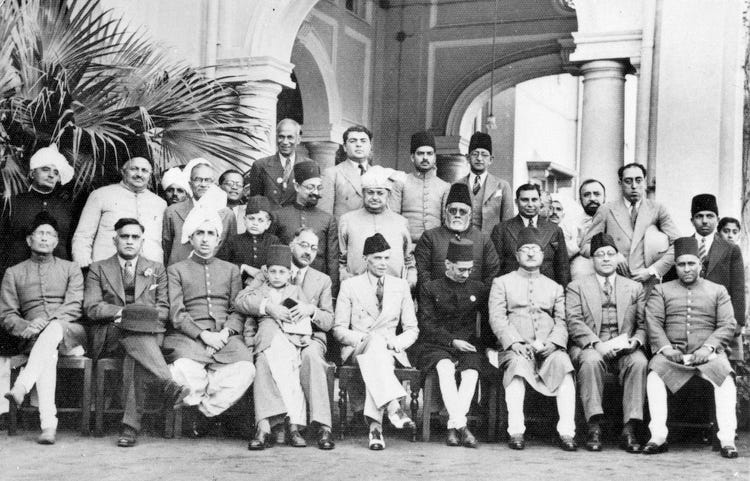
Image: Muslim League leaders in Lahore, 1940. Source: British Library via Wikimedia Commons / Public Domain.
Members of the All-India Muslim League gathered during the Lahore Resolution era, representing the collective leadership and political vision that led to the creation of Pakistan in 1947.
The resolution, adopted in Lahore, was born out of growing concerns that Muslims and other Indian minorities would be politically marginalised in an independent India dominated by a Hindu majority demographic.
India, ruled by the British Raj between 1858-1947, constituted a large Muslim minority of roughly a quarter of the population. However, as independence from Britain approached in the 1930s and 1940s, India’s minorities, led by the All-India Muslim League, became increasingly worried that the nature of the governance system being discussed at that time would result in a permanent Hindu-majority dominance.
The rising popularity of the “Two Nation Theory” proposed that Hindus and Muslims were distinct civilisations, with distinct laws, customs and worldviews, and that co-existence was neither feasible nor practical.
This climate set the stage for Lahore Resolution, which proposed the creation of independent states in the Muslim majority regions in the north-west and eastern parts of India.
This intended to allow both Muslims and all other minorities to self-govern appropriately with freedom, equality and security.
A Movement Built by Many
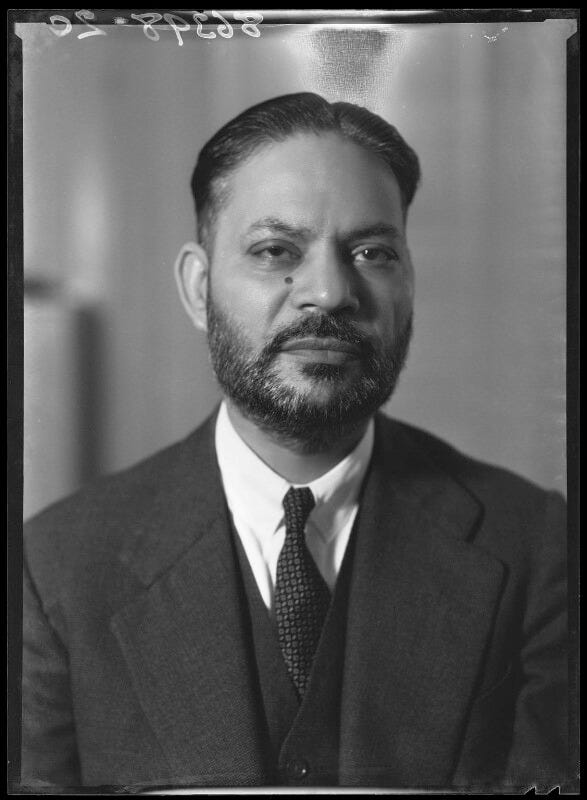
Image: Sir Muhammad Zafrullah Khan, Bassano Ltd, 1939. Source: National Portrait Gallery via Wikimedia Commons.
Sir Chaudhry Zafrullah Khan, diplomat, jurist, and statesman, whose leadership helped shape Pakistan’s constitutional and international identity.
Crucially, support for this future state, later named Pakistan, was spread over many regions and religious communities.
Muslims from both Muslim-majority regions and minority provinces played a major role in mobilising the intellectual leadership, political organisation and fundraising of the All-India Muslim League.
Ultimately various Muslim denominations and communities supported the idea of Pakistan, reflecting the fact that Pakistan was created through mutual co-operation and effort.
Pakistan’s first foreign minister, Muhammad Zafrullah Khan, an Ahmadi Muslim, who later also served as President of the UN General Assembly, played a key role in helping to form the creation of Pakistan, as well as representing the new state on the international stage.
The Pakistan Movement also drew support from diverse Muslim constituencies, including Ahmadi Muslims, Ismaili leaders such as Aga Khan III and many Sunni religious leaders in Punjab.
A More Complex Reality Today
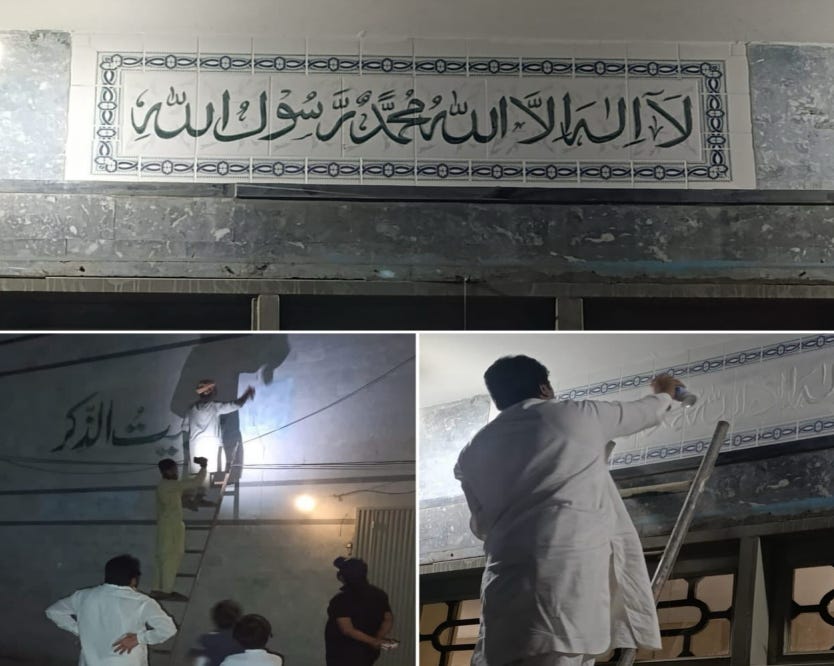
Police Erase Islamic Declaration of Faith on Ahmadi Muslim Mosque in Sheikhupura - Stop The Persecution of Ahmadi Muslims
Yet despite this historical shared commitment, for many of Pakistan’s minority communities today the 23rd March anniversary carries a far more complex and bittersweet meaning.
The erosion of those fundamental rights and the rise of religious intolerance has meant that life today in Pakistan is far from the religious freedom, self-determination and equality for all Pakistanis that was promised back in 1940. Today, many minority communities find themselves ostracised from mainstream society, curtailed in their religious freedoms and restricted in their once-promised rights to self-determine.
Decades of legal and social restrictions have limited their ability to practice their faith freely and participate with dignity in public life.
This dynamic is profoundly illustrated by the case of Atif Mian, a prominent Pakistani-American economist known for his research on the connections between finance and the macro economy. Atif was appointed to Prime Minister Imran Khan’s Economic Advisory Council in 2018.
Despite his burgeoning reputation as a shrewd economist and willingness to serve his country, he was compelled to resign within a week following public backlash and outcry centred solely on his religious beliefs as an Ahmadi Muslim. Legal and social pressures often mutually reinforced, can create a barrier for even the most accomplished professionals from contributing to the country’s national development. Social prejudice therefore is really a form of self-harm, for not only harms individuals; but also it deprives nations of help and critical expertise when it is most needed.
The Ahmadi Muslim Experience
For Ahmadi Muslims, this difference is painfully stark; the 1984 constitutional amendment declared Ahmadis as non-Muslim, while subsequent legislation criminalised essential aspects of their religious identity, including self-identifying as Muslim.
These measures have been accompanied by widespread social discrimination, imprisonment on unchecked blasphemy accusations and violence against Ahmadi Muslims and their mosques and even their graves.
Unsurprisingly, this leaves many Ahmadi Muslims feeling vulnerable in the very country their forefathers helped to build and with which they still have deep bond.
A Profound Paradox
Today’s reality stands in sharp contrast to the vision and ideals that inspired the demand for a separate homeland, a movement rooted in concerns about safeguarding dignity, identity and security.
For Ahmadi Muslims who supported this movement and contributed to the early development of Pakistan, the denial of such rights represents a profound paradox.
A nation once promised as a refuge from marginalisation has gradually become a hotbed of marginalisation itself.

The statement was made by Muhammad Ali Jinnah, the founder of Pakistan, a constitutional lawyer and statesman who led the All-India Muslim League. He became Pakistan’s first Governor-General in August 1947.
This contradiction does not diminish the historical significance of Pakistan Resolution Day but does raise important questions about whether or not the promise of equal citizenship has been fully realised.
A Moment to Reflect
The recent celebrations of Pakistan Resolution Day, mark an opportunity for all to reflect on the values of justice, tolerance and inclusivity that underpinned the spirit of the resolution.
Ensuring that every Pakistani can live without fear and practice their faith freely would be a fitting honour to the memory of the historic Pakistan’s resolution and would help transform this important anniversary into a moment of unity and hope for all Pakistani, regardless of their caste or creed.
Banglapedia, “Lahore Resolution” — for the adoption of the Lahore Resolution, Fazlul Huq’s role, and the wording on Muslim-majority north-western and eastern zones forming “independent states.”
Women Development Department, Government of Punjab, “23rd March – Pakistan Resolution Day” — for Pakistan Resolution Day and its connection to the Lahore Resolution.
National Assembly of Pakistan, “Mr. President (Quaid-e-Azam Mohammad Ali Jinnah)” — for Jinnah’s 11 August 1947 speech and the “You are free…” quotation.
Constitution (Second Amendment) Act, 1974 — for the constitutional declaration concerning Ahmadis.
Refworld, “Pakistan: Ordinance No. XX of 1984, Anti-Islamic Activities of the Quadiani Group, Lahori Group and Ahmadis (Prohibition and Punishment) Ordinance” — for Ordinance XX.
Pakistan Penal Code, Sections 298-B and 298-C — for restrictions on Ahmadis using Islamic terminology, calling their place of worship a “Masjid,” referring to their faith as Islam, or identifying as Muslim.
UK Home Office, Country Policy and Information Note: Ahmadis, Pakistan, March 2025 — for the current legal and social position of Ahmadis in Pakistan.
Amnesty International, “Pakistan: End cyclical harassment and persecution of Ahmadis in Pakistan” — for recent harassment, Eid-related restrictions, detentions and violence against Ahmadis.
Human Rights Watch, “A Conspiracy to Grab the Land: Exploiting Pakistan’s Blasphemy Laws for Blackmail and Profit” — for the wider context of Pakistan’s blasphemy laws and their impact on minority communities.
USCIRF, Pakistan 2025 Annual Report — for recent attacks on Ahmadiyya mosques, religious sites and graves.
Al Jazeera, “Bowing to far-right pressure, Pakistan removes Ahmadi adviser” — for Atif Mian’s removal from the Economic Advisory Council after backlash over his Ahmadi faith.
Dawn, “More embarrassment for govt as second economist resigns from EAC over Atif Mian’s exclusion” — for further reporting on the Atif Mian controversy and its consequences.
Permanent Mission of Pakistan to the United Nations, “Muhammad Zafrullah Khan” — for Sir Muhammad Zafrullah Khan’s role as Pakistan’s first Foreign Minister, UN General Assembly President and ICJ President.
United Nations Digital Library, “Muhammad Zafrullah Khan of Pakistan Elected President of the General Assembly” — for his election as President of the UN General Assembly in 1962.
All India Muslim League Working Committee, Lahore, 1940 — Wikimedia Commons, public domain.
Muslim League leaders after a dinner party, Lahore, 1940 — British Library via Wikimedia Commons, public domain.
Sir Muhammad Zafrullah Khan, Bassano Ltd, 1939 — National Portrait Gallery via Wikimedia Commons.
Pakistan flag image by Hamid Roshaan — Unsplash, free to use under the Unsplash License.
Police Erase Islamic Declaration of Faith on Ahmadi Muslim Mosque in Sheikhupura — Stop The Persecution of Ahmadi Muslims / Ahmadiyya Muslim Community UK.
Comments
Nothing yet. Say the first thing.
Sign in to join the conversation.