

When Working AI Fails to Deploy
In 2022, Ford deployed predictive maintenance AI for their Transit commercial fleet. The pilot succeeded: 22% of certain failures predicted 10 days in advance, 2.5% false positive rate, $7 million projected value.
The scale-up failed. Not because the technology didn’t work - because the infrastructure to connect Ford’s central AI to 3,000 independent dealer service departments didn’t exist.
Integration Level 1. Required: Level 4. Gap: 3 levels. Physics problem, not adoption problem.
When a commercial Transit van breaks down, it doesn’t inconvenience a single driver - it can paralyze an entire business operation for days. Ford’s commercial vehicle division saw predictive maintenance as the solution.
In 2022, they invested millions in an AI system analyzing real-time sensor data from vehicles. The pilot delivered:
22% of certain failures predicted up to 10 days in advance
2.5% false positive rate
122,000 hours of projected downtime savings
Approximately $7 million estimated upside
The technology worked exactly as designed. Engineers celebrated. Leadership approved the scale-up.
Two years later, the project remains in what industry analysts call “pilot purgatory” - a fate shared by 70-90% of enterprise AI initiatives. The AI still works. The delivery infrastructure still doesn't exist.
Ford has approximately 3,000 dealerships in the US. Each dealer runs their own service department. Each dealer independently selected their technology systems. The dealer network uses more than 10 different Dealer Management System platforms. CDK Global. Reynolds & Reynolds. Dealertrack. Tekion. Auto/Mate. Dominion. Others. None of these systems have standardized APIs for external maintenance alerts. Ford's central AI system sits in one place. It analyzes vehicle data. It generates predictions. Then those predictions need to reach 3,000 independent dealer service departments running 10+ incompatible systems that weren't built to receive automated alerts from external sources.
The Integration dimension: Level 1.
What the capability required: Level 4.
Gap: 3 levels. BLOCKED.
Here's what that looks like in infrastructure terms:
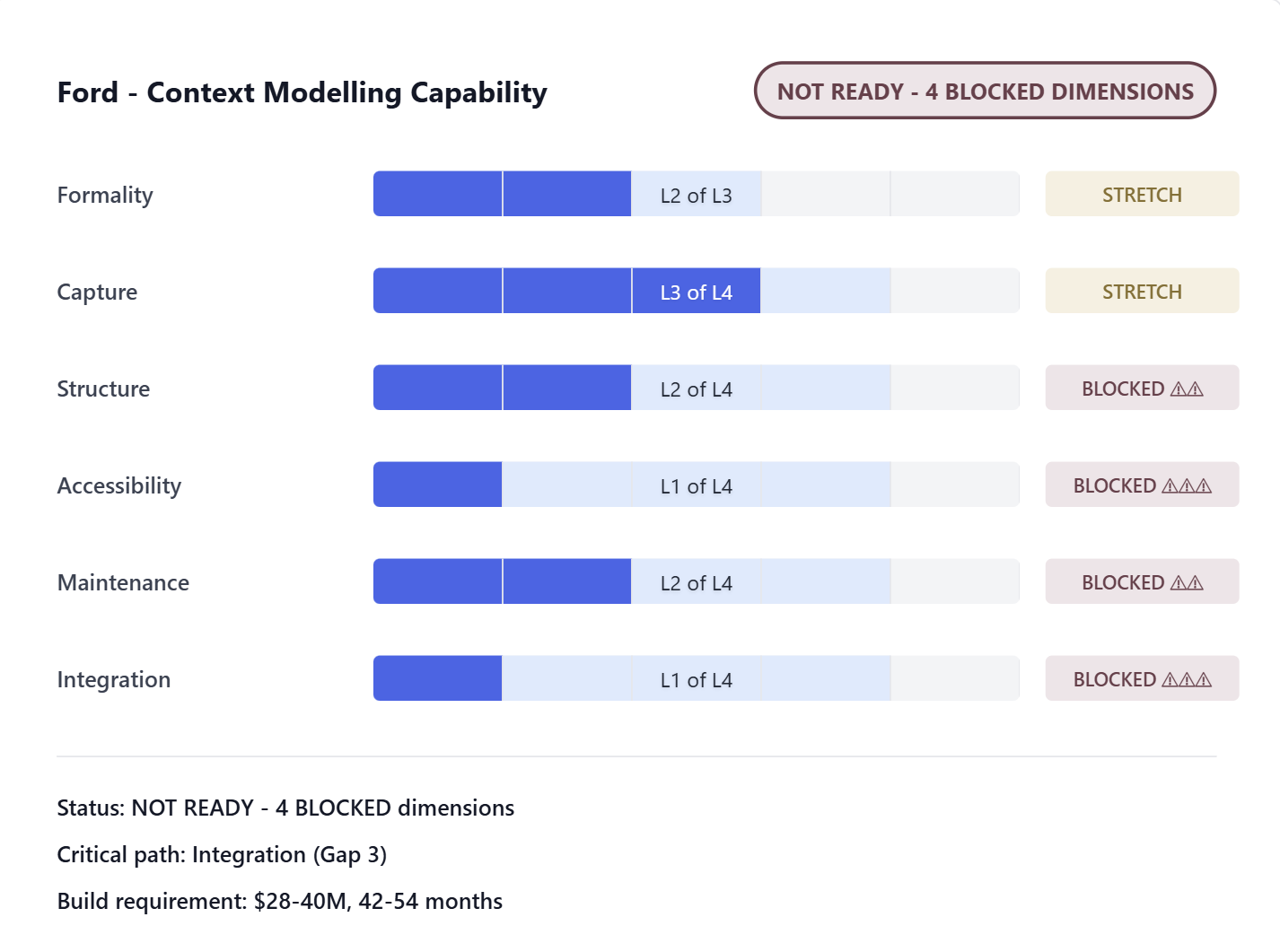
Four dimensions blocked. Structure and Accessibility at Gap 2 - infrastructure exists but fragmented across independent dealers. Maintenance at Gap 2 - context goes stale without systematic refresh. Integration at Gap 3 - no unified layer connecting Ford's AI to dealer systems. Integration is the critical path, but fixing it requires addressing the accessibility and structure gaps first. You can't integrate systems you can't access.
Ford’s dealer network operates on a patchwork of incompatible systems:
Multiple competing Dealer Management Systems: CDK Global, Reynolds & Reynolds, Dealertrack, Tekion, Auto/Mate, Dominion, and others
Each dealer independently selected their technology stack
No standardized API layer for external AI integration
Different data standards and communication protocols
The 2024 NADA Chairman, Gary Gilchrist, stated at the industry’s largest conference:
“The promise of AI and advanced analytics is enormous, but it’s a promise that remains out of reach for many dealers. Why? Because our data is often locked away in fragmented systems that weren’t built to communicate.”
The AI predicts a failure. Then what?
Intended workflow:
AI detects impending failure in Customer X’s Transit van ✓
System alerts dealer where Customer X services the vehicle ✗
Dealer proactively schedules preventive maintenance ✗
Customer receives seamless service before breakdown ✗
Where it breaks:
DMS platforms don’t expose APIs for external maintenance alerts
No standardized format for AI-generated service recommendations
Service scheduling systems disconnected from Ford’s central AI
Each integration would need custom development per DMS vendor
The technical success at Step 1 becomes meaningless without infrastructure for Steps 2-4. The AI isn’t failing. The context can’t flow to where decisions happen.
Ford has the Islands Pattern.
Signature: High Structure, Low Integration
What it looks like: Each system works well in isolation. They just don’t talk to each other.
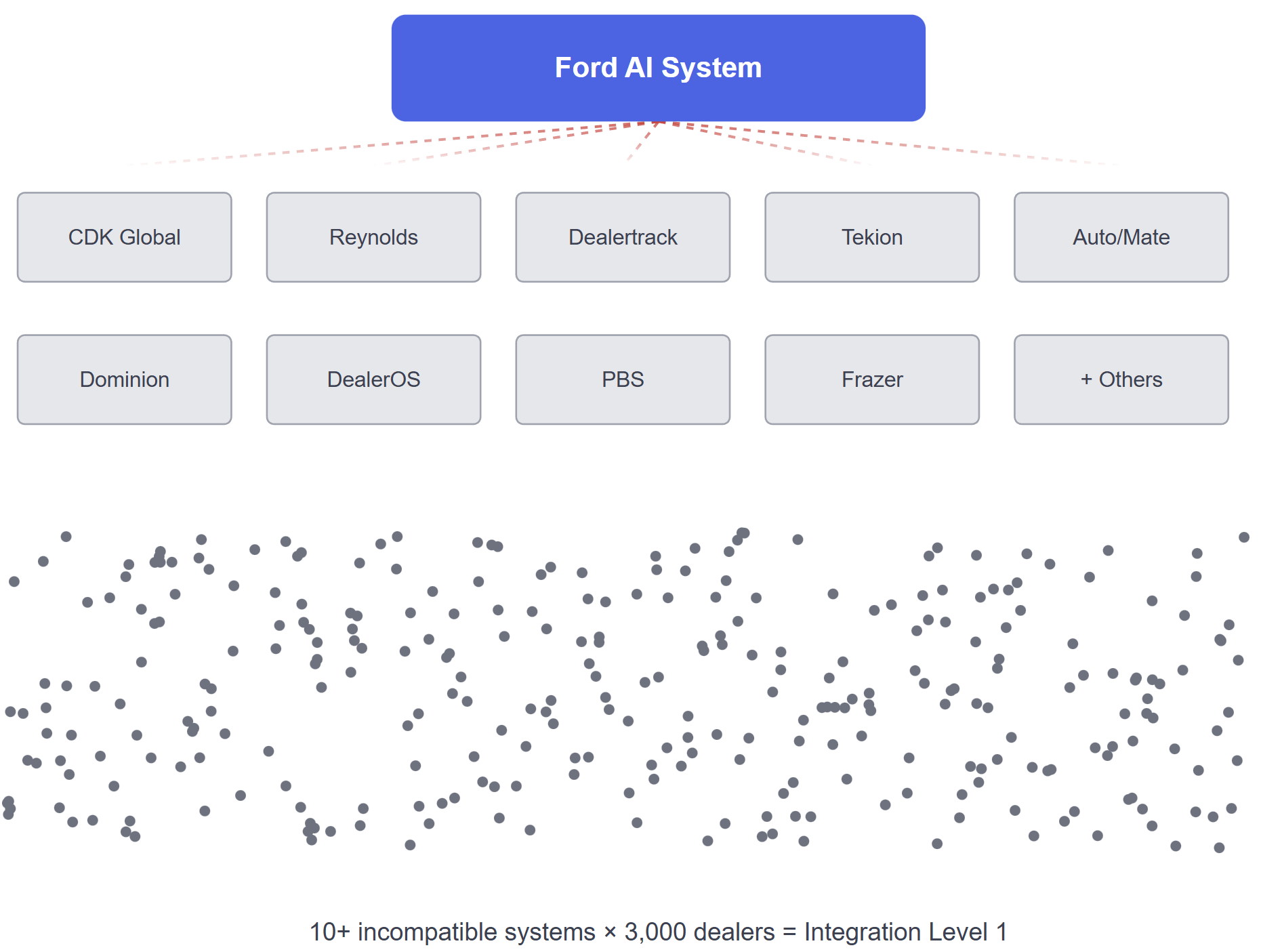
CMC signature: Structure 2-3, Integration 1
Who else has this:
Every automotive OEM facing the same dealer fragmentation
Hospital systems with independent practice networks
Franchise operations across any industry
Any organization where central AI capability requires data from distributed independent operations that selected their own technology stacks
The Islands Pattern appears wherever autonomous units optimized locally before enterprise AI requirements were known.
If Ford engaged traditional consultants on this stall, they likely received one of two diagnoses:
“Adoption Problem”: Users aren’t adopting. You need training, champions, and adoption programs.
“Pilot Worked, Scaling Failed”: The pilot was successful but scaling is a change management challenge.
[The latter seems most accurate given the facts.]
The pilot “worked” because Ford hand-crafted integrations for specific test locations. They manually connected the AI to selected dealer systems, built custom data pipelines, and had dedicated teams managing the context flow.
At scale, that manual context creation breaks. It’s not scaling that failed - it’s the illusion that infrastructure existed when what existed was heroics.
The evidence question: In the pilot, how much engineering effort went into connecting the AI outputs to dealer service systems? Multiply that by 3,000 dealers running 10+ different DMS platforms. That’s why it didn’t scale.
Adoption training doesn’t build APIs. Change management workshops don’t create data pipelines. The diagnosis was unfalsifiable. The infrastructure gap is measurable.
A CMC diagnostic before the pilot investment would have revealed:
Immediate blockers:
Integration at Level 1 (3-level gap from requirement)
No API layer for dealer system connectivity
Fragmented DMS landscape with no standardization path
Required infrastructure investment:
Universal dealer API layer: $25-40M
Timeline: 36-48 months minimum
Phased rollout starting with dealers on compatible systems
Why so expensive:
3,000 independent dealers across 10+ competing DMS platforms
Each major platform requires custom integration ($2-3M per vendor)
Real-time bidirectional integration (not just reading data, but delivering alerts and scheduling)
Franchise model: Ford can’t mandate; must negotiate dealer-by-dealer cooperation
Security, compliance, monitoring, and ongoing support infrastructure
Realistic sequence:
Assess CMC across dealer network
Identify DMS platforms with existing API capabilities
Build integration layer for top 2-3 DMS vendors (covers ~60% of dealers)
Pilot with integrated dealers only
Expand as integration layer matures
What this changes:
Pilot budget allocated to infrastructure, not just AI
Success criteria include integration milestones, not just prediction accuracy
Timeline expectations set by infrastructure reality, not technology optimism
Cost drivers: Enterprise scale (180,000 employees, 3,000 locations), franchise model complexity (independent entities requiring negotiation, not mandates), three-level infrastructure gap, and manufacturing compliance requirements. AI assistance provides 15-20% compression on technical work but cannot compress the organizational coordination that dominates the effort. These are order-of-magnitude estimates with significant variance - actual cost could range $18-65M depending on vendor cooperation, dealer adoption, and hidden technical debt. The core constraint: you're building integration infrastructure for 3,000 independent businesses using 10+ incompatible platforms.
High that infrastructure gaps (Integration + Accessibility) are the primary constraints
Evidence quality: Medium-High
Direct case study from industry analysts documenting pilot purgatory status
NADA Chairman’s public statements on dealer system fragmentation
Lotlinx survey: 78% of dealers unsure how to use AI predictive data; 19% cite integration as primary barrier
Pattern consistent with documented 70-90% AI pilot failure rates across industries
What would update this assessment:
Evidence of successful scaling to 500+ dealers (would reduce confidence significantly)
Ford statement attributing constraint to non-infrastructure factors
Documentation of alternative blockers (model accuracy, business case erosion)
Ford didn’t fail at AI. Ford succeeded at discovering their context modeling capability ceiling.
Ford succeeded at discovering their context modeling capability ceiling.
The AI works. The infrastructure doesn’t support it at scale. That’s not a technology problem - it’s a physics problem. And physics problems require infrastructure investment, not culture change.
The Islands Pattern appears wherever distributed operations selected technology independently before AI created the need for integration. Strong systems, no bridges.
Does your AI pilot need infrastructure diagnosis before you commit to scale? Email me: jonathan@context
Want to know your infrastructure status before you commit budget? The self-assessment takes 10 minutes: Free CMC Assessment
Agility at Scale - Enterprise AI Deployment Report (2025)
“From Pilot to Production: Scaling AI Projects in the Enterprise.” Published March 2025. Analysis of AI pilot success rates and production deployment barriers across enterprise implementations.
Klover.ai - Ford AI Strategy Analysis (2025)
“Ford Motor Company’s Strategy for AI Dominance.” Published June 2025. Industry analysis of Ford’s AI initiatives including predictive maintenance deployment.
NADA Show 2024 - Dealer Technology Keynote
Gilchrist, G. (2024). Chairman’s address on dealer technology fragmentation and integration challenges. National Automobile Dealers Association Annual Conference, February 2024.
Lotlinx - Dealer AI Adoption Survey (2024)
Automotive Dealership AI Adoption and Integration Barriers. Survey of US automotive dealers, December 2024. Key finding: 19% cite system integration as primary barrier to AI deployment.
Cox Automotive - Industry Report (2025)
“The AI Revolution is Here: Dealer Technology Infrastructure Assessment.” Published November 2025. Analysis of dealer management system fragmentation across US franchise networks.
Related Reading
“The 6 Dimensions That Determine If AI Works” - Frame Velocity Newsletter #4 (CMC dimension framework, infrastructure assessment methodology)
No posts
Comments
Nothing yet. Say the first thing.
Sign in to join the conversation.