

May 2025: Klarna’s CEO admits publicly: “We went too far.” The company reverses its AI customer service deployment, begins rehiring human agents, launches a “Uber-style” remote workforce pilot.
Timeline from deployment to reversal: 15 months.
What Gap ≥ 2 produces in financial services: 12-18 month failure timelines.
Klarna's 15-month timeline reveals how Gap ≥ 2 constraints unfold in financial services: Integration breakdown → escalation failures → quality decay → public reversal. Understanding this pattern lets us predict where similar failures will surface.
Understanding this mechanism lets us predict where similar failures will surface.
And right now, dozens of companies are deploying the same capability on the same infrastructure, looking at the same metrics Klarna published in February 2024 (”2.3M conversations, work of 700 agents, customer satisfaction on par with humans”), thinking they’ll get different results.
They won’t. Gap ≥ 2 doesn’t care about optimism.
Here’s what actually broke - and why the timeline was deterministic.
February 2024 announcement: AI handling 2/3 of customer inquiries across multi-market operations (US, UK, Europe, Australia). Full customer service spectrum - billing, refunds, disputes, fraud, account issues. Integrated with existing systems. $40M in projected profit improvements.
The infrastructure they had:
Payment processing: Level 3-4 (excellent; high-frequency transactions, deterministic workflows, real-time settlement)
Customer service context modeling: Level 2 across all six dimensions
The infrastructure they needed: Level 4+ across Integration, Maintenance, and Formality.
The gap: ~2 levels across every critical dimension.
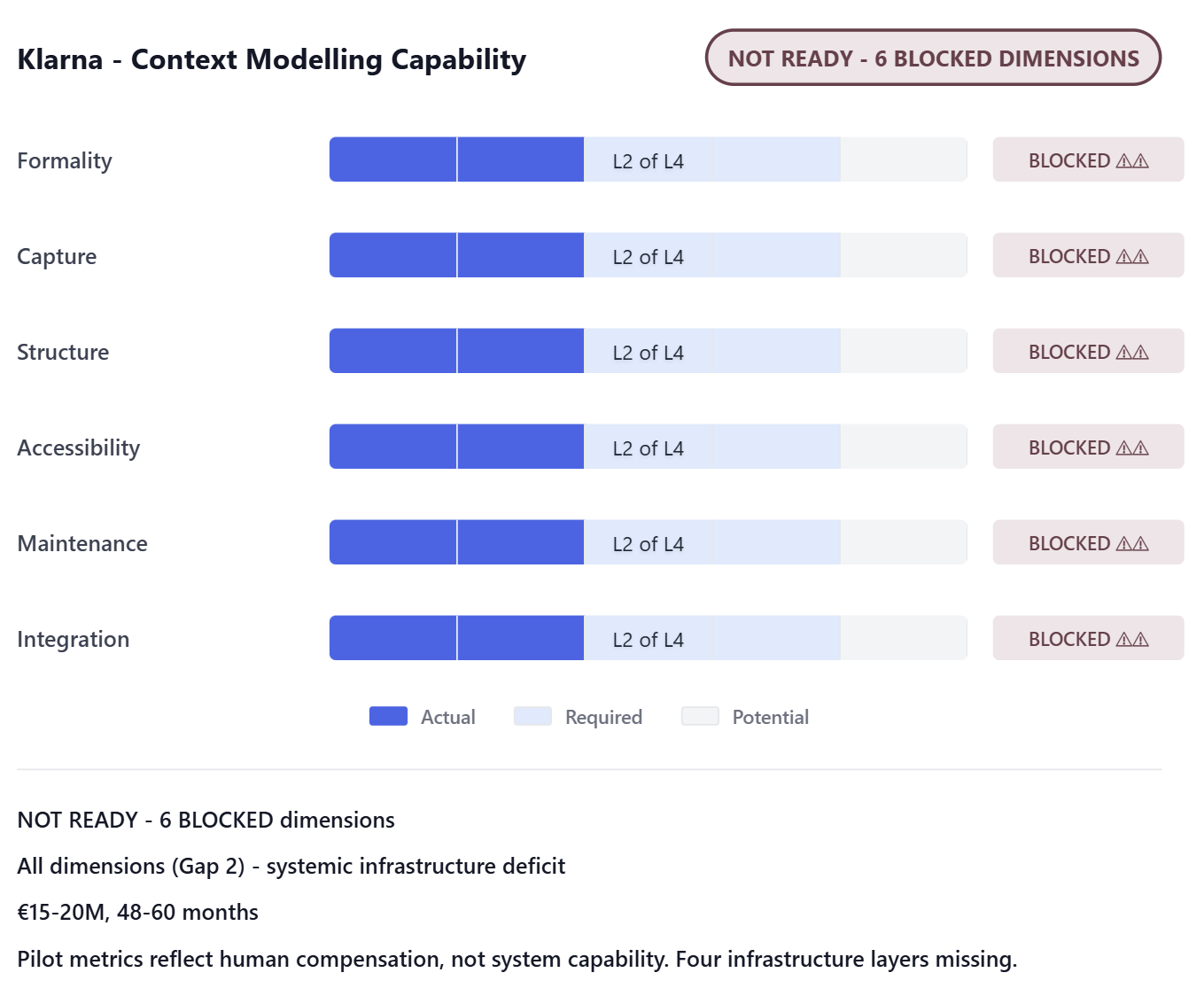
The visual tells the story. Perfectly uniform Level 2 across all six dimensions. This isn’t a deployment with one or two weak points. This is infrastructure built for the wrong use case entirely.
When gap ≥ 2, infrastructure doesn’t exist. The capability is physically blocked.
The only question was timing.
What broke:
Integration L2 of L4 → Gap 2 (BLOCKED): AI couldn’t orchestrate across CRM + payment processor + fraud detection + merchant verification. When resolution required coordinating multiple systems, AI failed. Escalation to humans meant starting over - context didn’t transfer. Result: 25% increase in repeat inquiries by Q1 2025.
Maintenance L2 of L4 → Gap 2 (BLOCKED): Policies manually updated, no real-time sync to AI knowledge base. Customers got different answers to the same question over time. Result: Inconsistent service quality, trust erosion.
Formality L2 of L4 → Gap 2 (BLOCKED): Complex resolution paths remained tacit. AI could handle “reset password” but not “merchant double-charged, account locked, refund pending for 6 weeks.” Result: Generic responses regardless of nuance - or confidently wrong answers.
Structure, Capture, and Accessibility were secondary constraints. Integration, Maintenance, and Formality were where the deployment broke.
By Q4 2024: 900+ Better Business Bureau (BBB) complaints concentrated in a few months. Refunds taking months, billing disputes unresolved, account locks requiring weeks. Forrester analyst comments publicly on the “overpivot to cost.”
By Q1 2025: Escalation pathways breaking. Internal data likely shows quality decay accelerating.
May 2025: Public reversal. CEO admits cost focus drove poor quality outcomes.
The 15-month timeline reveals how Gap ≥ 2 constraints unfold in financial services.
This isn’t a Klarna problem. This is the Transaction vs. Context Gap - a pattern showing up across financial services, SaaS support, healthcare navigation, B2B service operations.
The signature:
“We’re technically sophisticated. Our core infrastructure is world-class. We process millions of [transactions/requests/events] daily. AI should be straightforward.”
The miss:
Payment infrastructure ≠ context modeling infrastructure.
Transactions are deterministic: Money moves A→B, settled, done. Requires Structure + Accessibility.
Context is cumulative: Customer history + merchant behavior + fraud patterns + policy exceptions + judgment calls. Requires Integration + Maintenance + Formality.
Excellence in one domain creates false confidence about the other.
Klarna’s transaction infrastructure: Level 3-4. Could move money at scale with minimal error.
Klarna’s context infrastructure: Level 2. Could capture individual events but couldn’t maintain, integrate, or formalize the cumulative context AI needed to resolve complex issues.
The sophistication was real. It just existed in the wrong dimension.
And the AI didn’t care how good their payment processing was when it needed to coordinate a refund dispute across three systems with incomplete policy information.
Klarna is rebuilding. $15-20M over 4-5 years to get Integration L2→L4, Maintenance L2→L3, Formality L2→L3. That’s the infrastructure investment they needed before deployment.
Meanwhile, every company looking at those February 2024 metrics is running the same calculation:
“2.3M conversations handled”
“Work of 700 agents”
“$40M profit improvement”
“We should do this”
They’re not seeing:
25% repeat inquiry increase
BBB complaint spike
Quality decay timeline
Reversal cost
Trust erosion
The 15-month clock
The question isn’t whether you’re technically sophisticated.
The question is: In what domain?
If your excellence is in high-frequency deterministic operations (transactions, data pipelines, API orchestration) and you’re deploying AI into cumulative contextual operations (customer service, dispute resolution, relationship management), you’re running Klarna’s playbook.
Different infrastructure. Different requirements. Deterministic outcome.
Klarna serves as proof point for three claims:
1. Gap ≥ 2 = infrastructure doesn’t exist, not “high risk” They had Level 2, needed Level 4. Failure wasn’t probable - it was certain. Timeline was the only variable.
2. Infrastructure gaps create predictable failure timelines Financial services with 2-level gap → 12-18 months. Actual: 15 months. Not luck. Physics.
3. Domain-specific sophistication doesn’t transfer World-class transaction infrastructure provided zero protection against context infrastructure gaps.
The framework predicted this. The timeline matched. The failure mechanism matched (Integration + Maintenance gaps causing escalation breakdown and quality decay).
A traditional consultant would have diagnosed: cost focus over quality, leadership misalignment, or change management failures. What they would have missed: the infrastructure that made quality failures inevitable regardless of leadership intent.
This is one data point. The real validation comes when we predict future cases.
Want to know your infrastructure status before you commit budget? The self-assessment takes 10 minutes: Free CMC Assessment
CMC Level Assessment (Klarna at L2, needed L4):
Based on forensic analysis of documented failure symptoms: poor handoffs between AI and human agents (Integration L2), inconsistent policy responses over time (Maintenance L2), inability to handle nuanced customer issues (Formality L2), and generic responses regardless of context (Structure L2). Assessment methodology: reverse-engineering CMC levels from observable failure patterns, validated against typical consumer fintech infrastructure patterns. Confidence: HIGH (70%+) based on multiple independent evidence sources including CEO admission, customer complaints, and analyst commentary.
Required CMC Levels (Autonomous Customer Service L4):
Derived from capability analysis: autonomous customer service across billing/refunds/disputes/fraud requires integrated context across customer + merchant + internal systems (Integration L4), real-time policy synchronization (Maintenance L3-4), formalized decision logic for complex cases (Formality L4), and structured relationships between issues (Structure L4). Salesforce Agentforce and similar products require comparable infrastructure. Requirements validated against similar autonomous service deployments including Klarna’s own reversal evidence.
Gap ≥ 2 Timeline Formula (12-18 months for FinServ):
Calculated using CMC Prediction Methodology v1.0: Gap 2 base timeline (9-15 months) with financial services industry multiplier (1.2x for regulatory buffers, slower organizational cycles). Klarna actual timeline: 15 months (February 2024 deployment → May 2025 reversal). Formula validation: predicted 12-18 months, actual 15 months. Mechanism: Gap ≥ 2 crosses category boundary from partially explicit (L2) to fully explicit (L4) ontology—structure doesn’t exist, heroics cannot bridge.
Infrastructure Investment Estimates (€15-20M, 48-60 months):
Based on enterprise-scale (5,000+ employees), multi-market operations (US, UK, Europe, Australia), and six dimensions requiring 2-level upgrades. Cost drivers: formalization of complex customer service decision logic (1,000+ person-hours), real-time policy synchronization infrastructure, unified context layer across CRM + payments + fraud + merchant systems, and cross-market integration complexity. AI-assisted development provides 15-20% compression on technical work but cannot compress organizational coordination (policy harmonization across markets, stakeholder alignment, regulatory compliance). Timeline reflects organizational adoption cycles, not just technical build.
Transaction vs. Context Gap Pattern:
Identified through comparative analysis: Klarna’s payment processing infrastructure operated at L3-4 (high-frequency deterministic transactions, real-time settlement) while customer service infrastructure operated at L2 (contextual, cumulative, judgment-based). Pattern signature: sophisticated technical capability in wrong domain creates false confidence. Excellence at transactions (structure + accessibility) doesn’t transfer to context operations (integration + maintenance + formality). Validated against similar domain mismatch failures across industries.
“Forensic Analysis” Framing:
This is retrospective analysis, not real-time prediction made before Klarna’s deployment. Framework explains what happened after it happened. Predictive validation requires applying the mechanism to future cases before outcomes known. Klarna serves as calibration case: demonstrates Gap ≥ 2 → timeline mechanism, validates failure mode (Integration/Maintenance breakdown → quality decay), establishes baseline for financial services predictions.
Customer Complaint Data:
Better Business Bureau (BBB) Complaint Database (2022-2025). 900+ complaints over 3-year period, concentrated in 2024-2025. Dominant themes: refund delays (months), billing dispute resolution failures, account lock resolution requiring weeks.
Reddit r/Klarna community (2024-2025). User reports of “generic responses,” “repeated contact required,” “AI can’t resolve complex issues.”
Industry Analysis:
Forrester Research, Kate Leggett commentary (Q4 2024). “Klarna’s overpivot to cost” cited as cautionary example in customer service AI deployments.
S&P Global Market Intelligence (2025). “42% of organizations abandoned most AI initiatives in 2025, up from 17% in 2024.”
BCG Analysis (2024). “74% of AI projects stuck in pilot purgatory.”
AI Deployment Failure Statistics:
Challapally, A., et al. (2025). “The GenAI Divide: State of AI in Business 2025.” MIT NANDA Initiative. 95% of enterprise AI pilots fail to deliver measurable ROI. Based on 52 organizational interviews, 153 senior leader surveys, 300+ public AI deployment analysis.
RAND Corporation (2024). “80-95% of AI projects fail to deliver measurable business value.”
CMC Framework & Methodology:
“Context Modeling Capability Scoring Methodology” - Frame Velocity, January 2026. Defines 6-dimension assessment, level definitions, gap analysis framework.
Related CMC Case Studies:
“Working AI, Disconnected Infrastructure: Ford’s Islands Pattern” - Frame Velocity Newsletter, January 2026. [URL when published]
No posts
Comments
Nothing yet. Say the first thing.
Sign in to join the conversation.