

Your AI pilot worked in the lab. It died in production.
You know something broke. You can’t pinpoint where. The diagnosis you got pointed at culture, adoption, change management - things you can’t falsify, can’t measure, can’t fix with precision.
Here’s what actually determines if AI works: Six infrastructure dimensions. Measureable. Diagnosable. Fixable.
Most organizations assess AI readiness by asking: “Are we AI-mature?” Wrong question. AI maturity is vibes. Infrastructure is physics.
The right question: “Does our infrastructure provide the context AI needs to function?”
That question has six parts.
AI requires context to work. Not just any context - structured, accessible, current context that systems can query in real-time.
Most organizations have their context, but it’s trapped. In heads. In scattered files. In systems that don’t connect. Going stale by the week.
That’s not a maturity problem. That’s an infrastructure problem.
The infrastructure breaks down into six dimensions. Each dimension measures a different constraint. Each constraint can block deployment independently.
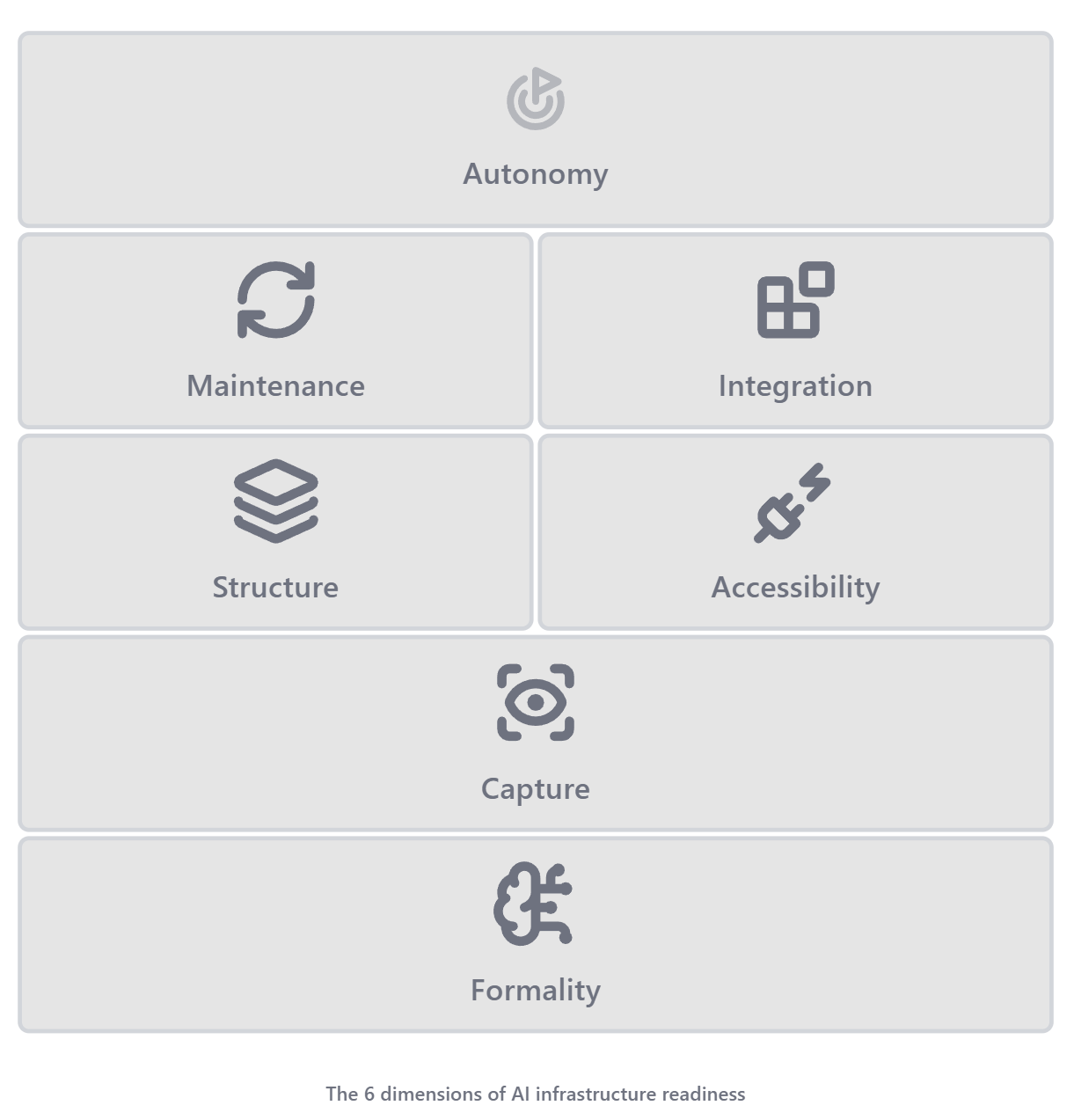
Formality: Is your critical knowledge documented, or trapped in people’s heads?
Level 0: “Ask John, he knows.” Level 5: Systems document themselves.
If context is tacit, AI can’t access it. You can’t automate what you haven’t made explicit.
Capture: How does knowledge move from events and decisions into your systems?
Level 0: No capture mechanism. Level 5: Real-time context streaming from workflows.
The gap between what happens and what gets recorded is where AI dies. Manual capture when someone remembers creates holes AI can’t bridge.
Structure: Can you query your context?
Level 0: Unstructured blobs. Level 5: Dynamic knowledge graph.
Unstructured documents might work for humans who can scan and synthesize. AI needs queryable structure. No structure, no retrieval.
Accessibility: Can AI reach your systems?
Level 0: No AI access. Level 5: Real-time full access.
Most organizations are Level 1: no APIs, no integrations, manual copy-paste. AI that can’t access your CRM, ERP, support systems is AI working blind.
Maintenance: How fast does your context go stale?
Level 0: No updates after creation. Level 5: Continuous streaming, always current.
If your product documentation is from 2019, your AI is giving 2019 answers. Real-time capabilities need real-time context infrastructure.
Integration: Do your systems share context?
Level 0: Complete silos. Level 5: Unified context layer.
The CRM doesn’t talk to the ERP. The support system doesn’t see the product system. AI needs unified context, not 15 disconnected sources.
Here’s the unspoken irony: Every technical leader already knew this.
You’ve been asking for API infrastructure for years. Arguing for data integration budgets. Fighting for documentation standards. Proposing master data management initiatives.
The business case got deferred. “Later. Not urgent. The systems work fine as is.”
Then ChatGPT launched. Suddenly AI is strategic priority. C-suite wants deployment yesterday. And now - just now - everyone discovers the blocker is the infrastructure you’ve been requesting for a decade.
The smart factory vision identified these exact constraints in 2015. Industry 4.0 roadmaps mapped the same requirements: system interconnectivity, data flow integration, real-time context availability.
The infrastructure requirements didn’t change. The urgency did.
Last week’s post established the shift: differentiation moved from the model layer to the context layer. When models commoditize, competitive advantage lives in how effectively you provide context to those models.
What the hype narrative missed: The context layer IS the infrastructure layer.
The six dimensions aren’t new concepts. They’re the technical requirements you already identified for systems integration, the ones that got deprioritized because “manual processes work fine.”
AI didn’t create these infrastructure gaps. AI made them non-negotiable.
Before AI, you could work around Level 1 Integration. Sales manually exports from CRM, imports to the reporting tool. Slow, but functional.
With AI, that gap becomes blocking. The AI agent needs real-time access across systems. Manual export/import breaks the capability entirely.
The infrastructure ceiling you could tolerate at human speed becomes the deployment blocker at AI speed.
What changed isn’t the technical requirements. What changed is that AI won’t work without meeting them.
Each dimension runs from Level 0 to Level 5. The gap between where you are and what you need determines if deployment is physically possible.
Gap less than 1: READY - Infrastructure exists, proceed.
Gap 1-2: STRETCH - Infrastructure exists but scaling requires significant organizational effort.
Gap 2 or more: BLOCKED - Infrastructure doesn’t exist. Capability cannot function.
Not “probably won’t work.” Cannot work.
This is the difference between physics and probability. When infrastructure doesn’t exist - when your Integration is Level 1 and the deployment needs Level 3 - the deployment fails. Not because people aren’t trying. Because the infrastructure gap makes the capability impossible.
Like trying to run 240V equipment on 120V power. No amount of effort changes the voltage. You either upgrade the infrastructure or accept the capability won’t work.
The infrastructure ceiling you could tolerate at human speed becomes the deployment blocker at AI speed.
This isn’t new. We’ve seen this pattern before.
In the 1980s, Walmart built real-time inventory infrastructure while competitors ran manual systems. For a decade, the gap looked like “Walmart is more efficient.” By the 1990s, the gap meant “competitors are structurally incomplete retail businesses.”
They didn’t lack efficiency. They lacked a foundational capability the market now required.
Kmart had stores. Had products. Had employees. But without real-time supply chain visibility, they couldn’t compete with an opponent whose infrastructure enabled capabilities theirs couldn’t support. They filed bankruptcy in 2002.
The AI infrastructure shift is happening faster. Much faster.
When IBM’s Chief Architect for AI Open Innovation states “In 2026, the competition won’t be on the AI models, but on the systems” - he’s marking the moment when context infrastructure shifts from advantage to requirement.
Competitors with Level 3-4 Integration aren’t just faster. They’re structurally complete in a way Level 1 organizations aren’t. They can deploy capabilities you can’t. The gap isn’t efficiency. It’s existence of function.
Your pilot worked because you manually created the context AI needed.
You hand-curated data. You connected systems with duct tape. You had your best people babysit it. At 10 users, with dedicated resources, you bridged the infrastructure gaps with human effort.
At 100x scale, those gaps become canyons.
The manual context creation that worked in the pilot breaks in production. Not gradually. Abruptly. Because infrastructure constraints are binary - they either exist or they don’t.
This is why “the pilot was successful” doesn’t predict production success. Pilots often succeed through heroics. Production needs infrastructure.
The six dimensions measure infrastructure, not heroics. They tell you what exists in systems, not what dedicated people can temporarily bridge through manual work.
Infrastructure diagnosis gives you three things feeling and intuition can’t:
Prediction - Know before you spend whether infrastructure can support the capability. Gap ≥2 in any critical dimension means blocked. You can see this before committing budget.
Precision - Not “we need better AI maturity.” Specific: “Your Accessibility is Level 1, deployment requires Level 4, build sequence takes 8-12 months.”
Falsifiability - Either the APIs exist or they don’t. Either systems connect or they don’t. You can measure infrastructure gaps. You can verify whether fixing them enabled the capability.
This is what makes infrastructure diagnosis different. It’s not interpretation. It’s measurement.
The six dimensions give you diagnostic precision.
Next post, I’ll show you what this looks like applied to a use case at scale. A major manufacturer, a specific AI deployment, infrastructure gaps that made the outcome deterministic.
Not vibes. Not culture. Not “they should have managed change better.”
Their Integration dimension was Level 1. The deployment required Level 3. Gap of 2. Blocked.
The systems couldn’t talk. The capability couldn’t function. The physics made failure inevitable.
You’ll see exactly how infrastructure diagnosis works and why it predicts outcomes conventional consultant frameworks miss.
Want to know your infrastructure status before you commit budget? The self-assessment takes 10 minutes: Free CMC Assessment
AI Deployment Failure Rates (2024-2025) S&P Global Market Intelligence (2025). “AI Adoption and Implementation Report.” Organizations abandoning most AI initiatives: 17% in 2024, rising to 42% in 2025.
AI Pilot Failure Statistics Challapally, A., et al. (2025). "The GenAI Divide: State of AI in Business 2025." MIT NANDA Initiative. 95% of enterprise AI pilots fail to deliver measurable ROI or P&L impact. Research based on 52 organizational interviews, 153 senior leader surveys, and analysis of 300+ public AI deployments.
IBM on System-Level Competition
Goodhart, G. (2025). "The trends that will shape AI and tech in 2026." IBM Think.
Chief Architect for AI Open Innovation states: "In 2026, the competition won't be on the AI models, but on the systems. We're going to hit a bit of a commodity point."
Walmart vs. Kmart Infrastructure Case Stalk, G., Evans, P., & Shulman, L. (1992). "Competing on Capabilities: The New Rules of Corporate Strategy." Harvard Business Review. Walmart's real-time inventory infrastructure as competitive capability vs. traditional retail systems. Kmart bankruptcy filed January 2002. https://hbr.org/1992/03/competing-on-capabilities-the-new-rules-of-corporate-strategy
Related Reading "Your Organization Is In Vibe State" - Frame Velocity Newsletter #2 (organizational vibe state, measurement infrastructure, METR study)
No posts
Comments
Nothing yet. Say the first thing.
Sign in to join the conversation.