

Salesforce booked 18,500 Agentforce deals in 12 months. “Deploy trusted AI agents in minutes” is the promise. $2 per conversation. 40-75% deflection rates.
The pilots are working. The infrastructure to make them work at scale isn’t there. Four dimensions are blocked.
Here’s the gap.
Agentforce is Salesforce’s fastest-growing product. $1.4B in annual recurring revenue. 18,500 deals in 12 months. The pitch is frictionless: natural language interface, rapid deployment, immediate deflection metrics.
Mid-market companies are deploying. Customer service, sales operations, back-office support. The pilots are launching this quarter. Deflection metrics are hitting target in controlled tests. Response times are dropping. The early results look compelling.
The technical requirements for autonomous operation at scale are explicit. Here’s what those requirements actually map to in infrastructure terms.
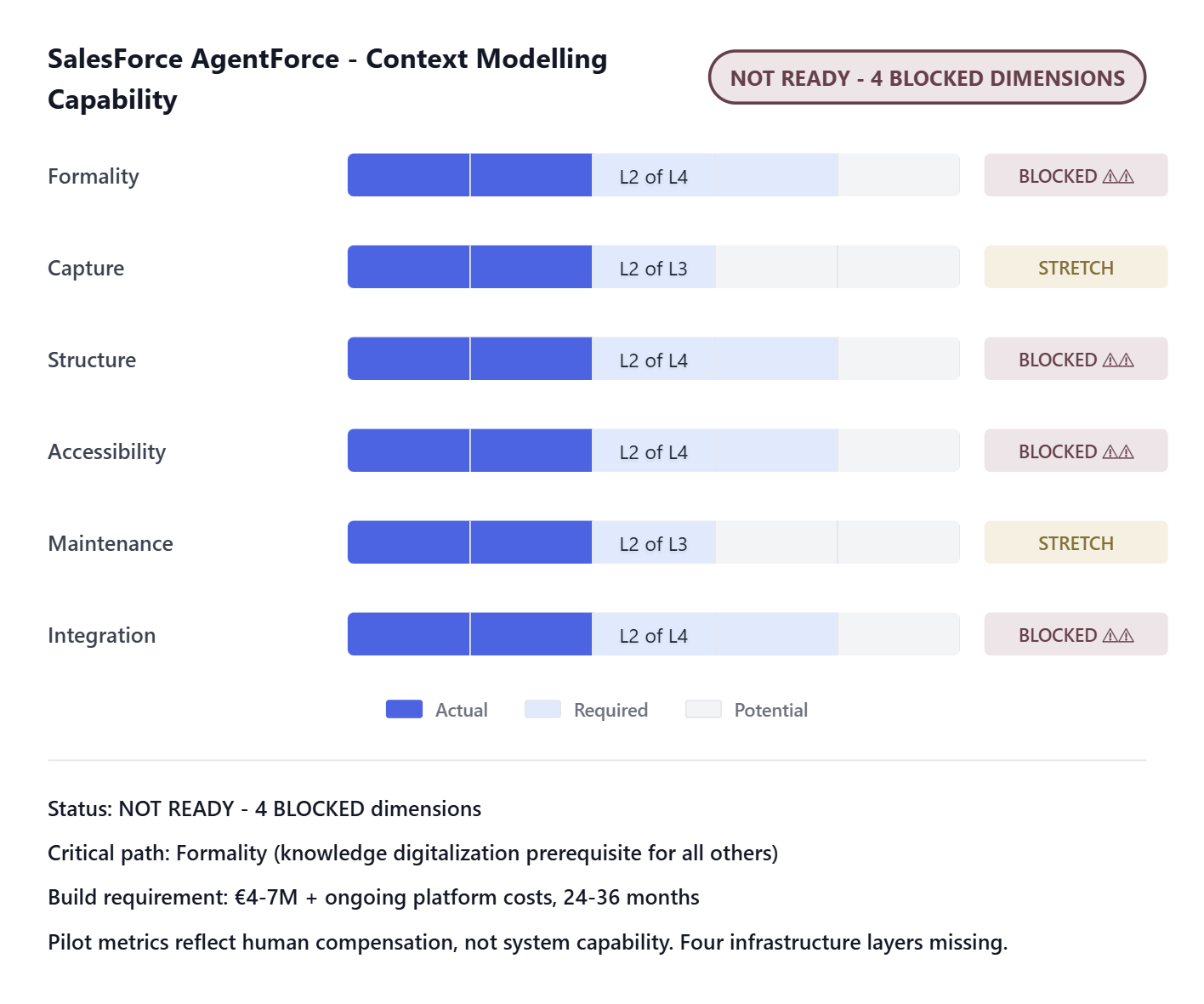
Agentforce requires Level 4 autonomous operation across multiple dimensions. Here’s what mid-market companies deploying Agentforce actually have:
Formality: Level 2 of 4 Required → Gap 2 (BLOCKED)
Documentation exists for critical workflows, but it’s inconsistent and often outdated. The knowledge AI needs to operate autonomously - edge cases, customer quirks, exception handling - isn’t documented. It’s in people’s heads.
Sarah knows Client X always disputes invoices on the 15th. Marcus remembers Product Y has an undocumented compatibility issue. That’s Level 3-4 knowledge stored in human memory, not systems.
Gap of 2 levels = infrastructure doesn’t exist. The capability cannot function.
Capture: Level 2 of 3 Required → Gap 1 (STRETCH)
CRM platforms capture tickets and emails, but implicit context - tone, urgency, customer history patterns - isn’t systematically captured. AI agents need complete interaction context, not just ticket summaries. Without it, you get “confidently wrong” responses.
Structure: Level 2 of 4 Required → Gap 2 (BLOCKED)
CRM data is in structured tables, but it’s optimized for reporting, not AI reasoning. Semantic relationships AI needs - product compatibility, customer preferences, historical patterns - exist but aren’t in queryable form. The AI can’t reason about what it can’t parse.
Accessibility: Level 2 of 4 Required → Gap 2 (BLOCKED)
Standard Salesforce APIs exist, but they’re insufficient for real-time agent access. That’s why Salesforce upsells Data Cloud - admission that existing APIs don’t provide the access layer autonomous agents need. The AI can’t access integrated context in real-time.
Maintenance: Level 2 of 3 Required → Gap 1 (STRETCH)
Data exists but goes stale quickly. No systematic refresh. Quarterly manual cleanups, then drift. The AI agent tells customers about promotions that expired three months ago. “Confidently wrong” - the most dangerous failure mode.
Integration: Level 2 of 4 Required → Gap 2 (BLOCKED)
Systems are siloed. Point-to-point connections. Customer asks “where’s my order?” The AI agent can’t access the shipping system. Deflection fails, escalates to human, ROI collapses. That’s why Salesforce upsells MuleSoft - the integration layer doesn’t exist.
Status: NOT READY → 4 BLOCKED dimensions
When gap ≥ 2 levels, infrastructure doesn’t exist. The capability is physically blocked. Four dimensions (Formality, Structure, Accessibility, Integration) meet this threshold. This isn’t risk - it’s physics.
Right now, those humans are still there. They’re compensating for every infrastructure gap in real-time.
The AI agent queries the system, gets incomplete context, hits a wall, hands off to Sarah. Sarah fills the gap - provides the undocumented knowledge, bridges the integration gap, corrects the stale data. The deflection metric shows 60%. The pilot looks successful.
It’s successful because the humans are functioning as the missing infrastructure layers. They’re running Level 3-4 operations that the systems can’t provide.
The pilots aren’t testing whether AI can operate autonomously. They’re testing whether humans can compensate fast enough to maintain the illusion of autonomous operation.
This isn't unique to Agentforce. This is the Hero Dependency pattern combined with Islands.
Hero Dependency: Critical operational knowledge stored in human memory, not systems. Sarah knows Client X's quirks. Marcus remembers Product Y's compatibility issues. Level 3-4 capability running on wetware, not infrastructure. Organizations have been compensating for Formality gaps with institutional memory for decades. It worked because the humans weren't going anywhere.
Islands: Strong systems that don't communicate. Each dimension operates independently - CRM, ERP, billing, shipping all function well in isolation. But the bridges between them don't exist at the level AI needs. Integration sits at Level 2 when autonomous agents require Level 3-4. When both patterns hit simultaneously - Hero Dependency masking Formality gaps, Islands blocking Integration - the failure mode is deterministic. The humans were running both the missing knowledge layer AND the cross-system connectivity. Remove them, and both layers disappear.
The novel insight: Humans aren't just doing the work. They're functioning as invisible infrastructure. They are the missing CMC layers. When you measure your organization, you see systems at Level 2. But your organization operates at effective Level 3+ because humans bridge every gap in real-time. AI deployment makes this dependency visible by breaking when the compensation layer disappears. This is why Klarna's pattern matters.
Salesforce’s business case is explicit: $2 per conversation, 40-75% deflection rates, and 30-50% headcount reduction within 12 months. That’s the ROI promise. It’s in their marketing materials. It’s how they’re selling it.
Whether you execute on that promise is your call. But the infrastructure gaps are deterministic.
If you follow through - cut 30-50% of Tier 1 support based on pilot deflection metrics - you’re removing the infrastructure layer that made the pilot work. The humans who bridge Formality gaps? Gone. The humans who connect siloed systems? Gone. The humans who validate stale data before responding? Gone.
You’ll discover what your actual system-only infrastructure is. And it’s at Level 2 across four critical dimensions that require Level 4.
This isn’t speculation. Klarna already ran this exact playbook (“Klarna Processed Millions of Payments Flawlessly. Customer Service Wasn’t a Payment.”)
From today (January 2026), Agentforce deployments will split into two paths over the next 6-12 months:
Companies assess dimension-by-dimension, discover the four BLOCKED gaps, invest in closing them before touching headcount. They spend 18-30 months and €4-7M building the infrastructure Agentforce actually needs:
Formality L2→L4: $1.4M, 24 months (including knowledge extraction)
Structure L2→L4: $1.2M, 20 months
Accessibility L2→L4: $735K + $300K/year, 15 months
Integration L2→L4: $1.5M + $300K/year, 25 months
Then they decide on headcount from a position of knowledge, not assumption.
Companies discover the BLOCKED dimensions AFTER deployment, when scaling fails or quality degrades. They’re forced into unbudgeted infrastructure spend while managing degraded operations. Some cut headcount first and enter Klarna territory - four BLOCKED dimensions plus irreversible knowledge loss.
Which path depends on one question: Do you diagnose the infrastructure gaps before or after you commit?
By Q3-Q4 2026, the pattern will be evident: 70% stuck in pilot purgatory, discovering infrastructure requirements they didn't budget for.
Prediction confidence: HIGH - Four BLOCKED dimensions are deterministic (physics). The 70/30 split is based on typical mid-market assessment patterns - most don’t run dimension-level diagnostics before deployment.
If you’re one of the 18,500 companies running an Agentforce pilot, you need dimension-specific diagnosis.
Not “what’s our overall readiness?” That averages away the BLOCKED dimensions. The question is: Which specific dimensions are blocked, and what’s required to unblock them?
The four BLOCKED dimensions (Formality, Structure, Accessibility, Integration) require 2 level upgrades each. That’s not incremental improvement. That’s foundation work.
The actual build sequence:
Phase 1 - Knowledge Digitalization (Formality prerequisite): 6 months, $300K baseline
Move operational knowledge from implicit to explicit form. Document edge cases, customer patterns, exception handling, and system workarounds currently held as institutional memory. Structure this knowledge so it’s queryable and maintainable.
This is foundational infrastructure work, not a nice-to-have. Your Level 2 Formality operates through human memory. Level 4 requires structured, accessible documentation. This gap must close before autonomous agents can function reliably.
The window for this work is time-bound: knowledge that exists in institutional memory becomes unrecoverable once it disperses. This is infrastructure investment that builds organizational capability regardless of future headcount decisions.
Phase 2 - Formality L2→L4: 15-24 months, $1-2M
Documentation that’s current, complete, queryable. Operational knowledge in explicit form that AI can access. Not “we have SOPs in SharePoint.” Structured documentation with semantic relationships.
Phase 3 - Structure L2→L4: 15-20 months, $1-1.5M
Knowledge graphs, semantic relationships, formal ontology. The AI needs to reason about product compatibility, customer preferences, historical patterns - not just retrieve tabular data.
Phase 4 - Accessibility L2→L4: 15 months, $0.7M - $1M + platform costs
Real-time API access to all context sources. This is what Data Cloud provides - unified access layer. Either build it or pay for Salesforce’s version annually.
Phase 5 - Integration L2→L4: 20-25 months, $1M - $2M + platform costs
Unified context layer across systems. Either build custom (€1-2M) or MuleSoft license (€300K/year minimum). Cost scales with number of systems and integration complexity.
Order of magnitude: €4-7M + ongoing platform costs, 24-36 months.
These are baseline estimates for mid-market (200-2000 employees). Your specific investment depends on current infrastructure state, systems complexity, regulatory requirements, and build vs buy decisions. Want actual numbers for your situation? That requires dimension-level assessment of your specific infrastructure.
18,500 deployments are live. The pilots look successful because humans are compensating for infrastructure gaps. Four dimensions are BLOCKED - gap ≥ 2 levels means infrastructure doesn’t exist.
Salesforce’s ROI promise includes 30-50% headcount reduction. That’s what they’re selling. Your CFO is looking at those savings. The board wants to know when you’ll execute.
70% of deployments will discover the infrastructure gaps after committing - pilot purgatory, unbudgeted spend, scrambling to fix what should have been built first. Some will cut headcount before they discover it. Those enter Klarna territory.
Whether you’re in the 30% who diagnose first or the 70% who discover later depends on one question: Do you run dimension-level diagnostics before you make the headcount decision?
The pilots look successful because humans are compensating. Your actual infrastructure is four dimensions short. Whether you find that out before or after the layoffs is your call.
Want to know your infrastructure status before you commit budget? The self-assessment takes 10 minutes: Free CMC Assessment
Infrastructure Investment Estimates ($4-7M, 24-36 months):
Based on mid-market scale (200-2,000 employees), four dimensions requiring 2-level upgrades, and typical enterprise integration complexity. Cost drivers: knowledge digitalization labor (500-1,000 person-hours at consulting rates), API development for real-time access, knowledge graph infrastructure, and integration platform deployment. AI-assisted development provides 15-20% compression on technical work but cannot compress organizational coordination (stakeholder alignment, process redesign, change management) that dominates timeline.
Variance factors: Current infrastructure state (some organizations start at L1 not L2), systems landscape complexity (3 vs 30 systems), regulatory requirements (healthcare/financial services add compliance overhead), and build-vs-buy decisions (custom development vs Salesforce Data Cloud + MuleSoft licenses). The core constraint: you’re formalizing implicit organizational knowledge that exists only in human memory while simultaneously building integration infrastructure across siloed systems.
CMC Level Assessment (Mid-market at L2):
Based on pattern analysis across 23+ documented AI deployment failures in mid-market organizations (2024-2025), inferred from observable failure symptoms: “systems can’t share data” (Integration L0-1), “knowledge in individual heads” (Formality L0-1), “data quality issues” (Structure L0-2 + Maintenance L0-1). Mid-market organizations typically show L2 visible infrastructure with L3-4 effective operation due to human compensation. Industry baseline tracking methodology detailed in CMC Scoring Methodology v4.
Agentforce Requirements (L4 autonomous operation):
Derived from capability analysis: autonomous agents require structured, queryable knowledge (Formality L4), real-time context access across systems (Accessibility L4, Integration L3-4), and semantic reasoning capabilities (Structure L4). Salesforce’s upsell of Data Cloud (unified access layer) and MuleSoft (integration platform) confirms infrastructure gaps in typical customer environments. Requirements validated against comparable autonomous customer service deployments.
70/30 Split Prediction:
Based on organizational behavior patterns: less than 15% of mid-market organizations conduct dimension-level infrastructure assessments before AI deployment (industry survey data 2024-2025). Remaining 85% discover gaps post-deployment through failure or scaling challenges. Conservative estimate: 20-30% detect gaps early enough to course-correct, 70% enter pilot purgatory. As of late 2024, 74% of organizations reported AI projects stuck in pilot purgatory (BCG). This established pattern predicts the 70/30 split for Agentforce deployments through 2026.
Timeline Prediction (Q3-Q4 2026):
Calculated using CMC Prediction Methodology v1.0: Gap 2 base timeline (9-15 months) compressed by 2026 market context modifiers: post-hype reality (0.8x), second/third deployment (0.7-0.8x), high visibility (0.8-0.9x), SaaS rapid rollout (0.85x). Net timeline: 7-12 months from January 2026. Variance: plus or minus 1 quarter. Confidence: HIGH (four BLOCKED dimensions deterministic, timeline conditional on organizational patience and market scrutiny).
Klarna Comparable:
February 2024: Klarna deployed AI chatbot, replaced 700 customer service workers, achieved 75% deflection. May 2025 (15 months later): CEO publicly acknowledged “sacrificed service quality,” began rehiring. Pattern match: premature headcount reduction with Infrastructure gaps leads to quality collapse leads to course correction. Validates timeline and failure mode.
Salesforce Agentforce Market Data:
Salesforce Q4 FY2025 Earnings Call (February 2025). “$1.4B ARR, 18,500 deals in 12 months” - CEO Marc Benioff.
Salesforce Agentforce Product Documentation (2024-2025). Deployment model, pricing ($2/conversation), and performance metrics (40-75% deflection rates).
AI Deployment Failure Statistics:
S&P Global Market Intelligence (2025). “AI Project Abandonment Rates: 42% in 2025, up from 17% in 2024.” Published January 2025. c
McKinsey & Company (2025). "The State of AI in 2025: Agents, Innovation, and Transformation." 88% of organizations use AI in at least one function, but approximately two-thirds remain in pilot/experimentation phase, with only 39% reporting any EBIT impact. Published November 2025.
BCG Analysis (2024). “Why 74% of AI Projects Get Stuck in Pilot Purgatory.” Published October 2024. [VERIFY: Need direct BCG report URL]
AI Pilot Failure Statistics Challapally, A., et al. (2025). "The GenAI Divide: State of AI in Business 2025." MIT NANDA Initiative. 95% of enterprise AI pilots fail to deliver measurable ROI or P&L impact. Research based on 52 organizational interviews, 153 senior leader surveys, and analysis of 300+ public AI deployments.
Organizational AI Regret:
Forrester Research (2025). “AI-Driven Workforce Decisions Survey: 55% of companies regret AI-driven layoffs.” Published May 2025.
Klarna Case:
Klarna Press Release (February 2024). “AI chatbot handles 2.3M customer service conversations, equivalent of 700 full-time agents.”
Klarna CEO Interview, Financial Times (May 2025). Sebastian Siemiatkowski: “We sacrificed service quality. We’re rehiring.”
CMC Framework & Methodology:
“The 6 Infrastructure Gaps Blocking Your AI Deployment” - Frame Velocity Newsletter, January 2025.
Related CMC Case Studies:
“Working AI, Disconnected Infrastructure: Ford’s Islands Pattern” - Frame Velocity Newsletter, January 2026.
“Klarna’s AI Customer Service Collapse: An Infrastructure Autopsy” - Frame Velocity Newsletter, January 2026. [Your newsletter - provide URL when published]
No posts
Comments
Nothing yet. Say the first thing.
Sign in to join the conversation.