
Every uncomfortable moment offers you a quiet choice: move toward it, or move away from it. In the moment, it can look small and harmless. It’s the conversation you keep putting off. The workout you skip because it feels too hard. The email you don’t send because you don’t want the response. Comfort feels like a reasonable decision, just this once.
But none of these choices are isolated. Each time you step toward discomfort and make it through, something changes inside you. And each time you step away, something changes too, except it’s in the opposite direction. You’re not just making a decision. You’re training your nervous system.
Hey there. It’s me, Kore. And you’re listening to Exercising Consistency: From Fitness to Flourishing.
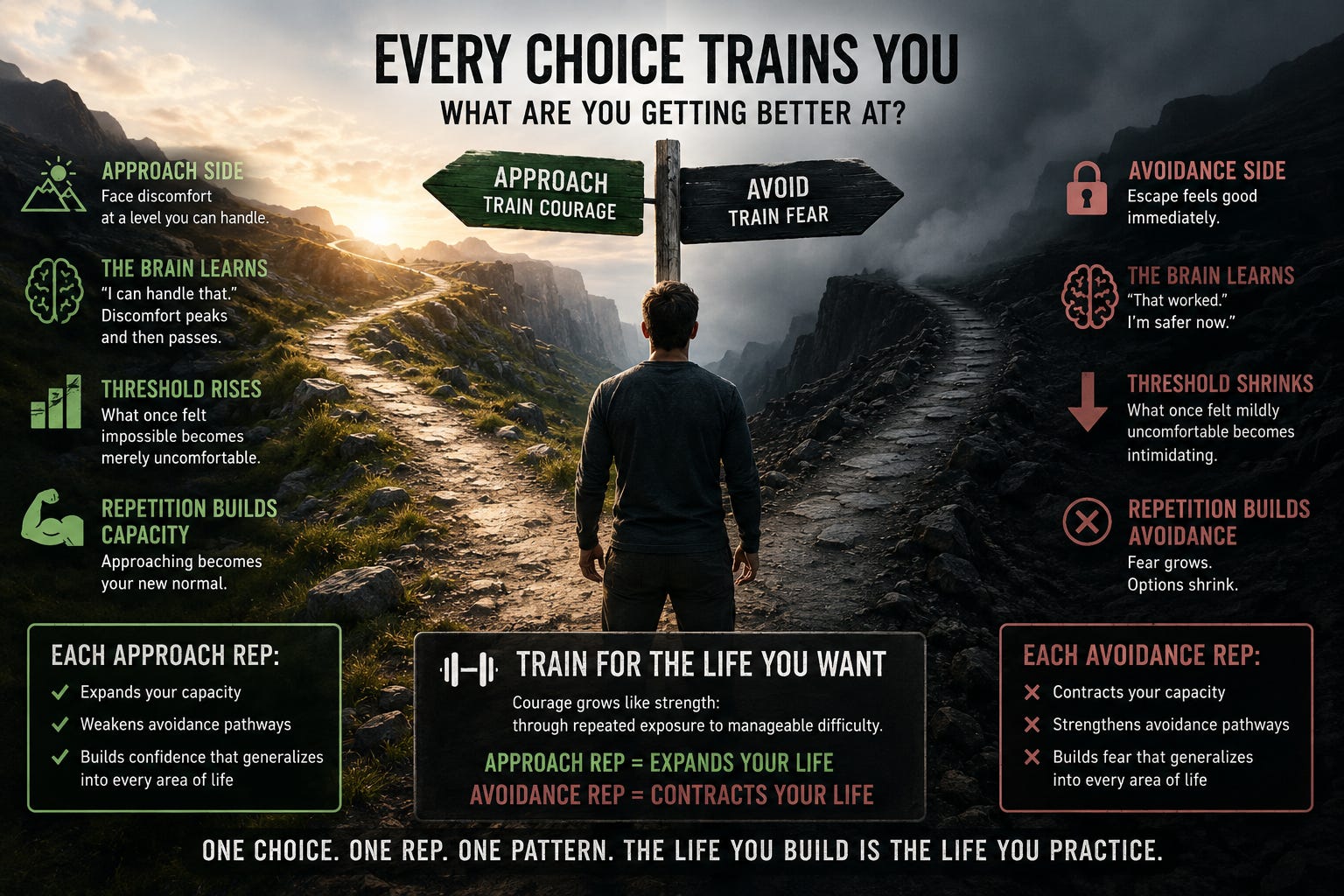
When you face fear and discomfort at a level you can handle, your brain updates its opinion of the situation. It learns, “I can handle that.” The discomfort rises, peaks, and then it passes. You come out the other side with proof that you can survive it. What used to require a big burst of courage starts requiring less. Your threshold moves because you moved it.
Over time, choosing the hard thing weakens the avoidance pathway. Approaching becomes more normal. What once felt impossible becomes merely uncomfortable. What once felt uncomfortable starts to feel neutral. And what once felt neutral begins to feel easy. This isn’t a quick flip of a switch. It’s a gradual shift created by repetition, the same way strength is built in the gym.
Avoidance also trains you, and it’s powerful because it feels good immediately. When you escape discomfort, the brain gets clear data: “That worked. I’m safer now.” Relief hits fast, and fast relief is extremely reinforcing. But the message underneath that relief is dangerous: the brain concludes the situation must have been threatening enough to require escape.
That’s how fear grows. The next time something similar shows up, avoiding it has become easier. Your sense of what you can handle starts to shrink. What used to be mildly uncomfortable becomes intimidating. Hesitation turns into refusal. Avoidance builds on avoidance the same way courage builds on courage, through repetition and reinforcement.
Here’s the important thing: this conditioning doesn’t stay localized. Courage in one area spreads into others. If you work on staying present in difficult conversations, you may find it easier to push through a tough workout. If you prove to yourself in the gym that you can do hard things, you may become more willing to take risks at work or speak up in relationships. The skill generalizes.
And the reverse is also true. When you avoid one challenge, you become more likely to avoid other challenges. You can become more courageous as a trait, and you can also become more fearful as a trait. You’re always practicing something, whether you mean to or not, and practice always works.
That’s why it matters to see each choice as a training session. Every decision is a rehearsal. You’re wiring in a default response. So it’s worth asking, “What am I practicing today? What am I getting better at?” Because whatever you repeat, you reinforce.
Courage grows the same way strength does: through repeated exposure to manageable difficulty. Every approach rep expands your capacity. Every avoidance rep contracts it. The nervous system keeps score whether you intend it to or not.
If you want a life that feels larger and more within your command, train it. Approach the small discomforts. Over time, the person who practices approaching discomfort stops needing to “feel brave” to act. They act because they’ve conditioned themselves to move toward challenge as the default.
Courage begins in a moment. The choice to be courageous is yours. Choose this often enough and it becomes a pattern. Build the pattern you want to live inside one choice at a time.
To put this practice in place and turn it from an idea into a lived experience, start your Day 1 inside The ACT Score Challenge. Go to exercisingconsistency.com.
That’s it for today. Catch you next time.
Comments
Nothing yet. Say the first thing.
Sign in to join the conversation.