
I’m going to repeat something I’ve said many times. You’ve probably heard it from plenty of other people, as well. Still, it’s worth hearing again. Sometimes the same message lands differently depending on where you are in life. And when it finally hits home, things can change fast.
Here it is: you already have enough information to start. I’m going to say this a bunch of different ways. It’s that important. Let’s get into it.
Hey there. It’s me, Kore. And you’re listening to Exercising Consistency: From Fitness to Flourishing.
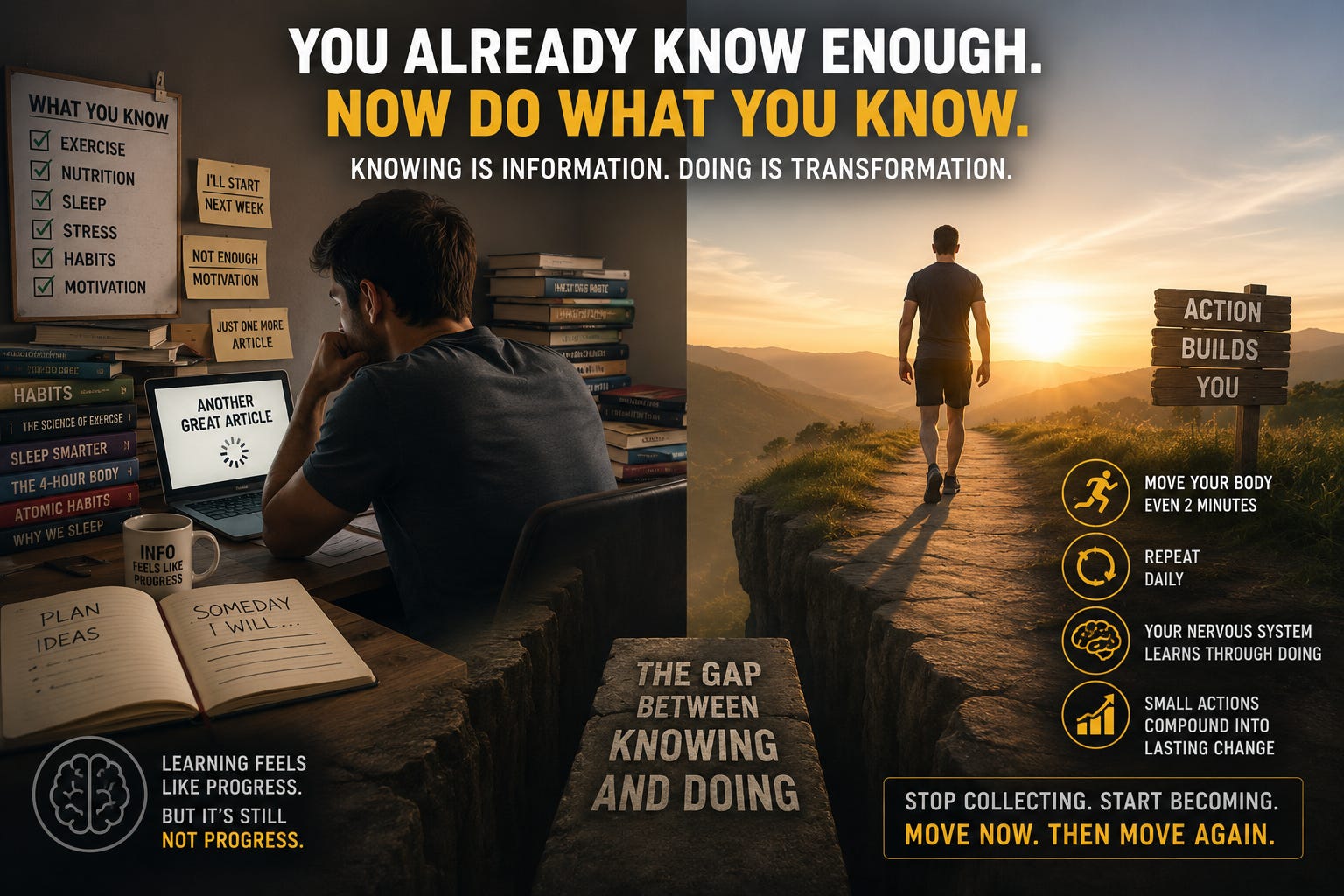
You already know exercise is good for you. You’ve heard the research on sleep, nutrition, stress, mood, and all the usual pillars. You’ve read books, saved articles, listened to podcasts, watched videos, and collected tips from a hundred places. Yet somehow, none of that has moved you closer to your exercise goals.
And even if exercise isn’t your struggle, there’s probably another area where this is true. Money. Relationships. Work. Confidence. You can know what to do and still not do it. That’s the real problem: the gap between knowing and doing.
The brain keeps selling us a comforting idea: if we just get enough information, behaviour will change automatically. But it doesn’t work like that. Knowing something and doing something are two different experiences. They use different systems in the brain, and they require different kinds of effort. Still, this illusion sticks around because learning feels like progress.
In a way, learning is progress. We need information to understand reality. But the point of learning is to function more effectively, not just to collect facts. Knowledge is supposed to lead to action. If it doesn’t, it’s just trivia or entertainment.
Here’s what makes it tricky: the brain treats learning like an accomplishment. You read an article about training or habits, and you get a little dopamine hit. You feel good, like you’re moving forward. But if you haven’t actually moved your body, nothing has changed. You may know more, but you haven’t become different.
That’s the gap information can’t cross for you. You can read ten articles about how to form a habit, but that tenth one won’t save you. You could have stopped at one and put what you learned to use. Behaviour changes through behaviour. Repeated behaviour. Through the accumulation of choices you actually carry out, not the accumulation of facts you store.
The body only learns through doing. You can’t think your way into a new action pattern, but you can act your way into a new thinking pattern. That’s why the first workout doesn’t require belief or motivation or a full identity shift. It requires movement. Imperfect movement.
And then the second workout is a little better, because that kind of learning gets applied immediately. The tenth workout feels different. The hundredth workout feels different again. The missing piece was never another podcast episode. It was the physical work, repeated over time, until your nervous system learned what the words can’t teach.
When you really understand this, you stop searching for better information and start practicing better action. Information can give you a perspective, sure. It can point you in a direction. But it can’t take a single step for you, and it can’t remove the friction that shows up when it’s time to do the work.
That friction is the moment that matters most: when you’re tired, when you doubt yourself, when you’re arguing in your head that “this is stupid,” when you feel like quitting. You can’t plan how to think your way out of that moment. You have to have moved to it to get through it. You have to face it in real time, in your body, with all you’ve learned along the way. And you can’t learn any of that in theory.
No amount of reading can prepare your nervous system for that choice point. Only action can. The smallest movement forward is infinitely better than a thousand volumes of information that never get acted on. Two minutes of movement contains more behavioural power than the most complete book on training.
Information has a place. It can inspire you. It can help you understand what you’re doing and why. It can help you avoid obvious mistakes. But it’s not efficient if the loop stays open between knowing and doing. Until you close that loop, you’re not progressing. You’re daydreaming.
So yes, the information you already have is enough. Even the cliché advice, “eat less, move more,” is directionally correct. It’s limited, and there are nuances, and people love arguing about it. But you don’t learn those nuances by debating them. You learn them by doing the simple version consistently and paying attention to what happens.
Move more. How much more? Two minutes. Will that teach you something? Absolutely. Will it teach you everything? Absolutely not. But neither will ten more books or five more videos. The gap won’t close because you understand more. It closes because you move. One rep, one choice, one tiny action that actually happens. That’s the play. Not digging into another tutorial.
So stop collecting and start becoming. Move now. Then move again. Keep moving. Make it a daily practice. Sooner than you think you’ll look back and be astonished at how much you’ve learned and changed.
When you’re ready to turn consistency from an idea into a solid practice, go to exercisingconsistency.com to start your Day 1 in The ACT Score Challenge.
That’s it for today. Catch you next time.
Comments
Nothing yet. Say the first thing.
Sign in to join the conversation.