
When it comes to exercise the beginner typically starts with too much intensity. Their goals are too ambitious, their planned routines too advanced, and they push themselves too hard in their first workouts.
This instinct comes from a reasonable place: change requires effort, so the amount of change wanted must correspond to the amount of effort exerted, right? The thing is, the body responds better to consistency in the beginning than it does to intensity. A manageable stimulus applied daily produces more adaptation than a challenging stimulus applied sporadically. The beginner who goes hard on day one often does not continue past day two. The beginner who goes easy on day one often does.
Hey there. It’s me, Kore. And you’re listening to Exercising Consistency: From Fitness to Flourishing.
The body’s systems adapt better to gradual loading than sudden shocks. Connective tissue strengthens over weeks, not days. The nervous system learns movement patterns through repetition, not cram sessions. Metabolic efficiency improves through sustained practice, not single herculean efforts.
When a beginner trains with high intensity before the supporting systems are ready, the body does not adapt faster. More likely it will break down faster. The risk of injury rises. The recovery demand increases. Skipped sessions become inevitable. The body is never the bottleneck for beginners. The bottleneck is always whether the behaviour will be repeated. Intensity does not solve that problem. It makes it worse.
For a beginner, the only variable that matters is the interval between sessions. Not the duration or the difficulty. It’s the gap between one session and the next. A five-minute walk repeated daily changes the body more than a sixty-minute gym session that happens once.
The practice matters more than the ambition. The two-minute workout, the short walk, the light stretching. These are the correct starting points. To condition the body systematically rather than sporadically you must commit to a repeated set of behaviours. The adaptation you want follows certainty. Certainty follows consistency. Consistency follows a standard low enough to maintain.
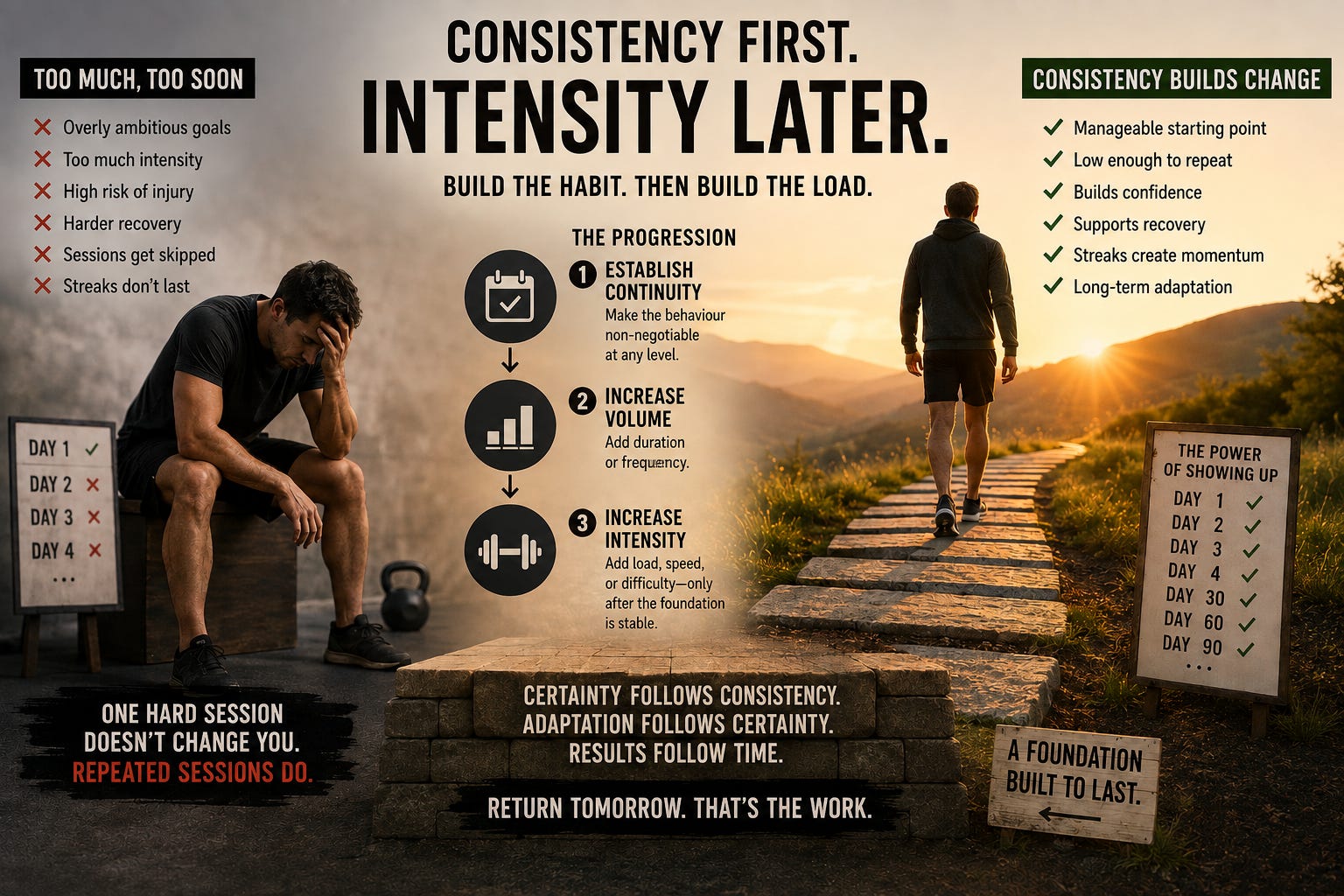
Intensity has its place. It’s simply not the place where beginners should start. Here is the beginner’s progression:
Establish continuity. The behaviour must become non-negotiable at any level.
Increase volume. Add duration or frequency while keeping the intensity manageable.
Increase intensity. Only after the behaviour is stable and the volume is sufficient should load, speed, or difficulty increase.
The beginner who skips immediately to step three has built a house on sand. The beginner who starts at step one is building a stable foundation.
Beginners don’t fail because the work is too light. They fail because the work isn’t repeated. The body doesn’t care how impressive a single session looks. It cares about what happens again. And again. And again.
A beginner’s real breakthrough isn’t physical, it’s behavioural. It’s the moment they stop trying to force change and instead establish a consistent practice. A streak. A rhythm. A pattern of showing up that becomes harder to break than to maintain.
Intensity will matter later. It will become a lever you can pull once the foundation is stable. But until then, the only metric that moves the needle is whether you return tomorrow. Continuity is the beginner’s superpower. Intensity is an advanced trainer’s privilege.
Even so, intensity only rests on the stable foundation of a consistent practice. That will never change.
When you’re ready to turn consistency from an idea into a solid practice, go to exercisingconsistency.com to start your Day 1 in The ACT Score Challenge.
That’s it for today. Catch you next time.
Comments
Nothing yet. Say the first thing.
Sign in to join the conversation.