
Reinvention is still romanticized. A breaking point. A bold leap. A dramatic pivot. That story is emotionally compelling, and strategically useless. In real careers, reinvention rarely happens in one move. It happens through deliberate reconfiguration across a few critical dimensions. When those dimensions are misaligned, reinvention feels chaotic and risky. When they’re aligned, reinvention becomes methodical, repeatable, and far less fragile. This is the Reinvention Quadrant.
Most reinvention attempts fail for the same reason. People change one dimension of their professional life and expect the rest to catch up.
They change skills but not identity.
They change identity but not networks.
They change networks but not systems.
The result is instability. Reinvention becomes emotionally exhausting because the system is fighting itself.
High-functioning reinvention works differently. It treats change as a four-part alignment problem, not a personal reinvention narrative.
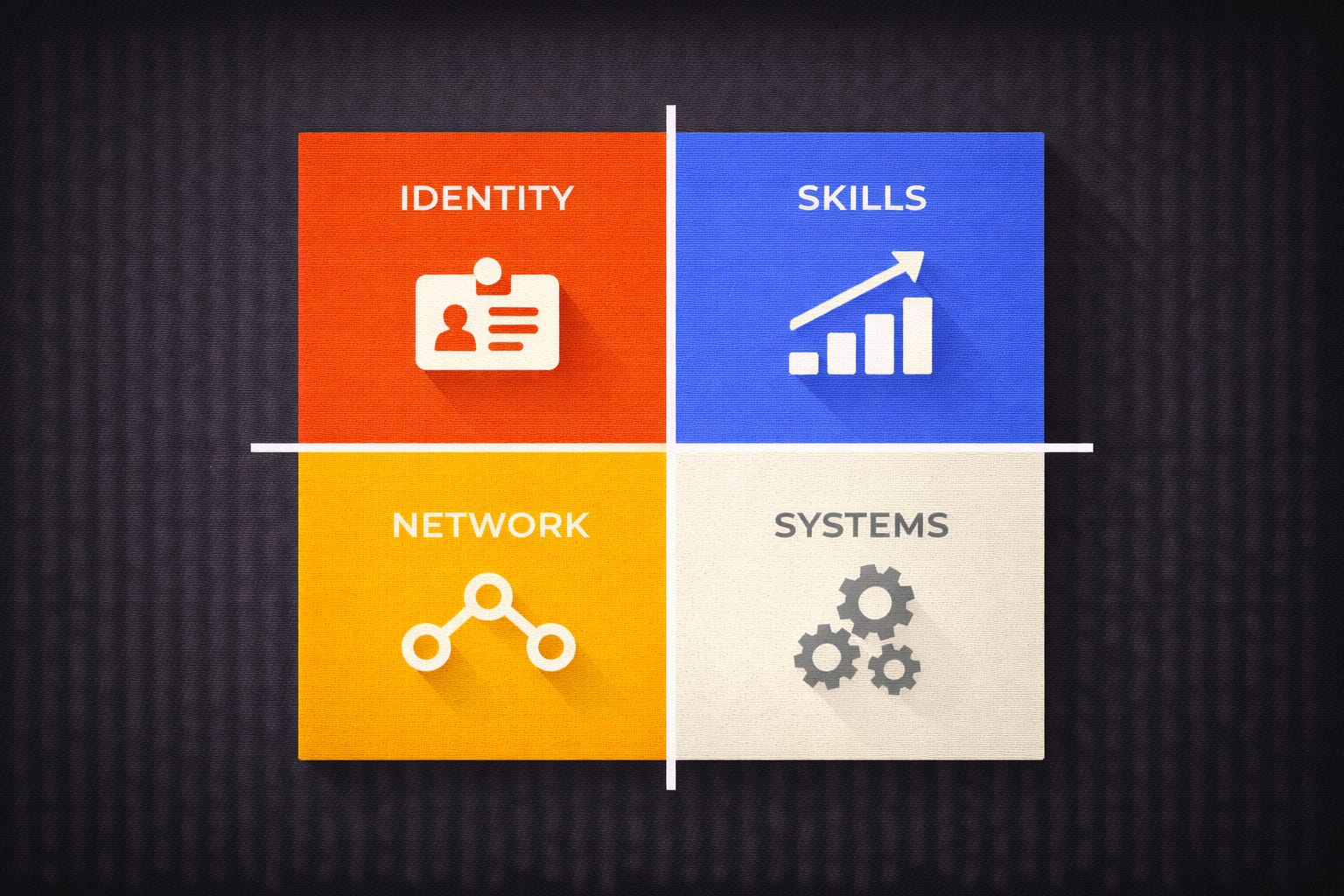
The Reinvention Quadrant is built on four interdependent dimensions:
Identity — How you are perceived and how you frame your value
Skills — What you can reliably do at a professional level
Network — Who recognizes, validates, and amplifies your value
Systems — How your work, income, and momentum are supported
Reinvention succeeds when these four move intentionally and in sequence.
Let me break down each one.
Who you are allowed to be next
Identity is not self-expression. It is market positioning.
It includes:
How you describe your value
What problems you are associated with
What level of work you are trusted with
Reinvention often stalls here because people try to feel different before they are seen differently.
Identity shifts are strongest when they are:
Anchored to prior credibility
Explained through continuity, not rupture
Reinforced consistently through language and choices
Failure mode:
Declaring a new identity without evidence to support it.
Example:
Weak framing: “I used to be in finance, but now I’m a strategist.”
Strong framing: “I spent 10 years in finance optimizing capital allocation. Now I apply that same systems thinking to organizational strategy.”
See the difference? One erases credibility. The other compounds it.
Stabilizing move:
Reframe past experience through a new lens instead of discarding it.
What you can execute credibly
Skills are the most visible part of reinvention and the most overemphasized.
New skills matter, but only when they:
Support the new identity
Are legible to the network you want to enter
Can be demonstrated, not just claimed
Skill accumulation without identity alignment leads to confusion.
Skill acquisition without systems leads to burnout.
Failure mode:
Over-investing in learning without creating leverage.
Example:
Someone taking course after course, collecting credentials, staying in “learning mode” because it feels safer than demonstrating capability.
That’s not reinvention. That’s avoidance.
Stabilizing move:
Build skills that transfer credibility across domains, not narrow expertise that traps you in transition.
Who confirms your reinvention
Reinvention is rarely self-authorized. Networks validate identity shifts long before résumés or titles do.
Your network determines:
Which version of you is believed
What opportunities you are exposed to
How fast your new identity becomes credible
This is why reinvention often feels lonely. Old networks reinforce the old version of you. New networks don’t know you yet.
Failure mode:
Trying to reinvent alone or waiting for permission.
Example:
Someone announces their reinvention on LinkedIn, updates their title, and... nothing happens because credibility doesn’t move at the speed of self-declaration. It moves at the speed of network validation.
Stabilizing move:
Cultivate parallel networks before fully exiting the old one. Build new relationships while maintaining old ones. Get validated in the new space before burning bridges in the old one.
What sustains momentum while you change
Systems are the least-discussed yet most decisive part of reinvention.
Systems include:
Income stability
Work rhythms
Decision frameworks
Feedback loops
Energy and recovery structures
Without systems, reinvention relies on emotional endurance. That is not sustainable.
Failure mode:
Burning financial or cognitive runway in the name of change.
Example:
Someone quits their job to “focus on the transition,” burns through savings, takes on financial stress, and has to make desperate decisions that undermine their positioning.
That’s not reinvention. That’s crisis management.
Stabilizing move:
Design transitional systems that protect momentum while identity, skills, and networks evolve. Keep income flowing. Maintain energy structures. Protect decision quality.
Reinvention breaks down when one quadrant races ahead of the others.
Identity without skills creates imposter syndrome
Skills without identity creates invisibility
Network without systems creates dependency
Systems without direction creates stagnation
Successful reinvention is not faster. It is more coordinated.
A stable reinvention sequence looks like this:
Don’t erase your past. Reinterpret it. Show how your previous experience compounds at a higher level or in a new domain. This creates continuity, not rupture.
Focus on skills that:
Transfer credibility across domains
Can be demonstrated quickly
Reinforce your target positioning
Avoid getting stuck in eternal learning mode.
Build parallel networks. Engage people who already operate in your target space. Get validated before you fully commit.
Protect:
Income stability
Energy management
Decision quality
Feedback loops
This keeps reinvention from becoming survival mode. This approach reduces risk and preserves confidence. Reinvention becomes an operating plan, not an existential crisis.
Use this to diagnose where your system is breaking:
☐ My target identity is anchored to my past credibility
☐ I can explain my reinvention as evolution, not rupture
☐ My language consistently reinforces the new positioning
If weak: Your identity leap lacks evidence
☐ I’ve identified skills that transfer credibility
☐ I can demonstrate (not just claim) new capabilities
☐ My skills reinforce my target identity
If weak: You’re overlearning without leverage
☐ New people are validating my target identity
☐ I’m building parallel networks before exiting old ones
☐ I’m getting invitations aligned to my next chapter
If weak: You’re reinventing in isolation
☐ Income stability is protected during transition
☐ Work rhythms support focus and recovery
☐ Decision frameworks prevent overreach
☐ Feedback loops give me fast, honest signals
If weak: You’re burning runway unsustainably
If reinvention feels unstable, ask:
Which quadrant am I over-relying on?
Most people over-invest in skills (learning mode) while neglecting identity framing, network building, and system design.
Which quadrant am I avoiding?
Common avoidance patterns:
Identity (feels vulnerable)
Network (feels manipulative)
Systems (feels boring)
Where is the system currently misaligned?
The weakest quadrant determines your pace, not your ambition. The answer tells you where to intervene next.
Senior leaders are not defined by linear careers. They are defined by how well they adapt without collapsing momentum.
Understanding reinvention as a system signals:
Strategic self-awareness
Risk management discipline
Long-term thinking
Leadership maturity
Reinvention done well does not look dramatic. It looks intentional.
Reinvention is not about becoming someone new. It’s about realigning identity, skills, network, and systems so the next chapter is credible, sustainable, and powerful. When reinvention is designed, not dramatized, it stops being scary and starts being strategic.
Most people delay reinvention because they think it has to be chaotic to be real. It doesn’t. The most successful reinventions are the ones nobody sees coming — because they’re executed so methodically that they look inevitable in retrospect. That’s not luck. That’s coordination.
Sources:
Research on career transitions, professional identity shifts, and organizational change management
Next in this series: The Execution Sprint Playbook — Running six-week cycles that beat one-off effort and stalled plans.
Comments
Nothing yet. Say the first thing.
Sign in to join the conversation.