
Execution doesn’t fail because people don’t work hard. It fails because effort isn’t cycled. Most execution problems are misdiagnosed. Teams are told to focus more. Individuals are told to push harder. Leaders are told to “hold people accountable.” None of that fixes the real issue.
Execution fails when work is treated as a continuous grind instead of a designed cycle. High-performing leaders don’t rely on bursts of effort or vague momentum. They run execution sprints with clear outcomes, defined checkpoints, and deliberate recovery built in. Progress compounds because the system resets cleanly instead of bleeding energy indefinitely.
Most people execute in an “always on” mode. There is no start, no finish, and no reset. Work expands to fill all available energy. Priorities blur. Progress becomes hard to measure. Eventually, output slows and burnout rises.
Research on performance cycles consistently shows that bounded execution periods outperform continuous effort. Teams that work in defined cycles with clear goals and reflection points deliver higher quality results and sustain performance longer than those operating in open-ended execution modes. Execution needs shape.
An execution sprint is not about speed.
It’s about containment.
A sprint creates:
Clear scope
Temporal boundaries
Focused objectives
Feedback loops
Psychological safety to finish
The goal is to finish something meaningful and roll the learning forward, not to do everything.
Six weeks is intentional. It’s long enough to create real outcomes and short enough to maintain intensity without burnout.
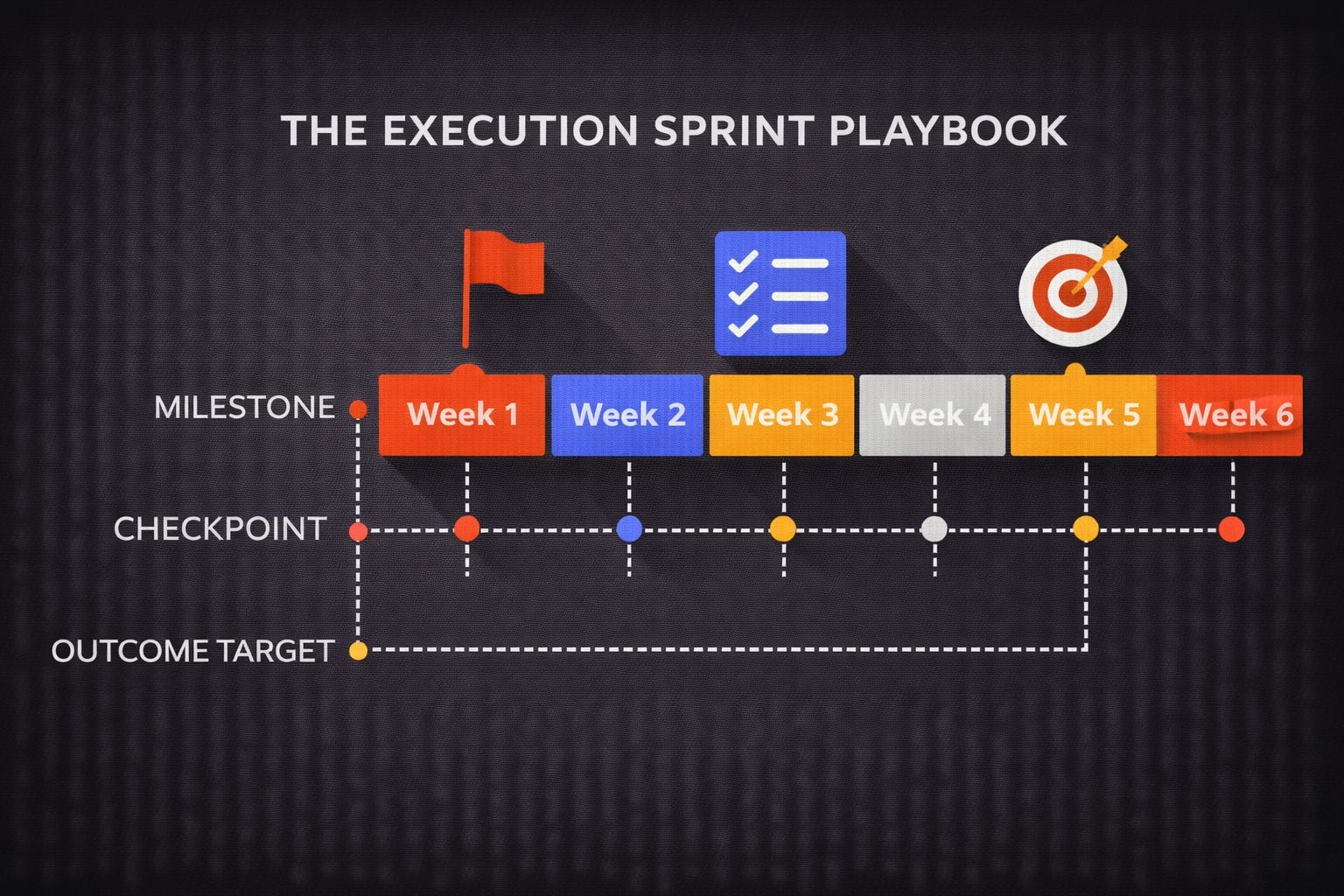
Each sprint follows the same structure. Consistency is what creates leverage.
Design before motion
Every failed sprint starts with a weak setup.
Before the sprint begins, define:
1. Outcome Target
What must exist at the end of six weeks that does not exist now? This is not a task list. It is a deliverable or decision.
Bad outcome: “Make progress on the strategic plan”
Good outcome: “Complete Q2 strategic plan with finalized budget allocations and executive sign-off”
2. Success Criteria
How will you know this sprint worked? Be specific. Ambiguity kills execution.
Bad criteria: “Good progress made”
Good criteria: “Plan approved by board, budget locked, team briefed”
3. Non-Goals
What is explicitly out of scope? Focus is enforced by exclusion.
Checkpoint:
If you cannot describe the sprint outcome in one sentence, the sprint is not ready.
Turn intent into executable parts
Week one is about clarity, not output.
Break the outcome into:
Major components
Decision dependencies
Known risks
Sequence work logically instead of reactively. This week prevents false starts and mid-sprint thrashing.
Checkpoint:
Everyone involved can explain how their work connects to the outcome.
Convert effort into visible progress
This is where most of the work happens.
The rule in the build phase is simple:
Work must create visible artifacts
Progress must be reviewable, not assumed
Artifacts reduce uncertainty and prevent rework. Avoid introducing new goals during this phase. Stability beats novelty.
Checkpoint:
By the end of week three, at least 50% of the outcome should be tangible.
Correct without restarting
Week four exists to prevent silent failure.
Review:
What is working
What is behind
What assumptions were wrong
Make course corrections, not scope expansions. This is not a status meeting. It is a decision point.
Checkpoint:
There is a clear plan to finish without heroic effort.
Prepare the outcome for reality
This week is about readiness. Polish, validate, test, and integrate the output so it can survive outside the sprint. This is where many teams rush and undermine their own work. Finish strong, not fast.
Checkpoint:
The outcome is usable by someone who was not part of the sprint.
Turn execution into learning
This week is non-negotiable.
Do three things:
1. Close the Sprint
Declare it done. No lingering tasks.
2. Capture Learning
What worked? What didn’t? What will change next cycle?
3. Reset Energy
Recovery is part of the system, not a reward.
Without this step, execution decays over time.
Checkpoint:
Learning is documented and informs the next sprint design.
Execution sprints work because they:
Create finish lines
Reduce cognitive load
Improve decision quality
Prevent burnout
Turn effort into institutional knowledge
Most importantly, they compound. Each sprint makes the next one cleaner, faster, and more effective.
These turn sprints back into endless effort:
Vague outcomes
“Improve the platform” is not an outcome. “Deploy v2.0 with 3 validated customer use cases” is.
Scope creep disguised as “improvement”
“While we’re at it, let’s also...” is the death of sprints.
Skipping mid-sprint review
Silent failure is still failure. Week 4 exists for a reason.
Treating recovery as optional
Week 6 reset is not a luxury. It’s what makes the next sprint possible.
Rolling sprints together without reset
Sprint 1 → Sprint 2 → Sprint 3 without breathing room = eventual collapse.
Use this for every sprint:
Outcome Target:
Success Criteria:
Non-Goals (Explicitly Out of Scope):
Readiness Check:
☐ Outcome is tangible
☐ Success criteria are specific
☐ Non-goals are explicit
Major Components:
Dependencies & Decision Points:
Known Risks:
Key Build Activities:
Artifacts to Produce:
Focus Protection Rules:
What’s Working:
What’s Behind:
What Assumptions Were Wrong:
Course Corrections:
Validation & Testing:
Integration Steps:
Readiness Criteria:
Sprint Closure Date: _____________
What Worked:
What Didn’t:
What Will Change Next Sprint:
Energy Reset Plan:
If execution feels heavy, ask:
Do my initiatives have real finish lines?
If you can’t point to a date when something is “done,” it’s not a sprint — it’s drift.
Are outcomes defined or implied?
Implied outcomes guarantee disappointment.
Do we stop, learn, and reset — or just keep pushing?
If you never reset, you’re not executing in cycles. You’re grinding. If the answer is no, the problem is not discipline, it’s design.
Senior leaders are evaluated on consistent delivery over time.
Leaders who run execution as a system:
Scale results without scaling stress
Build trust through reliability
Deliver progress that compounds
Protect energy without sacrificing ambition
Execution maturity is leadership maturity.
One-off effort burns people out. Execution sprints build momentum.
When work is designed in cycles:
Progress becomes visible
Decisions stabilize
Energy is protected
Results compound
Execution stops being heroic and starts being professional. Most organizations confuse motion with momentum. They measure hours, not outcomes. They reward effort, not delivery. Sprints fix this.
Six weeks. Clear outcome. Clean reset. Repeat.
That’s not hustle culture. That’s operating discipline.
Sources:
Research on performance cycles, agile methodology, and sustainable execution practices
Final episode in this series: The Leadership Validity Loop — How leaders earn trust, influence, and traction through repeatable action.
Comments
Nothing yet. Say the first thing.
Sign in to join the conversation.