
Skills are no longer static. They are layered. For most of our careers, skills were treated as durable assets. You learned something. You got good at it. You built a career on it.
That model no longer holds. In today’s environment, skills decay, mutate, and compound depending on how they are designed and used. Some skills remain foundational. Some are amplified by technology. Others create nonlinear advantage.
The leaders who stay relevant don’t collect skills. They architect skill systems.
Most learning plans still follow an outdated logic:
Identify gaps
Take courses
Add credentials
Repeat
That approach assumes skills age slowly and independently. They don’t. According to the World Economic Forum, nearly 44% of core skills are expected to change within five years — driven primarily by AI, automation, and shifting business models.
McKinsey’s research shows that the highest-performing professionals are not those with the most skills, but those who combine skills across domains in ways that technology amplifies. This is not a volume problem. It is a taxonomy problem.
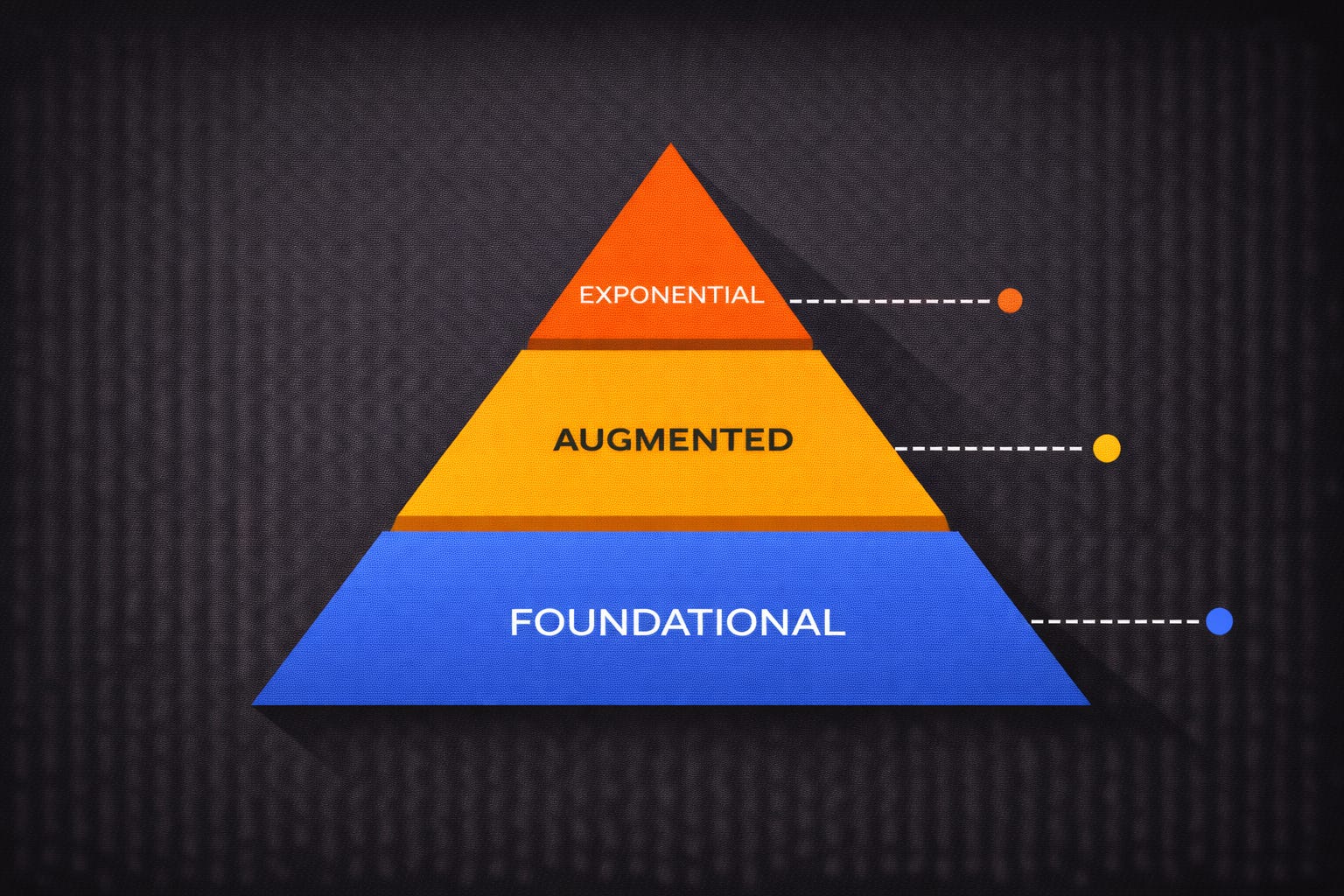
All skills now fall into one of three categories. Each behaves differently over time.
The baseline that enables participation
Foundational skills are the non-negotiables. They create professional credibility and allow you to function effectively, but they rarely differentiate you on their own.
Examples:
Clear communication
Analytical thinking
Domain literacy
Project execution
Basic digital fluency
These skills are necessary — but insufficient. Gartner’s research shows that foundational skills are increasingly assumed, not rewarded. They are table stakes for employability, not advancement.
How they behave over time:
High initial value
Rapid commoditization
Minimal compounding advantage
Foundational skills must be maintained, but they will not future-proof a career.
Human skills amplified by technology
Augmented skills sit at the intersection of human judgment and machine capability. These are skills where technology does not replace you; it multiplies you.
Examples:
Strategic analysis enhanced by AI
Decision-making supported by data models
Creative work accelerated by generative tools
Research, synthesis, and pattern recognition at scale
Deloitte’s research shows that professionals who combine human judgment with AI-enabled tools outperform both purely manual and purely automated approaches.
How they behave over time:
Value increases with tool fluency
Strong productivity lift
Moderate differentiation
Augmented skills reward those who learn how to work with systems, not just inside them. But here’s the limitation: They improve output — but don’t automatically improve leverage.
Skills that compound advantage nonlinearly
Exponential skills are rare, difficult to automate, and disproportionately rewarded. They sit above tools and tasks and shape how systems operate.
Examples:
Strategic judgment under uncertainty
Systems thinking
Narrative and influence architecture
Problem framing and prioritization
Cross-domain integration
Ethical and risk-aware decision design
McKinsey identifies these higher-order cognitive and leadership capabilities as the primary differentiator for senior roles in an AI-enabled economy. These skills do not scale linearly. They compound.
One strong decision framework can outperform thousands of automated tasks.
How they behave over time:
Slow to develop
Hard to copy
High leverage
Career-defining
Exponential skills are what make someone future-ready at the executive level.
Here is the common mistake. People over-invest in foundational skills, dabble in augmented skills, and neglect exponential ones.
The result:
Competent but replaceable professionals
High output, low leverage
Busy careers that plateau
Forrester’s research on digital leadership shows that long-term career resilience comes from decision quality, systems fluency, and influence — not technical depth alone.
Enterprise Example:
Consider two marketing leaders navigating transformation.
Leader A focuses on:
Perfecting execution
Learning new tools
Managing projects flawlessly
Leader B focuses on:
Reframing problems
Aligning stakeholders
Sequencing decisions
Shaping the narrative of change
Both work hard. Only one creates nonlinear impact. That’s the difference between augmented and exponential skills.
Use this to diagnose your current portfolio:
☐ Clear written and verbal communication
☐ Analytical thinking and reasoning
☐ Domain or industry literacy
☐ Project or execution management
☐ Basic digital and data fluency
Score: _____ / 25
0-10: Gap risk (credibility issue)
11-18: Functional baseline
19-25: Strong but likely commoditized
☐ Using AI or data tools to support analysis
☐ Synthesizing large information sets efficiently
☐ Improving decision quality with models or frameworks
☐ Accelerating creative or strategic output with tools
☐ Adapting workflows as tools evolve
Score: _____ / 25
0-10: Under-augmented (manual bottleneck)
11-18: Productive but replaceable
19-25: High output, moderate differentiation
☐ Strategic judgment under uncertainty
☐ Systems thinking and second-order reasoning
☐ Problem framing and prioritization
☐ Narrative and influence architecture
☐ Cross-domain integration
☐ Risk-aware decision design
Score: _____ / 30
0-10: Execution-heavy, leverage-light
11-20: Emerging leverage
21-30: Career-compounding capability
A sustainable learning strategy balances all three layers.
Keep them current
Do not over-invest
These are table stakes. Spending excessive time here is defensive, not strategic.
Learn how tools change decision speed and scope
Focus on workflows, not features
The question isn’t “Can I use ChatGPT?” It’s “How does AI change my strategic analysis workflow?”
Practice strategic thinking, not just execution
Study systems, incentives, and trade-offs
Develop narrative clarity and influence
Your goal is not to learn more.
It is to move up the leverage stack.
Ask yourself:
Which of my skills would still matter if tools changed tomorrow?
If most of your skills are tool-dependent, you’re over-indexed on augmented and under-indexed on exponential.
Where does technology amplify my judgment instead of replacing it?
This is where augmented skills live. If technology is replacing you, not amplifying you, those skills are commoditizing.
What decisions do I make that create disproportionate impact?
This is where exponential skills show up. If this answer is unclear, your leverage is too low.
The answers reveal whether your skill portfolio is future-ready — or quietly decaying.
Based on your self-assessment, design your next quarter:
Priority: Fix credibility gaps immediately
Time Investment: 30% of learning time
Action: Target the 1-2 skills causing the most friction
Priority: Learn to work with systems, not just in them
Time Investment: 40% of learning time
Action: Redesign one core workflow to integrate AI/data tools
Priority: Build leverage that compounds
Time Investment: 60% of learning time
Actions:
Run weekly decision retrospectives
Practice strategic framing
Map systems and incentives
Develop narrative architecture
Study cross-domain patterns
The goal: Move from execution excellence to strategic influence.
Organizations do not promote people for what they know. They promote people for how they think, decide, and influence under uncertainty.
Leaders who understand skill taxonomy:
Invest learning time strategically
Adapt faster to disruption
Remain relevant across cycles
Build careers that compound instead of reset
This is not about staying employable. It is about staying valuable.
Careers stall because people keep learning the wrong things. Future-ready leaders architect skill systems that compound over time.
Foundational skills keep you credible.
Augmented skills make you faster.
Exponential skills make you valuable.
Know the difference. Invest accordingly.
Sources:
World Economic Forum, The Future of Jobs Report 2023
McKinsey & Company, Skills for the Future World of Work
Deloitte Insights, The Augmented Workforce
Gartner, Top Skills for the Future
Forrester Research, The Future of Work Requires Human Judgment
Next in this series: The Reinvention Quadrant — Making personal and professional reinvention structured, not chaotic.
Comments
Nothing yet. Say the first thing.
Sign in to join the conversation.