
Momentum is not motivation. Most professionals talk about momentum as if it were an emotion. A good week. A burst of energy. A stretch of focus.
That framing is wrong.
Momentum is not how you feel. Momentum is how work behaves over time.
High-impact professionals do not rely on willpower, discipline, or motivation to accelerate results. They design systems that create self-reinforcing forward motion — where progress lowers friction instead of increasing it. This is the Momentum Flywheel, and understanding it is the difference between grinding harder and actually moving faster.
Here’s one of the most consistent patterns in organizational performance research:
Effort does not scale impact.
McKinsey’s work on organizational health shows that sustained performance improvement comes not from intensity, but from reinforcing management systems that make progress easier over time. Organizations that outperform their peers do so by embedding repeatable execution loops, not heroic effort cycles.
The same principle applies at the individual level. When momentum is missing, people compensate by working harder, adding hours, or chasing new tools. That increases cognitive load, decision fatigue, and fragmentation, which further slows progress. Momentum collapses when work requires constant re-starting.
In systems theory, a flywheel is a mechanism where early effort stores energy that reduces the cost of future motion. Once spinning, it takes less input to maintain speed than to start from zero.
Your work operates the same way. A healthy momentum flywheel has five interlocking components. Each feeds the next. Remove one, and acceleration breaks.
Momentum begins with clear direction, not long task lists.
Directional clarity answers:
What matters now?
What does progress look like?
What is explicitly not being worked on?
Research on strategic focus consistently shows that fewer priorities, clearly articulated, outperform broad goal sets. Leaders who reduce ambiguity around direction increase execution speed and alignment.
Signal this lever is working: You can explain your current priority in one sentence without caveats.
Clarity only feeds momentum when it converts into high-leverage execution. This is about actions that directly advance outcomes, not volume.
Execution that produces visible movement feeds the flywheel. Execution that produces activity without progress does not.
Deloitte’s research on performance management highlights that execution tied to outcomes, rather than activity metrics, drives faster improvement and stronger engagement.
Signal this lever is working: Something concrete exists at the end of the week that did not exist before.
Momentum accelerates when progress is visible. Visible progress reduces uncertainty, reinforces confidence, and shortens decision cycles. This is why dashboards, milestones, and artifacts matter. They convert effort into evidence.
Research in behavioral science shows that perceived progress is a stronger driver of sustained engagement than rewards or motivation alone.
Signal this lever is working: Progress itself pulls you forward. You are not forcing momentum.
Confidence in a healthy system is earned certainty, not bravado. When progress is visible, judgment strengthens. People second-guess less, reopen fewer decisions, and spend less energy re-litigating choices. Decision velocity increases without recklessness.
Gartner’s research on decision effectiveness shows that organizations with clearer feedback loops and evidence-based decision practices reduce rework and improve execution speed.
Signal this lever is working: Decisions feel lighter and faster without feeling careless.
The output of the flywheel is not more hours. It’s more capacity.
Capacity to:
Think strategically
Handle complexity
Absorb pressure
Make better trade-offs
This aligns with Forrester’s research on sustainable performance, which shows that systems that reduce friction and cognitive overload outperform those that rely on sustained intensity. That expanded capacity feeds back into clearer direction, and the flywheel spins faster.
Signal this lever is working: You feel less rushed even as output increases.
Momentum grows when systems reinforce it.
Key feeders:
Clear outcome anchors
Protected focus time
Short feedback loops
Visible progress tracking
Fewer priorities revisited weekly
Decisions tied to evidence, not mood
These are structural choices, not personality traits.
Momentum rarely dies from failure. It dies from friction.
Common killers:
Constant reprioritization without completion
Too many parallel initiatives
Measuring effort instead of progress
Invisible wins
Reopening decisions repeatedly
Letting urgency override direction
These drain stored energy until every week feels like a restart. Everest Group’s work on operational efficiency consistently shows that fragmentation and context switching are among the largest hidden drains on performance.
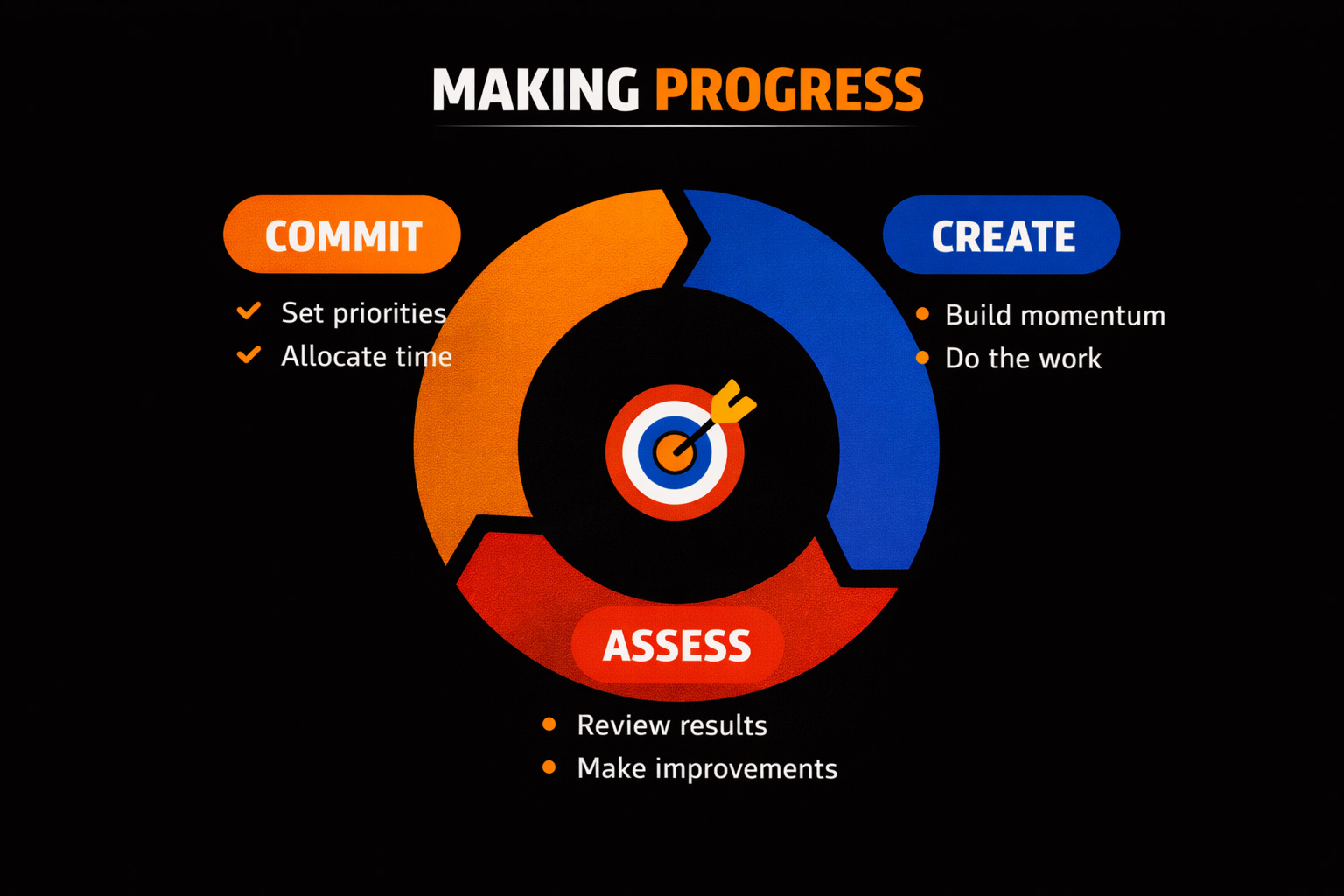
This week, do this:
1. Write one clear directional statement for the next seven days
Example: “Ship the enterprise feature set prototype and validate it with three target customers.”
Not: “Make progress on the product.”
2. Choose one execution block that directly advances it
Example: “Tuesday 9-12: Build feature prototype. Thursday 2-4: Run customer validation calls.”
3. Define what visible progress will exist by week’s end
Example: “Prototype deployed, customer feedback documented, decision on next iteration made.”
4. Capture that progress in writing or visuals
Don’t let wins disappear. Document them. Screenshot them. Log them.
5. Use it to inform next week’s direction
The evidence from this week powers the clarity for next week.
Repeat.
Momentum is not something you summon. It’s something you design.
Use this weekly to diagnose where the loop is breaking:
☐ I can state my primary direction in one sentence
☐ I know what progress looks like
☐ I’ve explicitly excluded non-priorities
☐ My execution directly advances my direction
☐ Something tangible exists that didn’t exist before
☐ I protected execution from fragmentation
☐ Progress is captured and visible
☐ I reviewed evidence this week
☐ Progress reduces my uncertainty
☐ Fewer decisions reopened this week
☐ My judgment feels grounded in evidence
☐ Decision-making feels lighter
☐ I have more strategic bandwidth than last week
☐ Pressure feels more manageable
☐ Output increased without adding hours
If any section shows weakness, that’s where the flywheel is breaking. Fix the weakest link first. Momentum resumes when the loop is intact.
Organizations do not promote or hire based on effort. They bet on people who create sustained acceleration.
Leaders who understand momentum as a system:
Scale impact without burnout
Create stability under pressure
Increase decision velocity
Build trust through consistency
That is not productivity. That is operating maturity, and it is one of the clearest signals of readiness for the next level.
Momentum is something you build once and protect fiercely, not something you chase.
Design the flywheel.
Feed it deliberately.
Remove what creates drag.
When momentum is real:
Acceleration becomes normal
Burnout stops being the cost of progress
And growth stops feeling fragile
That’s systems thinking, and that’s how high performers actually operate.
Sources:
McKinsey & Company, Organizational Health Index
Harvard Business Review, The Power of Small Wins
Deloitte Insights, Reinventing Performance Management
Gartner, Decision Effectiveness Research
Next in this series: The Burnout Breakpoint Model — Diagnosing system overload and institutionalizing sustainable recovery.
Comments
Nothing yet. Say the first thing.
Sign in to join the conversation.