
Most people are using AI wrong. They’re treating it like Excel macros or email rules — a convenience layer. Faster drafts. Quicker summaries. A little automation sprinkled on broken workflows. That’s not where the real advantage is.
Here’s the truth: AI isn’t a tool you plug into a workflow. Its strategic value comes when you treat it as an operating system, a decision-centric framework that accelerates outcomes, not just tasks.
The companies that derive real value from AI don’t sprinkle it on their to-dos. They embed it into their decision architecture so that AI augments human insight, amplifies strategic advantage, and reduces time-to-value. According to recent research, only about 5% of companies meaningfully benefit from AI investments. The ones that do? They tie adoption to decision impact, governance, and workforce integration.
Let me show you how.
Here’s why so many AI initiatives stall out. They start with the wrong question.
Most teams ask: “What can AI help us automate?”
High-performing teams ask: “Which decisions determine our outcomes, and where does human cognition hit its limits?”
That distinction matters. AI does not create value by doing tasks faster. It creates value by augmenting decision-making under complexity. When AI is bolted onto workflows without decision intent, three things happen:
It accelerates low-value work
It obscures accountability
It creates false confidence in outputs
That’s why you see organizations with dozens of AI pilots and almost no sustained impact. AI needs an operating model, not enthusiasm.
When I say “AI operating system,” I’m not talking about software. I’m talking about a decision architecture that governs:
Where AI is allowed to participate
What role it plays
Where humans must remain in control
How outputs are evaluated
When AI should not be used at all
Think of it this way. Your human brain is excellent at:
Judgment
Ethics
Context
Trade-offs
Meaning
AI is excellent at:
Pattern recognition at scale
Synthesis across large information sets
Scenario exploration
Consistency under repetition
An AI operating system allocates cognition intentionally. It doesn’t replace humans. It reinforces them where leverage exists.
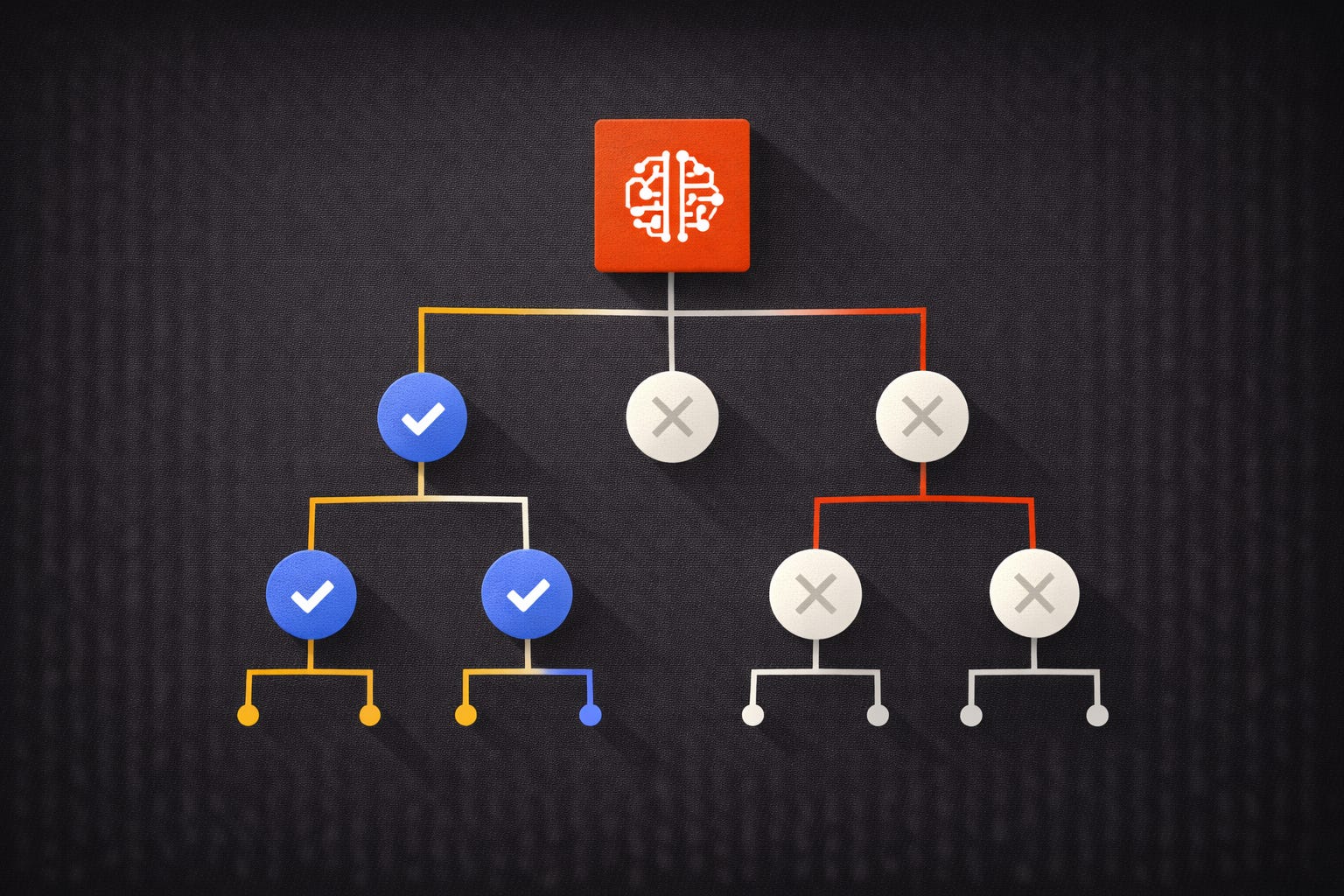
Here’s the framework. Use it before adopting any AI workflow.
Question: Is this workflow tied to a key strategic outcome?
Examples of strategic outcomes:
Revenue growth or pipeline quality
Decision velocity
Risk reduction
Customer experience improvement
Strategic insight or foresight
If NO → STOP.
AI should not be applied to non-strategic work.
If YES → Proceed to Step 2.
Why this matters: Strategic integration aligns AI with decision outcomes rather than focusing solely on task automation. This is the pattern seen in organizations that amplify innovation and competitiveness.
Question: Is the work data-rich and pattern-dependent?
Does it involve:
Repeated synthesis
Large information volumes
Signal detection
Scenario comparison
Classification or prioritization
If NO → Reassess task design.
AI may offer limited value. Consider whether this task should be redesigned entirely.
If YES → Proceed to Step 3.
Tasks with well-structured data and recurring patterns are where AI can reduce cognitive load and accelerate insight.
Question: Does this workflow span multiple steps, handoffs, or systems where humans are forced to manually stitch context and data together?
Indicators:
Multiple tools or platforms
Manual context switching
Repetitive re-entry of information
Human “glue work” holding steps together
If NO → AI may add automation but not strategic coherence.
If YES → Proceed to Step 4.
AI operating systems shine when they reduce friction across handoffs — not just within single, siloed tasks.
Question: Is the data required for AI accurate, structured, accessible, and representative of what you need to make decisions?
Check:
Data is structured or can be structured
Data is accurate and up-to-date
Data access is reliable
Data represents the decision context well
If NO → Fix data readiness first.
AI does not fix bad data. It industrializes it.
If YES → Proceed to Step 5.
AI systems are only as good as their data. Ensuring data readiness before integration reduces biased outcomes and improves reliability.
Question: Have you defined accountability, monitoring, and safety guardrails for the AI application?
Consider:
Human-in-the-loop checkpoints
Output review and validation
Bias and error monitoring
Data privacy and compliance
Clear ownership of outcomes
If NO → Establish governance first.
AI without accountability is not innovation. It’s a liability.
If YES → Proceed with integration.
AI at scale requires governance frameworks that align with strategic goals and ethical standards, transforming AI from a risky experiment into a trustworthy operational asset.
Here’s how you use the decision tree:
1. Identify candidate workflows that link to outcome anchors in your Strategic Year Map (revenue signals, engagement metrics, cost drivers).
2. Run each candidate through the decision tree — only workflows that pass all stages should move forward to design.
3. Design the AI integration modularly — prototypes that surface value fast and iterate quickly.
4. Embed monitoring and governance so your AI outputs are reliable and ethically aligned.
5. Review quarterly — adjust based on outcomes, not opinions.
This aligns with best practices in enterprise AI planning: making AI not just a productivity booster but a decision amplifier that enhances strategic foresight, risk management, and execution quality.
Let’s ground this in practice.
AI Role: Synthesizes signals, trends, and scenarios across large data sets
Human Role: Chooses trade-offs, defines direction, applies judgment
Decision Augmented: Strategic priority selection
AI Role: Identifies patterns and risk flags in prospect behavior
Human Role: Decides prioritization and engagement strategy
Decision Augmented: Resource allocation and sales focus
AI Role: Explores variations and audience resonance patterns
Human Role: Defines narrative, ethics, and brand intent
Decision Augmented: Message optimization for strategic alignment
Same model. Different domains. Framework first. Tools second.
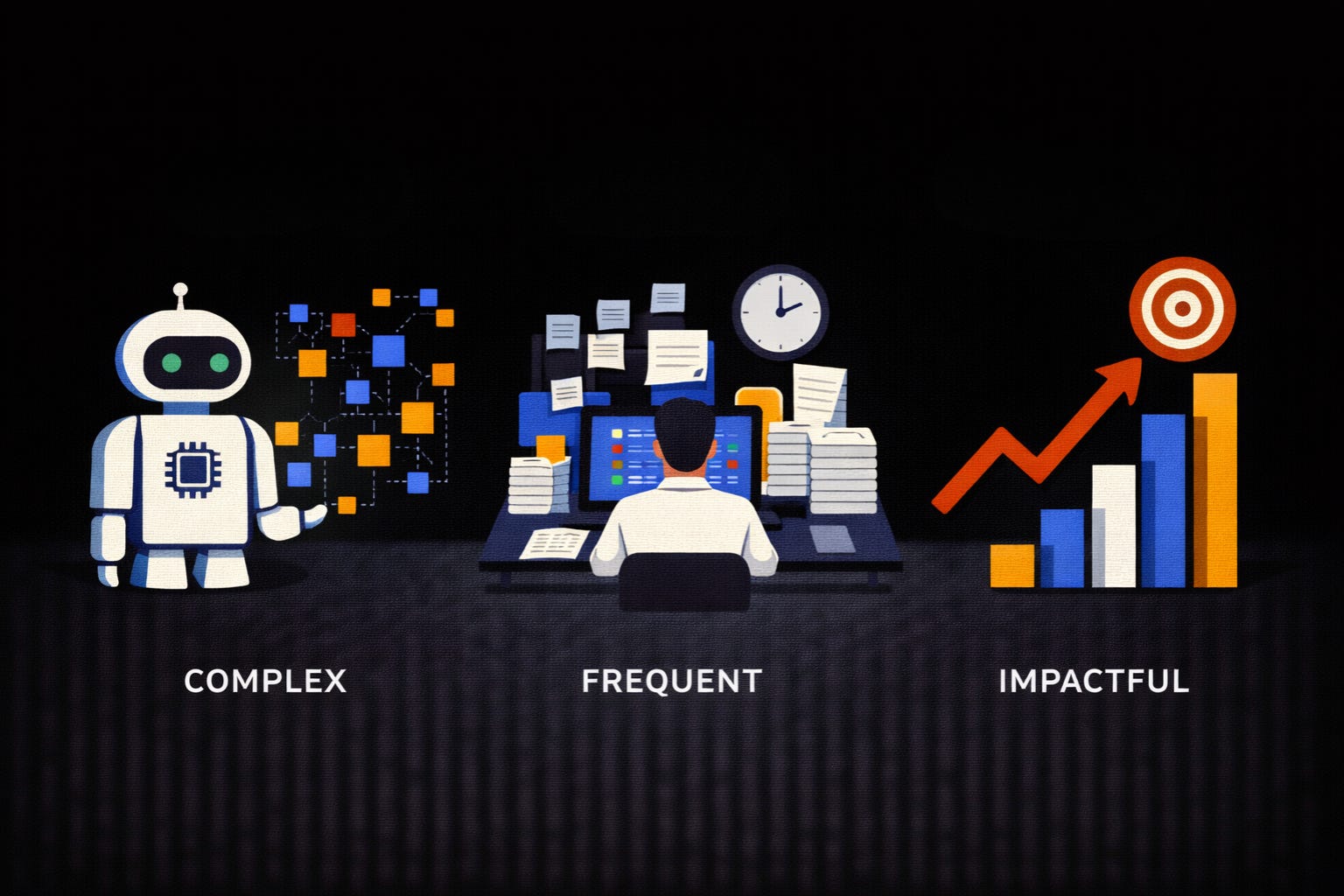
AI doesn’t fail because of technology limits. It fails when leaders treat it as a tool only instead of a strategic partner in decisions. The companies that succeed with AI integration embed it where decisions are:
Complex — requiring pattern recognition beyond human scale
Frequent — where scale makes manual handling slow or inconsistent
Impactful — tied to outcomes that influence competitive advantage
This is consistent with research showing successful AI adopters combine tactical pilots with governance, data readiness, and strategic alignment across workflows.
Use this to evaluate any AI opportunity:
Workflow Name: _____________
Owner: _____________
Strategic Outcome Influenced: _____________
☐ Step 1: Tied to strategic outcome?
☐ Step 2: Data-rich and pattern-dependent?
☐ Step 3: Workflow spans multiple handoffs/systems?
☐ Step 4: Data is ready (accurate, accessible, representative)?
☐ Step 5: Governance and accountability defined?
Decision(s) AI Will Augment:
AI Role in Workflow:
☐ Insight generation
☐ Pattern recognition
☐ Decision support
☐ Scenario modeling
☐ Synthesis/summarization
☐ Orchestration across steps
Human Oversight Points:
Success Metrics (Outcome-Based):
List three recurring workflows in your personal or team operations that influence strategic outcomes
Apply the AI Integration Decision Tree to each
For every workflow that passes all stages, create a draft integration plan that:
Defines the decision(s) AI will augment
Lists the data inputs needed
Outlines governance guardrails
Includes a pilot measurement plan
By focusing AI on decisions that move outcomes rather than tasks that feel busy, you elevate AI from a cost center to a strategic operating system that accelerates impact.
AI is not your shortcut. It’s your multiplier — if you design for it intentionally.
Treat it like an operating system:
Governed
Outcome-anchored
Decision-centric
Human-directed
If you do that, AI doesn’t just save time. It changes what’s possible. That’s the difference between using AI and leading with it.
Sources:
Business Insider, Companies Seeing Value from AI Investments
OpenAI, AI in the Enterprise: Strategic Integration
The Strategy Institute, AI in Strategic Planning Processes
Microsoft Learn, Cloud Adoption Framework for AI
Next in this series: The Momentum Flywheel — Building repeatable systems that sustain progress without burnout.
Comments
Nothing yet. Say the first thing.
Sign in to join the conversation.