
Burnout is still discussed as if it were an individual weakness. A resilience issue, a mindset gap, or a work-life balance problem.
That framing is outdated and dangerous. At scale, burnout is not an emotion. It is a system breach and like any breach, it follows patterns, thresholds, and failure modes that can be diagnosed early, managed deliberately, and prevented from cascading.
This is the Burnout Breakpoint Model. A rigorous diagnostic framework that treats burnout the way high-performing organizations treat risk, reliability, and operational continuity.
Despite increased awareness, burnout continues to rise among senior professionals and leaders.
The World Health Organization classifies burnout as an occupational phenomenon driven by chronic workplace stress that has not been successfully managed.
It is not a medical condition. It is a management failure signal.
McKinsey research shows that burnout risk is highest among high performers, not low performers — particularly in roles with sustained cognitive load, ambiguous priorities, and constant decision pressure.
The issue is not workload alone. It is unmanaged strain across multiple system dimensions.
Burnout occurs when strain crosses a threshold in three core dimensions at the same time. Individually, each dimension is survivable.
Together, they trigger system failure.
Dimension 1: Load Intensity
Dimension 2: Control Degradation
Dimension 3: Recovery Debt
Burnout is not the presence of stress. It is the absence of recovery capacity after thresholds are crossed.
Load intensity measures how much cognitive, emotional, and decision load a system is carrying. High load is not inherently bad. The problem is sustained high load without modulation.
Key indicators:
Continuous high-stakes decision making
Persistent context switching
Escalating responsibility without scope reduction
Compression of timelines without removal of complexity
Deloitte research shows that unmanaged workload intensity is strongly correlated with reduced decision quality and increased error rates over time, even among senior leaders.
Breakpoint signal:
Performance holds steady, but effort required to maintain it increases week over week.
Enterprise Example:
Consider a product leader at a global software company undergoing platform consolidation.
They’re managing:
Overlapping roadmaps
Customer escalations
Architecture decisions with incomplete data
Coordination across regions and time zones
Workload is high but manageable at first. The breakpoint emerges when scope keeps expanding, decision stakes rise, and there’s no corresponding reduction elsewhere. The leader doesn’t collapse. They compensate, and that compensation hides the problem.
Control degradation occurs when professionals lose the ability to influence:
Prioritization
Pacing
Scope
Decision sequencing
This is the most overlooked burnout driver. Gartner research shows that perceived loss of control is a stronger predictor of burnout than hours worked. Leaders burn out faster when they cannot shape how work flows through them.
Breakpoint signal:
Reactivity replaces intention. Decisions feel imposed rather than chosen.
Enterprise Example:
Think of a marketing leader in a PE-backed organization. New initiatives arrive weekly. Deadlines are externally imposed. Requests are labeled “urgent” by default. Even if hours don’t increase dramatically, autonomy collapses. The leader becomes reactive. Work stops being chosen and starts being absorbed.
This is critical: Perceived loss of control burns people out faster than long hours.
Recovery debt accumulates when recovery is deferred repeatedly in favor of output. This is not about vacations. It is about micro-recovery and cognitive restoration built into operating rhythms.
Harvard research shows that sustained cognitive performance requires regular recovery intervals. Without them, error rates and emotional volatility increase even when output appears stable. Recovery debt is invisible until it is not.
Breakpoint signal:
Rest no longer restores. Time off stops working.
Enterprise Example:
Consider a senior engineering leader during a sustained growth phase.
They defer recovery because:
“This is temporary”
“I’ll rest after the launch”
“Once we stabilize”
Except stabilization never quite arrives.
Eventually:
Time off stops restoring energy
Focus degrades
Emotional volatility increases
That’s recovery debt crossing its threshold.
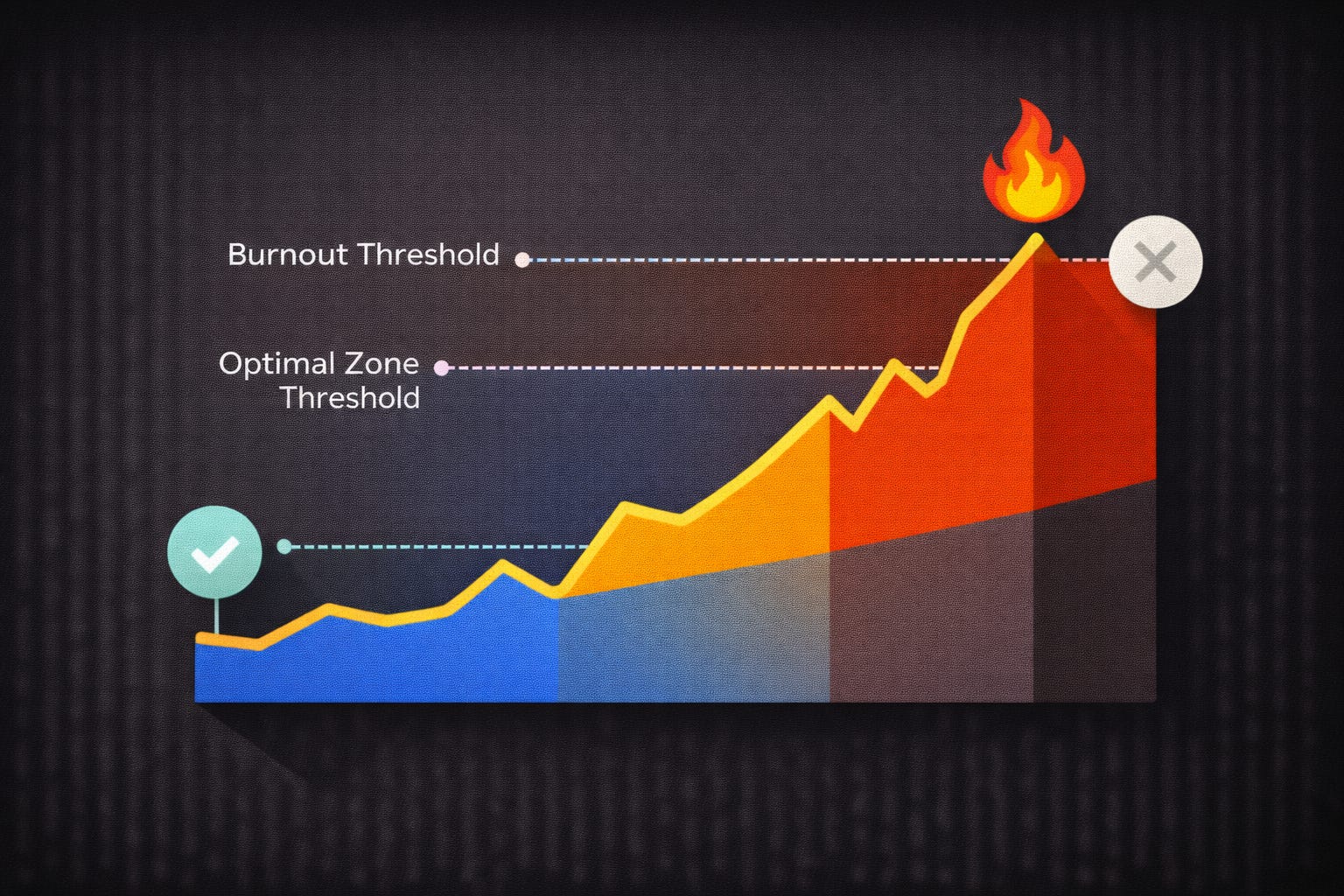
Burnout occurs when:
Load intensity remains high
Control continues to degrade
Recovery debt crosses a critical threshold
At that point, the system compensates by:
Emotional numbing
Cognitive narrowing
Short-term thinking
Reduced empathy
Increased cynicism
Performance may hold briefly. Then it collapses. This is why burnout often surprises people who were functioning well weeks earlier. The system broke before the person did.
Use this to assess current risk:
Rate each statement 0–5 (0 = not present, 5 = severe):
☐ My work requires continuous high-stakes decisions
☐ I am frequently context switching across unrelated priorities
☐ My responsibility has increased without scope reduction
☐ Timelines have compressed without complexity reduction
☐ I am compensating for system gaps personally
Score: _____ / 25
Threshold:
0–8: Manageable | 9–16: Elevated | 17–25: Critical
Rate each statement 0–5:
☐ I have limited influence over what gets prioritized
☐ Work arrives reactively rather than by plan
☐ Deadlines are imposed without negotiation
☐ Decision sequencing is externally dictated
☐ I feel pressure to respond immediately to most inputs
Score: _____ / 25
Threshold:
0–8: Stable | 9–16: Eroding | 17–25: Critical
Rate each statement 0–5:
☐ I delay rest to “get through” the workload
☐ Time off does not fully restore energy
☐ I feel mentally fatigued even after breaks
☐ Emotional volatility has increased
☐ Focus is harder to sustain than before
Score: _____ / 25
Threshold:
0–8: Low | 9–16: Building | 17–25: Critical
Burnout risk becomes acute when two or more dimensions are in the critical range.
☐ Load Intensity Critical
☐ Control Degradation Critical
☐ Recovery Debt Critical
Status:
☐ No immediate risk
☐ Elevated risk
☐ Breakpoint imminent or active
Burnout recovery is not generic rest. It is targeted system repair.
Recovery requires:
Scope reduction
Decision batching
Elimination of low-leverage commitments
Adding capacity before adding expectations
Recovery requires:
Reasserting prioritization authority
Resetting decision rights
Rebuilding pacing autonomy
Reducing reactive work intake
Recovery requires:
Structured recovery rituals
Cognitive unloading
Predictable restoration cycles
Elimination of unnecessary emotional labor
Generic time off without system change leads to relapse.
Burnout should never rely on self-diagnosis or self-correction.
High-performing organizations treat recovery the same way they treat:
Security incidents
Operational risk
Reliability engineering
Capacity planning
Forrester research shows that organizations that institutionalize recovery practices see improved performance sustainability and reduced leadership attrition.
Recovery is not a benefit. It is a business continuity process.
What this looks like in practice:
Load reviews alongside performance reviews
Explicit decision rights and prioritization authority
Protected recovery windows during high-load periods
Early-warning indicators tied to control and recovery debt
Leaders accountable for system balance, not just output
Senior leaders are not judged by how much they can endure. They are judged by how well they design systems that sustain performance.
Understanding burnout as a breakpoint model signals:
Systems literacy
Risk awareness
Leadership maturity
Long-term operating competence
This is not about surviving work. It is about designing work that does not break people who are doing it well.
Burnout is not a personal failure. It is a predictable system failure with measurable thresholds, leading indicators, and recovery pathways. Leaders who see it early and design for recovery protect both performance and people.
If you’re in the elevated or critical range on any dimension, take action now:
Identify your primary driver (Load, Control, or Recovery)
Apply the targeted recovery pathway for that dimension
Change the system, not just your effort level
Monitor weekly using the diagnostic scores
Burnout reverses when system balance is restored. Not through harder work. Through better design.
Sources:
World Health Organization, Burnout Classification
McKinsey & Company, Addressing Employee Burnout
Deloitte Insights, Workplace Burnout Survey
Gartner, Managing Employee Burnout
Harvard Business Review, The Making of a Corporate Athlete
Next in this series: Future-Ready Skills: What Actually Compounds — How to build skill portfolios that grow in value over time.
Comments
Nothing yet. Say the first thing.
Sign in to join the conversation.