
Leadership is not granted. It is verified. Most leadership advice focuses on presence, communication, or vision. Those matter, but they are not what ultimately determines whether a leader gains real traction.
Leadership works when people believe your decisions will hold. Not once. Not occasionally. Consistently.
That belief does not come from authority or intent. It comes from a repeatable pattern of action and feedback that proves you are worth following.
This is the Leadership Validity Loop.
Many leaders are competent, articulate, and well-intentioned — yet struggle to move organizations.
Common symptoms:
Ideas don’t stick
Decisions are quietly bypassed
Alignment erodes after meetings
Momentum dies between initiatives
This is often misdiagnosed as:
Resistance
Culture problems
Communication gaps
In reality, the issue is validity. People don’t resist leaders they trust, but they do hesitate when leadership signals are inconsistent.
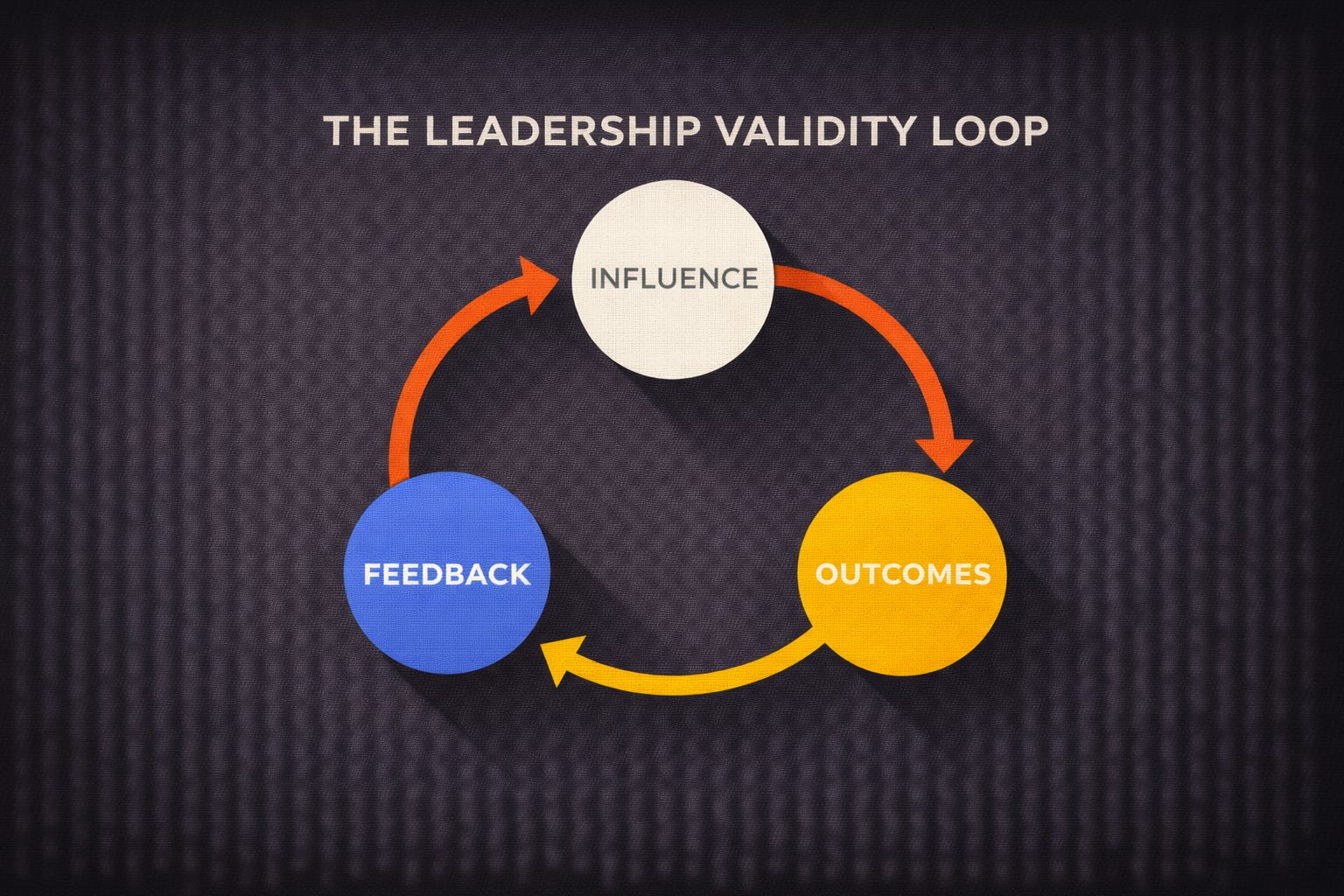
Leadership validity is a feedback loop built over time.
The loop has four stages:
Commitment
Action
Outcome
Feedback
When these stages reinforce each other, leaders gain traction. When the loop breaks, influence decays, often quietly. Let me break down each stage.
What you publicly stand behind
Commitments are leadership signals.
They include:
Stated priorities
Promises made in meetings
Decisions communicated to the organization
Every commitment creates an expectation, whether you intend it to or not.
Failure mode:
Over-committing or signaling intent without follow-through.
Enterprise example:
A leader announces three “top priorities” in one quarter. None receive sustained attention. Teams learn to wait things out.
Validity principle:
Leaders earn trust by being selective, not expansive, in what they commit to.
If everything is important, nothing is believed.
What you actually do when pressure arrives
Action is where leadership credibility is tested.
People watch for:
Consistency between words and behavior
How trade-offs are handled
Whether priorities hold under stress
Small actions matter more than grand gestures. They are harder to fake and easier to remember.
Failure mode:
Letting urgency override stated priorities.
Enterprise example:
A leader declares focus on strategic work but repeatedly interrupts it for urgent noise. The stated priority loses meaning.
Validity principle:
Leadership is validated when actions reinforce commitments, even when inconvenient.
What visibly changes as a result
Outcomes are the proof layer of leadership. They don’t need to be perfect. They need to be real.
Outcomes can include:
Decisions implemented
Work completed
Bottlenecks removed
Clarity increased
Failure mode:
Mistaking effort or activity for outcomes.
Enterprise example:
A leadership team meets weekly, debates issues intensely, but nothing visibly changes. Trust erodes despite hard work.
Validity principle:
People trust leaders whose decisions reliably produce observable results.
What the system reflects back
Feedback closes the loop.
It comes from:
Results data
Behavioral signals
Follow-on trust
Increased willingness to align
Strong leaders actively absorb feedback and adjust, not defensively, but deliberately.
Failure mode:
Ignoring feedback or blaming context.
Enterprise example:
A leader notices teams bypassing a process. Instead of enforcing compliance, they examine why and adjust the next commitment.
Validity principle:
Leadership credibility compounds when feedback informs the next commitment.
Commitments become sharper
Actions become faster
Outcomes become more predictable
Trust increases
Commitments are discounted
Actions are second-guessed
Outcomes lose meaning
Influence erodes
The most dangerous breakdown is inconsistency at the commitment level. Once people stop believing commitments are real, recovery is slow.
Charisma can create attention. Authority can create compliance. Neither creates sustained leadership validity; only repeatable evidence does. This is why some quiet, steady leaders outperform more visible ones over time. Their loop is intact.
Leadership is about being predictably reliable.
Use this to diagnose where your loop is breaking:
☐ I make few, clear commitments rather than many vague ones
☐ My priorities remain stable across weeks, not just meetings
☐ I avoid signaling intent unless prepared to follow through
☐ Stakeholders can accurately restate my priorities
☐ I explicitly name what is NOT a priority
Score: _____ / 25
0-10: Commitments discounted
11-18: Mixed signals
19-25: High credibility signals
☐ My actions align with stated priorities under stress
☐ I protect key priorities from urgent noise
☐ I model trade-offs explicitly rather than implicitly
☐ I intervene when actions drift from commitments
☐ I am consistent even when it is inconvenient
Score: _____ / 25
0-10: Credibility erosion
11-18: Inconsistent reinforcement
19-25: Strong behavioral alignment
☐ My decisions lead to observable changes
☐ Outcomes are visible beyond my immediate circle
☐ Work reaches completion, not perpetual progress
☐ Bottlenecks are removed, not discussed repeatedly
☐ Results can be pointed to without explanation
Score: _____ / 25
0-10: Effort without evidence
11-18: Partial delivery
19-25: Reliable outcomes
☐ I actively seek feedback on outcomes, not just intent
☐ I adjust future commitments based on results
☐ Stakeholders show increased willingness to align
☐ Resistance decreases over time
☐ Decisions stick with less explanation required
Score: _____ / 25
0-10: Feedback ignored or resisted
11-18: Feedback acknowledged but underused
19-25: Feedback drives compounding trust
Total: _____ / 100
0-40: Low trust / high friction
41-70: Fragile validity
71-85: Stable leadership traction
86-100: Compounding leadership validity
Your weakest stage is where your loop is breaking.
That’s where you start repair.
Ask yourself:
Do my commitments reliably turn into action?
If you make commitments that quietly die, you’re training people not to believe you.
Do my actions produce visible outcomes?
If your work is all effort and no results, you’re confusing motion with leadership.
Does feedback meaningfully shape my next decision?
If you’re not adjusting based on what the system tells you, the loop isn’t closing. If any answer is no, the loop is broken there.
Fixing leadership rarely requires a personality shift. It requires repairing the loop.
Senior leaders are evaluated less on ideas and more on follow-through integrity.
Leadership validity:
Reduces friction
Increases decision velocity
Builds alignment without coercion
Sustains momentum through change
Organizations don’t scale on vision alone. They scale on trusted execution.
Leadership is not proven by what you intend. It is proven by what people come to expect from you and are rarely disappointed by. When commitments, actions, outcomes, and feedback reinforce each other, leadership stops being performative and starts being powerful. That is the Leadership Validity Loop.
This is how you earn traction. Not through force. Not through charisma. Through disciplined, repeatable action that builds trust one cycle at a time.
Most leaders fail not because they lack vision or capability. They fail because their loop is broken and they’re trying to compensate with effort instead of fixing the system. Don’t be that leader.
Build the loop. Protect the loop. Let the loop compound.
That’s leadership.
Comments
Nothing yet. Say the first thing.
Sign in to join the conversation.