
Most people think storytelling is what moves teams and stakeholders. They’re wrong.
Generic storytelling — anecdotes, metaphors, feel-good arcs — can be entertaining and memorable without being meaningful for decisions or alignment.
Here’s the truth: High performers know that narrative isn’t about telling a good story. It’s about shaping context, meaning, and action in a way that aligns behavior and decisions behind a shared future.
This is strategic narrative engineering, and it separates elite leaders from the also-rans.
Most business storytelling lands in tropes. Inspirational anecdotes. Clever metaphors. Waves of optimism. That’s fine for entertainment, but influence — especially at the strategic level — requires architecture, not anecdotes.
Traditional narrative approaches lack the connective tissue that makes ideas operationally useful across stakeholders, teams, and decisions. A strategic narrative is more than a collection of stories. It presents a pattern of meaning that aligns people’s understanding of why change matters, how to get there, and what part each stakeholder plays. When narratives are structured intentionally, they help make sense of complexity and guide collective action. This is what leaders actually do when they move organizations.
A strategic narrative is a vision of a desired future connected to the present state through a logical, consequential journey that people can internalize and act on. It goes beyond a slogan or a slide deck. It becomes the throughline people repeat when you’re not in the room. Strategic narratives invite others to participate in that future, rather than just observe it.
This is the difference between communication that informs and communication that aligns action.

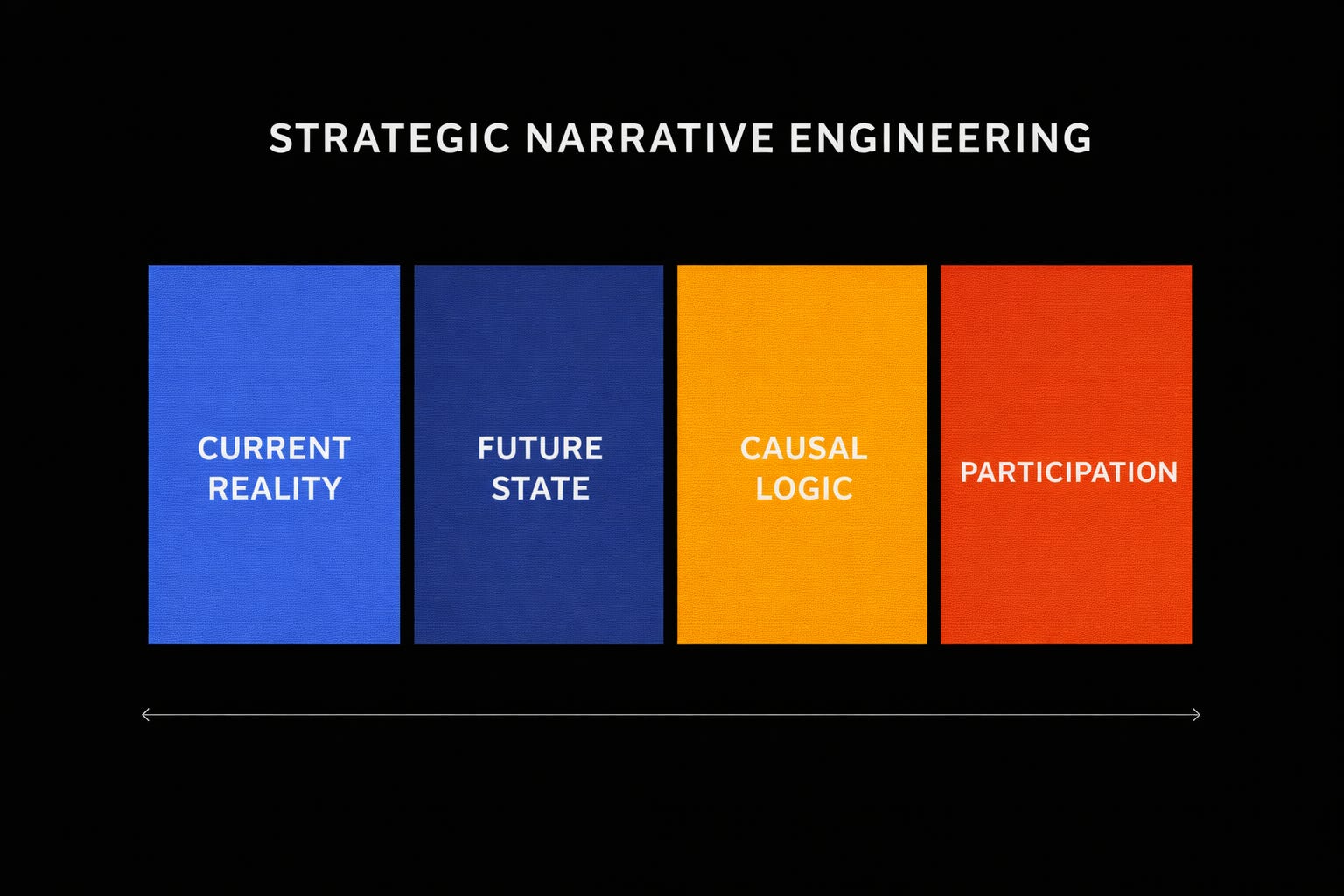
A narrative engineered for influence has four core components. Each part solves a common failure point in typical business communication: lack of context, lack of direction, lack of causality, or lack of participation.
Good influence always starts with a shared understanding of the present state. This isn’t complaining. It isn’t advocacy. It’s precise framing based on observable signals, trends, or data that the audience can agree describes their landscape.
In strategic narrative work, this contextual grounding is essential to establishing why change is necessary before prescribing any path forward. Without shared reality, your narrative floats untethered from experience.
Implementation Anchor:
Summarize the current state in three clear, verifiable observations tied to measurable conditions and business realities.
Example:
Customer acquisition costs have increased 40% YoY
Product adoption rates remain flat despite feature expansion
Competitive pressure has shortened our strategic response window to 90 days
See how this creates tension? It’s factual, not emotional, and that makes it powerful.
Strategy without destination is movement without direction. Your narrative must define a future that is specific, consequential, and meaningful to the audience’s interests. It’s not a value statement. It’s a tangible outcome people can imagine and justify. In practice, this vision becomes a beacon that guides organizational alignment and decisions over time.
Implementation Anchor:
Draft a one-sentence future state that connects strategic outcomes with impact (not activity).
Bad example:
“We’ll become the market leader.”
Good example:
“We’ll generate 60% of revenue from high-margin enterprise contracts, reducing CAC by 50% while doubling customer LTV.”
The difference? One is aspirational noise. The other is measurable direction.
This is the reasoned connective tissue of your narrative. It answers the critical question: Why does the future state follow from the current state if we take this path? Too many strategies fail not for lack of logic, but because the causal links are implicit, not explicit. Your audience won’t connect the dots for you. You have to show them why the path you propose leads to the outcome you promise.
Implementation Anchor:
Write 2–3 “Since... therefore... because...” statements that connect the present state to the future state through strategic drivers.
Example:
Since customer acquisition costs are rising and competitors are compressing our response window, therefore we must shift to enterprise contracts because they deliver higher margins with longer commitment cycles, reducing our vulnerability to CAC inflation while stabilizing revenue.
This is causal logic. It’s explicit, rather than fancy, and that’s what makes it convincing.
People don’t work toward a future they don’t see themselves in. The most persuasive narratives assign roles — they define what participation looks like and why that participation advances the causal pathway. A narrative without roles is a monologue. A strategic narrative is a shared operating context.
Implementation Anchor:
Define roles for the primary stakeholders with clear responsibilities tied to progress markers.
Example:
Product Team: Shift roadmap focus to enterprise feature sets; deliver first enterprise-ready release by Q2
Sales Team: Transition pipeline to 70% enterprise prospects; establish partnership with implementation services
Marketing Team: Develop enterprise positioning and thought leadership content targeting VP+ decision-makers
See how roles connect to the causal logic? Each one advances the path from current state to future state. This is how narrative becomes alignment engineering.
Generic storytelling can engage emotions. Strategic narrative engineering changes behavior.
Here’s the difference:
Generic Storytelling:
Might entertain
Might inspire feeling
Often lacks structure
Rarely aligns decisions
Strategic Narrative Engineering:
Anchors in shared reality
Defines clear outcomes
Connects causal logic
Assigns agency and roles
Guides decisions and alignment
This is why some leaders’ words move organizations while others’ fade into noise. It’s not charisma. It’s architecture.
Choose one strategic communication need this week:
A pitch
A planning meeting
A partnership proposal
A team alignment session
Build its narrative around the four parts:
Write your Current Reality in terms everyone can verify
Define the Future State in outcome-oriented language
Connect them with Causal Logic that makes the progression clear
Assign Participation & Roles so the narrative is shared, not broadcast
Before you share it broadly, test it with a trusted peer. Ask them to paraphrase it back in their own words. If they cannot reflect your logic and roles, refine until they can.
Use this to draft your next high-stakes narrative:
Three verifiable observations: 1. 2. 3.
Tension statement:
(Why is change necessary now?)
One-sentence future state:
(Specific, consequential, outcome-oriented)
Success looks like:
(Observable conditions or metrics)
Link 1:
Since __________, therefore __________ because __________.
Link 2:
Since __________, therefore __________ because __________.
Link 3:
Since __________, therefore __________ because __________.
Role 1:
Stakeholder: __________
Responsibility: __________
Contribution to logic: __________
Progress signal: __________
Role 2:
Stakeholder: __________
Responsibility: __________
Contribution to logic: __________
Progress signal: __________
Role 3:
Stakeholder: __________
Responsibility: __________
Contribution to logic: __________
Progress signal: __________
Companies don’t hire communicators. They hire leaders who shape context, align teams, and make the complex simple. Strategic narratives are a core leadership capability.
Leaders who can engineer narratives that unify audiences and guide decisions across functions and time horizons are the ones organizations bet on for scale, transformation, and sustained impact.
Get this right, and everything you communicate becomes not just a message, but a strategic lever for influence.
Sources:
Forbes, How to Build Strategic Narratives That Inspire and Align
World Economic Forum, Strategic Narrative as North Star
RAND Corporation, How Leaders Approach Narratives
Next in this series: The AI Operating System for Strategic Work — When to apply AI, when not to, and how to keep judgment in the loop.
Comments
Nothing yet. Say the first thing.
Sign in to join the conversation.