
Almost every professional works hard. Very few work at high impact. The difference isn’t effort. It isn’t hours. It isn’t even talent. It’s the levers you pull, how you sequence them, and whether they actually move the needle on outcomes that matter.
Here’s what most people get wrong about performance: They optimize effort, chase habits, and collect productivity tools. However, effort without leverage is just expensive motion.
Elite professionals don’t work harder. They work through strategic mechanisms that amplify results relative to input. These are operating levers. Once you learn to identify and sequence them, you stop grinding and start compounding.
People talk about habits as if behavior change equals impact. It doesn’t.
High performers don’t just do things — they select levers that amplify results relative to effort. A lever is a strategic mechanism you pull that has outsized effects on your outputs. It’s a causal driver, not an output itself.
In organizational research, high-performance work systems show that when practices like autonomy, targeted development, and decision latitude are present, outcomes like performance and innovation improve dramatically.
You don’t optimize effort. You optimize where and how effort intersects with strategy.
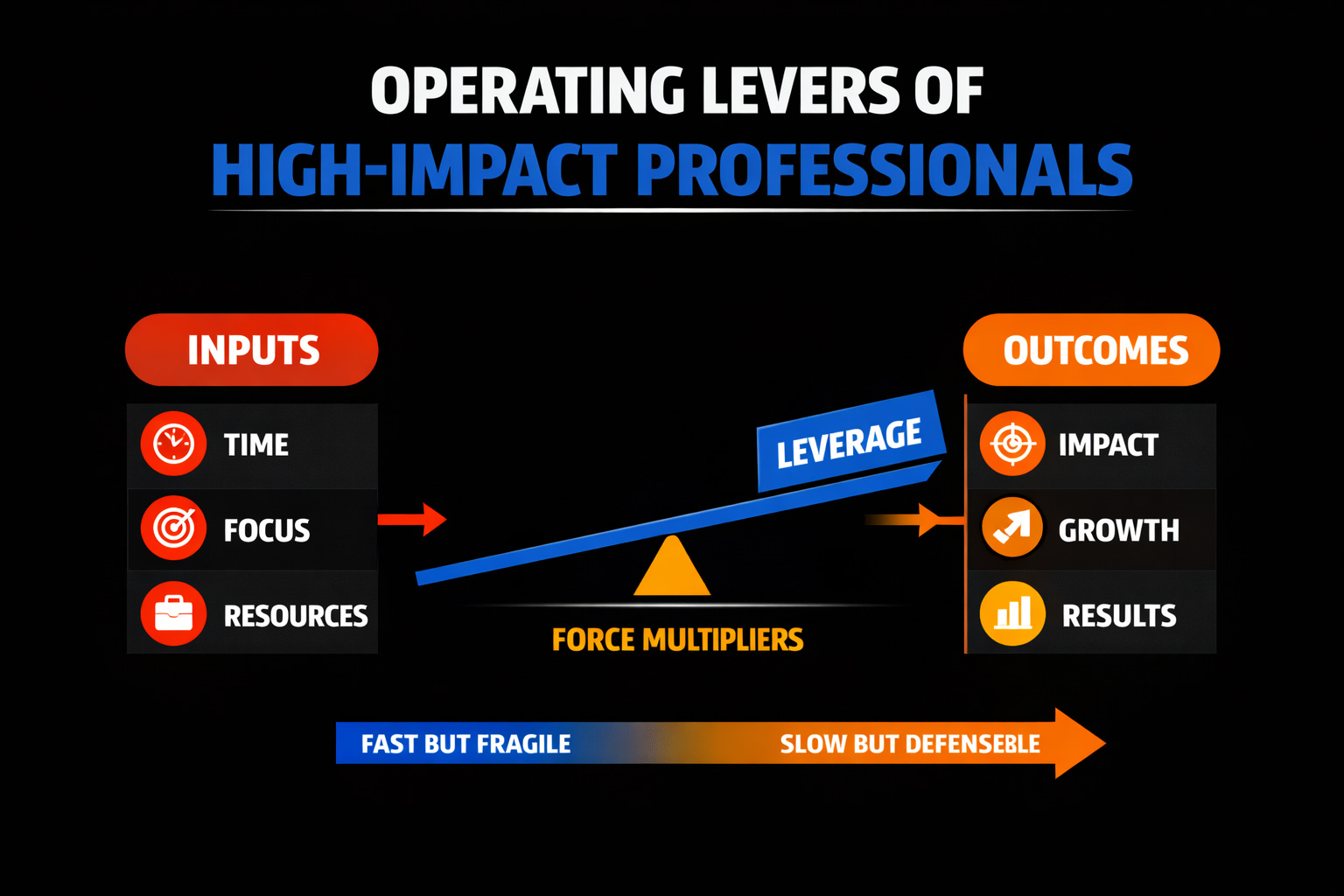
Here are the core levers elite professionals use. Each includes an implementation anchor: a concrete action you can take this week.
Elite performers optimize not just what they do, but why it matters. Contextual performance, actions that support goals beyond narrow task definitions, predicts engagement, satisfaction, and performance outcomes. When you understand how your work connects to strategic outcomes, you make better choices about what deserves your time.
Implementation Anchor:
For every key task this week, write down how it contributes to a strategic outcome. If it doesn’t clearly connect, reassess its priority.
High-impact individuals shape their work boundaries rather than merely respond to them. Autonomy isn’t just independence; it’s decision latitude over how tasks are executed.
Research on high-performance work systems shows that autonomy correlates with greater motivation, engagement, and performance quality.
Why this matters:
When you control how work gets done, you can optimize for outcomes, not just compliance.
Implementation Anchor:
Identify one decision you currently defer.
Rewrite the execution plan with you as the deciding owner — then communicate that plan to stakeholders.
Levers activate when you get fast, directional signals. Systems that build frequent, high-quality feedback loops, not vague praise, but actionable data, accelerate learning and course correction. Without feedback, you’re operating blind.
Implementation Anchor:
Build a weekly feedback ritual: Three data reflections tied to your top outcomes, including one external data point (metrics, user behavior, stakeholder signal).
Track what moves, not just what you do.
Growth isn’t consumption; it’s capability acceleration. Research shows high-performance systems contribute to innovation and positive attitudes by aligning skill development with autonomy and application. Elite performers don’t learn broadly. They invest deeply in the one skill whose improvement will multiply their impact.
Implementation Anchor:
Identify the one skill whose improvement this quarter will multiply your impact. Schedule weekly blocks dedicated exclusively to that skill’s application, not just study. Application trumps absorption.
High-impact performers treat execution like systems design, not ad-hoc hustle. Operational excellence principles, systematic improvement, waste reduction, and flow enhancement directly improve delivery consistency and value output. Tight processes free up cognitive capacity for strategic thinking.
Implementation Anchor:
For a recurring task, map the process end-to-end. Eliminate one late, redundant, or unmeasured step this week.
Elite professionals integrate into networks while driving directional influence. Strategic embedding, connecting with people and systems that accelerate outcomes, isn’t luck. It’s intentional relationship architecture. Your network either amplifies or constrains your effectiveness.
Implementation Anchor:
Identify one relationship this week that can unlock velocity for your key outcome. Initiate a planned engagement with clear expectations and mutual value exchange.
Elite contributors create clarity where others tolerate ambiguity. Research on team performance shows that clarity of norms, how people expect work and feedback to happen, is a stronger predictor of performance than psychological safety alone. When norms are clear, collaboration is faster, and friction is lower.
Implementation Anchor:
At the start of your next collaborative session, set explicit norms for communication, deadlines, and decision rights. Don’t assume alignment. Create it.
Elite performers don’t pull levers randomly. They sequence them strategically:
1. Contextual Mastery → Clarify which outcomes you optimize
2. Decision Autonomy → Claim authority where it accelerates progress
3. Operational Precision → Design repeatable systems
4. Feedback Levers → Measure and refine
5. Capability Pull → Skill acceleration aligned to outcomes
6. Network Levers → Connect with allies who accelerate impact
7. Norm & Safety Structures → Create clarity that reduces friction
This sequence isn’t arbitrary.
Contextual Mastery comes first because you can’t optimize leverage if you don’t know what matters.
Decision Autonomy comes second because ownership unlocks initiative.
Operational Precision comes third because systems enable scale.
Feedback comes fourth because you need data to refine.
Capability comes fifth because now you know which skills to accelerate.
Network comes sixth because relationships compound existing levers.
Norms come seventh because clarity protects momentum from friction.
By aligning levers to your Strategic Year Map outcomes and weekly planning rhythm, you turn these mechanisms into predictable advantage rather than mysterious epiphanies.
Use this to evaluate your current lever strength:
Rate yourself 1–5 on each lever (1 = rarely applied, 5 = consistently applied):
Lever Current Score (1-5) Implementation Priority
Contextual Mastery
Decision Autonomy
Feedback-Rich Execution
Targeted Capability Development
Operational Precision
Network Leveraging
Norm & Psychological Clarity
Your lowest-scoring lever is your highest-leverage opportunity.
That’s where you start.
Pick your top outcome anchor from your Strategic Year Map
Assign one lever to that outcome (start with your lowest score)
Create a 15-minute execution experiment using the implementation anchor
At week’s end, evaluate: Did this lever move the needle on your leading indicator?
If yes, loop it into a repeating pattern. If no, refine the lever application.
Levers aren’t static. They’re mechanisms you tune.
Breakthrough impact isn’t random. It’s the deliberate pulling of strategic levers that shift output from effort-driven to outcome-driven.
Elite professionals know:
Contextual clarity beats blind effort
Decision autonomy beats waiting for permission
Feedback loops beat guessing
Targeted capability beats broad learning
Operational precision beats ad-hoc hustle
Network leverage beats solo grinding
Norm clarity beats ambiguous collaboration
These are performance multipliers. Start with one lever, pull it deliberately, and measure the effect. Then pull the next one.
This is how you stop working harder and start working with strategic leverage.

Sources:
AIHR, High-Performance Work Systems
National Library of Medicine, Work System Performance Research
Wikipedia, Job Characteristic Theory and Operational Excellence
Next in this series: Strategic Narrative Engineering — How leaders design stories that drive alignment, belief, and action.
Comments
Nothing yet. Say the first thing.
Sign in to join the conversation.