
Some encounter suffering and instinctively retreat from it. Others move toward it, and my good friend Jetha Devapura belongs firmly in the second category.
When I sat down for an interview with Jetha in our Sydney studio as part of The Giving Habit podcast, I planned for a conversation about philanthropy, mental health and social impact. I planned for a conversation around our shared love for Sri Lanka. What I did not plan for was such a deeply personal exploration of pain, purpose and what it means to transform private suffering into public service.
Jetha is the founder of CCC Foundation, an organisation that has spent more than two decades supporting vulnerable communities in Sri Lanka through cancer care, crisis support and mental health initiatives. More recently, he has also founded the Let’sTALK programme, an evidence-based framework designed to build psychological safety in schools, universities and workplaces.
But, as with many meaningful social movements, the origin story was neither strategic nor polished. It began with discomfort.
In the late 1990s, while visiting Sri Lanka, Jetha toured a cancer hospital in Colombo with a local Lions Club group. Walking through the wards, he noticed mothers and children lying on the floor of crowded corridors. “They’re floor patients,” someone explained.
These were families who had travelled long distances for cancer treatment but had nowhere to stay after receiving chemotherapy or radiation. No transit housing. No support system. No refuge. “I just couldn’t walk away from that,” Jetha told me.
That sentence captures something essential. Most acts of social impact do not begin with certainty. They begin with an inability to look away.
Jetha returned to Melbourne and organised a small fundraiser with family and friends. His initial goal was modest: raise money for medication to help children undergoing chemotherapy manage nausea and retain food. Four hundred people showed up, that first event raised $10,000 and suddenly, an idea became momentum.
Over the following two decades, CCC Foundation evolved into something extraordinary. Today, it operates a 200-bed transit facility inside the Colombo cancer hospital complex, a “home away from home” for families navigating one of the hardest experiences imaginable.
Yet listening to Jetha speak, it becomes obvious that the buildings themselves are not the real story. The deeper story is one of values.
The name CCC originally stood for Care for Cancer Children. But over time, the acronym took on a far more personal meaning: Courage. Compassion. Commitment.
Those words emerged not from an organisational vison, mission and strategy session, but from Jetha’s own battle with obsessive compulsive disorder (OCD) decades earlier. During a difficult period working overseas in Southeast Asia as a corporate executive, isolation and pressure triggered severe anxiety and compulsive behaviour. Returning to Melbourne, he was diagnosed with OCD. Not the casual stereotype people often joke about, but a debilitating anxiety disorder that consumed his daily life.
He described the compulsions vividly: checking things repeatedly, battling intrusive fears, feeling dragged back again and again by anxiety. And somewhere in the middle of that suffering, three ideas began to anchor him. The courage to sit with discomfort. The compassion to stop attacking himself internally. And the commitment to keep getting out of bed and moving forward.
Those values became, in his words, a “healing circle.” Jetha later repurposed that personal healing framework into a philosophy of service. The same courage he needed to confront anxiety became the courage required by families battling cancer. The same compassion he needed for himself became compassion for strangers. The same commitment that sustained his recovery became commitment to community. Pain, in other words, became transferable wisdom.
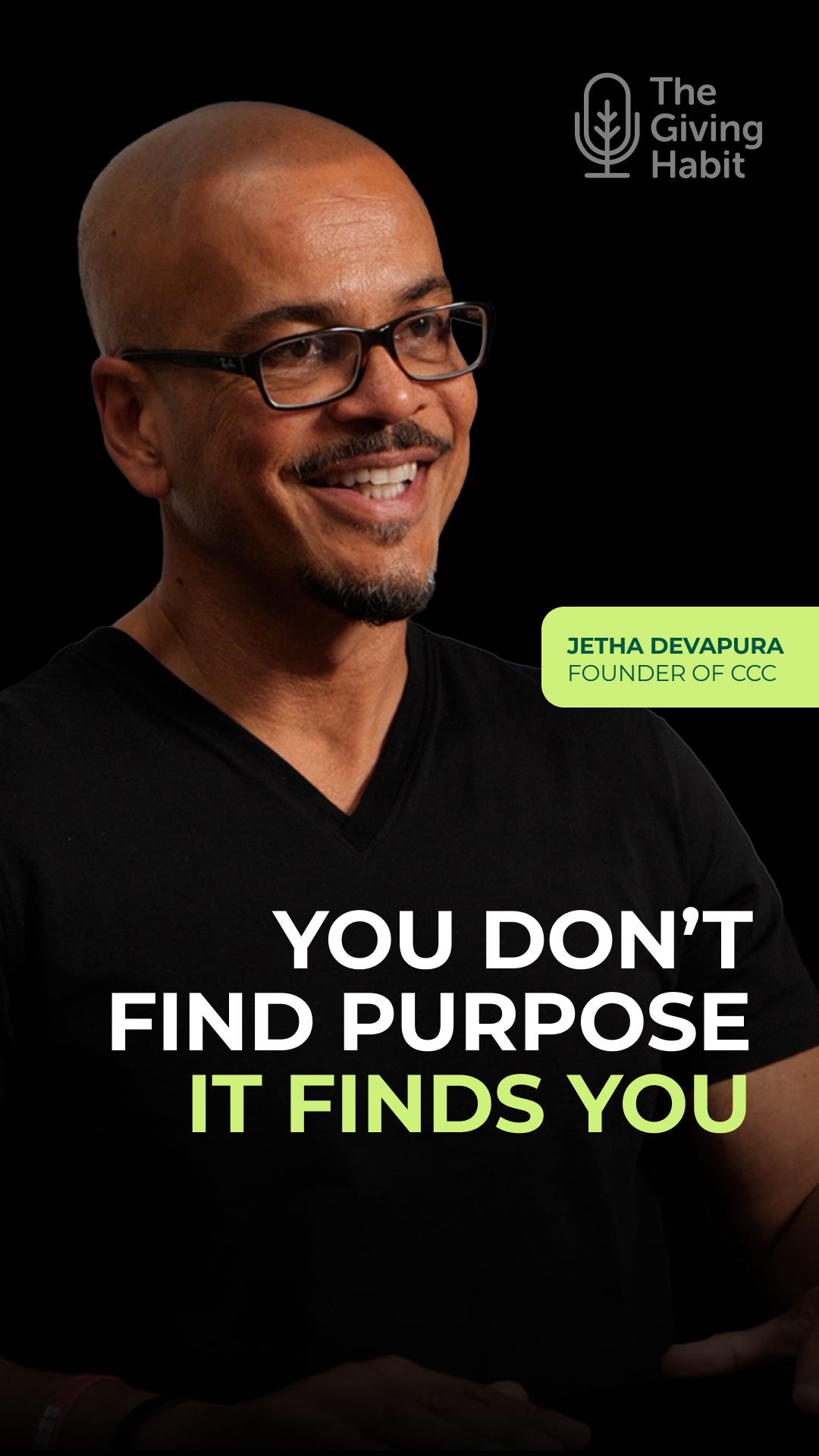
There was a lovely phrase Jetha used during our conversation. “You don’t go looking for purpose,” he explained. “Purpose will come to you.”
This immediately brought to mind a presentation given by Debra Searle at a conference I attended many years ago. She framed it slightly differently, and in the context of her attempt to row solo across the Atlantic. “Don’t go rushing back into your comfort zone. Wait for your comfort zone to come to you.”
These observations feels particularly important in modern culture. Many people feel paralysed by the idea that they must somehow discover a perfectly formed life mission before taking action, or that all risk must be mitigated. Jetha’s story suggests something far simpler and perhaps more achievable.
Learning often happens as we start performing the task. Purpose often emerges through service, not before it. It might be a small act of contribution. A phone call. It might be a difficult conversation, or it might be a fundraiser for something that matters.
Over time, confidence and meaning accumulate around action. We are defined by what we do repeatedly. That philosophy shaped the next major chapter of his work.
After years supporting cancer patients and their families, Jetha became increasingly drawn toward mental health. Sri Lanka, at the time, had one of the highest suicide rates in the world. So once again, he asked a deceptively simple question: “What if we copied what already works elsewhere?” After all, Australia had Lifeline. Why not Sri Lanka?
At this moment, Jetha did something wonderfully uncomplicated and brave. He picked up the phone and called Lifeline Australia with a desire to learn. That single act eventually led to the creation of CCC Line 1333, Sri Lanka’s leading crisis support service.
Today the hotline receives around 60,000 calls annually and operates through trained volunteer crisis supporters across multiple centres. Again, though, what interests me most is not merely the scale of the operation. It is the philosophy underneath it.
Jetha repeatedly returned to the idea that service heals both the recipient and the giver. “When you serve others, you serve yourself,” he believes. That line could easily sound sentimental in lesser hands. But hearing it from someone who has personally wrestled with anxiety, uncertainty and emotional suffering gave it real weight.
There is something profoundly human about the idea that meaning is discovered relationally rather than individually. It strikes me that modern society often encourages radical self-focus: optimise yourself, improve yourself, protect yourself, market yourself. Yet many people remain deeply lonely.
Jetha’s work quietly challenges that paradigm. Perhaps healing, and meaning, does not only come from looking inward. It also comes from contributing outward.
That insight sits at the heart of the Let’sTALK programme. While reviewing call data from CCC Line, Jetha noticed something revealing. The majority of callers were not initially phoning about severe psychiatric crises. They were calling about relationship problems. Loneliness, financial stress, and / or social isolation.
This led him to another uncomfortable question: Why are people more willing to speak vulnerably with a stranger on a hotline than with their own family, friends or colleagues? The answer, he concluded, was psychological safety. Or rather, the lack of it.
And so Let’sTALK was born. The programme teaches communication frameworks designed to help people feel seen, heard and valued. It focuses particularly on helping schools and workplaces create environments where vulnerability, honesty and emotional openness are safe rather than punished.
What I admire about the programme is its practicality. Jetha is not interested in vague motivational language. He wants usable tools. One framework he developed — facts, feelings and fears — has stayed with me since first learning about it years ago.
When we become distressed, we often get overwhelmed by emotional reactions. We catastrophise. Our fears dominate. The framework instead teaches us to navigate our distress, or that of others, more intentionally: What are the facts? How do we feel? What are we really afraid of?
Simple. Accessible. Human. And increasingly evidence-based.
Recently, the Let’sTALK programme underwent a randomised control trial involving ten schools in Melbourne in partnership with Swinburne University and the Black Dog Institute. The results demonstrated measurable improvements in psychological safety, wellbeing and help-seeking behaviour among students.
That matters. Not because data replaces humanity. But because evidence allows the humanity to scale. It gives schools, organisations and governments confidence to invest in Let’sTALK as a form of prevention rather than waiting for crisis.
During our conversation, we spent considerable time discussing male suicide and emotional suppression. Jetha made an important observation: it is unfair to expect men to suddenly “open up” as adults when many have spent their entire childhood being taught the opposite. “Man up.” “Don’t cry.” “Teaspoon of cement.”
Those messages leave deep marks. Which is why his focus has increasingly shifted toward schools and younger generations. Teach children emotional literacy early. Teach psychological safety early. Teach boys that vulnerability is not weakness. Teach girls that self-worth matters. Teach all young people that asking for help is normal. It sounds obvious, but obvious things are often the hardest to implement consistently.
Perhaps the most courageous part of Jetha’s story, however, is not the founding of CCC or the creation of Let’sTALK. It is what happened recently. After years balancing corporate leadership with volunteer service, he made the decision to leave stable employment and commit himself full-time to expanding the programme.
That leap was not romanticised during our interview. He spoke honestly about the uncertainty, financial pressure and discomfort involved. And yet he also described something deeper: a willingness to sit with uncertainty rather than run from it. A middle path. A deliberate acceptance that meaningful work often requires discomfort.
At one point he reflected, “Thank you so much for my OCD… because it woke me up to do the work I’m doing.” There is immense wisdom in that statement, and not because suffering is desirable, but because suffering, when processed consciously, can become transformative.
Toward the end of our conversation, he recalled advice his father used to give him in Sinhalese: “Heming, Heming.” Slowly. Slowly. I loved that. In a world obsessed with acceleration, optimisation and immediate outcomes, perhaps we need more reminders that meaningful change often unfolds gradually.
One fundraiser. One phone call. One child. One conversation. One difficult truth shared safely. That is how cultures shift. That is how people heal. That is how we grow the giving pie.
Perhaps that is the deeper invitation within Jetha Devapura’s story. You do not need to have your entire purpose mapped out before you begin. You simply need the courage to take the next compassionate step. The commitment to stay with it. And the humility to let purpose reveal itself along the way.
For more information on the CCC Foundation, click here.
For more information on Let’sTALK, click here.
To listen to the full interview, click here.
No posts
Comments
Nothing yet. Say the first thing.
Sign in to join the conversation.