
I recently ran the Coast to Coast path across England, 300KM in six days to help raise funds for the IFS Foundation. There was a moment during the run that has stayed with me more vividly than any summit, finish line or Strava statistic. It wasn’t on the final day as we reached Robin Hood’s Bay and touched the North Sea. It wasn’t even during the brutal opening stage, when almost 58 kilometres, nearly 2,000 metres of climbing and unexpectedly high temperatures left me wondering whether I had underestimated what lay ahead.
It happened somewhere late on day four, when my running partner developed shin splints.
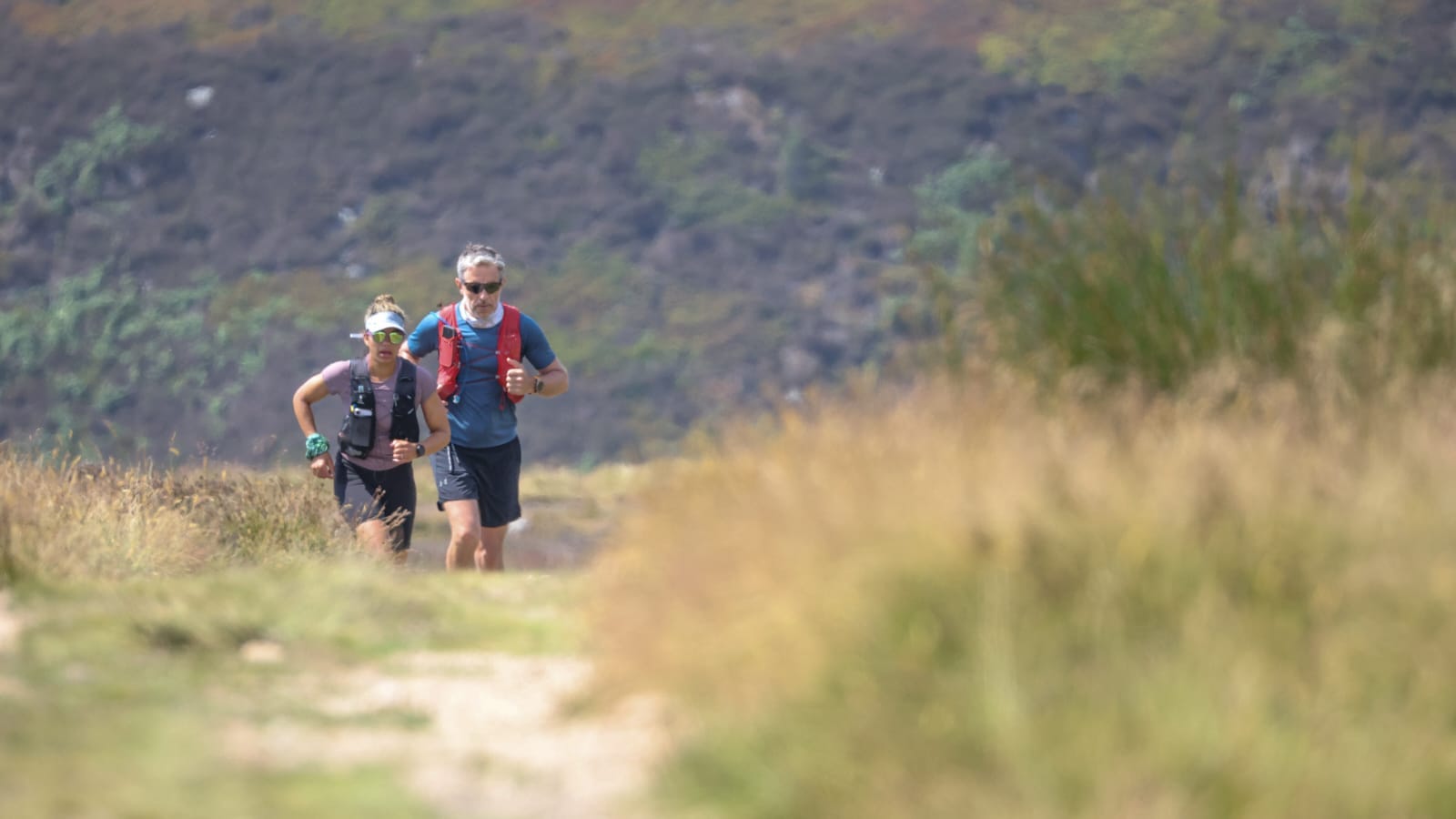
Until then, I had been engaged in the familiar internal conversation that accompanies almost every endurance event. My left knee was occasionally complaining. My right quad, which had caused concern in the final days before the event, remained under constant surveillance. Was I eating enough? Drinking enough? Was this ache significant? Would that tightness become something more?
Nothing was seriously wrong, but my attention was firmly directed inwards. Yet as my running partner’s discomfort increased, my own quietly receded. The questions occupying my mind were no longer about my body. Instead, I found myself thinking about hers. How was she coping? Did we need to slow the pace? What would help her reach the next checkpoint? Was there anything practical I could do?
Looking back, I find it remarkable that many of my own niggles seemed to lose their importance. They didn’t disappear. My knee still hurt occasionally and my quad certainly hadn’t healed overnight. But they were no longer the centre of the story.
Psychology has long recognised that pain is influenced not only by tissue damage but also by attention. We all know this instinctively. A child falls over, looks to a parent for reassurance and often decides how much it hurts based on the response. Soldiers have been known to suffer injuries in battle that they barely notice until the fighting stops. The body sends signals, but the mind decides how much of its precious attention those signals deserve.
Yet something deeper was also happening. As my focus shifted towards another person, the challenge itself acquired a different meaning. Up until that point, success had been measured by whether I could complete the route. Once my running partner began struggling, the objective subtly changed. It was no longer simply about getting myself to Robin Hood’s Bay. It became about getting us there.
That small change in language matters. There is a profound psychological difference between pursuing an individual goal and accepting responsibility for another human being. The former draws us into ourselves. The latter invites us out of ourselves.
Modern life encourages a great deal of introspection. By midlife, many of us have become highly skilled at monitoring our own condition. We track sleep scores, heart rate variability, resting pulse, body composition and blood biomarkers. We think carefully about our careers, retirement planning, financial security and health. Much of this is sensible. Some of it is essential.
But there is a danger that we become the permanent subject of our own attention. How am I feeling? Am I happy? Am I fulfilled? Am I making the most of my life?
These are not unreasonable questions. They simply become exhausting when asked every day. What struck me during Coast to Coast was how liberating it felt when those questions were replaced by a different one. What does someone else need from me right now?
Viktor Frankl argued that meaning is often found through serving a purpose beyond ourselves. His insights emerged from unimaginably harsh circumstances, and it would be absurd to compare an endurance event with the experiences that shaped his thinking. Nevertheless, the principle still resonates. Human beings appear remarkably resilient when our attention is directed towards something larger than our own immediate comfort.
There is another dimension to this that feels particularly relevant in midlife. Many of us spend the first half of our lives being needed. We build careers solving problems. We raise children who depend on us. We support ageing parents. We mentor colleagues. Our days are full of responsibilities that can sometimes feel overwhelming.
Then, gradually, those responsibilities begin to change. Children become independent. Careers plateau or end. Retirement approaches. The phone rings less often with problems that only we can solve.
On the surface, this sounds like freedom. Sometimes it is. But for many people it also creates an unexpected absence. We discover that being needed wasn’t simply an obligation. It was part of our identity.
Listening to people who have retired from successful careers, I have often noticed that what they miss most is not status or income. It is usefulness. Perhaps that explains why one thought kept returning to me after the event. My running partner needed help. And, although I didn’t realise it at the time, I needed someone to help.
That sentence initially sounds contradictory. Surely the person requiring assistance is the one who benefits? Yet I suspect the exchange runs in both directions. By giving me an opportunity to contribute, she also gave me purpose. My attention stopped circling around my own discomfort because there was something more important to think about.
It reminded me that contribution is rarely a one-way transaction. We often imagine ourselves generously helping others, but the relationship is usually reciprocal. The person receiving support gives us something in return. They remind us that we still have something valuable to offer.
Looking back over the week, this explains why my strongest memories have surprisingly little to do with running. I remember conversations while climbing out of valleys. Small moments at checkpoints where nobody said very much because nobody needed to. Shared laughter at the absurdity of voluntarily crossing England on foot. The extraordinary generosity of our support crew, who somehow anticipated every need before we had articulated it ourselves.
The event reinforced something I have increasingly come to believe. We greatly overestimate the importance of individual resilience and underestimate the importance of collective resilience.
Popular culture celebrates the lone hero who battles adversity through sheer determination. Real life is usually less dramatic and considerably more collaborative. We cope because people encourage us. We continue because someone walks beside us. We find another gear because another person’s struggle reminds us that we still have something left to give.
The irony is that we often search for resilience by looking inward when, in reality, we might find it more easily by looking outward.
This idea extends far beyond endurance running. Many viewers of Don’t Let The Old Man In are navigating the complex territory of midlife. Some are leaving careers that defined them for decades. Others are adjusting to children leaving home. Many are balancing concern for elderly parents with questions about what the next chapter should look like.
The instinctive response is to ask, What should I do now? After Coast to Coast, I wonder whether a better question might be, Who could benefit from what I already know?
That answer won’t necessarily involve climbing mountains or raising money for charity. It may involve mentoring a younger colleague, volunteering in a local community, supporting a friend through a difficult period or simply making yourself available in ways that modern life often discourages.
Purpose does not always emerge from prolonged self-reflection. Sometimes it arrives because another human being quietly places a hand on your shoulder and needs you to walk beside them for a while.
If Coast to Coast taught me anything beyond the satisfaction of finishing, it was this. We often think that helping others is something we do once we have become strong enough ourselves. The truth may be the other way around.
Sometimes helping another person is precisely what makes us strong enough to keep going.
To learn more about the IFS Foundation, please visit: https://www.ifsfoundation.org/en
No posts
Comments
Nothing yet. Say the first thing.
Sign in to join the conversation.