
Do harsher sentences actually create safer communities, or do they simply satisfy our desire for retribution? Should justice focus primarily on crime and punishment, or on restoring fractured families and preventing trauma from repeating itself across generations? And perhaps the hardest question of all: what are we really trying to solve for — compliance with the law, or the possibility of long-term social harmony?
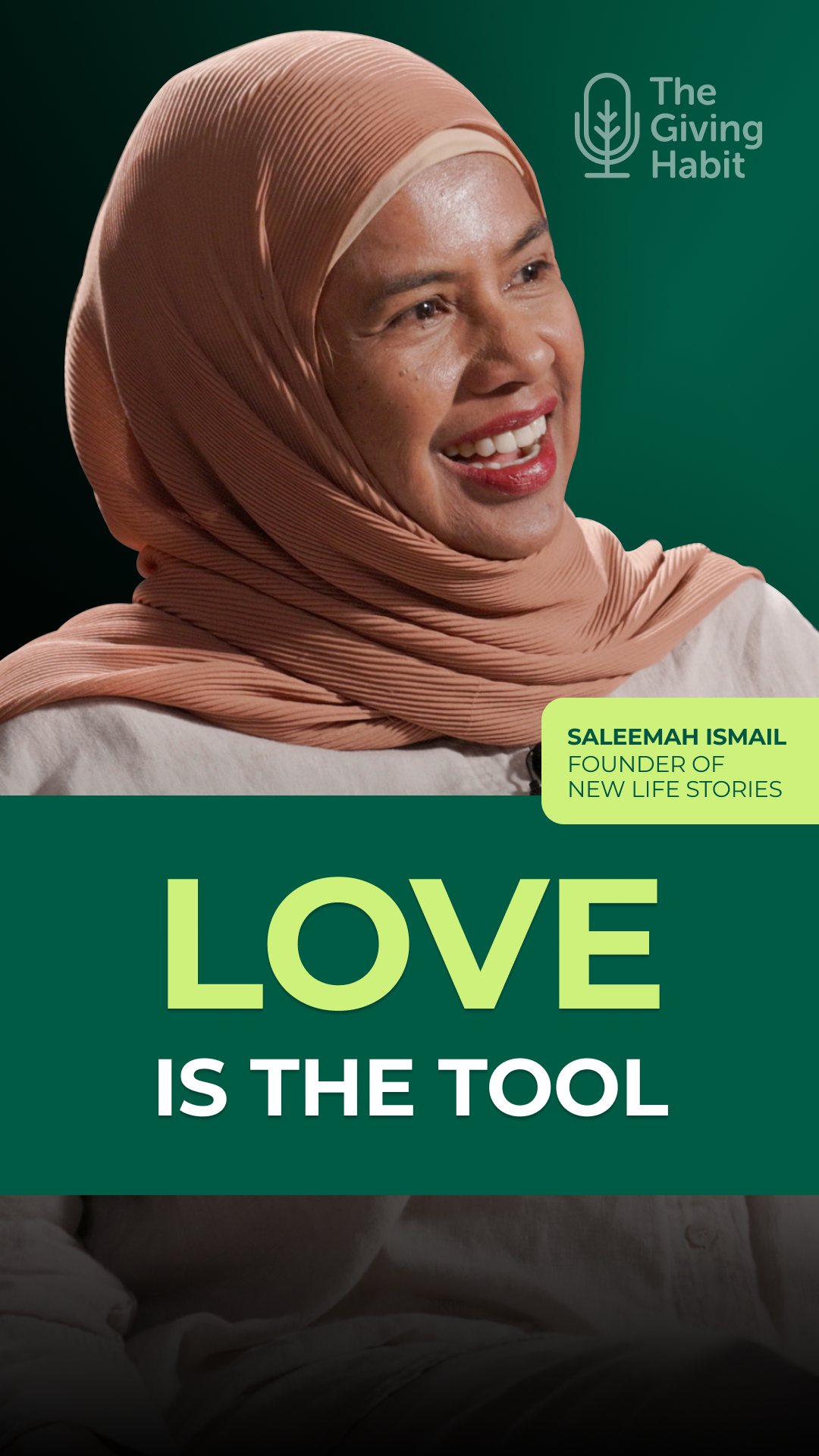
These questions came sharply into focus for me during a recent conversation with Saleemah Ismail, CEO and founder of Singapore-based charity New Life Stories.
I first met Saleemah through my volunteering work with The Majurity Trust, a Singapore-based charitable organisation. Even in brief interactions, her energy is striking: warm, thoughtful and deeply human. Sitting down with her for an episode of The Giving Habit, a new podcast show, revealed something even more powerful. Saleemah is a leader whose work is built not on ideology, bureaucracy or abstract policy, but on a universal truth: Love changes people.
New Life Stories is busy proving something many modern systems struggle to acknowledge: emotional connection is not peripheral to social rehabilitation. It is foundational.
Saleemah’s work focuses on supporting families affected by incarceration, particularly children whose parents are in prison. The statistics are sobering. Research in Singapore has shown that children of incarcerated parents are significantly more likely to encounter the criminal justice system themselves later in life. Trauma, neglect, instability, shame and social isolation often compound over generations.
Yet Saleemah does not approach these families through the language of deficit. She approaches them through the language of relationship. And remarkably, the entire New Life Stories organisation began with what she herself describes as a “hunch.”
In 2012, while considering whether to return to work in Myanmar or remain in Singapore, Saleemah accepted an unexpected invitation from a friend to tour a women’s prison. During conversations with incarcerated mothers, she asked a simple question: “What makes you sad, glad and mad?”
The answers stunned her. What made the women saddest was hearing their own children reject them. What made them glad was hearing their children say, “I love you.” And what made them mad was realising they had recreated the same cycles of pain they themselves had experienced growing up. One woman described it as listening to a cassette tape on “auto rewind.”
Saleemah then asked the children of these incarcerated mothers similar questions. Their answers mirrored the mothers almost exactly. The children were grieving for living parents who felt emotionally absent. They were angry at being abandoned. Yet beneath that anger was still an aching desire for connection.
Those questions became the genesis of New Life Stories. “What if we flip the narrative?” Saleemah wondered. “What if we focus on strengthening that relationship?”
What followed is one of the most innovative and compassionate social interventions I have encountered anywhere. On the surface, the organisation runs literacy and mentoring programmes. Volunteers visit children weekly to read with them. Mothers in prison write personalised children’s books in which their own child becomes the hero of the story. The mothers record themselves reading the books aloud so their children can hear their voice.
But as Saleemah explains, the literacy itself is not the central intervention. The emotional meaning behind it is. The child interprets the volunteer showing up every week not simply as educational support, but as evidence that their mother still loves them.
Too often, social programmes focus exclusively on functional outcomes while neglecting emotional realities. Yet human beings do not experience life in spreadsheets. We experience it relationally. A child who feels loved absorbs the world differently to a child who feels abandoned.
New Life Stories is not attempting to erase trauma through sentimentality. It is carefully creating conditions in which trust can slowly be rebuilt. And trust, especially in fractured families, requires patience.
One of the recurring themes in Saleemah’s work is fear. Children fear being disappointed again. Incarcerated parents fear rejection. Both sides often desperately want reconciliation while simultaneously protecting themselves from further pain.
So the organisation works in very small steps. A shared biscuit. A hand touching another hand. A short conversation. A volunteer arriving consistently each week. These are tiny acts of reliability, tiny acts of trust building, of love.
“We cannot break down the physical walls of prison,” Saleemah explains, “but we want to break down emotional walls.” In truth, emotional walls exist far beyond prisons. Many of us carry them. Shame. Rejection. Fear. Saleemah believes that guilt can become “a much bigger and thicker prison than the physical wall itself.” I suspect she is right.
Modern society often talks about rehabilitation in procedural terms: sentencing, compliance, monitoring, reintegration. Necessary though those things are, they rarely touch the deeper emotional dynamics that shape human behaviour across generations.
New Life Stories’ work is founded on the insight that trauma replicates itself relationally. Children internalise the narratives they repeatedly hear. If a child grows up constantly told they are worthless, difficult or destined to fail, eventually those messages stop feeling external. They become identity. And identity drives behaviour.
That is why New Life Stories gradually expanded from working solely with incarcerated parents and children to engaging entire family systems. Healing one relationship while leaving the wider environment unchanged is rarely enough. Grandparents, caregivers, siblings and blended families all shape the emotional ecosystem surrounding a child. Each needs to be engaged as part of a broader restorative process to heal trauma and help prevent future incidents.
This systemic understanding is one reason the organisation’s outcomes are so compelling. Among children enrolled in the New Life Stories strengthened family support programme since 2020, not a single child has entered the juvenile justice system. Meanwhile, recidivism rates among participating parents are significantly below national averages. The associated downstream social savings (avoided criminal justice costs) cannot be ignored.
But perhaps even more important is the philosophy underneath them. New Life Stories does not define success primarily through economic indicators, cost avoidance or a child’s academic performance. Instead, it measures resilience. Can children cope? Can they regulate conflict? Do they believe they have worth? Do they experience home as a safe and loving environment?
These are profoundly human questions that will ultimately determine the prevalence of intergenerational recidivism.
During the interview, I challenged Saleemah on how she convinced funders, prison authorities and partners to back what initially sounded like intuition rather than evidence-based programming. Her answer was both amusing and revealing. She deliberately approached investment bankers because, in her words, they were more comfortable with risk. And what exactly was her pitch? Love. Literally.
“The basis of New Life Stories,” she explains, “is love”. It sounds almost absurdly simple. Yet maybe that simplicity is precisely why this programme works.
We are often suspicious of emotional language in professional contexts because it feels imprecise. But we human beings are emotional creatures long before we are rational ones. We are shaped by attachment, affirmation, belonging and care. Children especially, and perhaps societies too.
Another core theme of the work undertaken by New Life Stories is dignity. I noticed it when I visited their offices. I observed counselling rooms designed to resemble living rooms rather than institutional offices. I noticed it again when we discussed introducing facial-recognition tele-visit systems that allow families easier access to incarcerated loved ones without exhausting cross-island journeys.
These are not merely operational improvements. They are expressions of empathy. They recognise that systems themselves communicate messages. Cold systems communicate distance. Human-centred systems communicate worth.
That same philosophy extends to the way Saleemah leads her own team. Working daily with trauma places enormous emotional strain on social workers and counsellors. Having personally experienced vicarious trauma earlier in her career while working with survivors of human trafficking, she now sees one of her primary leadership responsibilities as holding space for her staff. Their wellbeing, she insists, is essential.
Again, what emerges is a remarkably integrated philosophy. Care for the child, for the family, for the caregiver, and for the system.
In highly developed societies, we sometimes assume social problems can be solved primarily through technical sophistication. Better policy. Better technology. Better data. All of those matter. But listening to Saleemah reminded me that beneath every policy challenge sits a profoundly human reality: people longing to be seen, forgiven, accepted and loved.
Perhaps this is why the work resonates so deeply. It refuses to reduce people to their worst moment. It refuses to define children by the mistakes of their parents. And it refuses to accept that cycles of trauma are inevitable. Saleemah’s work looks beyond punitive justice systems, even beyond restorative justice. Her work is both enlightened and enlightening.
I fundamentally believe the world is made up of decent people who want to contribute meaningfully. The challenge is often not willingness, but proximity. We do not always see suffering clearly enough to know how to respond appropriately.
What organisations like New Life Stories do so beautifully is create pathways for ordinary people to participate and contribute, a core tenet of The Giving Habit podcast. Whether that is a volunteer showing up weekly, a prison officer willing to experiment, a donor funding an uncertain idea, a mother recording a bedtime story, or maybe a child deciding to give someone another chance.
This is how change happens. Not all at once or through grand declarations, but through small, repeated acts of human connection. Perhaps that is the deepest lesson I took from my conversation with Saleemah Ismail. Yes, systems matter. Policy matters. Data matters.
But love — properly understood as commitment, consistency, forgiveness and presence — may still be the most transformative force we possess.
Courageous, compassionate love. The kind that is willing to keep showing up, even when healing arrives slowly. Even when trust takes years. Even when the world tells you some people are beyond repair. Sometimes the most radical thing we can do is simply refuse to give up on one another.
For more information on New Life Stories, please visit here. To listen to the full interview with Saleemah, please visit here.
No posts
Comments
Nothing yet. Say the first thing.
Sign in to join the conversation.