
Speaking with Carole Schlessinger, co-founder of Kids Giving Back in Sydney, I realised that much of what her organisation creates is not simply volunteering programmes for children. It is memory formation. Emotional imprinting. The careful creation of moments that teach children how to see other human beings, and perhaps even how to see themselves.
Our conversation took place as part of a new podcast miniseries called The Giving Habit. The show explores the grit, hope and creativity of social impact through the lived experience of funders, founders, changemakers and enablers. Carole’s story, and the underlying message of optimism for the future, is definitely one worth sharing.
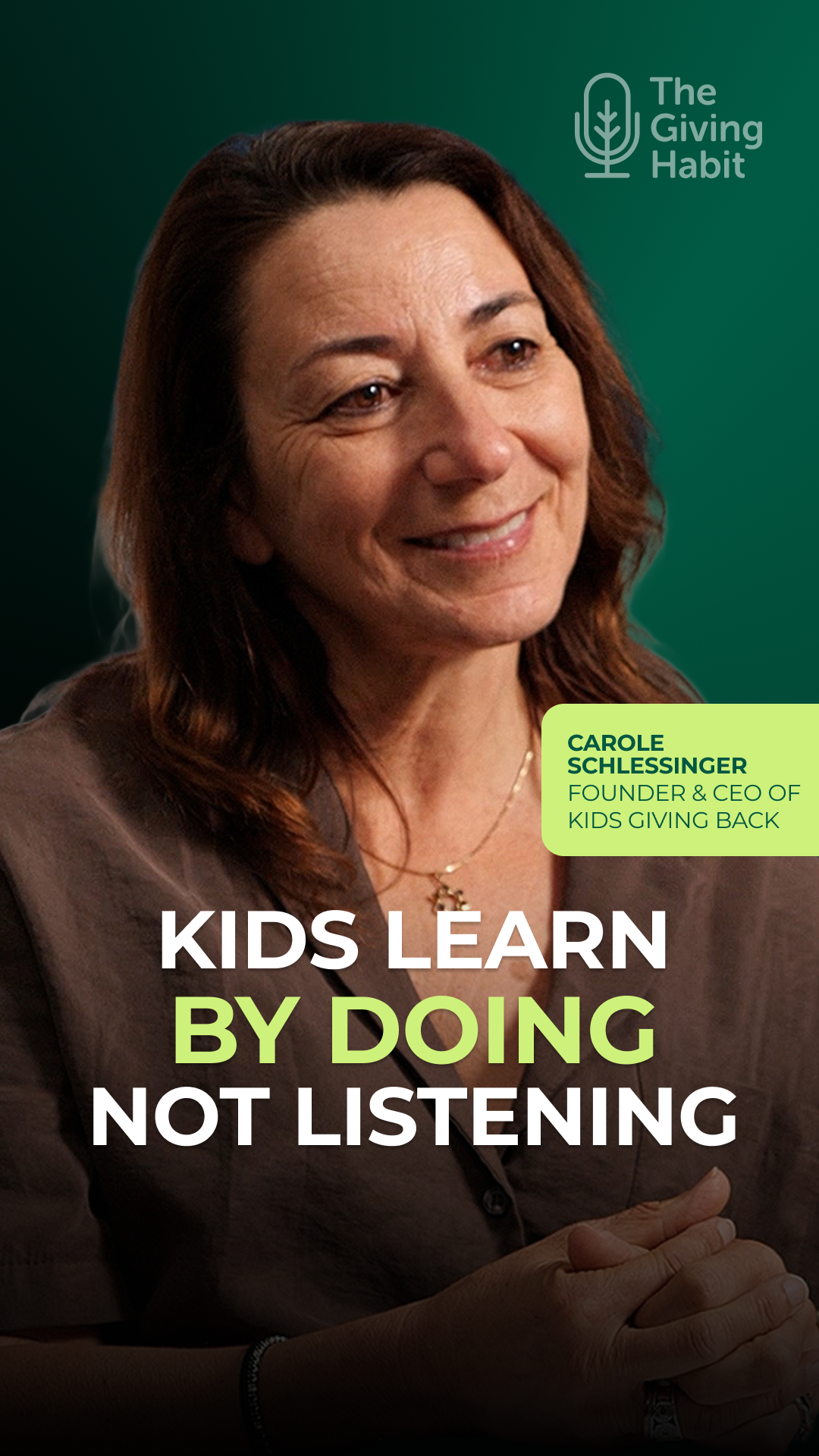
Kids Giving Back began, as many meaningful social movements do, not with grand institutional ambition but with parental concern. Fifteen years ago, Carole and her co-founder Ruth were simply mothers trying to navigate an increasingly digital and disconnected world. Their children were young, and both women shared an instinctive desire to expose them to something more grounding, more human and more relational than screens and consumer culture alone could provide.
“We really wanted to teach our kids something,” Carole told me. “To give back and really connect with that humane aspect in such a digital world.” What struck me was how deeply intergenerational the story already was.
Carole had grown up watching her own parents volunteer regularly. Her mother worked in an op shop supporting charitable causes. Service was not preached abstractly in the household. It was modelled quietly and consistently. That matters, because children learn generosity less through instruction than through observation. They absorb what they repeatedly witness. Compassion itself can become inherited behaviour.
The original idea for Kids Giving Back emerged from a surprisingly simple problem: Carole wanted her kids to volunteer, but found there were very few meaningful opportunities designed specifically for younger children. Carole and Ruth, her friend and co-founder, searched for ways their own families could serve together but found most programmes were either inaccessible, inappropriate or insufficiently engaging for kids. So they created their own.
At first, it was wonderfully grassroots. Small groups of family and friends gathering in a kitchen in Bondi preparing meals for people experiencing homelessness and hardship. But very early on, they realised something profound. The real transformation did not happen in the cooking. It happened in the connection.
One story from our conversation captured this perfectly. Carole described taking her young children to a hospital one rainy afternoon to deliver homemade cookies to patients. They entered the room of an elderly woman sitting alone. The woman held her son’s hand, began crying softly and simply expressed gratitude for the visit. When they left the room, her children were transformed. “Mum,” they said, “that was so cool.”
Children can feel authenticity immediately. And what they felt in that moment was human connection. That insight became foundational to the Kids Giving Back model.
Today, the organisation still revolves around practical service: cooking meals, preparing care packages, creating toys for homeless people’s pets, writing letters to elderly residents and supporting vulnerable communities across Sydney. The emotional architecture underneath those activities is far more sophisticated than it first appears.
Children are not merely helping anonymously. They are encouraged to witness the impact directly. They hand over meals personally. They knock on doors, look people in the eye, have conversations, and hear stories. They experience gratitude relationally rather than abstractly.
Carole is enthusiastic about those “aha” moments when children suddenly understand that their actions genuinely matter to another human being. And I suspect that is where the real power sits. Connection as transformation.
Yes, the recipients of the meals or care packs benefit from these acts of generosity. But after listening to Carole — and reflecting on my own experiences with Kids Giving Back — it is clear that the children themselves are equally profound beneficiaries.
Because what the organisation is really cultivating is emotional literacy. Kids are taught empathy, perspective, confidence, belonging. And increasingly, in a fragmented world, those qualities matter enormously.
One of the most compelling parts of our conversation centred on homelessness. Each Kids Giving Back programme includes significant time helping children unpack the stereotypes they may be carrying around people experiencing homelessness.
Many children initially describe the same familiar image: an older dishevelled man sleeping rough on the street. Then they learn the reality. For example, women over 55 are now one of the fastest-growing demographics experiencing homelessness in Australia. Only around 7% of homeless people are actually sleeping visibly on the streets. The majority are invisible: couch surfing, living in cars, cycling through shelters or existing in precarious housing insecurity.
Participants hear directly from people who have experienced homelessness, and learn a deeply important lesson; even when you think you have nothing, you still have something to give.
Those who have spent time living on the street talked of the despair of invisibility, of people looking right through them or ignoring them altogether. Often it takes just a smile, a nod of the head, the dignity of witnessing someone, stopping in the street, crouching down and saying “hello”. This costs nothing, but can mean everything to another human being.
This educational component feels deeply important. Compassion without understanding can easily become sentimentality, whereas compassion informed by human reality becomes something more durable. Fear and ignorance give way in the face of compassion and newfound knowledge.
The organisation’s philosophy rests on three pillars: Education, Action, and Reflection. First, children learn about the communities they are helping. Then they engage practically through volunteering. Finally, they reflect emotionally on how the experience made them feel.
That final stage — reflection — may be the most important of all. Because reflection turns activity into identity. A child begins to internalise who they are becoming. The transformation is both simple and profound.
My own family became part of the Kids Giving Back community during a very difficult season in my life. Following a divorce, I found myself overwhelmed by loneliness during the weekends when my children were not with me. Looking back honestly, I first joined one of the organisation’s programmes simply because I needed distraction from emotional pain.
But something deeper happened. Volunteering alongside my youngest son created a completely different relational space between us, one untouched by the trauma and tension surrounding the divorce itself. We were simply there together helping other people. And somehow that made it emotionally safe. I saw my son in a different light. I witnessed his curiosity and confidence. I saw myself differently too.
When I shared that story during our conversation, Carole responded with another powerful example: a father suffering severe depression who attended a programme with his children shortly before intending to take his own life. The experience shifted something in him. It somehow helped him through.
That story stayed with me long after the recording ended. Because beneath all the meals, programmes and logistics sits a deeper truth: Human beings heal relationally, often through contribution, connection, and shared meaning. Through temporarily stepping outside ourselves and participating in something larger.
Much of the work performed by the Kids Giving Back team is ultimately about shifting people from thinking only about “me” toward thinking about “we.” That distinction may explain why volunteering carries such measurable mental health benefits.
Australian research shows that children who volunteer before the age of 13 experience significantly more positive mental health outcomes later in life. That finding should make us all take pause, particularly at a time when youth anxiety, loneliness and emotional distress are escalating globally. One reason volunteering matters so much is because it counters several of modern society’s most corrosive tendencies simultaneously. Isolation. Self-absorption. Disconnection.
Through Kids Giving Back, children (and their parents) discover they are capable of contributing meaningfully. They discover that other people’s struggles are real. They discover they can make someone smile. And in doing so, they often begin discovering resilience within themselves too.
I was especially moved by Kids Giving Back’s intergenerational programmes connecting school children with elderly residents in aged care facilities. Again, the genius lies in the relational detail. The children and elderly participants first become pen pals before meeting in person. They exchange letters, share profiles and gradually build familiarity before the actual visit. The result is less transactional volunteering, more relationship-building. In super ageing societies increasingly fractured by loneliness and age segregation, that matters enormously.
Emerging research showing that social connection may be one of the single strongest predictors of healthy longevity and life satisfaction. Organisations like Kids Giving Back are quietly creating those conditions every single day. This is social impact at its most human scale.
I am sure that neither Carole nor Ruth could possibly have imagined, fifteen years ago, where this journey would lead. What began as a desire to help their own children navigate an increasingly chaotic world has evolved into a movement shaping thousands of young people across Sydney.
We often underestimate the long-term power of small acts repeated consistently. These things may appear modest in isolation. But over time they shape identities, families, and entire communities. They help grow the giving pie.
Generosity, ultimately, is not something children are taught once. It is something they practise into becoming. And perhaps the greatest gift we can offer the next generation is not simply success or security, but the ability to truly see other people. And to know, deeply, that they themselves have the power to make someone else’s life better.
To find out more about Kids Giving Back, and to sign up to one of their fantastic programmes, click here.
To watch or listen to the full interview with Carole, click here.
No posts
Comments
Nothing yet. Say the first thing.
Sign in to join the conversation.