
Executive Summary
For more than a decade, Bitcoin’s price has been known to follow an extraordinary long-term power law with an exponent near 5.7 and an R^2 now exceeding 0.96. The long-term power law describes Bitcoin’s secular growth, while previous work has shown that the residuals exhibit log-periodic structure with a decaying amplitude. The natural next question is whether these oscillations are simply statistical regularities or the observable signature of an underlying dynamical system.
To investigate this possibility, we first remove Bitcoin’s long-term power-law growth, leaving only the residual dynamics. Rather than analyzing these residuals in ordinary calendar time, we reconstruct their evolution in logarithmic time using delay-coordinate embedding, a standard technique from nonlinear dynamical systems theory. This allows us to examine the geometry of the system that governs Bitcoin’s departures from its long-term adoption trajectory.
The reconstructed state space reveals a coherent attractor rather than an unstructured cloud of points. Quantitative analysis yields two positive Lyapunov exponents, consistent with sensitive dependence on initial conditions, together with an overall contraction of phase-space volume, demonstrating that the reconstructed dynamics are dissipative rather than explosive. Taken together, these findings provide strong evidence that Bitcoin’s departures from its long-term power-law trajectory arise from a deterministic low-dimensional dynamical system rather than unconstrained random fluctuations.
Bitcoin power-law residuals are inconsistent with being purely random market noise.
These findings naturally complement earlier evidence that Bitcoin exhibits discrete scale invariance and log-periodic oscillations around its long-term power-law growth. Rather than viewing Bitcoin as a stochastic process fluctuating around a deterministic trend, it may be more accurate to regard the power law as the equilibrium manifold of a dissipative dynamical system whose chaotic evolution gives rise to the familiar boom-and-bust cycles. In this picture, the power law describes Bitcoin’s long-term adoption, the log-periodicity describes its discrete scaling behavior, and the reconstructed attractor describes the underlying state-space dynamics that connect them.
Workflow
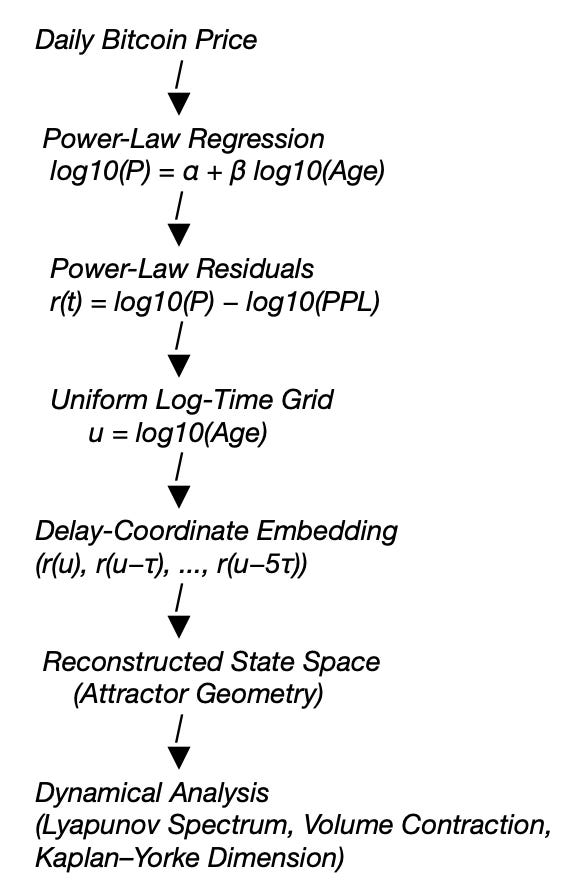
A key step is delay-coordinate embedding, which transforms a one-dimensional record of Bitcoin prices into a reconstructed state space, allowing the dynamics themselves—not merely the price—to be studied.
Why do we do it? Because dynamics require state. A single time series does not define a dynamical system. A trajectory through state space does.
The output of this workflow is not another regression or statistical fit. It is a reconstruction of the system’s state space—a geometric object known as an attractor. If Bitcoin’s residual fluctuations are generated by an underlying deterministic process, that process should leave a recognizable geometric signature in the reconstructed state space.
Log-time delay embedding
We start out with nearly 5800 daily observations. Then we interpolated those into 3000 equally spaced points in the log of Bitcoin age. Bitcoin is better represented in log space as revealed in its power law scale invariance, so that is the natural basis to work in, rather than linear time.
Imagine dragging a comb along the log-time residual series. Each tine of the comb samples the residual at a different delay. The number of tines is the embedding dimension m; the spacing between them is the (log time) delay τ. Every position of the comb produces one point in reconstructed state space.
Reconstructed Attractor Views
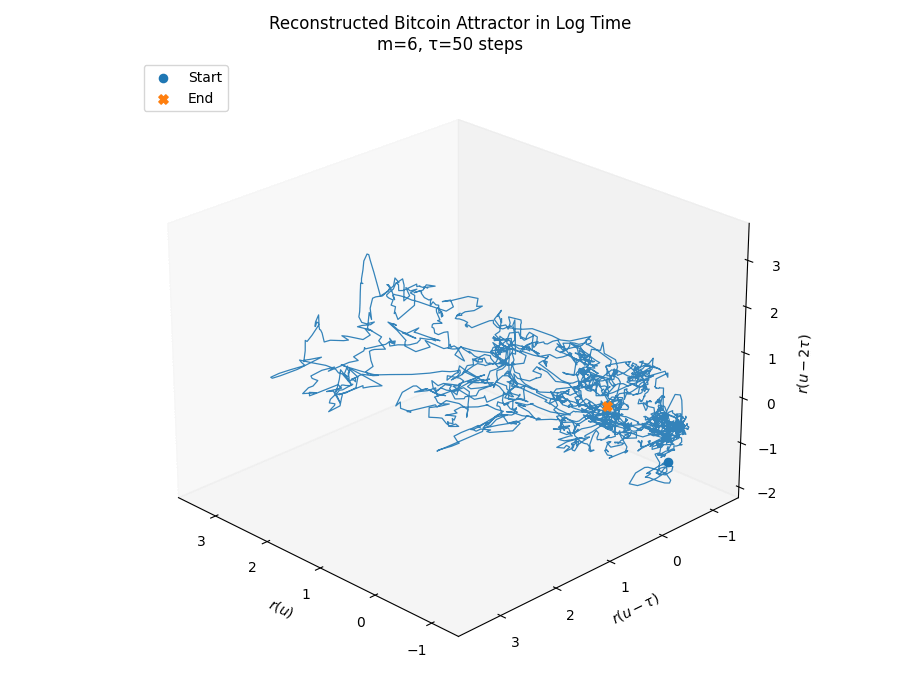
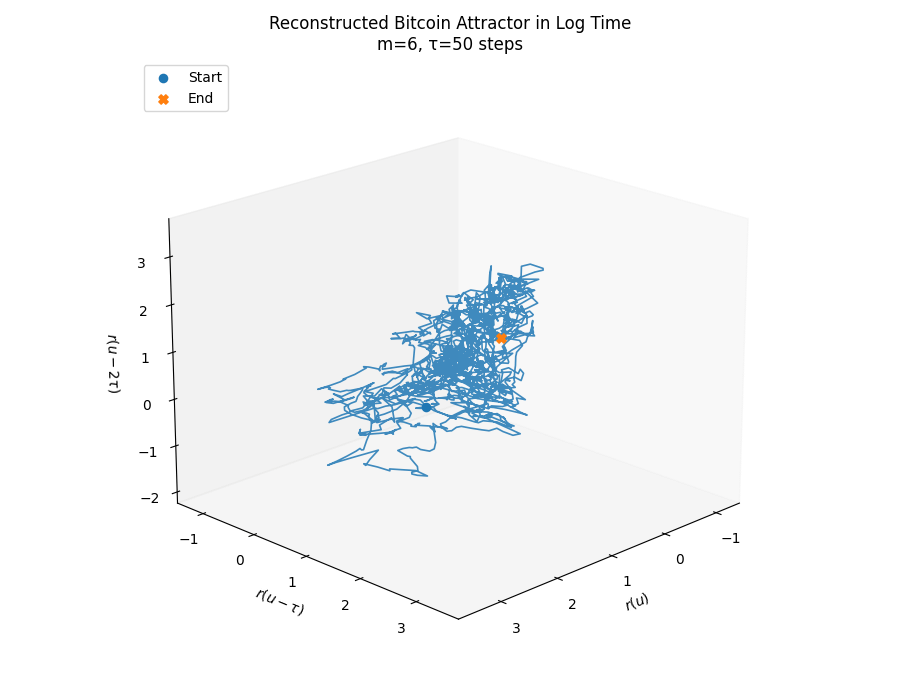
What we present here is a reconstructed attractor, an approximation to the true attractor. What the reconstructed attractor is:
* The power law tells us where Bitcoin tends to be: Destination
* The attractor tells us how Bitcoin moves: Path
Figures 2a and 2b are two views of the same Bitcoin state space revealed by delay-coordinate embedding. One sees immediately that this reconstructed attractor is confined to certain regions of the volume, and the core is a pronounced smaller volume. Indeed the initial (blue) and final (orange) states both lie within the same compact region of the reconstructed state space despite spanning more than sixteen years of market history, illustrating the bounded nature of the reconstructed dynamics and the fidelity to the power law.
The reconstructed attractor is a three-dimensional projection of a six-dimensional delay-coordinate embedding constructed from the residual series r(u), where u= log10 (Age). Each point represents the state vector [r(u), r(u-τ), … r(u-5τ)], with only the first three delayed coordinates shown for visualization.
Identifying a reconstructed attractor is only the first step. In nonlinear dynamics, the next question is not whether an attractor exists, but where the system currently resides on it. Local properties such as stretching, curvature, and phase determine whether nearby trajectories are stable, diverging, or approaching critical transitions. In a future article I will examine the geometry of the Bitcoin attractor itself and ask whether these local dynamical quantities contain information about future market behavior.
Lyapunov Spectrum
The Lyapunov exponents (usually denoted Λi) quantify the average exponential rate at which nearby trajectories in a dynamical system either separate or converge. Taken together, the ordered set
Λ = (Λ1, Λ2 … Λm) is called the Lyapunov spectrum.
Lyapunov exponents describe the reconstructed state-space dynamics, not the original scalar price series directly. Under the assumptions of Taken’s embedding theorem, the reconstructed attractor preserves the essential dynamical invariants of the underlying system.
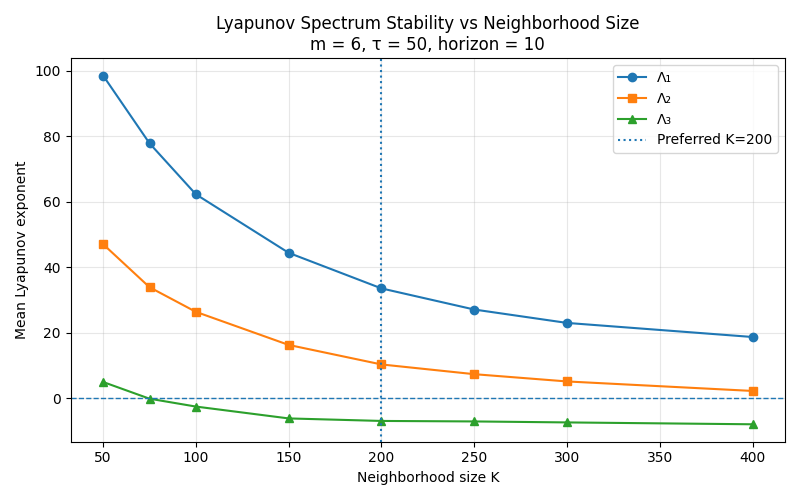
One chooses an embedding dimension m, a neighborhood size K, and a delay τ. The delay is chosen as a stable compromise and in this case amounts to about 4% of age. The neighborhood where stability began to be apparent is around K = 200, or 1/6 of the age at any given time. The smooth nature of the curve vs. K is encouraging. dimension is varied to explore the natural dimensionality of the state space.
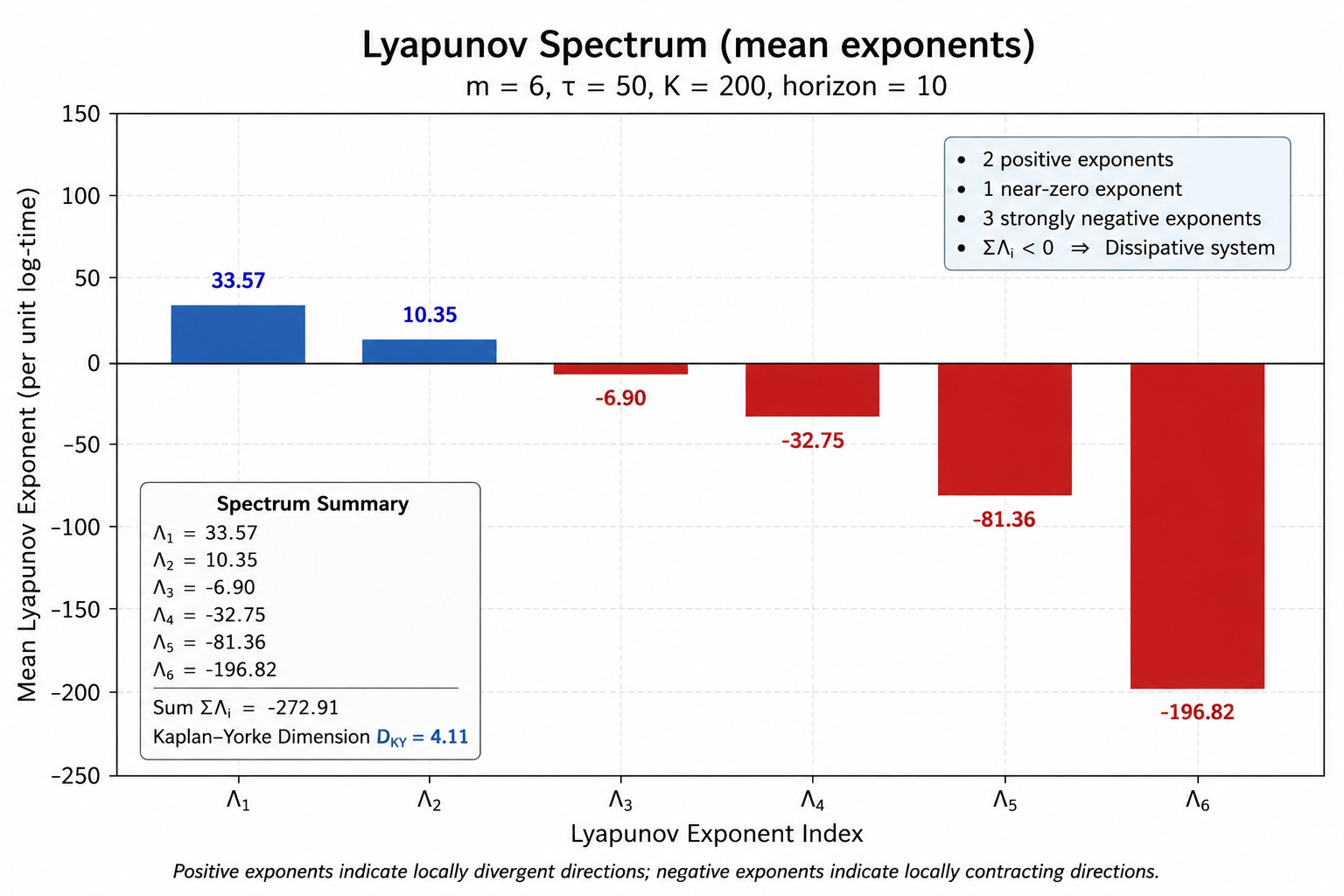
I explored possibilities ranging from m of 3 up to 10 and found the Kaplan-Yorke dimensionality rose with m, but more slowly. We show the Lyapunov spectrum of m = 6 which suggests a Kaplan-Yorke dimension for the system of 4.1, but this must be viewed as a lower bound. Nevertheless given the complexity of the network and the thousands of observations, a relatively finite dimensionality for the state space is promising for further investigation.
For our reconstructed Bitcoin residual dynamics (embedding m=6), the key qualitative results are:
Two positive exponents (Λ1 >0, Λ2 >0)
Nearby trajectories diverge exponentially in two independent directions.
This is strong evidence of deterministic chaos rather than simple periodic motion.
Remaining exponents negative
Perturbations contract along the remaining directions.
Trajectories are continually pulled back toward a lower-dimensional attracting set.
Negative sum of all exponents
Sum over all Λi < 0
State-space volumes shrink with time.
The system is dissipative, not conservative.
Kaplan–Yorke dimension DKY ~ 4.1
When embedded in six dimensions, the long-term dynamics occupy only about four effective dimensions. Again, the true dimension may be higher and requires more exploration.
Robustness
After testing a variety of values, I settled on τ = 50 as a practical optimum, corresponding to about a 4% age delay, α range of one month to 1/2 a year or so more recently. It provided:
enough temporal separation to unfold the dynamics,
deterministic evolution,
a stable Lyapunov spectrum,
good neighbor statistics, and
still leaves approximately 2,750 embedded states from the available data.
For the neighborhood size, K = 200 was used as a reference, spanning about 1/6 of Bitcoin’s age at any given time if τ is 50. As shown in Figure 4, the Lyapunov spectrum behaves in a monotonic fashion with K, and is beginning to appear stable with two positive exponents for m = 6 and flattening profiles for the Λ values.
Conclusions
The reconstructed state space is highly constrained. The delay-coordinate reconstruction produces a compact, structured trajectory rather than a diffuse cloud, indicating deterministic structure in the residual dynamics.
The reconstructed dynamics are consistent with an attractor. The trajectory repeatedly visits the same region of state space, suggesting an underlying attractor rather than independent stochastic fluctuations.
The underlying dynamical system requires more than four dimensions. An embedding dimension of six is needed for the reconstruction, while the estimated attractor dimension remains substantially lower, implying the true system has at least several effective degrees of freedom.
The Lyapunov spectrum contains two positive exponents (for the m = 6 reconstruction). This is evidence of local exponential divergence along two directions in the reconstructed dynamics, consistent with deterministic chaos.
The dynamics are dissipative. Persistent volume contraction (negative sum of Lyapunov exponents) together with a finite Kaplan–Yorke dimension indicate a dissipative system rather than a conservative one.
Bitcoin power-law residuals do not behave as random noise, rather they exhibit deterministic low-dimensional structure that is amenable to nonlinear dynamical systems analysis.
The coexistence of positive Lyapunov exponents, persistent volume contraction, and a lower than m Kaplan–Yorke dimension is consistent with Bitcoin’s power-law residual dynamics evolving on a reconstructed dissipative attractor in log-time state space. The reconstructed dynamics are not adequately described by three or four degrees of freedom. The effective dimension based on exploration at larger m, not detailed here, is likely to be at least six.
At present, we can conclude only that the reconstructed state space possesses a highly structured geometry, including a distinctive stretched and curved frontier. The dynamical significance of this feature remains an open question and will be the focus of a subsequent article.
Stephen Perrenod is engaged in econophysics and nonlinear science research as Associate Director of the Scientific Bitcoin Institute.
Comments
Nothing yet. Say the first thing.
Sign in to join the conversation.