
Revision note (24 July): This article has been updated considerably to reconstruct Bitcoin’s residual dynamics on a uniform logarithmic-age grid. Log-time reconstruction strengthens the evidence for low-dimensional organization while deprecating the earlier inference of progressive tube narrowing.
Executive Summary
In the first article of this series, I showed that Bitcoin’s departures from long-term power-law growth are not purely stochastic. Delay-coordinate reconstruction revealed organized, low-dimensional structure within the residual dynamics. The second article characterized the local geometry of this reconstructed system through measures of stretching and curvature. This article asks the next question: what is the global dynamical structure of the reconstructed state space?
Because Bitcoin’s long-term evolution is approximately scale invariant, the appropriate developmental clock is logarithmic age, (u= log t), rather than calendar time. I therefore revisit the original analysis using a uniformly sampled log-time grid. Selected comparisons with the earlier linear-time construction show why this distinction matters: equal intervals in log time represent equal proportional increases in Bitcoin’s age and avoid mixing fundamentally different developmental scales.
A uniform-log-time reconstruction strengthens the central geometric result. In a six-dimensional delay embedding, the residual dynamics are globally compressed and display coherent rotational organization. Their five-dimensional cross-sections are highly anisotropic: approximately 91% of the transverse variance is concentrated in two principal directions, with an effective transverse dimension close to 2.0 rather than the approximately 2.5 obtained from the linear-time construction. The reconstructed system is therefore better described as a membrane-like geometry than as a five-dimensional volumetric cloud.
The revised analysis does not, however, support the earlier conclusion that this transverse tube progressively narrows with Bitcoin’s age. On a uniform log-time grid, late transverse widths are comparable to, or modestly greater than, early widths. The robust conclusion is consequently low-dimensional transverse organization—not progressive contraction.
The comparison between two residual definitions further clarifies the source of this organization. The power law residual, r(u), retains the fitted discrete-scale-invariant component and exhibits a conspicuous loop-like global geometry. After the fitted DSI (log periodic) component is removed, the resulting second-order residual, q(u), is less globally compressed but retains an approximately two-dimensional transverse structure. The dominant rank-2 transverse plane of (r(u)) aligns closely with the sine–cosine plane generated by the fitted DSI mode, indicating that much of its most visible rotational organization is the geometric expression of discrete scale invariance.
Together, these results suggest a hierarchical description of Bitcoin’s long-term dynamics. The power law defines the primary scale-invariant growth trajectory; discrete scale invariance generates a coherent log-periodic rotational mode around that trajectory; and the remaining residual dynamics occupy a compressed, membrane-like reconstructed geometry. This is evidence for organized dynamical structure, but not by itself proof of a contracting attractor or a stable forecasting mechanism. Robustness, surrogate testing, and out-of-sample persistence are taken up in the next article.
The Vector Field
In Beyond the Power Law I, I reconstructed Bitcoin’s residual dynamics using a six-dimensional delay-coordinate embedding. In Beyond the Power Law II, I examined the local geometry of that reconstruction through Jacobian stretching and curvature. Here I turn to the vector field: the average direction in which nearby reconstructed states subsequently evolve.
The time coordinate is important. Bitcoin’s long-run growth and its log-periodic oscillations are naturally expressed in logarithmic age, u = ln t, where t is Bitcoin’s age. Equal increments of u correspond to equal proportional increases in age. By contrast, equal calendar-time intervals represent quite different fractions of Bitcoin’s lifetime near the beginning and end of the historical record.
The log-time vector field is constructed from 3,000 equally spaced observations in u, rather than from daily observations in t. The six-dimensional delay embedding uses a separation of 50 log-time grid steps, corresponding to δu ~ 0.0406. Local motion is measured over 10 grid steps, or δu ~ 0.0081. All velocities and neighborhood comparisons are consequently defined on the same logarithmic developmental clock.
I examine two related residuals. The first, r(u), removes the continuous-scale-invariant power-law trend but retains the fitted discrete-scale-invariant oscillation. The second,
\([q(u)=r(u)-r_{\mathrm{DSI}}(u),]\)
also removes the fitted DSI component. Comparing them allows us to distinguish geometry associated with the known log-periodic mode from structure that remains after that mode has been removed.
The CSI residual: DSI retained
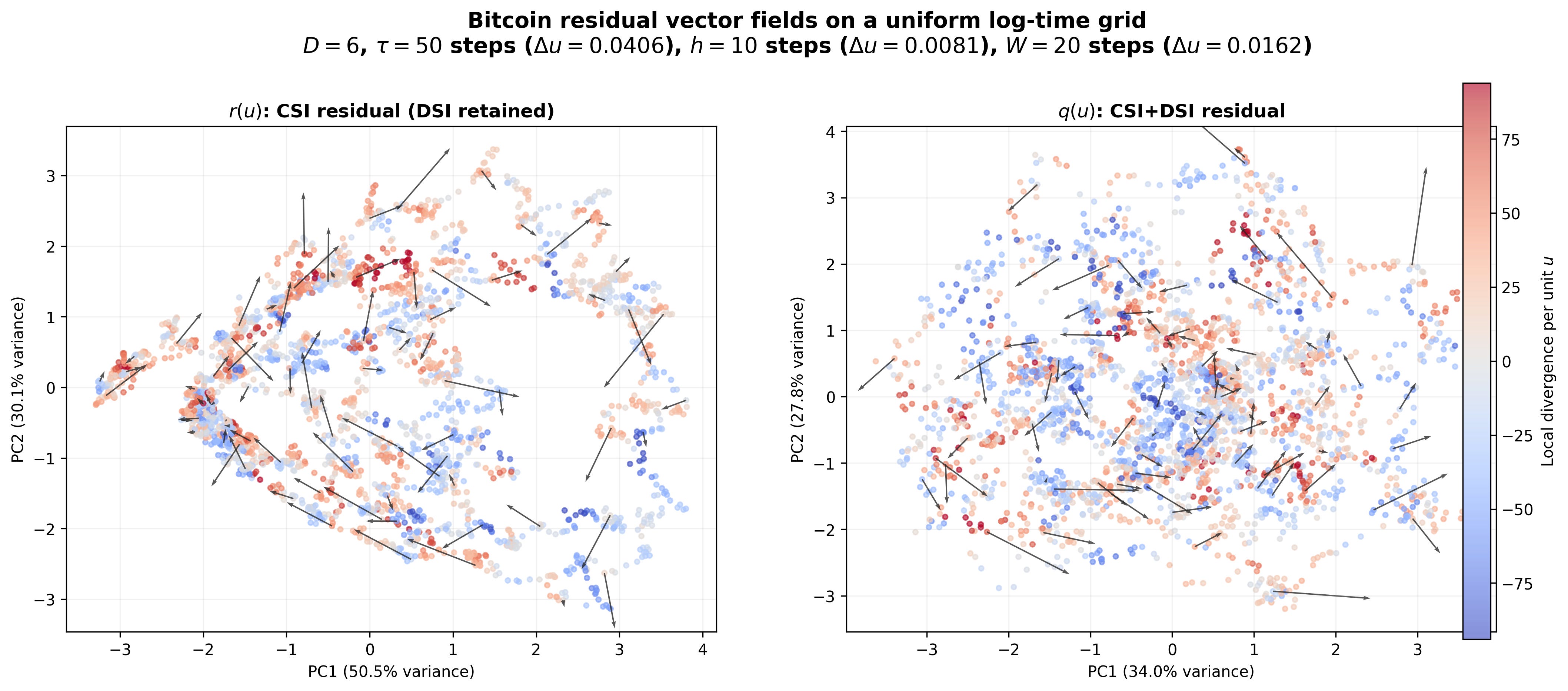
The reconstructed r(u) states form a conspicuous loop-like geometry when projected onto their first two principal components. These two components capture approximately 80.5% of the total six-dimensional variance: 50.5% in PC1 and 30.1% in PC2.
The locally averaged velocity vectors follow this organization rather than pointing independently in arbitrary directions. This indicates that much of the visible global geometry of r(u) is dynamically coherent. The flow has a substantial tangential component, with a median absolute tangential-to-radial ratio of approximately 1.3.
The fraction of locally estimated flow directed inward is approximately 0.53. This is close to an even division between inward and outward motion, however, and does not establish a globally attracting spiral sink. The defensible conclusion is coherent rotational organization, not persistent contraction toward a fixed center.
The CSI+DSI residual: DSI removed
After removing the fitted DSI component, q(u) becomes substantially less compressed in its first two global principal components. PC1 and PC2 capture approximately 34.0% and 27.8% of the variance respectively, for a combined share of approximately 61.9%.
The conspicuous loop in r(u) is correspondingly weakened, but the q(u) reconstruction does not become a random cloud. Local velocity estimates here also display organized directional patterns, and tangential flow remains prominent. The median absolute tangential-to-radial ratio rises to approximately 2.2, indicating that local motion is more tangential than radial in this projection.
Once again, there is no strong net attraction toward the estimated center: the inward fraction is approximately 0.50. The post-DSI residual therefore retains rotationally organized local motion but does not support the interpretation of a contracting spiral sink.
The apparent clockwise or counterclockwise direction in a PCA projection do not carry physical significance. The sign of each principal axis is arbitrary, so reversing one axis reverses the apparent rotational direction without changing the underlying dynamics. The meaningful quantities are the coherence and relative rotational strength of the projected flow, not its handedness.
What changes in logarithmic time?
The earlier calendar-time construction also suggested coherent rotational motion, but it combined a fixed number of days across very different stages of Bitcoin’s development. The uniform-(u) reconstruction places early and late observations on the same proportional-age scale.
This revised analysis sharpens the interpretation. The strong global loop in r(u) is closely associated with the retained DSI oscillation. Removing that oscillation produces a less globally compressed q(u) geometry, while leaving significant local organization. The reconstructed flow therefore appears to contain at least two levels of structure: a dominant log-periodic rotational mode and a less visually conspicuous residual geometry that remains after the fitted mode is removed.
The vector-field analysis alone does not demonstrate that the residual states converge toward an attracting center, nor does it establish predictability. It shows that their movement through the reconstructed state space is organized and strongly non-radial, and that much of the most prominent global organization is connected to discrete scale invariance.
Flow Contours
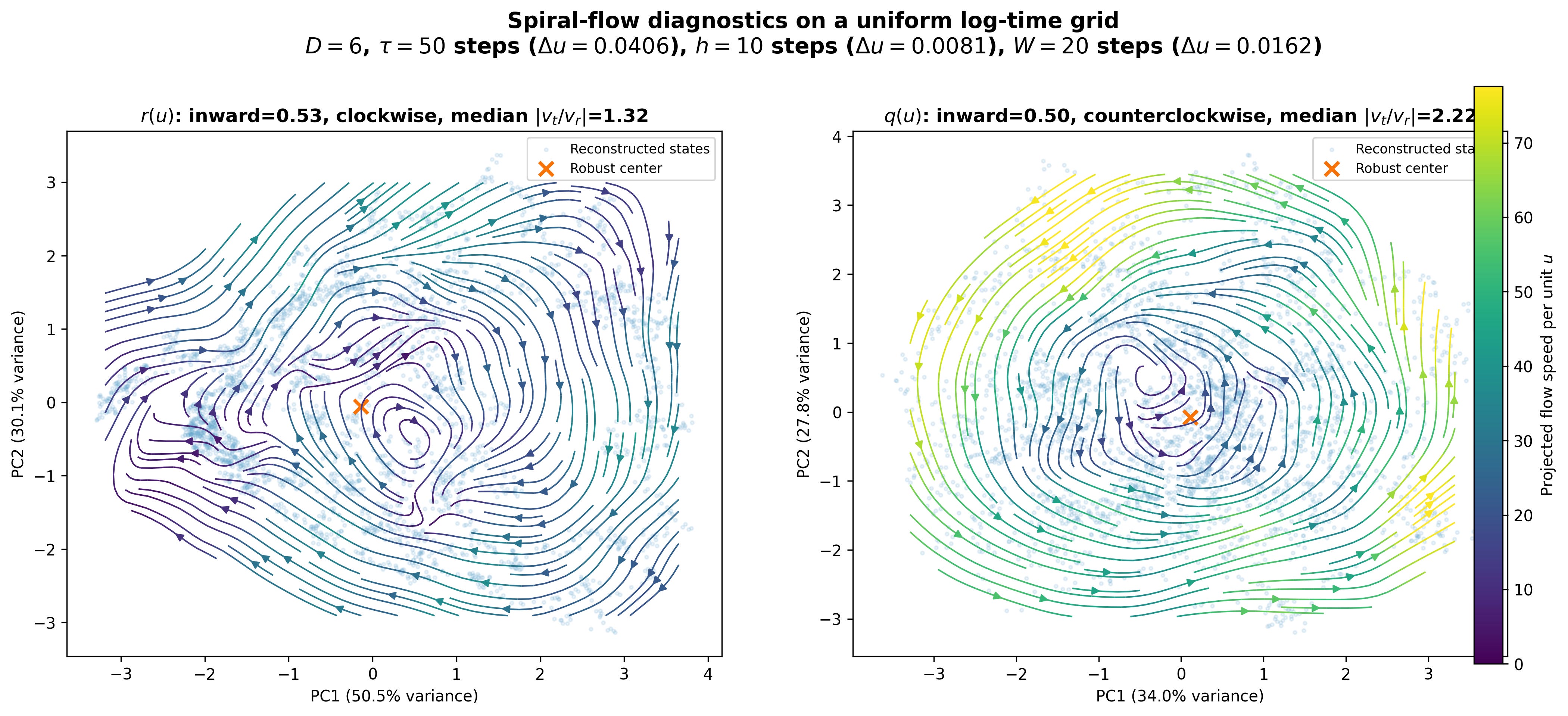
Unlike local measures such as Jacobian stretch or curvature studied in article II, the reconstructed vector field estimates the average direction of motion throughout the attractor and therefore provides a global description of the system’s dynamics. The locally estimated vector field can also be represented as a set of flow contours. These streamlines provide a smoothed view of the average direction of motion in the first two principal-component coordinates.
For r(u) the flow contours display conspicuous rotational organization around the central region. The median absolute ratio of tangential to radial flow is approximately 1.3, indicating that motion around the center is generally stronger than motion directly toward or away from it. This organization is consistent with the loop-like geometry visible in the reconstructed states and with the presence of the fitted log-periodic mode.
The inward-flow fraction is 0.53, an approximately even division between inward and outward motion. The field should therefore not be described as a clearly attracting spiral or spiral sink. It demonstrates rotational organization, but not persistent convergence toward the estimated center.
For q(u), after removal of the fitted DSI component, the global contours are less regular but remain strongly non-radial. Its median absolute tangential-to-radial ratio is approximately 2.2, while its inward-flow fraction is 0.50. Thus, removing DSI weakens the visually dominant global loop without eliminating local rotational organization. Indeed, relative to radial motion, the remaining flow is even more tangential.
The displayed direction of rotation—clockwise in one panel or counterclockwise in another—is not physically meaningful by itself. Principal-component axes have arbitrary signs, and reversing either axis reverses the apparent handedness of the plot. The invariant result is the strength and coherence of rotational motion, not its displayed chirality.
Taken together, the two flow fields separate two aspects of the reconstructed dynamics. The fitted DSI mode accounts for much of the smooth, conspicuous global rotation in r(u), while q(u) retains a less globally ordered but still strongly tangential local flow. Neither field provides evidence of sustained net contraction toward a central point.
An Approximately 2-D Transverse Membrane
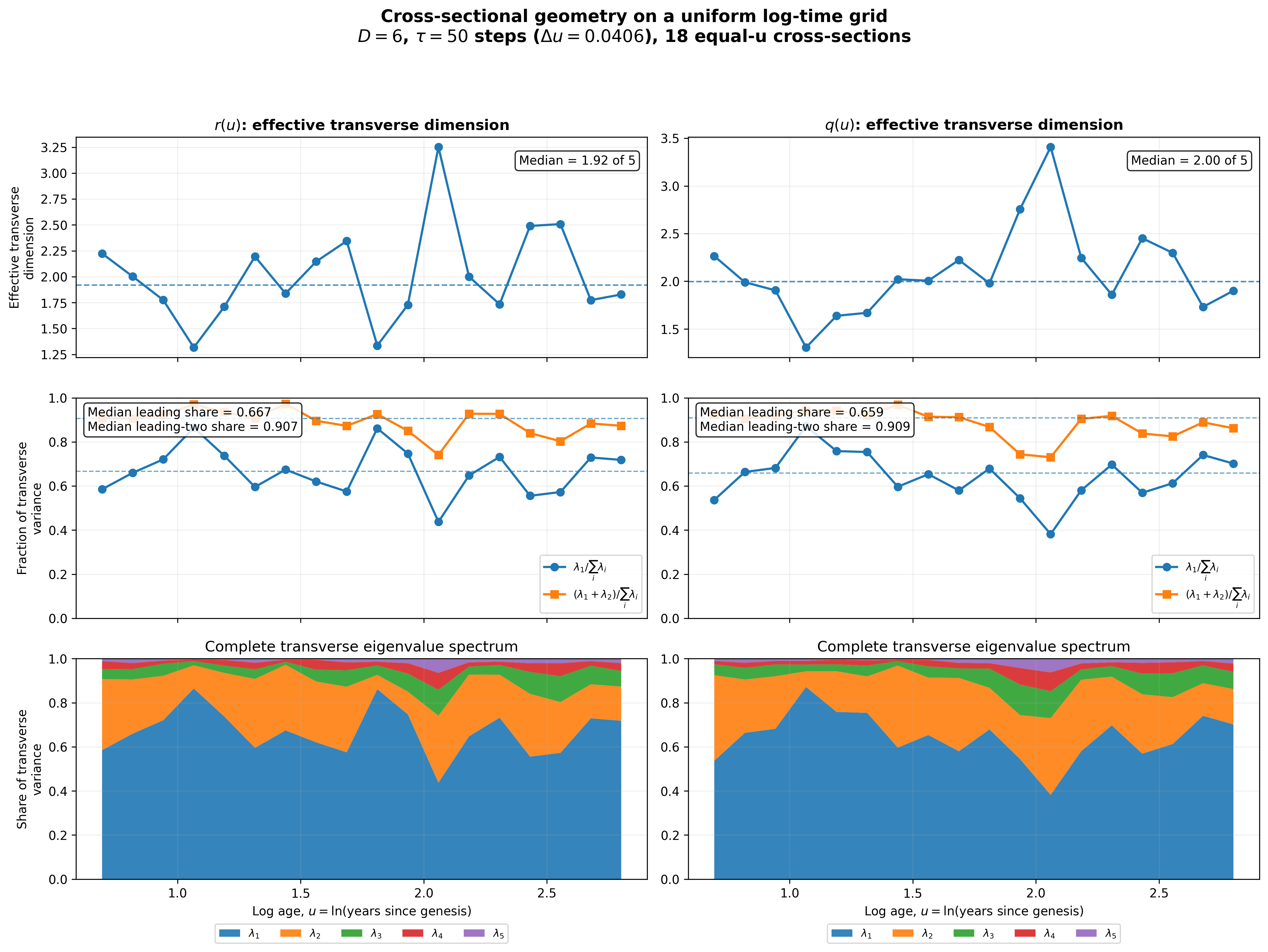
A six-dimensional reconstructed trajectory has five directions transverse to its local direction of motion. To determine how many of these directions are meaningfully occupied, I divide each uniform-log-time reconstruction into 18 equal-(u) cross-sections and calculate the five eigenvalues of the local transverse covariance matrix.
If variance were distributed evenly across all five available directions, the effective transverse dimension would approach 5. Instead, both residual constructions have an effective dimension close to 2. The median is 1.92 for r(u) and 2.00 for q(u), after DSI removal.
The low effective dimension results from a strong concentration of variance in the leading transverse directions. For r(u), the largest transverse eigenvalue accounts for a median 66.7% of the variance, while the two largest together account for 90.7%. For q(u), the corresponding shares are 65.9% and 90.9%. The remaining three directions collectively contribute only about 9% of the typical transverse variance.
The two leading directions are not equally strong. The dominant direction usually carries roughly two-thirds of the variance, producing an elongated, anisotropic ellipsoidal cross-section rather than that of a circular disk. The second direction supplies most of the remaining organized width. The resulting geometry is therefore best pictured as a thin, locally two-dimensional membrane embedded within the five-dimensional transverse space.
The similarity between first and second order residual results, using r(u) and q(u), is important. Removing the fitted DSI component substantially changes the global appearance and overall compression of the reconstructed trajectory, but it does not eliminate its approximately rank-2 transverse geometry. DSI therefore accounts for much of the conspicuous global loop in r(u), while the local concentration of transverse variance into two directions is a broader property shared by both residuals.
This conclusion is sharper than in the earlier calendar-time construction, which produced a median effective transverse dimension near 2.5 and placed approximately 82% of the transverse variance in the leading two directions. On the uniform-(u) grid, the corresponding dimension is near 2 and the leading-two share rises to approximately 91%. Fixed calendar-time sampling made the transverse geometry appear thicker and more diffuse.
The uniform-log-time analysis does not show that the transverse tube becomes progressively narrower with age. Late cross-sectional widths are comparable to, or modestly greater than, early widths. The result supported here is persistent low-dimensional anisotropy: the reconstructed states remain concentrated mainly within two of the five available transverse directions, but there is no evidence of systematic contraction in their overall transverse width.
The Dynamics Interpreted
The results of this article and the preceding work suggest a hierarchical picture of Bitcoin’s dynamics. The power law provides the primary scale-invariant growth trajectory and accounts for approximately 96% of the variance in log price. Discrete scale invariance contributes a damped log-periodic mode that explains approximately half of the remaining residual variance. Other endogenous and exogenous innovations account for the residual movement not captured by these fitted components.
These innovations displace the observed system from its CSI–DSI reference trajectory. In a six-dimensional delay reconstruction, their evolution is organized within a strongly anisotropic transverse geometry: approximately 91% of the transverse variance lies in two principal directions, producing an effective transverse dimension close to 2 out of the 5 available directions.
Removing the fitted DSI component substantially weakens the dominant global loop in r(u), but leaves this normalized cross-sectional geometry almost unchanged. Both r(u) and q(u) occupy an elongated, approximately two-dimensional transverse membrane. DSI therefore accounts for much of the prominent global rotational geometry, but not all of the lower-dimensional organization remaining in Bitcoin’s residual dynamics.
Conclusions
Across this three-article series, Bitcoin’s dynamical geometry has been examined through a six-dimensional delay-coordinate reconstruction. Its long-term evolution appears consistent with three interacting components: deterministic power-law growth, a damped log-periodic mode associated with discrete scale invariance, and residual innovations of endogenous and exogenous origin.
On a uniform logarithmic-time grid, the reconstructed residual dynamics display coherent rotational organization and a membrane-like transverse geometry with an effective dimension close to 2. DSI accounts for much of the dominant global loop, while approximately rank-2 transverse organization remains after the fitted DSI component is removed.
The resulting picture is not that of a stationary equilibrium point or a demonstrated spiral sink. Rather, Bitcoin evolves around a scale-invariant reference trajectory, with structured residual motion occurring within a compressed reconstructed state space. The analysis supports low-dimensional organization but provides no evidence of systematic transverse narrowing with age.
The next article examines robustness across embedding choices, surrogate-process significance and out-of-sample persistence.
This is not investment advice. Stephen Perrenod is engaged in econophysics and nonlinear science research as Associate Director of the Scientific Bitcoin Institute.
Comments
Nothing yet. Say the first thing.
Sign in to join the conversation.