
At every security checkpoint in Kabul, there are two entrances: one for men, one for everyone else.
Parallel spaces. Separate waiting areas, separate search rooms hidden behind walls or curtains.
Most public space in Afghanistan is now, by design, overwhelmingly male. Streets. Markets. Parks. Hotel lobbies. Restaurants.
The visible world belongs almost entirely to men.
But inside the small, hidden spaces, the waiting areas and back offices, the atmosphere changed completely. Conversation loosened, faces relaxed, we laughed more easily.
I have been thinking about those spaces lately. My government recently cast the sole vote against a UN resolution on girls’ and women’s access to justice. The narrowing is not only happening there.
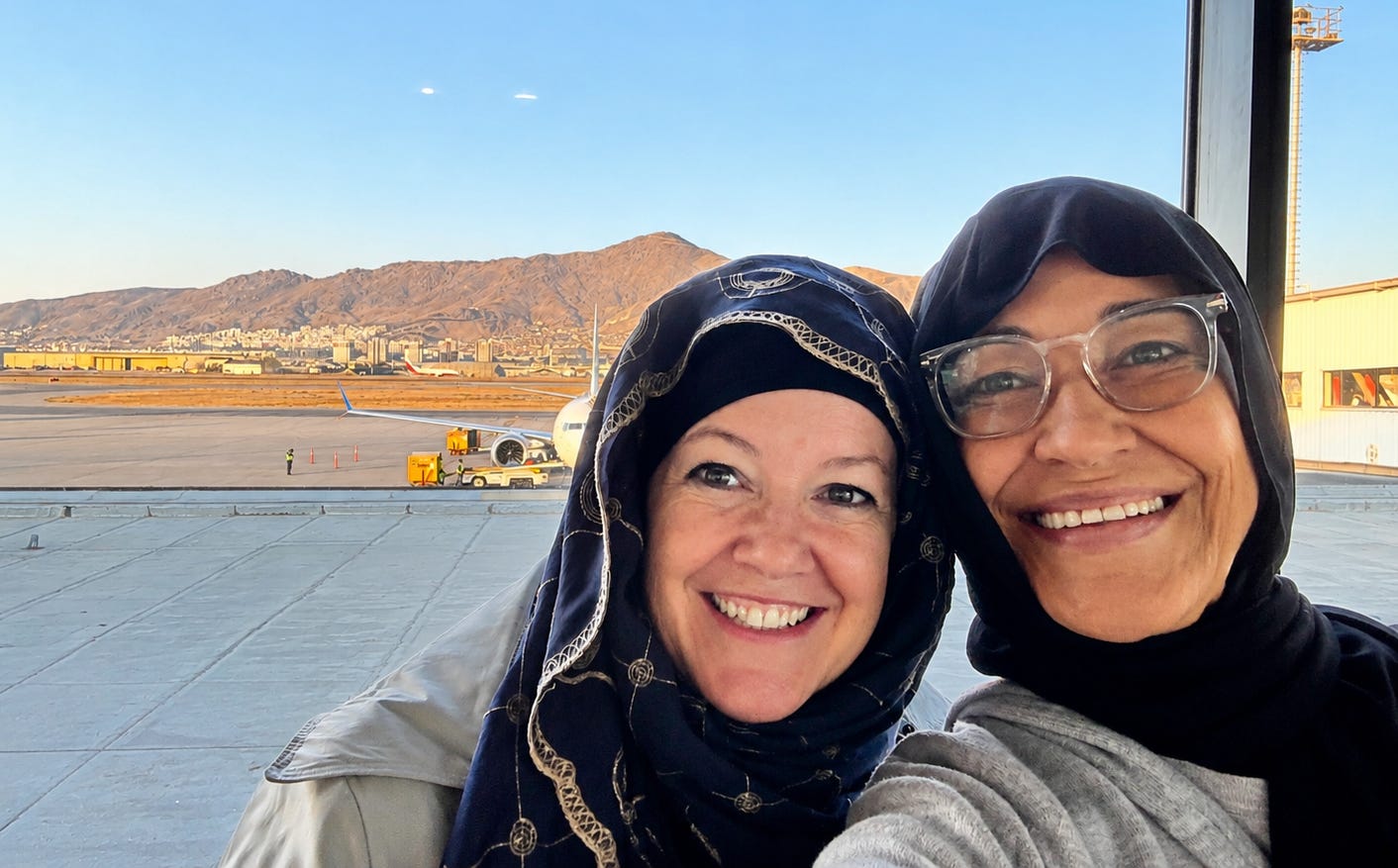
This past November I traveled to Afghanistan with the International Legal Foundation (ILF), the first and largest provider of criminal legal aid in the country, to meet lawyers who had spent years navigating the narrowing.
Since the Taliban takeover in 2021, women judges, prosecutors, and defense lawyers have been largely pushed out of the justice system. The Afghan Independent Bar Association was dissolved. Many of the country’s most experienced lawyers fled.
From afar, it can look as though women in the legal system have simply disappeared.
They have not.
In Kabul, a small number of female lawyers are appearing in court through ad hoc permission issued by the appeals court. It is not a license. It is not recognition. It is a letter from one judge that another judge might honor. But it is enough to keep working.
The situation across Afghanistan is deeply uneven.
In practice, whether a woman can continue working as a lawyer often depends on the province, the judge, and the relationships she can still navigate.
Sometimes it means appearing before a judge willing to accept a female defense lawyer. Sometimes it means visiting prisons on the few days female lawyers are allowed access. Sometimes it means advising clients from home because, as women, they cannot enter government buildings.
In some places, it means writing legal motions that clients carry into court themselves.
None of it is easy. But it is happening.
Before 2021, ILF lawyers in Afghanistan were doing far more than appearing in court. They met clients in the earliest hours after arrest, the period of greatest risk for torture, coercion, and forced confessions. They followed cases through prosecution, trial, and appeal. They ran legal clinics at universities, trained younger lawyers, visited prisons, and handled the hardest cases: murder, kidnapping, and political prosecutions. One lawyer told me he personally managed more than 150 criminal cases a year.
Over time, ILF lawyers expanded beyond criminal defense into family, inheritance, and employment matters, because legal crises rarely arrived one at a time. A criminal case might also involve property disputes, abandoned families, lost documentation, inheritance conflicts.
After the Taliban takeover in 2021, much of Afghanistan’s criminal legal aid system collapsed almost overnight. International programs shut down. Defense lawyers lost salaries, institutional backing, and in many cases, the ability to practice at all.
One lawyer who had spent years representing poor defendants told me he survived for a time by selling household belongings, then his wife’s jewelry, piece by piece.
“Whatever we had in the bank,” he said, “it was all gone.”
For a time he considered leaving. He tried driving a cab. Then, after nearly two years at home, he began quietly rebuilding a legal practice through personal connections, charging those who can afford it in order to represent those who cannot.
His years at ILF left a mark:
“Rich and poor commit crimes,” he said. “But the poor fill the prisons.”
In some courts, lawyers said they are no longer referred to as 'defense lawyers' at all, but as 'commission agents’.
For women lawyers, the contraction went further.
One lawyer in Herat, whom I will call Leila, had built her life against considerable odds. Her parents had not supported her education. She fought for it anyway, studied law, and eventually became one of the country’s most respected defense lawyers, working criminal cases that most lawyers wouldn’t touch.
She described what the work had meant to her: “When I represented a poor person and got them free,” she said, “seeing the smile on their face gave me so much pleasure.”
Now she is trapped at home, as she has been, effectively, for five years.
She cannot enter courts, visit prosecutors, or go to detention centers.
“Each single day and night I have stress,” she said. “Panic attacks. Crying. You cannot do anything. You try to manage yourself, your family.”
Before 2021, she sometimes came home from prison visits in tears. Now she cries because she cannot reach the prisoners at all.
She still advises on family disputes and employment matters.
But she is doing it from her living room.
“The hardest thing,” she told us, “is not the danger. It is knowing that someone is innocent and sitting in prison because I could not get there.”
A lawyer in Balkh has managed to keep practicing, but only by carefully navigating local authorities and individual judges, including officers of the Ministry for the Promotion of Virtue and Prevention of Vice, who wear white and have the authority to stop and interrogate anyone, at any time, for any reason.
She handles family disputes, employment matters, and criminal cases. She said she has built credibility with judges. “They believe in me,” she said quietly. “They know my work.”
But even there, some judges say: "This is my court. I do not need defense lawyers. The judge knows everything."
She said that at least 142 women are currently imprisoned in Balkh province without defense counsel. She estimated that across the province, at least half of all accused people have no access to legal counsel. Among them: a woman serving a murder conviction whose entire family has left Afghanistan. She has been in prison for over a year without counsel, without appeal, without anyone to review the record. No one to file on her behalf. No one who knows whether the conviction was sound or whether she was simply unrepresented at the moment it counted.
“They need someone,” she said.
The constraints reach everyone. One male lawyer mentioned, almost in passing, that he keeps his beard longer than he would choose because the bar association will not renew his license otherwise. It is a small compliance, a daily reminder of who holds authority over the profession.
For women, the authority doesn't ask for a longer beard. It asks for everything else.
A female lawyer drafts a motion from her home. A client carries it into court. A family member delivers paperwork to a clerk. Legal arguments travel where the lawyer herself cannot.
Inheritance work has become one of the few relatively consistent areas of practice for female lawyers. Afghan women are legally entitled to inherit property from their families, but many are denied those rights through customary pressure and informal arrangements.
Female lawyers help them understand their rights, draft documents, pursue claims. They do it without ever entering a courtroom.
Juvenile cases represent another opening. In Herat, two NGOs are nominally active in this space, but the lawyers I spoke with were blunt: the coverage is inadequate. The need is there. The lawyers are there. The gap is institutional support.
But the clients keep coming.
“A woman who asks for her legal rights is often told it is against religion,” one lawyer said. “I know the law — and I know my religion. Both say she has a right to inherit.”
When defense lawyers disappear, something else fills the space. The International Legal Foundation has seen it in Rwanda, Afghanistan, Nepal, Myanmar, and Tunisia: torture during interrogation. Years in prison before trial. Wrongful convictions with no one to challenge the record. This is the baseline whenever poor defendants face the justice system alone.
After two decades of international state-building projects in Afghanistan, most funding for justice work disappeared almost overnight in 2021. What little remains is often what can be delivered remotely: training programs, workshops, capacity building.
These are not useless. But they do not put a lawyer in a courtroom or a prison.
The lawyers I met were unambiguous about what they needed.
“We don’t need training,” one said. “We are trained. We need access to our clients.”
One donor proudly described funding yet another remote training program for Afghan women lawyers who had already practiced for years, knew the courts, knew the law, and still could not physically reach their clients.
“Afghans are trained,” another said. “We need to be able to go out and do the work.”
The International Legal Foundation has operated in Afghanistan since 2003, representing indigent clients directly, in court, in detention centers, case by case. It re-registered under the Taliban this year and is resuming operations. Its lawyers are among those negotiating which judges will allow a female defense lawyer through the door.
Even official permission is thinner than it sounds. A Ministry of Justice authorization can be ignored by individual judges, while a Supreme Court letter compels cooperation across the system. One piece of paper can be ignored. The other cannot.
Legal access is not simply allowed or prohibited. It is constantly negotiated: province by province, court by court, judge by judge, through personal relationships, improvised permissions, and narrow openings that can disappear without notice.
The lawyers I met are not asking for charity. Most of them had opportunities to leave Afghanistan and chose not to. They have the skills. They have the commitment. Their clients have no one else.
On my last day, passing back through the checkpoints, I thought about the rooms behind the curtains. Most public space in Afghanistan now belongs to men. But the work I had come to see was happening in the other spaces, the hidden ones. Motions drafted in living rooms. Rights explained at kitchen tables. Arguments that travel, in a client’s hands, where the lawyer herself cannot go.
The Taliban decided where women could work. They have not decided whether.
At the end of our final meeting, no one spoke. The silence was not quite hope, not quite resignation.
“Give us a path to work,” one lawyer said. “We will take care of the rest.”
Driving past the former US Embassy in Kabul's “Green Zone,” abandoned since the 2021 withdrawal:
Disclosure: I serve on the board of the International Legal Foundation. In 2022, the ILF established the Stephanie Kleine-Ahlbrandt Fund to support coaching and training for its frontline lawyers and staff.
Comments
Nothing yet. Say the first thing.
Sign in to join the conversation.