
The slide read: Know Your Rights & ICE Preparedness.
I was in a church hall in the Bronx, one of perhaps sixty people. Folding chairs. A projector. Coffee and empanadas going cold on a table near the kitchen. Hands Off NYC had organized the training, drawing representatives from across the city’s rapid response network: organizations that didn’t exist five years ago, now operating at a scale that would have been hard to imagine.
The training was methodical and precise.
It was also familiar. More familiar than it should have been.
I have visited North Korea six times. I lived in Rwanda after the genocide, in Bosnia after the war, in China. I know the quality of a room where people are learning to survive their own government: the way attention sharpens, humor appears and disappears quickly.
This was not supposed to be that kind of country.
This was the Bronx. This was a Saturday morning in April. This was the country I had always been able to come home to.
For most of my adult life, I worked from a position that felt sustainable: I could move between other people’s crises, learn the languages, apply the frameworks, and return to a country that was, if deeply imperfect, not a primary threat to its own people or to international peace.
It was also a form of privilege: the ability to make other people’s emergencies into a vocation, and then leave.
That option is closing.
It is hard to justify learning other systems, other people’s crises, when your own country is both threatened and threatening. The idea that one can focus elsewhere begins to fray. And then it doesn’t fray. It breaks.
No leader is coming to save us. What will matter is what communities organize, build and defend. Room by room.
The training laid out the logic plainly:
Here is what is happening.
Here is how systems behave under these conditions.
Here is what people can do in response.
Then, quietly, it asked:
What will you do.
The next slide read: What to do when you see ICE.
A hotline number. A protocol: photograph first, then report on size, activity, location, unit, time, equipment.
That hotline fed into a larger architecture: volunteers, legal observers, rapid-response networks designed to move faster than official ones.
Hundreds of colorful 3D-printed whistles were spread across the tables. Two signals: one for when ICE was spotted, one for when someone was being taken.
Then detailed photos helping identify ICE when appearances shift, when multiple agencies are present, when enforcement is less visible than expected. A note at the bottom, almost an afterthought: do not post this on social media.
And then what happens after.
This conversation changed the register of the room. How to help neighbors build contingency plans: who to call, who could take the children, which documents to have ready for the moment someone didn’t come home. Not if. The training did not say if.
The woman behind me had come with her young nephew. She had handed him her phone. He stood with his back to the room, using the a chair to steady his hands, thumbs moving, unaware that this part of the training was about him.
It felt close. Too close.
Across the room I recognized a woman who had babysat me as a child in Indiana. We hadn’t seen each other in years. She was there for the same reason I was.
I have attended versions of this training before—in Kigali, Yangon, Monrovia. Different slides. Different specifics: arbitrary detention, torture, disappearances, the narrowing of public space. But the same structure. The same attention: what they were learning, they might need tomorrow.
In those rooms, the premise required no argument. The state was a threat. People would have to build around it.
The Bronx has been doing this for over a century: through labor and tenant organizing, through collective responses to disinvestment, mass incarceration, and police violence. Through every iteration of the same hard lesson: when institutions fail, or cause harm, people build their own. Protection. Information. Mutual aid. Assembled quietly, passed down like a language.
The trainer walked through what she called the authoritarian’s playbook—not as history but as the present tense: concentration of power, capture of institutions, elimination of oversight, normalization of emergency measures, expansion of surveillance, criminalization of dissent.
The sequence is recognizable. The pace varies.
In most of the places I have worked, by the time people are naming the pattern, they are already living inside it.
A friend who came with me said he had assumed that RSVPing to a training like this over unencrypted text could get us on a no-fly list.
I had a flight to Berlin later that week. Standing in the immigration line on the way back, I found myself running through what I had written, what I had posted, where I had been. I held my passport too tightly.
I know something about how personal information is gathered and used, and what it costs, later, to have been visible in the wrong place at the wrong time. I have helped other people think through that calculation for years, about other governments. It felt different to run it on myself.
In the U.S., privilege offered insulation, for a while. For Black and brown Americans, for undocumented immigrants, for people living in poverty, it never did. What feels new to some has long been immediate, ordinary, and generational: not a change in weather but the climate itself.
The question is not whether something is happening.
It is whether you are part of it.
The training did not linger in outrage. It had no time for it. It moved directly to action: hotlines, roles, infrastructure.
You can document. You can disseminate. You can delay. You can disrupt.
“Disrupt,” a slide clarified, meant challenging the expectation that you will do nothing. Not heroism. Not sacrifice. Just the refusal to look away.
Not new. Just newly local.
Versions of this training have been moving city to city, from Los Angeles to Minneapolis to Chicago, adapting to local conditions, updating as enforcement tactics change.
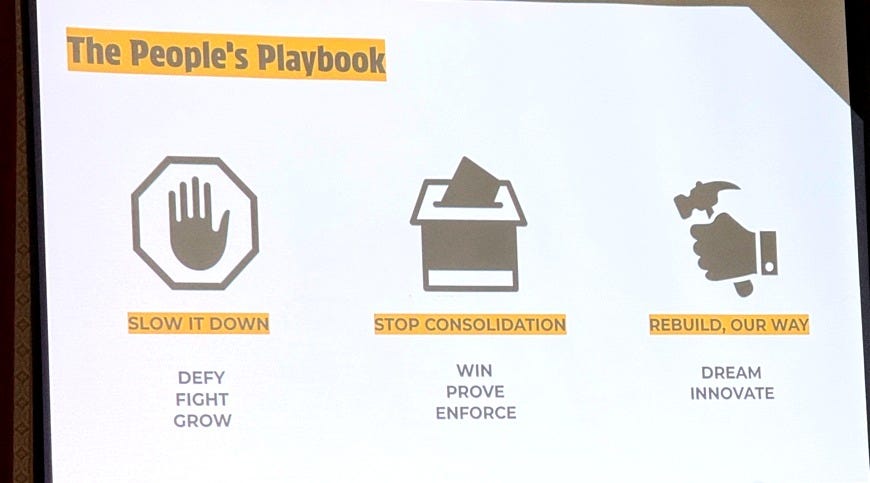
What stayed with me, as much as any slide, was how well the room was run.
This was not a room of despair. It was a room of work.
The trainer moved with practiced precision, pulling people in, shifting from listening to participation before attention could drift. There was a role play: an ICE stop, then an abduction. Confusion, escalation, removal.
The room watched in silence. My body did not entirely believe it was staged.
The man who had played the one being questioned spoke afterward with a kind of detachment. He said the role felt natural. There was a pause after he said it.
He had been stopped enough times that it required no imagination.
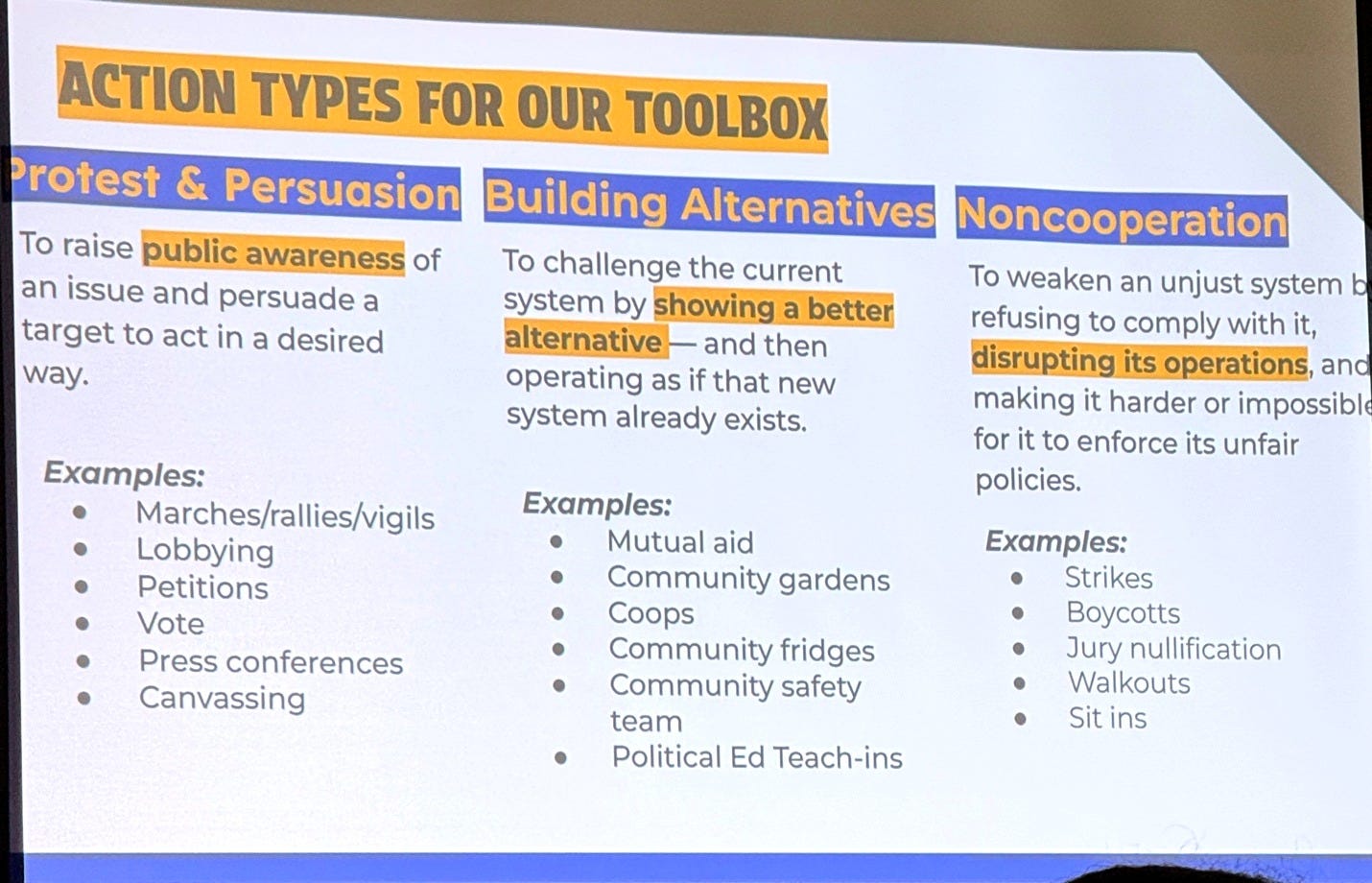
There was also an emphasis on limits.
Participation was framed not as moral obligation but as a calculation. You are not expected to do everything. You need to assess your own vulnerability—legal, financial, personal—and act within it. Not permission to do nothing, but an instruction to be honest about what you can sustain.
For years I helped people in other countries work through exactly this: what to put in writing, how to sense the line before it moves, which risks are yours to take and which belong to the people around you who did not choose to be exposed.
I had not expected to need it here.
The woman who delivered most of the training, Laura, was the daughter of immigrants. She told me afterward that similar organizations were multiplying faster than they could coordinate. There were already turf disputes, the ordinary friction of movements under pressure. Her own interest was simpler: to train as many people as possible, in as many rooms as she could reach. When I offered to help, she didn’t hesitate.
For years, I was the one who came from elsewhere, who brought the frameworks, worked alongside people navigating these conditions, and then left.
That position has closed.
This is the room I am in now.
Behind me, a boy’s thumbs moved across a screen.
What will you do.
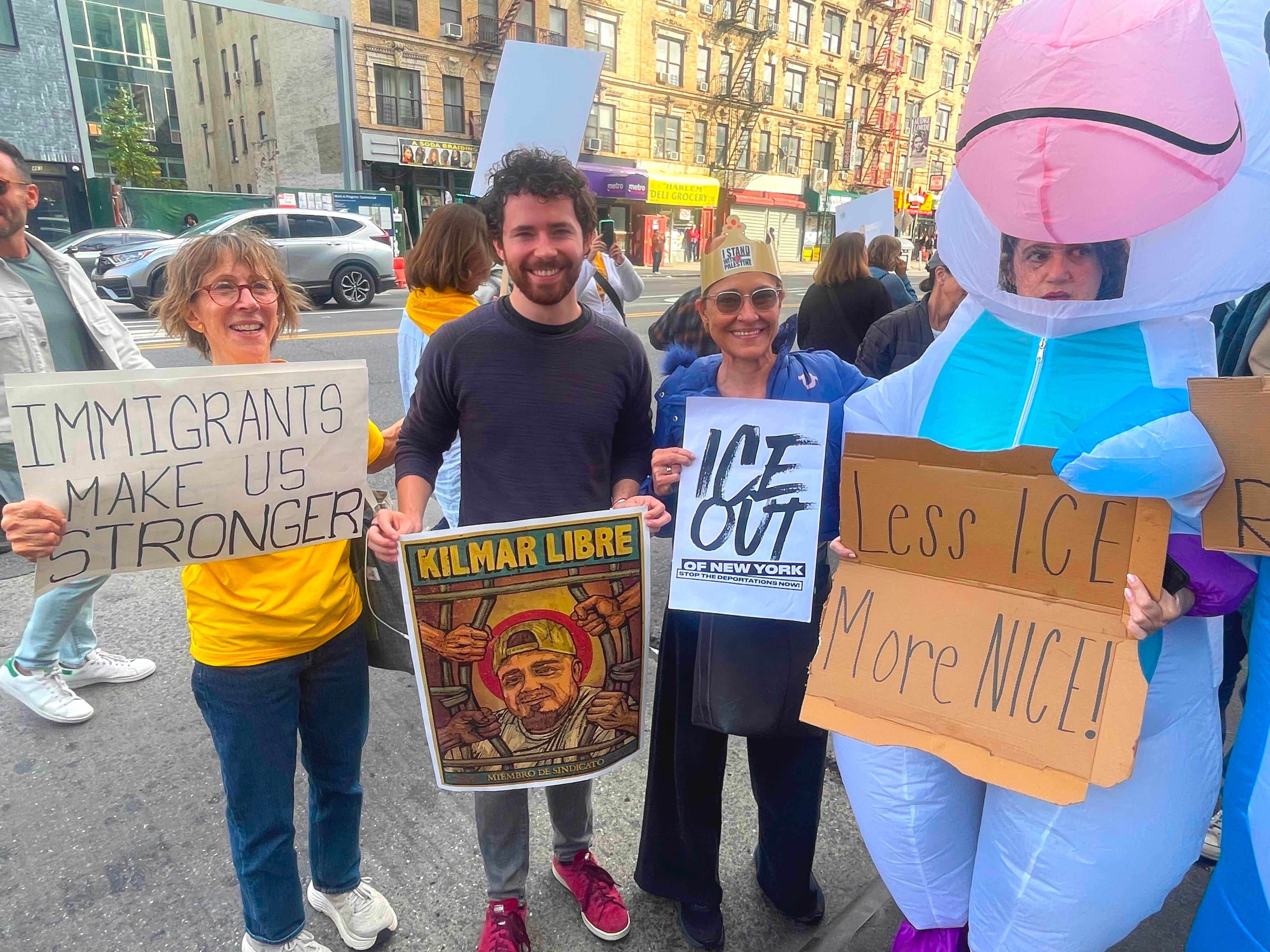
P.S. A French documentary crew was present at the training, as part of a film called Démocratie maintenant! (Democracy Now!), directed by Cyril Dion and Paloma Moritz, following citizen movements across the United States, Brazil, Belgium, England, France, and the European Parliament. They plan to release the film before the French presidential election, with the explicit aim of shaping the campaign debate. The Bronx is not the margins of this story. It is one of its centers. Follow and support the film here: fr.ulule.com/democratie-maintenant
Comments
Nothing yet. Say the first thing.
Sign in to join the conversation.