
Last week we were excited to release Episode 10 of the STEMCONNECTOR AI Vodcast Series, Behind the Bot: Exploring the Infrastructure Powering AI in Education, closing out our ten-episode series produced with the Utah STEM Action Center covering a range of compelling topics at the intersection of AI, education, and workforce development.
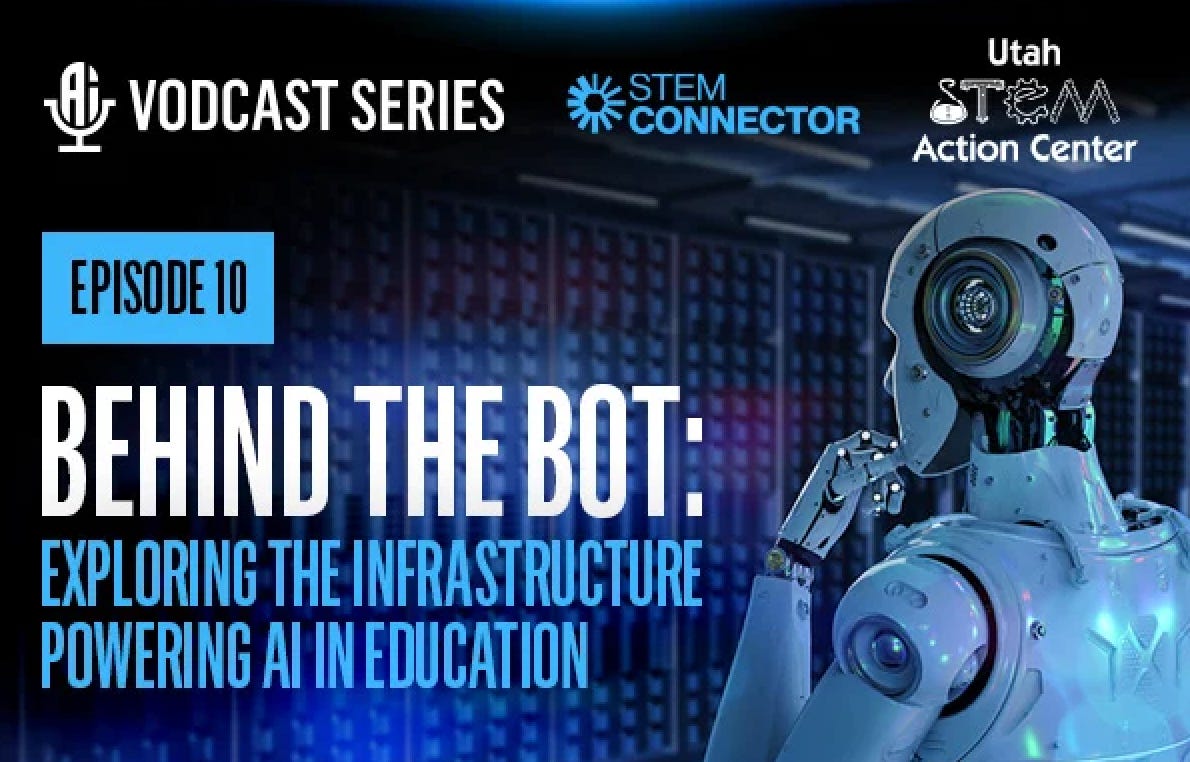
Most of the conversation involving AI in education focuses on tools, platforms, prompts, and what they are able to support and empower in our classrooms. Episode 10 goes behind the scenes to ask what powers it all, and what it means for students, educators, and the workforce. The panel, featuring Amy Garner from Vantage Data Centers, Amanda Trumble from ABB, Cammie Kannekens, District Instructional Coach, Prairie Rose Public Schools; Educational Technology Training Consultant, Logics Academy, and Adam Garry of StrategicEDU Consulting, covers the infrastructure requirements that most educators aren’t aware are needed to support this platform, including data centers, cloud computing, servers, energy systems, and the supply chain of people and skills that keeps it running.
Of particular importance to our STEM education and talent pipeline stakeholders is this infrastructure is generating significant workforce demand in areas like construction, electrical work, data center operations, and energy management. These fields are connected directly to the CTE and technical workforce pathways we’ve discussed previously. The episode also addresses concerns regarding AI’s environmental footprint and the innovations aimed at making AI infrastructure more sustainable, and the resources page includes a classroom guide from AI for Education and a piece from the Hechinger Report on teaching AI without harming the planet.

Recent data from the broader labor market reinforces why the topics we’ve covered has mattered. A survey of 1,000 U.S. hiring managers found that 48% would rather invest in AI tools than hire and train a recent college graduate. This view reflects a structural shift that is occurring in how employers consider investing and developing early talent, and should inform how we approach preparing students for a market that is placing less value on generic degrees and credentials.
At the same time, CompTIA’s inaugural AI Skills Tracker found that fewer than one in three professionals describe themselves as highly AI-literate, despite four in five using AI tools monthly. The disparity between using AI and understanding it well enough to apply it with judgment and accountability is the gap our AI Vodcast Series has been exploring, from personalized learning to maker education and policy to now the infrastructure that powers it all.
The Department of Education recently finalized a rule tying student loan eligibility to graduates’ first-job earnings, which has sparked a useful debate regarding what competencies that are tied to degrees and credentials are supposed to measure. C-BEN President Charla Long argues that wage thresholds at a graduate’s first job are a poor proxy for what workers actually know and are able to do, especially as AI and automation reshape job roles faster than degree programs are able to respond. The more compelling accountability model, she argues, is one that verifies specific competencies embedded in a credential rather than relying on classroom seat time or entry salary. Her argument connects to what our Math Bottleneck Webinar and Maker Learning Webinar have stated earlier: what students are able to do matters more to employers than what credential they hold, and the education system needs to build accountability structures around these market-validated, demonstrated capabilities.
The credential still matters, but also what surrounds it: applied experiences, employer connections, and the functional and durable skills that help translate classroom learning into workplace contribution.
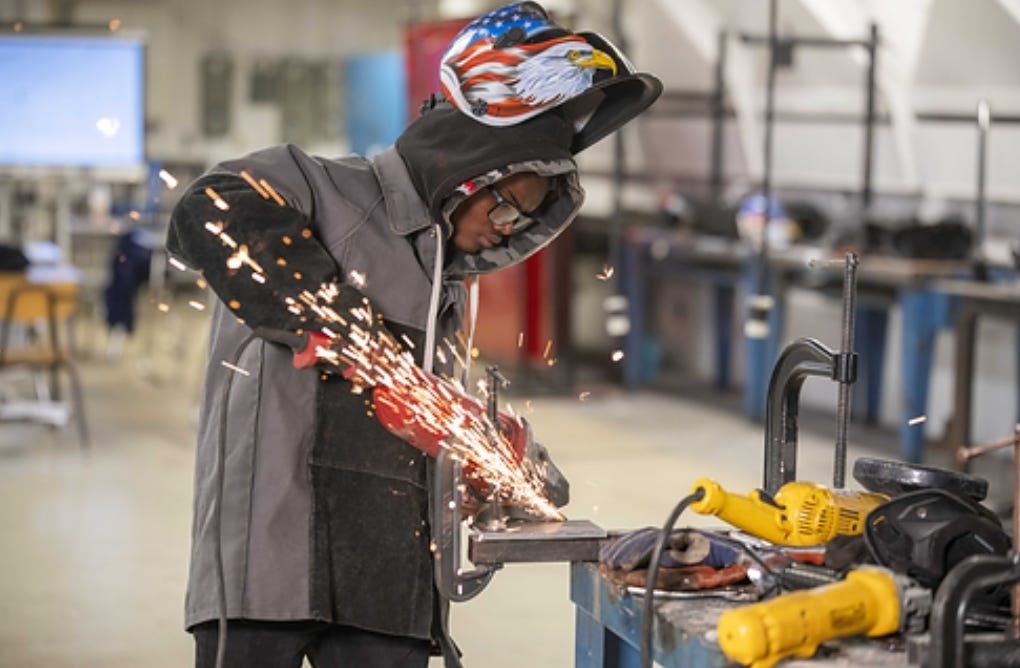
July also brought news of the Alliance for America’s Skilled Trades, a new coalition launched by BlackRock, Carhartt, Ford, and Google aimed at closing a projected 2.1 million-worker gap by 2030. The founding members have independently committed to supporting skilled workforce training in 30 states. This worker gap is being driven in significant part by AI infrastructure buildout. Data centers require electricians, HVAC engineers, and construction workers at scale. Nvidia’s Jensen Huang said at Davos earlier this year that this buildout will create enormous demand for plumbers, electricians, and network technicians alongside AI engineers, which is what Episode 10’s experts discuss and address.
There is also a useful angle on the apprenticeship side worth noting. A new field briefing from Apprenticeships for America points to the country’s 27,000 staffing agencies as an underutilized partner in building apprenticeship infrastructure. These agencies already handle the recruiting, payroll, and compliance that apprenticeship requires. The report estimates that converting just over 2% of staffing placements into apprenticeships would add 220,000 new apprentices annually. For organizations working on technical workforce pipelines, this is a compelling opportunity to leverage.
If you haven’t watched the full AI Vodcast Series, we encourage you to do so. The ten episodes build on each other, together providing one of the more comprehensive cross-sector examinations of AI in education and the workforce currently available. Topics include:
Invent. Iterate. Innovate: AI in the Maker Movement: directly connected to our maker learning work this summer
Policy Implications of AI in Education: featuring Mary Crowe from NSF’s TIP Directorate
Impact of AI on STEM Careers: the employer perspective on what is changing
What’s Up Next
While this series is wrapping up, producing content where industry, education, and policy leaders come together around questions that matter most for the workforce is central to our mission at STEMCONNECTOR. We will be launching a new series, webinars, and convenings in the months ahead. If your organization is interested in being part of our community of practice, we would welcome the discussion. Reach out to us at stemconnector.com.
Stay Current with the STEMCONNECTOR Quarterly Newsletter
Our Q2 2026 Quarterly Newsletter provides our members and partners across the STEM ecosystem with updates on what others are building, launching, and learning this quarter, including maker learning, AI workforce readiness, federal investment strategy, and more.
No posts
Comments
Nothing yet. Say the first thing.
Sign in to join the conversation.