
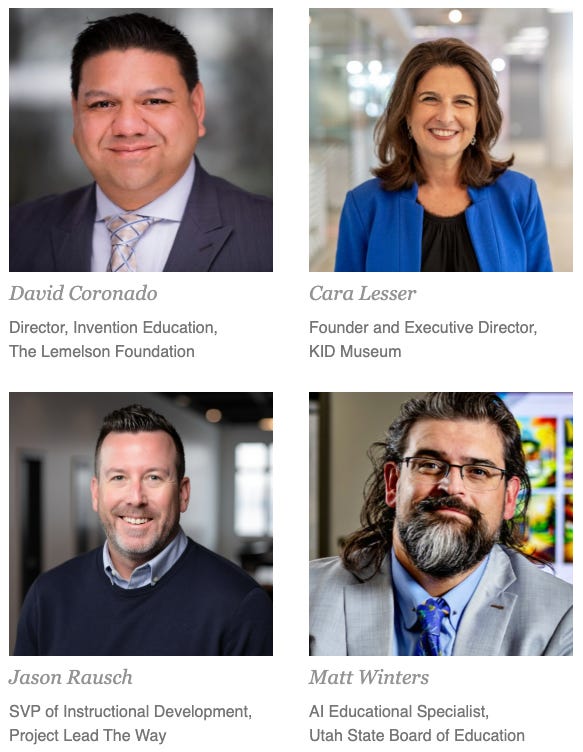
Last week, STEMCONNECTOR convened four of the most experienced voices in Maker Learning for a webinar to continue the discussion we started at our Salt Lake City Innovation Lab in June. The panel, David Coronado from The Lemelson Foundation, Cara Lesser from KID Museum, Jason Rausch from Project Lead The Way, and Matt Winters from the Utah State Board of Education, spent an hour with STEMCONNECTOR Co-CEO Drew Glassford sharing their perspectives on maker learning, why it matters for workforce development, and what it will take to move it from isolated bright spots into mainstream education.
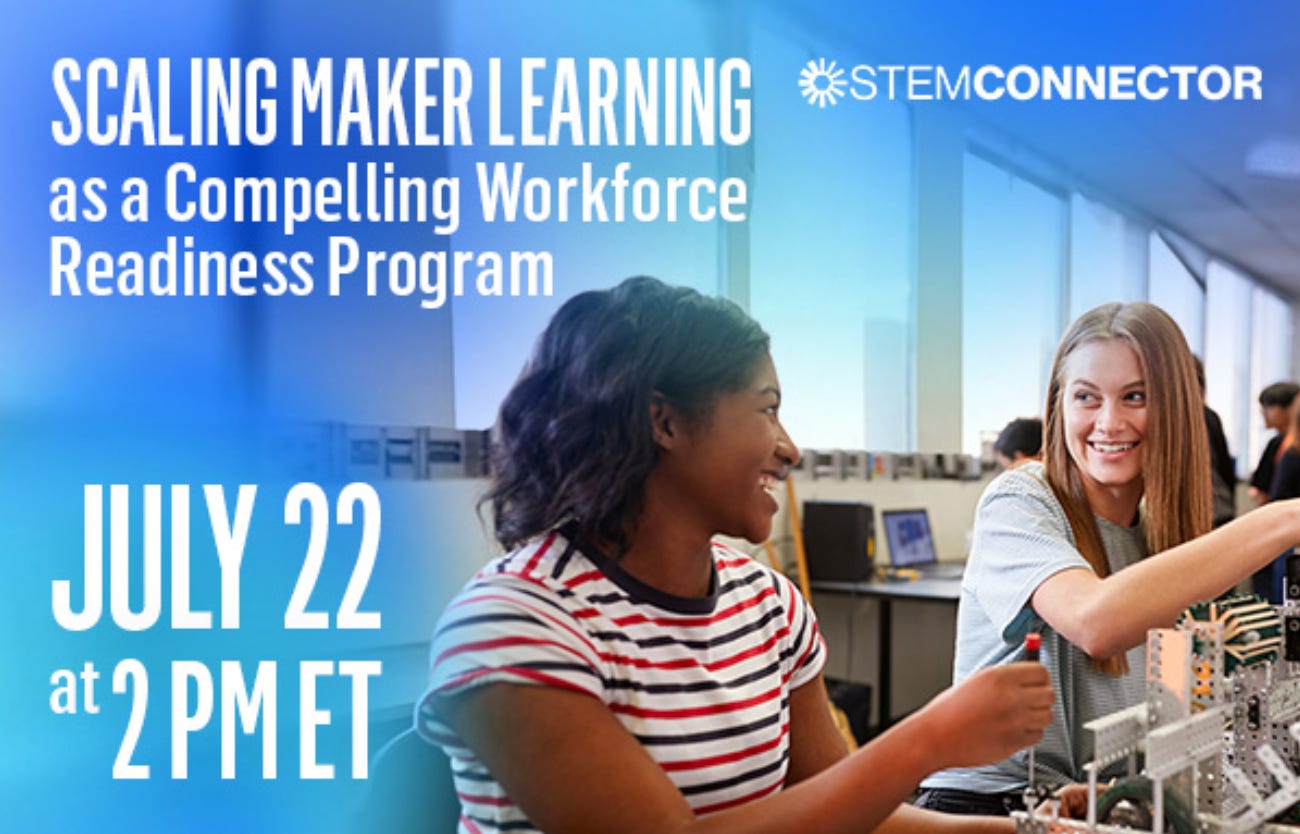
One of the first topics of our panel was to clarify what constitutes authentic maker learning, which goes far beyond giving students a 3D printer or creating a makerspace. As Cara Lesser shared, “We let kids go play around in the maker space and we have 3D printers and that’s great, but what we focus on in Maker Learning is to build the mindset and identity of someone as a creative problem solver.”
David Coronado framed it around what the Lemelson Foundation calls transdisciplinary learning, the idea that real-world challenges do not separate neatly into math, science, or English, and neither should the way we prepare students to address them. “In invention and maker learning, kids find problems they care about,” he explained, “and we help them understand how to use their knowledge across all these different subject areas, including user design, to figure out how to solve them.”
For Jason Rausch, the value of maker learning is in the benefits it provides students long after specific content is forgotten, known as transferable skills. “We believe these problem-solving mindsets and maker’s mindsets are critical for student success wherever they go, whether it’s aerospace engineering, another career path or as an entrepreneur creating their own products and company.”
The common thread across all four speakers: maker learning is fundamentally about positive identity, durable skills development, curiosity and agency, all giving students the confidence and belief that they are someone who is able to figure things out.
The panel was clear that maker learning is no longer just an enrichment program- its workforce development application is significant. AI is reshaping job roles faster than most training systems are able to respond. The skills employers consistently say they are not finding in early-career talent, including problem solving, functional reasoning and design thinking, are exactly the skills maker learning develops.
As Coronado noted, “We have to be able to provide students with durable ways of being so they are able to manage their future.” Rausch reinforced this from the employer’s side, describing a conversation with the CEO of US Synthetic who told him the top of a resume should say “problem solver” — not GPA or a credential, as evidence of someone who has found and solved real challenges. Based on our panelists’ perspectives, it is becoming more apparent that our current system of knowledge-based credentialing is much less relevant to employers.
Lesser added a clarifying observation about the current moment: “No one knows what the future of work looks like in any industry right now. So it is a moment where there’s much more openness to collaborating with kids who are not only digital natives but AI natives.” Lesser’s framing matters for employers considering how to engage with education. Students who have grown up with these tools think differently about them, and maker learning environments are compelling opportunities for employers to contribute to where this thinking gets developed and applied.
A critical part of our discussion focused on the barriers to adoption inside formal education systems. Teachers are operating under significant time demands, including curriculum mandates, reporting requirements and time constraints. It is understandably challenging to add more of a load by asking teachers to shift to a project-based, facilitative approach without adequate supports, especially without lessening other demands. Glassford shared that the benefits of AI supports for more of the administrative work might provide an opportunity to free-up time needed for our educators to begin to develop and lead more project-based maker learning curriculums.
Matt Winters offered a useful reframe: “We know what best practices look like in terms of learning and teaching. So let’s apply AI to that and see what we can do with it, and the same thing is true with maker education.” Educators do not need to abandon what they know about good teaching. AI could help them leverage it, and enhance their ability to spend more time on what they are good at and enjoy about it. Maker learning works best when it is connected to standards and introduced through approaches teachers and their students are able to see and experience themselves, versus just reading about.
Cara Lesser emphasized meeting schools where they are. “It is about finding those champions in the schools and then building capacity school by school, district by district, those who we can help them become comfortable with a different approach to teaching and learning.” KID Museum has built a maker math initiative, for example, that connects hands-on making directly to elementary and middle school math standards, providing teachers a compelling reason and approach to teach math concepts without requiring them to reinvent their curriculum.
The panel’s closing discussion focused on what needs to change for maker learning to move from champion-led and grant-dependent pilots into embedded, sustained practice.
Coronado’s framing was clear: “We follow the money, and where you follow the money, you follow requirements. So long-term, we need to change what it is that we see as the value of education.” Until state assessment systems measure the durable skills that maker learning develops and our employers are seeking, school boards and administrators will continue allocating resources toward what continues to get measured, whether relevant or not to our rapidly evolving workforce needs.
Winters pointed to what Utah has done as a model worth studying and emulating. The state invested in dedicated R&D sites (including the Davis Catalyst Center, which hosted our STEMCONNECTOR Innovation Lab in June) where alternative instructional approaches are able to develop and demonstrate results over multiple years before being scaled. “If you have people at the top who are able to talk to legislators, get funding in place, and have that longer-term investment to see it grow, then you are going to go the distance.”
Rausch brought it back to ecosystem thinking. “Scale is not about replication of spaces. Sustainability comes from connecting with and into existing systems and providing that value add.” Project Lead The Way has spent 27 years learning that teacher training, community building, and alignment with employer needs, not the physical makerspace itself, is what makes programs last. It’s the education and workforce ecosystem collaborative shift, driven and supported by a compelling program, that is needed.
For our STEMCONNECTOR community of practice, the webinar reinforced a consistent message: maker learning works where it has the right combination of leadership support, effective programming, sustained funding, teacher development, and industry engagement. No single element is sufficient on its own, and the organizations and states that are seeing exciting results have invested in all of them together over time.
As David Coronado shared in closing, “It takes a village to shift what education should actually look like in schools, and you have a part in it.”
The full webinar recording is available here:
Several resources came up during the discussion that are worth exploring further. The Lemelson Foundation’s Framework for Invention Education provides a practical foundation for understanding how invention-based learning develops the transdisciplinary problem-finding and problem-solving skills the panel discussed. For educators and state leaders interested in the AI integration approach Matt Winters raised, the Utah State Board of Education’s Portrait of an AI-Infused Educator and Learner outlines the knowledge, skills, and dispositions that define AI readiness across different roles in the education system. For schools considering a maker learning partnership, KID Museum offers resources on their School Partnerships model and a Maker Math Case Study that shows how hands-on making is able to directly support math learning standards. For educators looking to bring AI literacy into the classroom in a standards-aligned approach, Project Lead The Way recently launched a Principles of AI course designed to help students and teachers navigate the landscape together.
The discussion from our July webinar reflects the compelling cross-sector thinking we track, facilitate and curate for our community every quarter. Our latest newsletter edition covers what leading organizations across the STEM ecosystem are building, launching, and learning, including highlights on maker learning, workforce strategy, AI integration, and the collaborations shaping the future of STEM education and talent development. It is designed for leaders across education, industry, nonprofits, and government who want to stay informed on emerging innovative approaches, who is doing it and why it matters.
No posts
Comments
Nothing yet. Say the first thing.
Sign in to join the conversation.