

I have had the good fortune of traveling to India well over one hundred times over the past three decades, working across defence, aviation, oil and gas, refining, safety and security, automation, and automotive. At the peak, we had nearly 15,000 employees in India, more than 10,000 of them engineers — not simply executing someone else’s designs, but supporting our global product development in both software and hardware, and increasingly creating end-to-end innovation in India, for the world. It’s the vantage point this essay comes from.
The question I get asked most often is how India compares with China. That’s a real question, but it’s not a fair one to answer in a paragraph — it deserves its own essay, and I intend to write it. What I want to do here is narrower: address the elephant in the room, pun intended, which is what artificial intelligence is about to do to India’s IT and white-collar workforce.
India spent three decades turning an apparent weakness into a genuine advantage. Unable to match East Asia’s manufacturing scale, it built a different export machine instead: software development, technology services, business-process outsourcing, and a vast pool of English-speaking engineers and graduates. That machine integrated India into the global economy, strengthened its balance of payments, and opened a path into the middle class for millions of families.
Artificial intelligence now threatens to rewrite that bargain. The tasks most exposed to generative AI aren’t peripheral to India’s success — they sit at its center: routine coding, software testing, application maintenance, customer support, transaction processing, document review, basic analytics, administrative work. These are also the tasks through which young graduates traditionally learned the business and climbed the professional ladder.
So the real question isn’t whether India will keep growing. It almost certainly will. The harder question is whether it can create enough productive, accessible work while its most successful export industries become dramatically less labor-intensive.
The danger is not that AI stops India’s growth. It’s that India grows without building enough ladders into the middle class.
A fast-growing economy with an unusual structure
India entered 2026 as one of the world’s fastest-growing large economies. MoSPI’s provisional estimate, released in June 2026, put real GDP growth at 7.7 percent for FY2025-26 — up from 7.1 percent the year before, with the fourth quarter alone running hotter still, at 7.8 percent.[1] The headline number is genuinely impressive. What sits underneath it matters just as much: India remains a services-led economy, manufacturing accounts for only about the mid-teens share of value added, agriculture still employs far more people than its share of output would suggest, and modern services generate disproportionate income, exports, and urban opportunity.[1]
That structure cuts both ways. Domestic consumption is large, construction remains a major absorber of labor, and digital public infrastructure has lowered transaction costs across the economy. But India’s most valuable export surplus comes from services, not goods — its merchandise trade balance is persistently negative, driven by imports of oil, electronics, machinery, chemicals, and gold. Software, professional services, and business services finance much of that gap.[2]
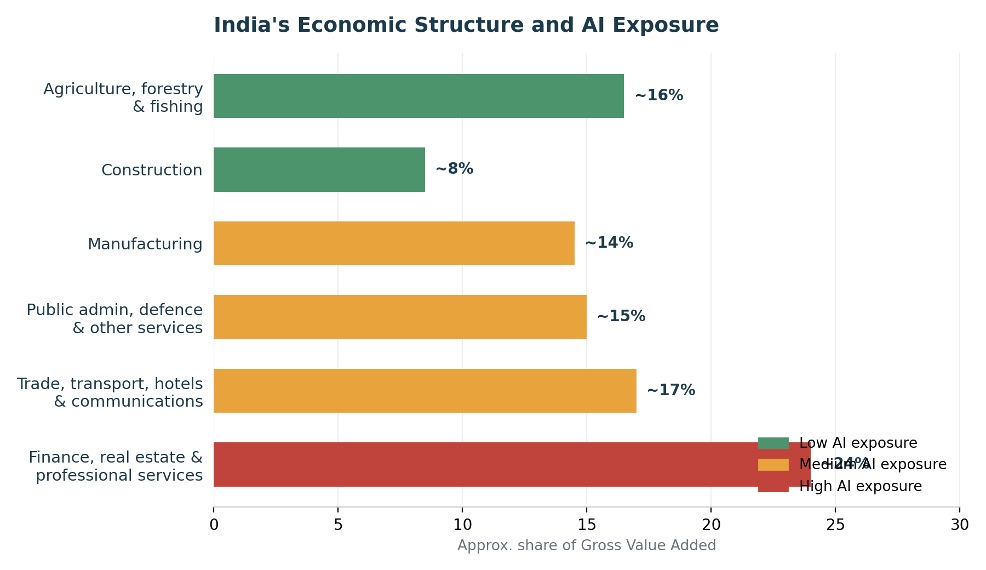
Source: MoSPI national accounts and author’s classification. Shares are rounded structural proportions, not precise forecasts.
Manufacturing: real, but not a mass-employment substitute
India’s industrial policy has become sharper and more credible than it was a decade ago. Production-linked incentives, electronics assembly, semiconductor investment, defence procurement, renewable-energy manufacturing, and infrastructure spending are building capabilities that didn’t exist ten years back. Electronics is the clearest success: mobile-phone and telecom-equipment exports have grown rapidly, and India is becoming a genuine alternative production base as multinationals diversify away from China.[3]
Three cautions still apply. Assembly is not deep industrial capability — much of the high-value content in electronics, solar equipment, batteries, and machinery is still imported. Modern factories are increasingly automated, so a billion dollars of electronics or semiconductor output no longer buys the same number of jobs that textiles or footwear once did. And India still competes head-to-head with Vietnam, Bangladesh, Mexico, and China on cost, logistics, reliability, and trade access.
Light manufacturing
Labor-intensive industries — textiles, apparel, leather, footwear, food processing, furniture, toys, consumer goods — remain critical because they employ workers across every level of education. They’re less exposed to generative AI than software or BPO; their threat comes instead from robotics, computer vision, and automated cutting and packing, plus fierce competition from lower-cost exporters. The policy challenge is making them more competitive without automating away the jobs they’re supposed to create.
Heavy and technology manufacturing
Automobiles, engineering goods, chemicals, metals, defence, aerospace, electrical equipment, semiconductors, and clean-energy technologies carry more productivity and strategic value. AI is more likely to augment these industries than gut them — accelerating design, simulation, quality control, maintenance, and supply-chain planning. The deeper risk is that India captures final assembly while the most valuable components, IP, and production equipment stay imported.
Manufacturing can absorb some of the shock. It will not reproduce the employment intensity of the old Asian industrial model — those factories are simply too automated now for that.
The export machine at the center of the risk
India’s external accounts show why this is a macroeconomic question, not merely a technological one. The country runs a large merchandise deficit financed by a large services surplus. In FY2024-25, merchandise exports totaled roughly $437 billion against imports of $720 billion. Services exports were roughly $388 billion against imports of $199 billion — a services surplus close to $189 billion.[4]
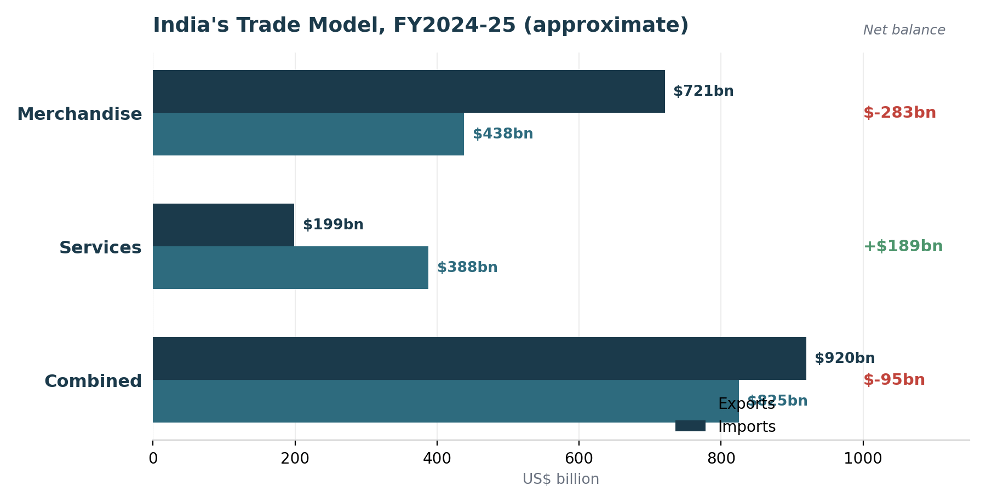
Rounded from Department of Commerce and Economic Survey data.[4]
That surplus finances a real share of the goods deficit and supports the rupee, reserves, urban consumption, and business investment. Software services remain the largest piece, joined increasingly by consulting, financial services, research, engineering, and the global capability centers now scattered across India’s major cities.
Here’s the uncomfortable part. AI could make Indian service providers more productive and let them capture a larger share of global technology spending — the Economic Survey has already flagged faster growth in AI-intensive service exports.[5] Or the same AI could simply mean each export dollar requires fewer Indian workers to produce it. Both can happen simultaneously: a company grows revenue, improves margins, and increases exports while quietly slowing entry-level hiring. To an investor that looks like productivity. To a country graduating millions of young people every year, it looks like a slow-motion social problem.
Where the shock hits first
India’s technology and business-services industry is a roughly $300 billion-plus sector spanning high-value consulting and engineering on one end, and vast pools of repetitive digital work on the other. The exposure across that range is anything but uniform.
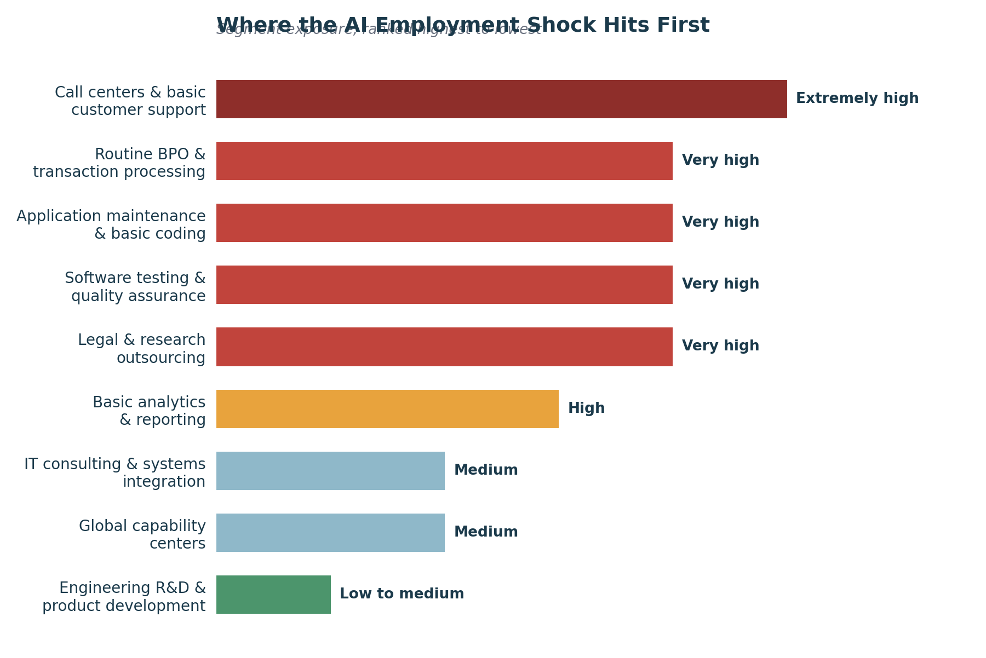
Call centers are the clearest case: generative voice systems can already manage routine conversations, authenticate customers, and schedule appointments, leaving one human agent to oversee several automated ones instead of fielding every call directly. The likely effect isn’t the disappearance of the job — it’s a steep drop in how many workers a given contract requires.
Software development is more complicated. AI doesn’t remove the need for architecture, judgment, cybersecurity, or client trust. But it does sharply cut the time spent on boilerplate code, documentation, testing, debugging, and maintenance — which directly challenges a business model historically built on billing clients for large teams of engineers.
The hidden vulnerability: the first rung of the ladder
The deepest risk isn’t to India’s best engineers — senior architects, product leaders, cybersecurity specialists, and domain experts may well become more valuable. The danger falls on the first rung of the ladder. I hired and promoted thousands of engineers who started on exactly that rung, so I don’t say this abstractly: for decades, large IT and BPO firms acted as finishing schools for the Indian middle class, hiring graduates who weren’t yet fully productive and training them through testing, maintenance, helpdesk work, and customer support. Those early tasks were never glamorous. They were developmental.
AI is particularly good at absorbing precisely that kind of apprenticeship work. If companies need fewer junior employees, the economy loses not just current jobs but the pipeline that produces future managers and experts. The result could be a widening gap between a small class of highly capable, AI-augmented professionals and a much larger pool of graduates whose degrees no longer guarantee a career.
That matters because India’s demographic dividend isn’t self-executing. A young population is an advantage only when education, employment, and urban institutions convert potential into productivity. Left unconverted, the same demographics can just as easily produce frustration, inequality, and political pressure.
Why an economy-wide meltdown is still unlikely
The case for caution shouldn’t collapse into fatalism. India has defenses that smaller outsourcing economies simply don’t have:
A vast domestic market — consumption, infrastructure, housing, health, education, logistics, and finance can sustain growth even if external demand softens.
A diversified service economy — beyond IT and BPO, India has large domestic sectors in trade, transport, finance, healthcare, construction, tourism, and government services.
Real digital infrastructure — Aadhaar, UPI, and related platforms let businesses and government deliver services at unusually low transaction cost.
A deep technical base — enough engineering and entrepreneurial capability to become a major global provider of AI implementation, data engineering, cybersecurity, and cloud services.
Geopolitical tailwinds — continued supply-chain diversification is opening doors in electronics, manufacturing, research, and global capability centers.
Productivity-led export growth — AI can help Indian firms compete on quality rather than wages, and reach markets that were previously uneconomic.
The likely outcome, then, is not collapse but divergence: leading companies and skilled workers prosper, export revenue keeps rising, and employment growth lags — especially for young graduates and workers doing standardized digital work.
Can manufacturing and new services absorb the shock?
Policy often assumes manufacturing will become the next employment engine. It has to become a bigger one — but it can’t carry the load alone. Even successful industrialization today is more automated than it was when China, Korea, or Taiwan climbed the same ladder.
The better strategy is a portfolio, not a single sector:
• Labor-intensive manufacturing — apparel, footwear, food processing, furniture, toys, consumer products
• Advanced manufacturing — electronics, automotive systems, defence, aerospace, clean energy, industrial equipment
• Construction, housing, urban infrastructure, logistics
• Healthcare delivery, eldercare, diagnostics, medical technology
• Tourism, hospitality, retail, and other locally delivered services
• AI-enabled professional services — cybersecurity, cloud transformation, engineering R&D
• Small-business productivity, where inexpensive AI tools help millions of firms formalize, sell, and export
Not every job India needs will be “high tech.” A healthy model has to create pathways for elite engineers, ordinary graduates, skilled technicians, and workers with limited formal education, all at once.
What India must do now
1. Measure employment intensity, not just investment. Incentives should report jobs, domestic value added, wage progression, and training outcomes — not just announced capital expenditure.
2. Protect the apprenticeship function. Subsidize structured entry-level training and rotations so AI doesn’t eliminate the process that turns graduates into professionals — it’s the first thing companies cut under margin pressure, and it doesn’t rebuild itself once it’s gone.
3. Rebuild vocational education around real demand. India needs technicians in robotics, industrial maintenance, electronics, healthcare, logistics, and construction — not only more generic degrees.
4. Help service firms abandon body-shopping. Price for outcomes and IP, not hours and headcount. It will reduce employment intensity, but it’s the only path to staying competitive.
5. Deepen manufacturing value chains. Electronics assembly should lead to components, tooling, materials, and local suppliers — otherwise exports rise without capturing real value.
6. Use AI to lift small-business productivity. The biggest employment gains may come from millions of MSMEs using AI for accounting, sales, and compliance — not from a handful of national champions.
7. Increase women’s participation. Safe transport, childcare, and enforceable workplace protections could unlock one of India’s largest underused sources of growth.
8. Stay open to trade and talent. Manufacturing competitiveness needs reliable imports, export access, foreign capital, and global supply-chain participation. Protection alone won’t build world-class industry.
9. Modernize social protection. Portable benefits, wage insurance, and better unemployment data will matter more as occupational change accelerates.
India’s other export: leadership
There’s a dimension to this story that gets lost in GDP tables and trade balances, and it’s worth naming directly: India’s soft power is now a hard economic asset.
Walk into the executive suites of the world’s most valuable companies and you’ll find Satya Nadella running Microsoft, Sundar Pichai running Alphabet and Google, Arvind Krishna running IBM, Shantanu Narayen at Adobe, Nikesh Arora at Palo Alto Networks, Vimal Kapur at Honeywell, and Indra Nooyi’s legacy still shaping how PepsiCo thinks about global growth. That list keeps growing, and it isn’t an accident — it’s the compounding output of the same IIT and engineering pipeline this essay has spent its length worrying about. Add Bollywood’s reach into markets far beyond South Asia, one of the largest and most influential diasporas on earth, and a generation of Indians who move fluidly between Bangalore, London, Dubai, and Palo Alto, and you get something China, for all its manufacturing might, has never quite built: a global leadership class that carries India’s fingerprints into every boardroom that matters.
That’s not a side note to the AI story — it’s the other half of it. The same qualities that produced these leaders — English fluency, technical depth, comfort operating across cultures — are precisely what’s now being automated at the entry level. The country’s challenge is to keep manufacturing that leadership class even as the bottom rung of the ladder that used to produce it gets thinner.
Three possible Indias by the early 2030s
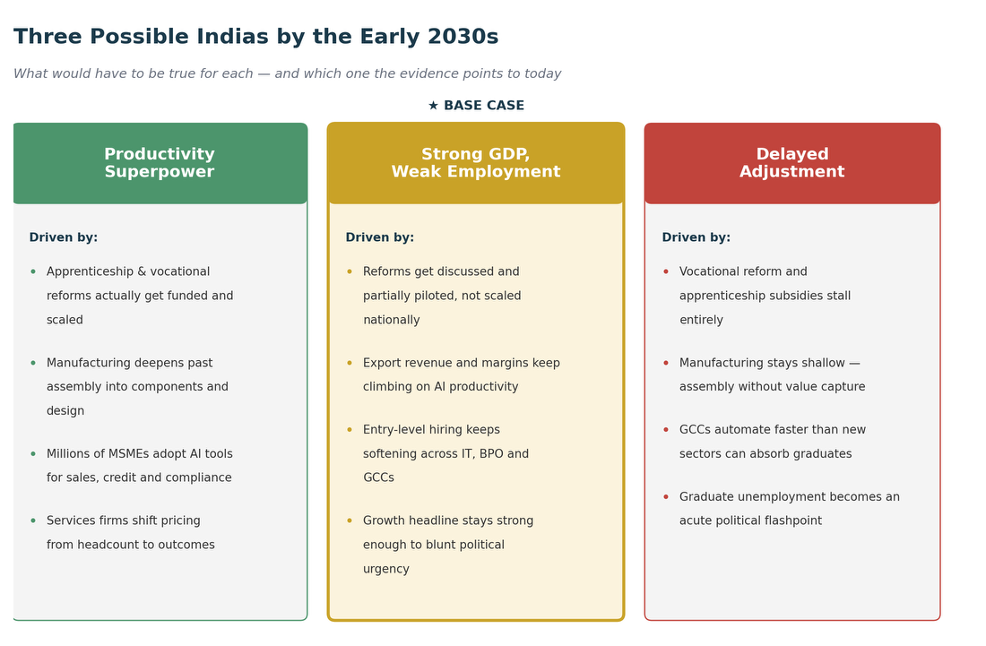
I’ll put my own conviction on the table rather than hide behind a number: my base case is the middle scenario — strong headline growth with weakening employment quality. Not because I’ve modeled a probability, but because it’s the path of least resistance. It requires no one to change course. Export revenue keeps compounding on AI-driven productivity, the growth headline stays strong enough to blunt political urgency, and the harder reforms — apprenticeship subsidies, outcome-based pricing, vocational rebuilding — get discussed and piloted rather than scaled. That’s simply what happens by default when an economy is doing well enough at the top to postpone fixing what’s breaking underneath.
The productivity-superpower scenario is fully within reach, but it doesn’t happen by momentum — it requires India’s government and its largest employers to deliberately choose the harder, less glamorous reforms in the list above, on a timeline measured in years, not election cycles. And I’d put delayed adjustment as the least likely of the three, not because India’s institutions move quickly — they don’t — but because its private sector, its entrepreneurial base, and its diaspora capital have a thirty-year track record of improvising around a slow state. That instinct to route around dysfunction is one of India’s most reliable features, and it’s the reason I’d bet on the middle scenario tipping toward the first over the decade, rather than sliding toward the third.
The real test of reinvention
India has defied predictions of both imminent takeoff and imminent collapse more than once in my lifetime of watching it. Its politics slow implementation, but its entrepreneurial energy, its domestic scale, and its improvisational talent are real. AI will test whether those strengths convert into a new development model — or whether they simply widen the gap between those who already made it and those still trying to.
India doesn’t need to preserve every call-center seat or junior coding job. Trying to freeze the old economy in place would be futile and beside the point. What it needs to preserve is something larger: the ability of millions of people to enter productive work, learn, rise, and take part in the country’s growth.
So the decisive metric isn’t whether India stays the world’s fastest-growing large economy, or whether its tech exports keep climbing. It’s whether that growth keeps generating broad pathways into competence, dignity, and economic security — for the many, not just the few who were already positioned to win.
Here is why this moment matters beyond India’s own borders. India is now the most populous nation on earth, perpetually measured against China, endlessly described as a “potential” engine of global growth — a word that, after three decades of hearing it, many have grown impatient with. Potential is not a compliment. It’s an unpaid debt. India’s engineers already run the world’s largest technology companies; its stories already fill the world’s screens; its diaspora already sits in the rooms where global decisions get made. The raw material for a first-rate power has been sitting in plain sight for a generation.
AI is not a threat to that future. It’s the final exam. It will decide, within the next decade, whether India converts its scale, its talent, and its extraordinary soft power into the kind of broadly shared prosperity that makes a civilization great — or whether it simply produces a wealthier country with the same unfinished promise. I have watched India refuse to be underestimated for thirty years. I would not bet against it now. But I would stop calling it potential, and start asking it — respectfully, urgently — to finally cash the check.
Notes and sources
[1] Ministry of Statistics and Programme Implementation, “Press Note on Provisional Estimates of Annual GDP for FY2025-26,” June 5, 2026; Government of India, Economic Survey 2025-26, chapters on the state of the economy and services.
[2] Government of India, Economic Survey 2025-26, chapter on the external sector; Department of Commerce annual trade data.
[3] Government of India, Economic Survey 2025-26; Department of Commerce, Annual Report 2024-25; policy documents on electronics and production-linked incentives.
[4] Department of Commerce and Economic Survey 2025-26. Figures are rounded; services estimates draw on RBI and Commerce Department data.
[5] Government of India, Economic Survey 2025-26, “Services: From Stability to New Frontiers,” including its analysis of AI-intensive services exports.
[6] Reserve Bank of India, Annual Survey on Computer Software and IT Enabled Services Exports; NASSCOM and MeitY industry estimates for technology and BPM revenue.
[7] NITI Aayog, Roadmap for Job Creation in the AI Economy; World Bank and IMF assessments of India’s growth, labor participation and reform priorities. Indian-origin CEO roster per 2026 industry reporting (Forbes, Khaleej Times).
Author’s note: This essay is intended for broad public discussion. Sector shares and trade values are rounded to emphasize structural relationships. AI exposure ratings and scenario likelihoods are analytical judgments, not forecasts of a fixed number.
No posts
Comments
Nothing yet. Say the first thing.
Sign in to join the conversation.