
From the deck of a ship, the Mariana Trench looks like nothing at all. The water is the same blue as any other water. Gulls follow the wake. A tourist leaning on the rail would never guess what lies beneath. Then you go down.
At two hundred metres the colour drains out of the world. At one thousand the last photon from the surface has been swallowed and it is dark, permanently, in a way nothing on land is ever dark. At four thousand the pressure would crush a submarine hull like a paper cup. And at eleven thousand metres, at a place called Challenger Deep, you reach the bottom of the planet. The pressure there is a thousand times what you are feeling right now. Almost nothing lives. What does live has abandoned eyes, abandoned colour, abandoned any expectation of light, and arranged itself entirely around the business of surviving conditions no ordinary creature could tolerate for a second. Fewer human beings have been to the bottom of that trench than have walked on the moon.
I want to tell you about an even deeper one.
It is wider than the Mariana, and darker, and considerably harder to reach. And unlike the Mariana, it did not take tectonic plates thirty million years to open. It was made by men, in under fifty years, and it is maintained daily by people who go home at night to gardens in the hills above Tehran. Let me take you down there.
From the surface it looks like nothing at all. Tehran at eight in the morning is one of the great cities of the world doing what great cities do. Twelve million people in a valley under the Alborz, traffic knotted solid on Vali-Asr, the longest tree-lined street in the world. Bakeries pulling sangak off hot stones. The bazaar opening its shutters, a covered city inside a city, cardamom and copper and carpet and gold. Cafés in Tajrish full of students arguing about films. Bookshops on Enghelab. Girls walking with their headscarves around their shoulders now, openly, the way you would carry a scarf on a warm day, because a generation decided the law was finished whatever the law said. Ski lifts running at Dizin. A wedding somewhere with three hundred guests and a sound system that ought to get a warning. Kids on scooters. Instagram. Traffic. Life.
Any visitor who spends a week in that city goes home and tells friends that Iran is nothing like the news. They are telling the truth. They just never went down.
Because a few hundred metres under that surface the light starts to go.
It is a woman with a master's degree in chemical engineering who has been out of work for four years, because employers have quietly learned not to hire women for those roles, and the state that paid to educate her has legislated her out of the economy. It is her brother, thirty-one, who drives a Snapp car sixteen hours a day and lives with his parents because the rent on a room costs more than he can earn. It is the price of meat, which he has stopped buying. It is his salary in rial, which lost a third of its value while he was earning it.
Go deeper. It is a Baha'i girl with the entrance exam scores for medicine who will never see the inside of a university, because her faith is written on a form, and sixty years of policy have established that she may not be educated. It is a Kurdish town where the language of instruction is not the language of the home. It is a Baluch man in Sistan whose province has the worst everything: water, schools, roads, life expectancy, and the shortest distance to a firing squad.
Deeper. It is Evin. It is Qarchak. It is the wards where the country keeps its students, its lawyers, its journalists, its trade unionists, its poets, and increasingly its teenagers. It is a mother who has been told to come collect her son's clothes. It is the several million Iranians addicted to opiates in the country that sits on the world's busiest smuggling corridor, an epidemic that flourishes under the protection of the same security apparatus that has the manpower to police the length of a woman's coat. It is the young women in the border cities selling the only asset they have left, and the husbands who broker it, God help us, because the children have to eat. It is the organ classifieds. It is the kidney for sale.
Deeper still, past where any camera goes. It is a hillside outside a provincial city with fresh soil and no headstones, and it is the thousands of Iranians, countless thousands, who were shot in the streets in January and then buried by the state at night so nobody could count them, in a country whose government will not say how many of its own citizens it has killed because the number is not a fact it is willing to permit.
This is the trench. This is the part CNN does not film and the BBC does not reach and the diplomats in Islamabad are not discussing. This is what it means, in practice, to be a nation so unimaginably rich and so unforgivably poor.
And here is the thing about a trench. What lives down there adapts. It learns to survive without light, and it stops expecting light, and after a while it stops describing the light to its children. That, more than any single atrocity, is what is being done to Iran.
Every Iranian I have ever known has had a version of this conversation. It happens at dinner tables in Los Angeles and Toronto and Dubai, and it happens in living rooms in Shiraz. Somebody says it out loud, usually late in the evening, usually after the third glass: look at what we have, look at who we are, look at what we could have been. Everybody nods. Somebody sighs. The conversation moves on.
It is the most repeated sentence in the Iranian language and the least consequential, because it has never been anything more than a feeling. Glaringly obvious, endlessly discussed, never measured. And a grievance that cannot be measured is a grievance the world can ignore with impunity.
So the question I want to answer is a narrow one, and it is not rhetorical. Can the gap between what Iran is and what Iran could be actually be quantified? Can you put a number on it, set that number beside other nations, and show that the intuition every Iranian carries is not sentiment but arithmetic?
I believe you can, and that is what the rest of this essay is about.
Then there is the harder question, which is why it matters. Suppose we prove the trench is the deepest on earth. So what? Nations underperform. Potential goes unrealised everywhere. Why should a reader in Ohio or Osaka care about the arithmetic of Iranian disappointment?
Because the gap is not contained. It never has been. What falls into that trench does not stay in it. It comes back out as militias, as closed shipping lanes, as oil at prices that reach every household on this planet, as a proliferation race in the most combustible region on earth, and as a brain drain that staffs other countries' hospitals and laboratories. You have been paying for this hole in the ground for forty-seven years, whether or not anybody told you what the line item was.
And there is one more reason, which I will come to at the end, and which I think is the most important argument in this essay: what the world stands to gain if the trench is filled is larger than anything currently on any diplomatic agenda.
Start with the inheritance, because almost nobody, including most Iranians, has ever seen it added up in one place.
Iran holds roughly thirty-two trillion cubic metres of proven natural gas, second on earth only to Russia, and roughly two hundred billion barrels of proven oil, third or fourth depending on whose ledger you use. Those two facts are usually reported separately, which is exactly how the headline gets missed. Convert the gas to barrels of oil equivalent and add them together, which is the only honest way to compare an energy endowment, and the ranking changes.
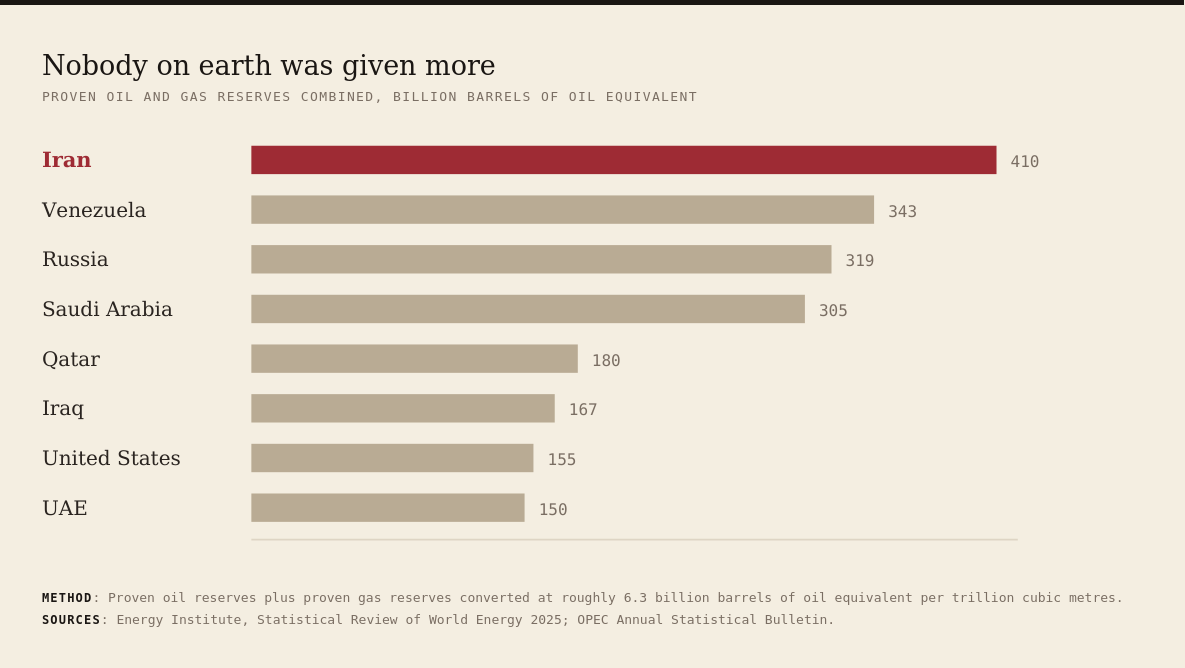
Iran is first. Not in the top five. First. No country on this planet was handed more recoverable energy than the Islamic Republic of Iran, yet Iranians queue for petrol and burn furniture oil in winter.
The hydrocarbons, though, are the least interesting part of the inheritance, because they are the part everyone knows and waves away as the resource curse. Go one layer down.
Iran sits on sixty-eight distinct minerals across roughly fifty-seven billion tonnes of proven reserves, worked by some six thousand active mines. Tehran's own Chamber of Commerce values that mineral base at something on the order of twenty-seven trillion dollars. More than seven percent of the world's proven mineral reserves lie inside a country occupying about one percent of the world's land.
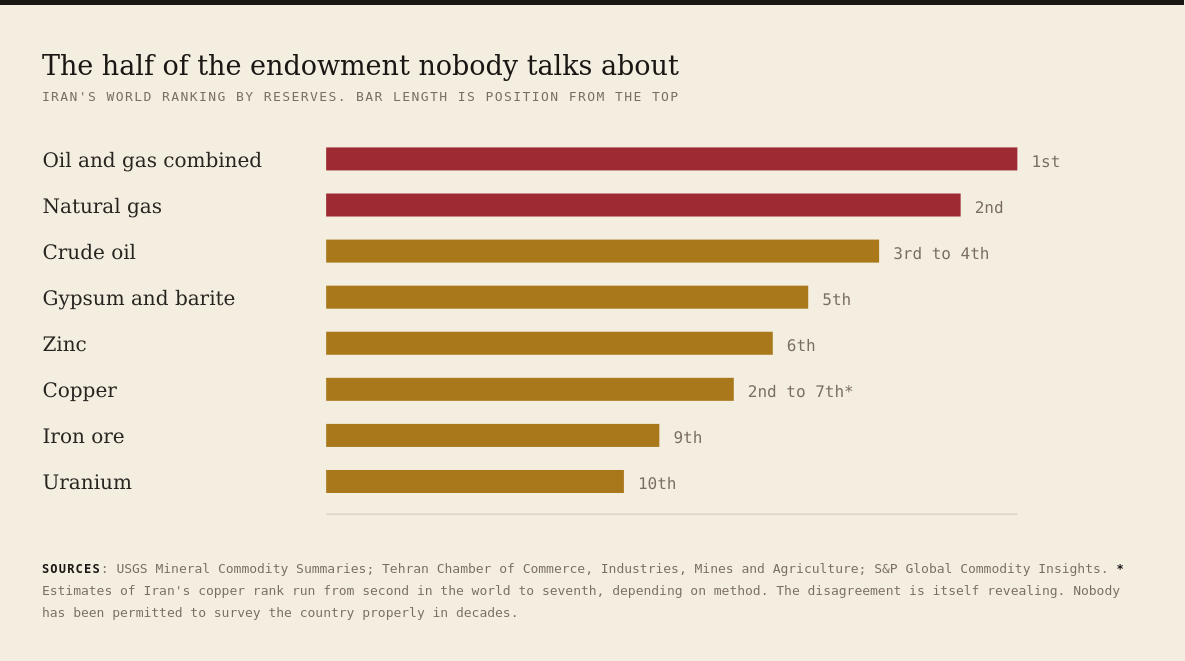
Sar Cheshmeh in Kerman is among the largest open pit copper mines on earth, and copper is the metal that every electrification pathway on this planet runs through. Mehdiabad is regarded as one of the world's largest undeveloped zinc resources, and the operative word in that sentence is undeveloped. Central Iran and Yazd carry rare earth anomalies across some seven thousand square kilometres, barely explored. And above all of it grows an agricultural signature no other country possesses: roughly ninety percent of the world's saffron, and the pistachio that once defined the global market.
There are perhaps three countries that combine world leading hydrocarbons with a genuinely diversified top ten mineral base. Iran is one. Russia is another. And through the entire twenty-first century story of electrification, batteries and critical mineral scarcity, one of the three has been essentially absent from the market.
Now the part that matters more, and I want to make it concrete rather than statistical, because the statistics have a way of turning people into an aggregate.
Since Iran first entered the International Mathematical Olympiad in 1985, its teenagers have won more than fifty gold medals. Iran has finished in the global top ten on nineteen separate occasions and won the whole thing outright in 1998. Four Iranian students have achieved a perfect score of forty-two out of forty-two. In composite rankings across the mathematics, physics, chemistry and informatics Olympiads, Iran routinely places among the top handful of countries on earth, alongside China, Russia, the United States and South Korea. This is a country under sanctions, with schools that cannot buy equipment, producing sixteen year olds who beat the world.
One of those students scored a perfect forty-two in 1995 and another gold the year before her. Her name was Maryam Mirzakhani, she went to Sharif University in Tehran, and in 2014 she became the first woman in the history of mathematics to be awarded the Fields Medal. She died at forty, a professor at Stanford. When the news broke, about her medal, Iranian newspapers had to publish photographs of her with her hair digitally covered or cropped out of frame. The state could not bring itself to show the world the face of the greatest mathematician it had ever produced.
That single editorial decision is the whole argument of this essay, compressed into one photograph.
Sharif University of Technology, where she studied, is routinely described by faculty at Stanford and MIT as having one of the finest undergraduate engineering programmes anywhere in the world. It is also, and this is the point, one of the most reliable feeders of graduate students into American engineering departments. Stanford's electrical engineering programme has absorbed cohort after cohort of Sharif students for thirty years. Iran trains them at public expense to a standard almost no country matches, and then hands them, at twenty-two, to somebody else.
Look at where they end up. Dara Khosrowshahi runs Uber. Hamid Moghadam built Prologis into the largest industrial real estate company on earth. Maky Zanganeh is co-chief executive of Summit Therapeutics and helped build Pharmacyclics before it sold for twenty-one billion dollars. Anousheh Ansari built and sold a telecoms company, became the first Iranian in space and the first woman to fund her own trip there, and now runs the XPRIZE Foundation. Pierre Omidyar founded eBay. Firouz Naderi ran NASA's Mars programme at the Jet Propulsion Laboratory. Ali Javan co invented the gas laser at MIT. In medicine, in finance, in film, in academia, the pattern repeats until it stops being a list of exceptional individuals and starts being a statistical property of a population.
And the statistics confirm exactly that. Fifty-nine percent of Iranian immigrants in the United States aged twenty-five and over hold a bachelor's degree or higher, against thirty-three percent for the American born population and for immigrants overall. More than thirty percent hold a graduate or professional degree. Median household income sits near seventy-nine thousand dollars, with some estimates placing Iranian American households around eighty-seven thousand, ninth among all ethnic groups in the country. In Germany, forty-seven percent of Iranian asylum seekers in a single recent year arrived holding a university degree. Asylum seekers. People who left with what they could carry.
The same people, in different institutions, produce top decile outcomes in the wealthiest societies on earth.
This forecloses an entire genre of argument. Every explanation for Iran's condition that reaches for culture, for religion, for the Iranian character, for some civilizational unsuitability to modernity, dies right here. The raw material is not the problem. The raw material has been proving itself, in exile and at home, for forty-seven years.
Iran fronts the Persian Gulf and the Caspian. It holds the northern shore of Hormuz, through which roughly a fifth of the world's oil moves. It is the land bridge between Turkey, Central Asia, South Asia and the Gulf, the only viable corridor connecting four regions that between them hold a third of humanity. In a functioning world that is among the most valuable real estate in existence.
And beneath all of it lies a civilization of two and a half thousand years that absorbed the Greeks, the Arabs, the Mongols and the Turks and came out the other side recognisably itself every time. It gave the world Ferdowsi, Hafez, Rumi, Khayyam. It functioned for centuries as the cultural motherboard of a Persianate world running from Anatolia to Bengal.
Add it up: first in the world in energy; top ten across the industrial metals; command of the strait; the land bridge between four regions; ninety-two million people who win the Olympiad and run the Fortune 500; twenty-five centuries of continuous civilization.
There may be four countries on this planet with a comparable draw. There is not one with a worse conversion rate.
To measure what has been squandered we first have to say what a country is for. Four answers are available, and only the last of them was written in Persian.
The first says that a good life is for the accumulation of wealth, and that GDP per capita is the measure. It is convenient and it is easy to collect. It also rates a subject of an absolute monarchy and a citizen of a free republic as equally well off at equal income, which is a conclusion almost nobody accepts on reflection, least of all the subject.
The second comes from Amartya Sen and Martha Nussbaum, and it separates having from doing. Resources, in this view, are inputs rather than outcomes. What matters is a person's capability set, meaning the range of lives they could actually choose to lead. Consider a woman with a doctorate in chemical engineering who is barred by law and by practice from most of the professions she trained for. Her human capital is enormous. Her freedom to spend it is close to zero. Income accounting registers the first and is blind to the second. Something has clearly happened to that woman that a GDP figure will never show you, and any measure that cannot see it is not measuring a life.
The third simply asks people to rate their own lives on a ladder from zero to ten, then decomposes the answers by income, health, social support, freedom to make choices, generosity and perceived corruption. It has an obvious weakness, which is that human beings adapt and lower their expectations. It also has one virtue the other two lack, which is that it asks the people concerned.
And then there is the fourth, which is older than all of them and which was written here, in Iran, in Persian, addressed to Iranians. It holds that a human being should be regarded as a mine rich in gems of inestimable value, and that education alone can cause it to reveal its treasures. It then adds a second condition, and that second condition is the one that matters for everything which follows: that those treasures are given so that a person may carry forward an ever-advancing civilization. Two tests, therefore, rather than one. Was the mine opened? And was what came out of it permitted to be spent?
Hold that image against the previous section for a moment. Iran's true wealth was never the copper at Sar Cheshmeh or the gas beneath South Pars. It was Maryam Mirzakhani. The state opened that mine, at public expense, to a standard almost no country on earth can match. And then it would not print her face.
Realized potential is a nation's capacity to open its mines and let their treasures be spent. Not what a country could produce. What its people are permitted to become, and what they are permitted to build with it.
Three moving parts, and we will track all three. Capacity, meaning health, schooling and income, which is whether the mine is opened at all. Freedom, meaning the ability to turn that capacity into a chosen life, which is whether the treasure may be spent. Experience, meaning whether the resulting life is one people report as good.
A country that scores high on the first and near zero on the second and third has not realized its potential. It has warehoused it.
On raw capacity, Iran performs respectably, and this should be said plainly rather than grudgingly. Its Human Development Index score is 0.799, placing it around seventy-fifth of one hundred ninety-three countries, inside the high development band and ahead of Brazil, Egypt, Ukraine, Iraq and India. Life expectancy is near seventy-seven. The expansion of rural healthcare and mass schooling after 1979 was real, and it built human capacity that the system did not entirely intend to build.
Then look at what is done to that capacity.
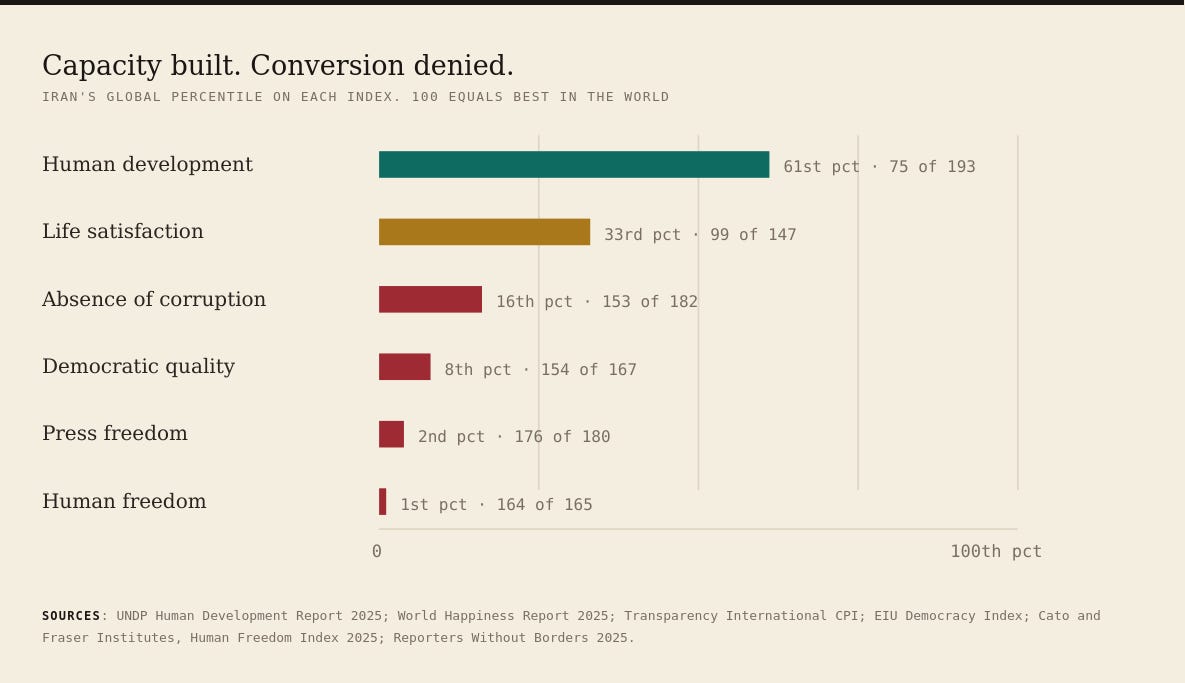
Read that chart from top to bottom and you are watching a country build the ingredients of a good life about as well as a mid tier middle income state, then close, one by one, every channel through which those ingredients become a life somebody chose. One hundred sixty-fourth of one hundred sixty-five on human freedom. Below Russia. Below China. Below Venezuela.
Two numbers belong on that chart and are not on it.
Fourteen percent is female labour force participation in Iran, against a world average above fifty, in a country where women are a majority of university entrants. The state paid to educate them and then legislated them out of the economy. No sanctions regime anywhere in the world does this to a country. It is a decision, renewed every morning.
Seventy percent is the share of students at Sharif and Amir Kabir, Iran's finest technical universities, who report wanting to leave. Around a hundred and thirty thousand Iranian born students were enrolled in foreign universities before this war began. Iran recorded the fastest growth in emigration to wealthy countries of any nation on earth in the early 2020s. Between forty and fifty percent of graduates, physicians and professors say they want out.
The endowment is walking out of the country. Every year, the human capital column of Iran's ledger transfers itself, permanently, into the achievement columns of other nations.
An isolated score proves nothing, so here is the comparison. Score every country on what it was handed, meaning resources, people, scale and position. Score it again on what it delivers, meaning income, health, freedom, institutional honesty and how people rate their own lives. Subtract the second from the first. Plot the result.
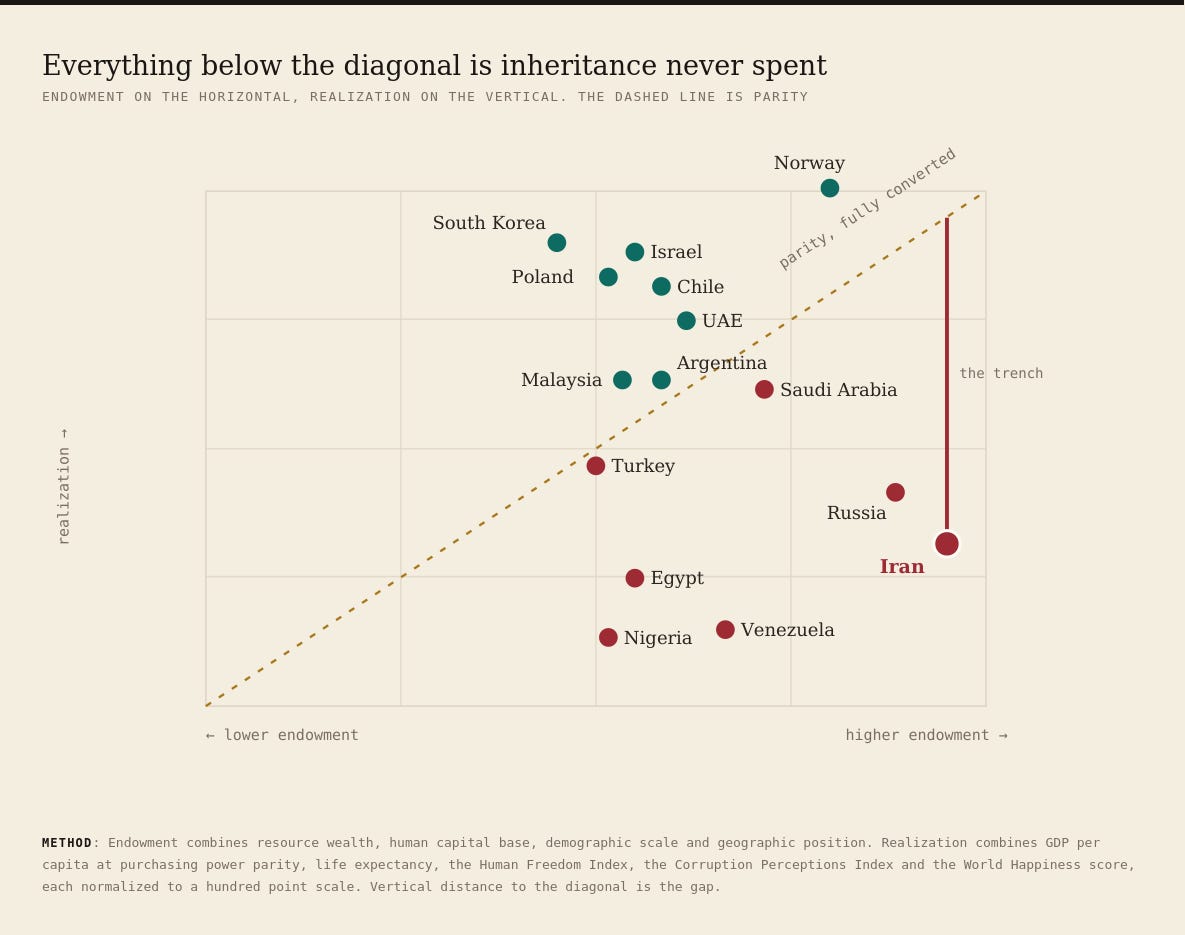
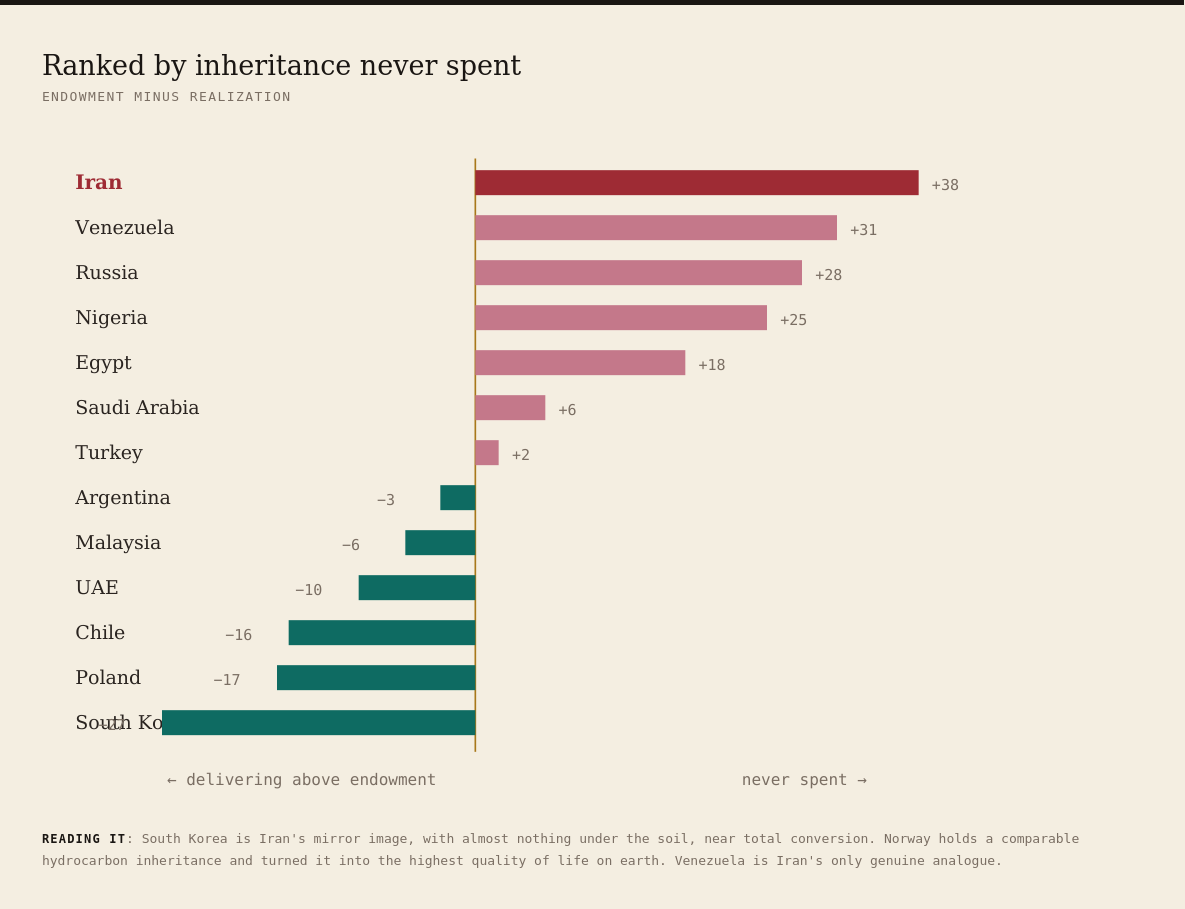
Two comparisons carry most of the weight. Norway proves that immense hydrocarbon wealth need not become a curse, given a sovereign fund, an honest judiciary and a working parliament. South Korea proves the reverse: a nation with essentially nothing beneath its soil, flattened by war and ruled by generals within living memory, now delivers among the finest lives anywhere.
Iran resembles neither. Iran resembles Venezuela, and outranks it.
A word on the method, since the objection is a fair one. The realization side of this calculation is built entirely from published indices compiled by other people. The endowment side is not, because no institution publishes an index of what a country was handed, so those scores are my own weighting and a reader is entitled to disagree with them. I would encourage it. Move the weights around, favour population over minerals or geography over education, and Iran's precise margin over Venezuela and Russia will shift. What does not shift is its place at the top. I have not found a defensible weighting of resources, people, scale and position that removes it, which is the finding rather than a caveat about it.
Now for the objection that arrives within thirty seconds of any conversation on this subject, and it deserves a fair hearing before it is taken apart.
Iran has lived under sanctions since 1979, tightened savagely after 2018 and now operating under reimposed United Nations snapback measures. The effects are not cosmetic. Iran is locked out of dollar clearing and Western trade finance. It cannot buy the upstream technology its own gas fields require. Foreign investment is close to zero. Its oil sells at a discount through intermediaries and dark fleets. A country holding the second largest gas reserves on earth imports gas in winter, because the pressure maintenance equipment South Pars needs sits on an export control list.
All of that is true, and it explains a great deal about the ceiling.
It explains nothing whatsoever about the floor.
Sanctions do not write the laws that push half the population out of the workforce. Sanctions do not bar a Baha'i teenager from university because of the religion listed on her application, a policy that has been in continuous force for four decades and costs the treasury nothing to repeal. Sanctions do not fill Evin and Qarchak with lawyers, students, teachers, film-makers and trade unionists. Sanctions do not put ropes around the necks of people who were children when they were arrested, making Iran one of the last countries on earth still executing juvenile offenders. Sanctions do not dispatch a morality patrol into the street to beat a young woman for the position of a piece of cloth, and they did not kill Mahsa Amini.
Sanctions do not rank a country one hundred fifty-third of one hundred eighty-two on corruption, nor do they institutionalise that corruption at every level, from the customs officer to the ministry to the foundations that answer to nobody. Sanctions do not hand roughly half a national economy to a praetorian guard subject to no audit, no parliament and no court. Sanctions do not produce forty percent inflation, which requires a printing press, a finance ministry, and an instruction.
Sanctions did not drain Lake Urmia, and they did not empty the aquifers beneath Tehran until the president of the country had to warn, out loud, that his own capital may become unlivable.
Sanctions do not explain several million opiate addicts in a nation whose smuggling routes run through territory the security services control absolutely. A state that can identify a woman's loose headscarf from a traffic camera can identify a narcotics convoy. It has decided which of the two threatens it.
And sanctions certainly do not explain the princelings. Not the mansions in Lavasan and Farmanieh and the hills north of Tehran, with the gates and the imported cars, the children of the men who preach austerity to a country that has stopped buying meat. Not the Instagram accounts, since deleted, of the sons and daughters of senior clerics and commanders posing in Vancouver and Toronto and Nice and Istanbul, on holiday from a revolution their fathers still describe as a war against global arrogance. Not the billions moved out of Iran and parked in Canadian and European and Emirati real estate, laundered through channels that only the sanctioned can access, because evading sanctions is itself a monopoly and monopolies are profitable.
Here is the part nobody wants to say plainly. Sanctions have made a small number of Iranians extraordinarily rich. The men who control the workarounds control the entire import and export economy of a nation of ninety-two million. Every tightening of the screws increases the value of their franchise. This is why forty-seven years of pressure have never once produced the internal crisis that the theory of sanctions predicts. The pressure lands on the trench floor. The rent accrues at the top.
And then there is the cleanest test of all. Sanctions are an external constraint on transactions; they have never been a constraint on governance. Vietnam was embargoed and reformed. China was isolated and reformed. Both were poorer than Iran when they started. And the instruments that would close most of this gap are modest ones: an independent central bank; an honest commercial court; a competitive tender; a tax on the foundations; a student permitted to sit an entrance exam whatever her religion; a woman permitted to take a job. They cost nothing. They require nobody's permission. They have been available every single day for forty-seven years.
Not one of them was taken. Not once. Not in forty-seven years.
A pattern this consistent, sustained this long, stops being a constraint and becomes a confession.
Which brings us to the question that actually decides everything, and it is worth stating carefully rather than sloganeering it.
There are two versions of the charge. The first is that the Islamic Republic requires the gap, that the trench is not a failure of the system but a product it manufactures, because poverty creates dependence, fear prevents organisation, emigration removes leadership, and isolation creates monopoly rents for the men holding the keys. The second is milder and says nothing about intent, only that suppression is simply in the nature of the thing, an unavoidable by-product of what this system fundamentally is.
I think both are true, and I think the distinction matters less than a third question, which is the only one with any practical consequence: whatever its intentions, is this system capable of closing the gap?
I wager that it is not, and not because it lacks the will, but because the defects are inherent. They are load bearing.
Deng Xiaoping could dismantle Maoism because he was the state and Maoism was merely its software. He kept the party and rewrote the operating system. The Islamic Republic cannot run that manoeuvre, because in Iran the ideology is not the software. It is the motherboard. Velayat-e faqih, the guardianship of the jurist, is not a policy that can be adjusted. It is the theological claim on which the entire structure stands. Remove it and nothing justifies the Supreme Leader, the Guardian Council, the parallel judiciary or the Revolutionary Guard.
Now walk the reform list and watch every item collide with that fact.
Break the inflation. This requires a central bank the executive cannot raid. But raiding is the fiscal model, the mechanism by which a sanctioned state finances a war economy and a patronage network at the same time. It cannot be done.
Unwind the parastatals. The foundations and the Guard's conglomerates are not a distortion of the system; they are the coalition that holds it upright. Subjecting them to competition and audit is not economic policy; it is the dismantling of the regime's own base. It cannot be done.
Build an honest commercial court. A judiciary that will rule against a connected party over a contract is a judiciary that can rule against him over anything. There is no firewall between commercial independence and judicial independence, and the whole design of the current judiciary is the absence of that firewall. It cannot be done.
Put women to work. This is the single largest available gain in national output, and it requires no capital and no foreign permission. It also requires overturning the gender architecture the system treats as its theological signature and its proof of authenticity. It cannot be done.
Treat minorities and dissenters as equal citizens. Open the universities to every citizen whatever their faith, teach Kurdish in Kurdish schools, allow Sunnis a mosque in the capital, let Baluch and Ahwazi Arabs govern their own provinces, stop executing people for what they say and think. Every one of these is cost free, and every one of them concedes that the state's authority is civil rather than divine, which is the one thing it cannot concede. It cannot be done.
Loosen the clergy's grip on private life. End the morality patrols, return marriage, inheritance, custody, dress and speech to the citizen. This is the most popular imaginable reform in Iran and the cheapest. It is also a direct admission that the clerical claim over private conduct was never legitimate, which vacates the founding premise. It cannot be done.
Bring the diaspora home. This requires physical safety, convertible currency and careers not gated by political vetting. It requires, in short, that the regime stop being the reason they left. It cannot be done.
Every road out of the trench runs through the regime's own foundations. This is why forty-seven years have produced not one durable structural reform, only a rotating cast of reformists and hardliners performing a manufactured drama whose real function is to absorb the population's desire for change and convert it into endurance.
The gap is not a problem the Islamic Republic has failed to solve. The gap is what the Islamic Republic produces, in the same way a factory produces its output, and it has been producing it at a remarkably consistent rate for half a century. Incompetence is random. This is not random.
A state that cannot build prosperity at home builds influence abroad instead, and it builds it the only way a country with nothing to sell can build it, which is through militias: Hezbollah in Lebanon; the Houthis in Yemen; the Shia militias across Iraq and Syria. This is not so much an ideological programme as a substitute foreign policy, the projection of a state whose only export is disruption.
Consider what that money would have bought at home. Ahvaz is the capital of Khuzestan, the province that sits directly on top of Iran's oil, the ground from which nearly all of the national revenue is pulled. It regularly records the worst air quality of any city on earth. In summer it passes fifty degrees. The rivers that gave the province its name have been diverted, and its farmers have watched their fields turn to salt. In 2021 people came out into the streets of that province, the richest ground in Iran, to protest that they had no drinking water, and the state answered them with live ammunition.
Ahvaz sits on the oil and has no water. Beirut has rockets that Ahvaz paid for. That is the entire foreign policy of the Islamic Republic in two sentences.
Now count what it has cost everyone else: a Bab el-Mandeb that global shipping has spent years avoiding after sustained Houthi missile and drone attacks, with a resurgence of Somali piracy compounding the risk, so that vessels are sent around an entire continent, adding weeks and billions to the price of every container of everything; a Lebanon held hostage to a militia stronger than its own army; an Iraq that cannot fully govern itself; a Syria that became a corridor; a Gulf that lives under missile threat and buys air defence instead of schools. And this year, the thing the shipping world has dreaded since 1979: Hormuz itself, closed and reopened and contested and blockaded, a fifth of the world's oil held hostage to a channel twenty-one miles wide, with the cost of energy in every household on this planet moving on the daily temper of a regime in its death throes.
Add the nuclear file, which is the same problem in a different guise. A state that cannot offer its people prosperity requires an existential enemy and an ultimate insurance policy. Every step it takes toward that policy pushes Riyadh, Ankara and Cairo toward their own, which is a proliferation cascade in the most combustible region on earth and the single most dangerous foreseeable event in world affairs.
Add the human ledger: one of the largest and fastest brain drains on the planet, running for four decades and accelerating; physicians trained at Iranian public expense who now staff hospitals in Muscat and Toronto and Berlin; engineers educated at Sharif who now build other countries' technology industries; the most educated population in the Middle East, distributed almost everywhere except the country that raised it.
What the trench exports is not oil, not gas, not copper. It exports instability, price shocks, proliferation risk and refugees.
And still the world's answer is the bargain from Le Guin's Omelas, the quiet civilised agreement that the child stays in the dungeon because letting it out would upset the arrangements. Iranian stagnation is accepted as the price of regional stability, and better, so the reasoning runs, to keep the door locked.
Look at that region this year and tell me the bargain worked. Systems built on enforced humiliation do not produce stability. They produce precisely what we are watching.
Now invert it. Fill the trench, not to the surface, just partway, and ask what the world receives. Not what Iranians receive, because that part is obvious and it is theirs by right, but what the rest of us receive.
It would not be degraded, and it would not be contained. It would be defunded and purposeless. Hezbollah exists because Tehran believes it needs forward depth against an existential threat it largely manufactured. A normal Iranian state trading with its neighbours has no use for a militia in Beirut and no budget line for it that would survive a parliament. Lebanon gets its country back. Iraq gets its sovereignty. Yemen loses its supplier. The southern Red Sea reopens, and stays open. This is the largest single available reduction in political violence anywhere on earth, and it requires nobody to fire another shot.
Hormuz stops being a weapon the moment the state on its northern shore is the party with the most to lose from closing it. A trading Iran is a permanent guarantor of that strait rather than its permanent hostage taker, and that single change removes the largest tail risk in global energy.
Thirty-two trillion cubic metres of gas re-entering world markets is a structural change in European energy security and a permanent reduction in Russian leverage over the continent. Iranian gas reaching Pakistan and India is the difference between coal and not coal for two billion people. And the minerals, the copper and zinc and the whole undeveloped inventory, enter global supply chains at exactly the moment when the electrification of everything is bottlenecked on precisely these commodities, and when the world is desperate for sources outside a single dominant supplier.
Iran is the missing segment of every east to west and north to south route between Asia and Europe. Open it and Central Asia connects to the Gulf, India to Russia, China to Turkey, across the shortest viable land route on the map. That is not a bilateral benefit. That is a rewiring of Eurasian commerce.
A young, urban, ferociously educated market of ninety-two million, with a diaspora holding hundreds of billions in capital and, far more valuable, the operating knowledge of every advanced economy on earth. The Chinese and Indian diasporas came home when home became worth returning to, and their return was the accelerant of both miracles. Iran's diaspora is proportionally better educated than either of them was.
A free, prosperous, secular Iran, grounded not in Western imitation but in its own civilizational depth, would be the most powerful repudiation of religious fundamentalism the Islamic world has ever produced.
Understand exactly why. For half a century the Islamist argument has rested on one claim, that the choice is between authentic faith and Western corruption, between dignity and submission. Iran is the only country on earth that has run that experiment to completion, with full state power, for two generations. And the result is that the most rigorously theocratic state in the world has produced the most secular population in the Middle East. Iranians did not read their way out of political Islam. They lived their way out, and it cost them everything.
A flourishing post-theocratic Iran would broadcast that verdict from a Muslim majority country of ninety-two million, in Persian, from the very civilization the Islamists claimed as their proof of concept. No Western argument, no counter-messaging programme and no drone strike has ever come close to that kind of force. It would do more damage to the recruiting logic of fundamentalism than every counterterrorism budget of the past twenty-five years combined.
Some rulers in that region will read this and feel a chill, and they should. A prosperous free Iran exposes every neighbouring government that justifies its grip on the grounds that its people are not ready. But to the people of that region, and to the leaders among them who genuinely want to govern prosperous societies, a flourishing Iran is not a threat. It is the anchor the Middle East has never had, a large, confident, secure state that does not need militias because it has markets, and does not need enemies because it has a future.
Put the whole ledger on the table one last time.
On one side: first in the world in combined oil and gas; sixty-eight minerals and twenty-seven trillion dollars of them; top ten in copper, zinc, iron and uranium; command of the strait through which a fifth of the world's oil moves; the land bridge between four regions holding a third of humanity; teenagers who win the International Mathematical Olympiad; the first woman ever to win the Fields Medal; ninety-two million people who, placed in functioning institutions, land in the top decile of the richest societies on earth; twenty-five centuries of continuous civilization.
And on the other: one hundred sixty-fourth of one hundred sixty-five on human freedom; fourteen percent of women in the workforce; forty percent inflation; seventy percent of the best engineering students planning their exit; a girl with the scores for medical school, barred from the lecture hall over the religion on her form; a capital that may run out of water; countless thousands shot in the streets in January and buried at night in ground nobody is allowed to count; a negotiation over the future of their country in which they have no seat.
That is the trench. And I want to be exact about what kind of thing it is.
The Mariana was opened by two tectonic plates over thirty million years. Nobody is responsible for it, nobody profits from it, and nobody can fill it. The Iran Trench is none of those things. It was opened in under fifty years. It has an address, a payroll and a chain of command. It is maintained by identifiable people who understand precisely what they are doing and why, because the day it closes is the day they end.
Which means it can be filled.
Not by sanctions, which in half a century have never moved this system toward reform and have mostly enriched the men running the workarounds. Not by bombs, which kill the people at the bottom of the trench and consolidate the guardians at the top of it. And not by another generation of the Omelas bargain, that comfortable global agreement to leave the child in the room because the music is so pleasant out here.
It will be filled the way it was always going to be filled, by Iranians. The generation waiting now, the women who led the last uprising and paid for it, the engineers with their bags packed, the students who came out in all thirty-one provinces, the exiles with one foot already turned toward home, is the most educated, most secular and most internationally connected population in the history of that country. They have already done the hardest work, which is the work of the mind. They know exactly what they want, and they have paid in blood for the clarity.
What the rest of the world owes them is not salvation, not paternalism, and not another war fought over their heads. It is something much simpler. Stop pretending the door is locked from the inside. Stop signing agreements with the men holding the key while the people in the room are not permitted to speak.
And understand that this trench is not stable. Every year it stays open, part of it closes permanently. Aquifers do not refill. A surgeon who leaves at forty does not return at seventy. A child taught that ambition is a form of exposure does not unlearn it at thirty. The endowment is not patient. It is depreciating right now, this morning, while the negotiators exchange drafts in Islamabad.
Iran was given more than almost any nation on this earth. Its people have been permitted to keep almost none of it.
The distance between those two sentences is the deepest man-made gash on the planet, and the largest unrealized human project in the world. It is not a tragedy. Tragedies are inevitable and nobody is to blame for them. This one was dug, and it is guarded, and it can be filled.
There is light above it. There always was. The only question left is how many more Iranian lives have to be wasted before somebody finally opens the lid.
ABOUT THE AUTHOR
Shane Tedjarati is the Founder, Chairman and Chief Executive of the Tribridge Group. He is a Henry Crown Fellow of the Aspen Institute and a co-founder of its Middle East Leadership Initiative and its China Fellowship Program. He writes on geopolitics, leadership and civilization at stedjarati.substack.com.
SOURCES
Energy Institute, Statistical Review of World Energy 2025 · OPEC Annual Statistical Bulletin · USGS Mineral Commodity Summaries 2026 · Tehran Chamber of Commerce, Industries, Mines and Agriculture · S&P Global Commodity Insights · UNDP Human Development Report 2025 · World Happiness Report 2025 · Cato and Fraser Institutes, Human Freedom Index 2025 · Transparency International CPI · EIU Democracy Index · Reporters Without Borders 2025 · International Mathematical Olympiad official results · Migration Policy Institute · Stanford Iran 2040 Project · World Bank World Development Indicators · OECD international migration data.
A NOTE ON METHOD
Realization scores are drawn from published indices. Endowment scores are the author's own weighting, since no institution publishes a measure of what a country was handed. Casualty, addiction and emigration figures are contested and drawn from sources of varying alignment. They are used here for scale and direction rather than precision.
No posts
Comments
Nothing yet. Say the first thing.
Sign in to join the conversation.