
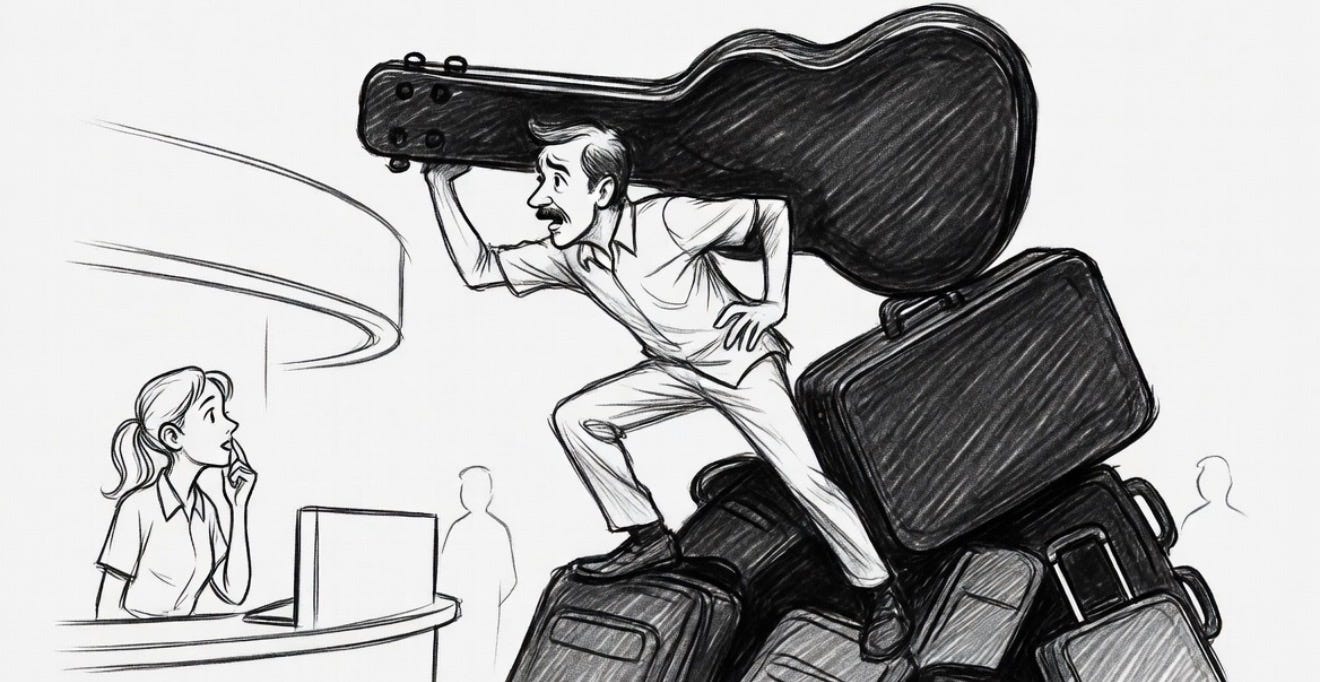
Forty years ago, I was a young expatriate on a summer visit to my family in Montreal, about to return to my overseas posting. Life abroad was spare, so I had stocked up — two enormous suitcases, each well over fifty pounds, packed with shampoos, clothes, daily necessities, everything my father had added for good measure. My ticket back was a youth standby fare: ninety dollars, one way, twenty kilos maximum. The airline was notorious. Half a kilo over and they would charge you more than the ticket itself.
I was at the kitchen table with a scale, weighing each item with surgical precision, deciding what to sacrifice, when my father walked in.
He looked at the scale. He looked at the suitcases. He looked at me.
"Forget it," he said. "Pack everything."
I tried to explain. Twenty kilos. Strict airline. Fifty-pound bags. He waved his hand as if I had just told him the sky was blue and this was somehow my concern. Then, on his way out to load the car, he turned around.
"Bring the guitar."
My younger brother, who actually owned the guitar, came flying out of his room. "What guitar? Nobody is taking my guitar." My father said don't worry, the guitar is not going anywhere, just bring the guitar, trust me. My brother protested. My father had already moved on — cheerful, unhurried, almost goofy. As if none of this was remotely serious.
That was the performance. And it had already begun.
At Mirabel Airport — a full hour from Montreal, built for a future that never quite arrived — my father loaded the two massive suitcases onto the trolley and placed the enormous guitar case on top. The tower of luggage was roughly the size of a small car. He wheeled it to the check-in counter with the serene confidence of a man who had already won — because he had.
The check-in agent was young, efficient, trained to hold the line. My father placed the first bag on the scale. She smiled. He placed the second. She stopped smiling. He hoisted the guitar case on top.
She could barely see over the counter.
"Monsieur — "
And then my father, in the most magnificently broken French-English hybrid ever deployed at an international airport, began. He spoke of his son traveling alone, far from home, to difficult conditions. He spoke of the revolution, of what was taken from us, of the quiet hardships of exile. The line behind us grew. And grew. My father kept talking — not frantically, not desperately, but warmly, sorrowfully, with the patient gravity of a man sharing something true. Which, to be fair, he was. He just wasn't sharing it because he had to. He was sharing it because it worked.
The agent softened. You could see it happening in real time. But she couldn't let all of this through. It was too much.
Finally, my father paused. He looked at the guitar. He sighed — a sigh of such theatrical depth it deserved its own boarding pass.
"I understand," he said gently. "I know you cannot accept the guitar. I know it will break his heart — music is everything to him out there, alone — but I understand your situation. I don't want to make this difficult for you." He reached for the guitar case. "We will leave it behind."
The agent looked genuinely pained. "I am so sorry. I truly cannot accept the guitar." And as she said it — apologizing, explaining, her eyes on the guitar she was turning away — her hands were moving. Tagging the first bag. Tagging the second. Printing the boarding pass.
My father accepted her apology with grace and quiet dignity. We walked away. No guitar. Two fifty-pound suitcases checked through without a single word about the weight.
In the car, my father turned to me. He was trying not to smile.
"Did you see what just happened?"
I had seen it. I still couldn't quite believe it.
He wasn't rattled back there. He wasn't improvising. He was never in doubt. The whole scene — the broken French, the sorrow, the sigh, the guitar — was a carefully directed performance, and he had played every role simultaneously: the grieving exile, the reasonable man, the reluctant one making concessions. He gave up something he never wanted and never intended to take. And in doing so, he made her feel like she had won.
"This," he said, "is how Persians negotiate. You put something on the table that you were never going to get. You make them feel that they are the ones saying no. And while they are busy feeling guilty about the guitar — they check in everything else."
He said it with a grin. For him, this was not a hustle. It was an art form. Intellectual gymnastics. He was operating on an entirely different level — and the most delicious part was that he looked, the whole time, like he wasn't operating at all.
———
I thought about that morning eleven years ago when prominent American officials asked me, during the JCPOA negotiations, whether I thought the deal was sound. I told them this story.
The guitar, I said, is the nuclear program. So visible, so dramatic, so consuming of everyone's attention that no one notices what is being tagged and loaded onto the plane. Iran walked away from Vienna with billions in unfrozen assets, sanctions relief, and its regime not merely surviving but legitimized — its grip on power ratified by the signatures of the world's major powers. Human rights: an internal matter. IRGC regional aggression: not on the table. The velayat-e faqih — the supreme theocratic authority — untouched, unquestioned, unchallenged. The future of ninety million people: not even raised.
They walked away having surrendered the guitar. They thought they had won.
Eleven years later, the guitar is back on the trolley. Bigger, shinier, more dramatic than ever. The cameras are on it. The diplomats are arguing about it. The headlines are full of it. And the world has lined up patiently behind, just like the passengers in that queue at Mirabel — seeing nothing, suspecting nothing.
And behind the counter, the hands are moving again.
Billions in sanctions relief. CHECK.
Three hundred billion dollars in new investment commitments — rewarding the architects of destruction. CHECK.
The IRGC — not dismantled, not diminished, not even named — walking away intact and emboldened. CHECK.
The regime's survival: guaranteed. CHECK.
The velayat-e faqih: untouchable. CHECK.
The rights of women — to equal standing before the law, to movement, to bodily autonomy, to existence without a mandatory veil and a morality police - denied. CHECK.
The rights of religious minorities — Bahá'ís, Christians, Jews, Sunnis — persecuted, imprisoned, erased. CHECK.
The Iranian people — their voice, their future, their freedom — not on the scale. Not on the table. Not in the room. CHECK.
Not even on the trolley.
Ninety million people. And not one of their names in the agreement.
The guitar comes home. It always does.
But the Iranian people are not luggage. They are not excess weight to be left behind while their oppressors negotiate their silence. They are not a footnote to a ceasefire. They are the entire point of this journey.
And it is long past time they were on the plane.
— Shane Tedjarati
No posts
Comments
Nothing yet. Say the first thing.
Sign in to join the conversation.