
In a new study published in Cell Host & Microbe, researchers went looking in the guts of people with irritable bowel syndrome (IBS) and people with insulin resistance.
They found that both groups were missing the same ingredient.
Not a vitamin. Not a mineral.
A gut-derived molecule that can be produced from a common dietary fat.
I promise we’re going to get into the specifics, and the solutions. But before we do, I need to provide a little more framework.

IBS—and in this case, specifically IBS with diarrhea (IBS-D)—is a gastrointestinal disorder affecting millions of people worldwide. Furthermore, IBS, and the more severe inflammatory bowel diseases (IBD), are tightly associated with a Westernized diet.
*Author’s aside: On a personal note, whether my childhood diet of Subway, Twizzlers, and industrial quantities of breakfast cereal caused my eventual diagnosis of inflammatory bowel disease… well, I suppose, a bit like the center of a Tootsie Pop… the world may never know.
Anyway, nostalgia aside, I know it also won’t surprise you that another pathology linked to Westernized diets is insulin resistance.
But are these simply two conditions (IBS and insulin resistance) that happen to be associated with the same dietary pattern?
Or is there a deeper connection?
I think you’re smart enough to know where this is going.
According to these new data, there is a link.
And it starts in the microbiome.
Maybe this isn’t a surprise. The microbiome is one of the primary gatekeepers between the outside world and our internal biology.
What we eat, how we live, and the environments we inhabit can profoundly reshape the microbiome, influencing everything from gut health and symptoms like bloating, diarrhea, constipation, and abdominal pain, to metabolic health and insulin sensitivity.
But this study takes the scientific story a step further.
Let’s start with where the researchers themselves started: in humans.
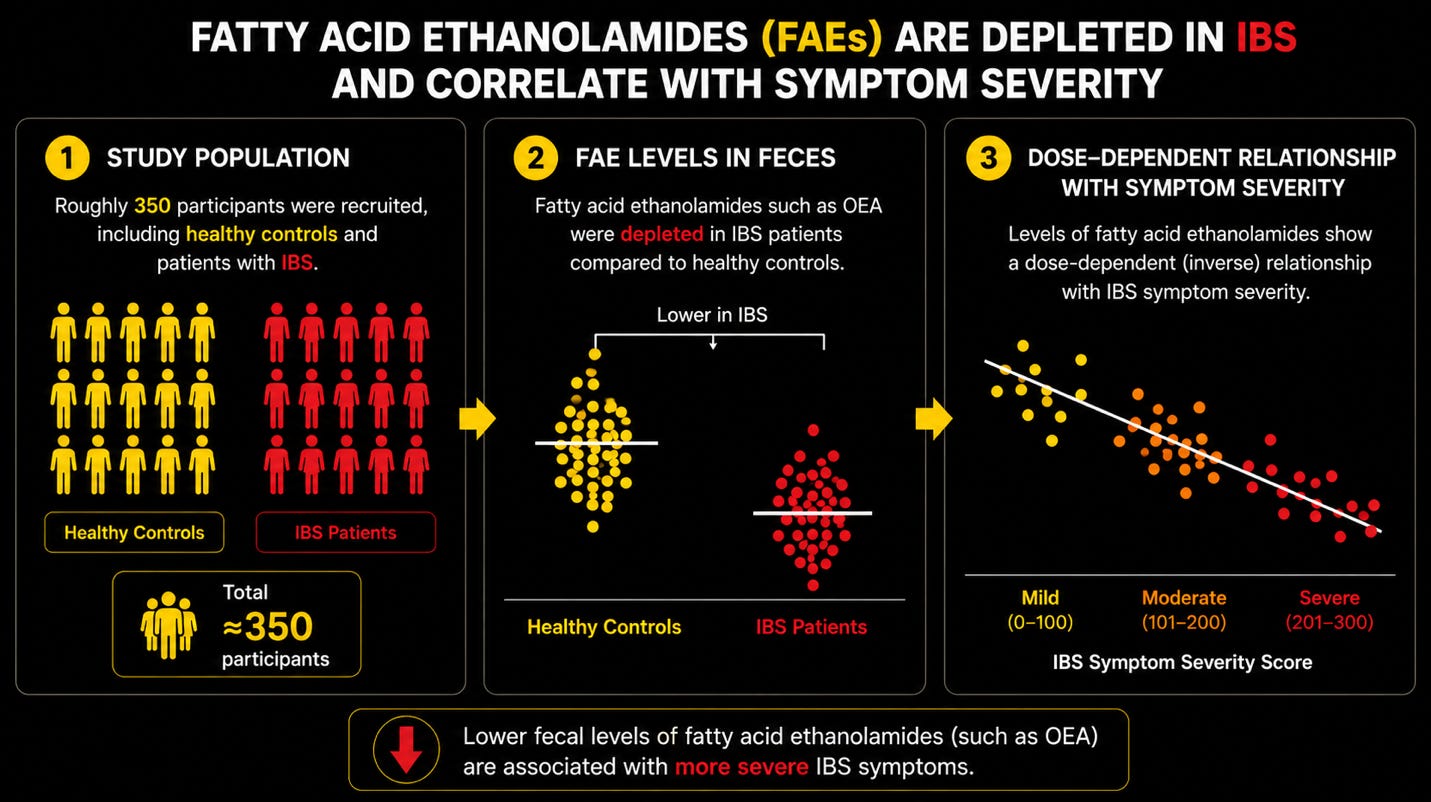
They recruited roughly 350 participants, including healthy controls and patients with IBS, and performed a comprehensive analysis of gut microbiome metabolites—essentially the molecules produced by gut bacteria that can appear in the bloodstream or in feces.
What stood out was a group of molecules known as fatty acid ethanolamides (FAEs).
These are microbial-derived metabolites that are produced from fatty acids found in the diet.
One example is OEA (oleoylethanolamide), a well-known FAE derived from oleic acid, the same fat found in olive oil.
Importantly, levels of fatty acid ethanolamides such as OEA were depleted in the feces of patients with IBS compared to healthy controls.
Interestingly, this relationship held regardless of whether the patients had obesity.
In other words, OEA levels were more tightly linked to IBS than they were to the presence or absence of obesity.
In fact, levels of these fatty acid ethanolamides showed a dose-repsonse relationship with symptom severity.
Even among patients with IBS, the lower the levels of OEA and related compounds, the worse the gastrointestinal symptoms—including pain, distension, and urgency.
But what about insulin resistance?
Fascinatingly, the researchers observed a similar pattern when comparing healthy controls with patients who had diabetes. Insulin resistance was likewise associated with lower levels of these fatty acid ethanolamides, including OEA.
So, let’s take a step back and summarize.
We now have a class of molecules—FAEs, with OEA chief among them—whose levels are reduced in both IBS and insulin resistance.
Those are fascinating correlations.
But where the rubber really meets the road is when we get to the mechanisms.
Because once we understand what’s really going on, the path becomes clear for developing solutions.
In the rest of this letter for StayCurious Metabolism Premium members, we dive into:
Mechanisms: How FAEs influence metabolic health and gut symptoms
Solutions: We’ll explore strategies to increase levels of FAEs, including dietary approaches, specific nutrients, and probiotic interventions.
If you’re someone who loves living at the cutting edge of metabolic health science, join a community of genuinely curious and passionate individuals. Discover why StayCurious Metabolism is the fastest-growing premium science newsletter on Substack.

Comments
Nothing yet. Say the first thing.
Sign in to join the conversation.