
When I was 23 years old, I developed extraordinarily high cholesterol.
I was told repeatedly that my cholesterol was so high that I would be developing cardiovascular plaque within years and probably have my first heart attack by age 30.
I never did.
My arteries are perfectly clean, even on the most sensitive imaging.
The reason why has been a source of debate. Special genetics? I don’t think so. A fluke of fate? That’s not scientific. Just not enough time? Maybe, but it actually skirts around the question.
I think the answer, at least in part, lies in something far more obvious on the surface, but far more interesting underneath.
And it comes down to two things I do every single day, both of which reduce inflammation in my arteries, and one of which has been shown to cause plaque regression in a human randomized controlled trial published this year.
And the best part is that both of them are free.
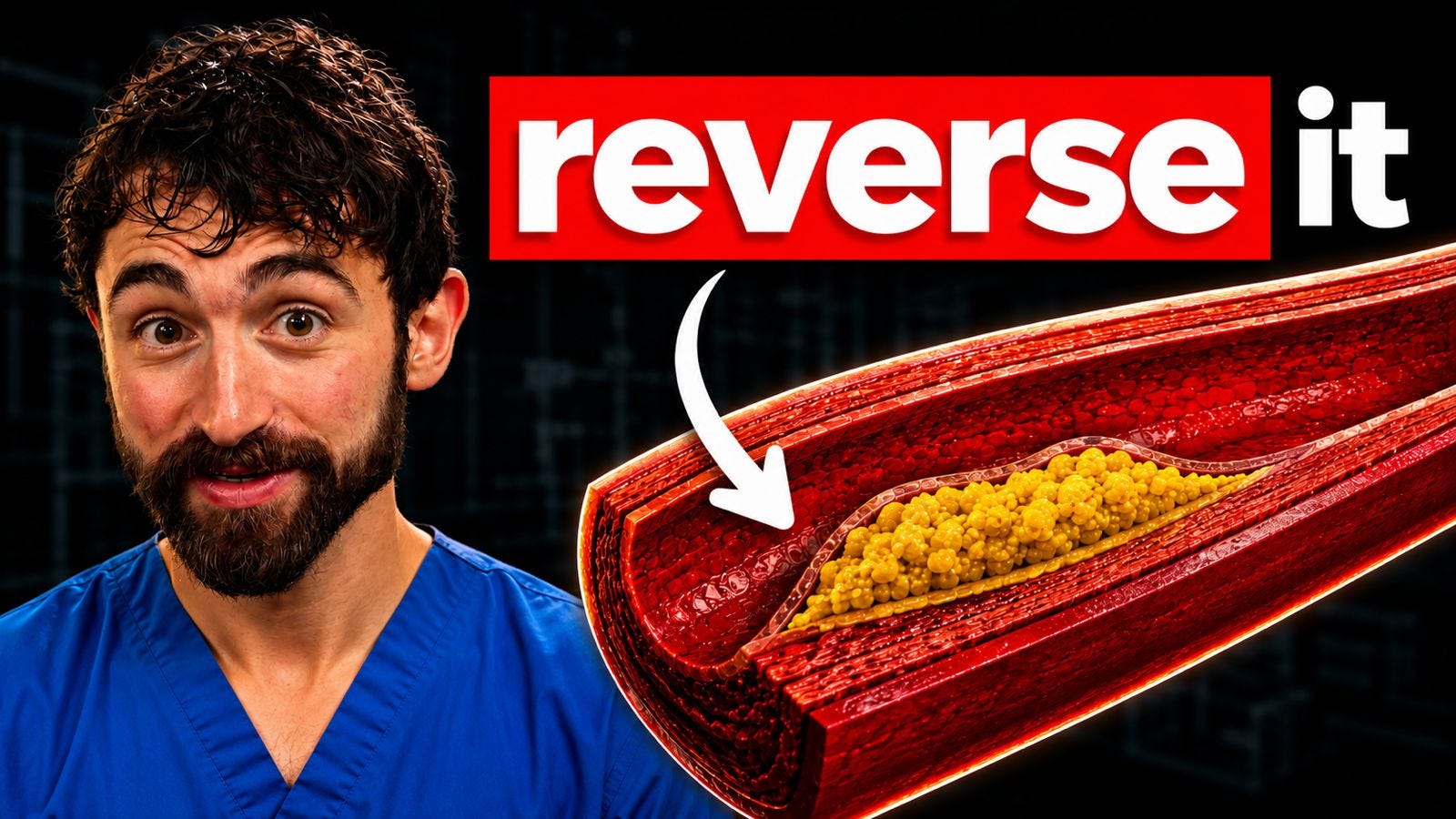
They are sleep and exercise.
Now, before you click off because you think I’ve revealed the secret, I haven’t. What appear to be banal, obvious, healthy lifestyle interventions act on your arteries in ways you couldn’t even imagine.
In fact, when I read the first paper we’re going to discuss, it introduced me to an idea I’d never thought about when it comes to heart health. So come with me on this journey, because I’m about to open your eyes before you close them later tonight.
Let’s begin somewhere unexpected.
A new study in Nature reveals that sleep and exercise can tame mutant blood cells that drive heart disease.
Now, if you haven’t heard of this study, one of the reasons it probably didn’t make headlines is that it’s too bogged down in abbreviations and jargon for most science journalists to make sense of it. Trp53 LOF, Dnmt3AR882H, JAK2V617F. I could go on.
But I’m going to spare you the alphabet soup and introduce one word you need to know: “clonal hematopoiesis.”
“Clonal” is obvious, referring to clones.
“Hematopoiesis” refers to the generation of new blood cells in the bone marrow. The prefix hemato- refers to blood, and -poiesis means formation or production.
So, “clonal hematopoiesis” refers to the generation of new blood cells, including immune cells, that are clones.
Why should you care?
Think of your bone marrow as an ecosystem. A healthy one is diverse — thousands of cell lineages coexisting. Clonal hematopoiesis is what happens when one lineage stops playing nice, like an invasive species, and starts crowding everyone else out. And the lineage that wins tends to be the aggressive, inflammatory one: it picks up a mutation that hands it a survival edge, expands, and tilts your whole immune system toward inflammation.
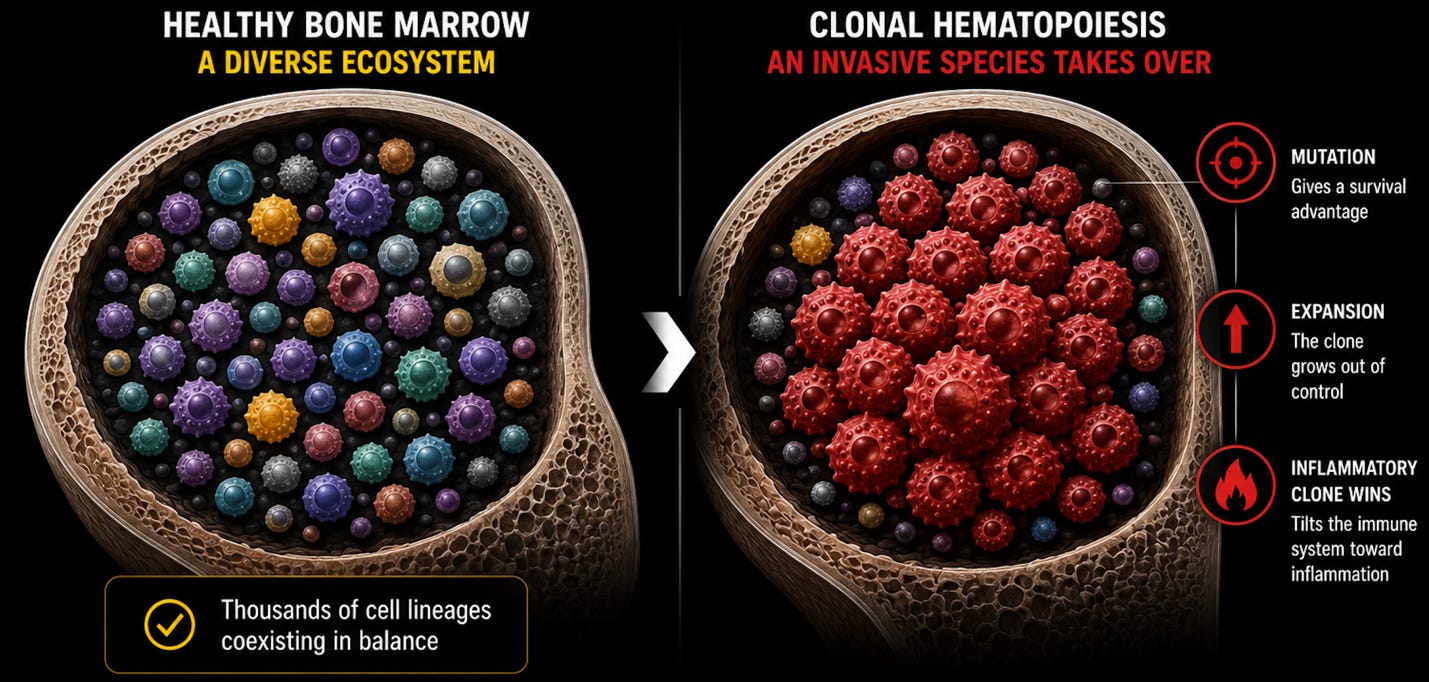
There’s a parallel to cancer here, and it may already be occurring to you. This isn’t full-blown cancer — but it’s the same plot. A population of cells gains an edge and outcompetes its neighbors. Except these particular winners are inflammatory. And they sneak into your artery wall and fire up atherosclerosis.
The consequence is summed up in the opening line of the abstract, which reads:
“Clonal hematopoiesis activates inflammation and increases the risk of atherosclerosis.”
In other words: mutations you didn’t ask for, silently expanding in your bone marrow, may be quietly driving a leading cause of death worldwide.
And this is not some rare, exotic condition.
Clonal hematopoiesis becomes more common with every decade of life — quietly present in a real fraction of older adults, most of whom have no idea and have never had it looked for. If you’ve been told to fixate on a cholesterol number, odds are no one has ever mentioned the mutant, inflammatory cells that may be doing the actual damage.
But you can stop the clones—as I’m about to show you.
Let’s start with the human data.
What the researchers did was amass two large datasets: the UK Biobank and the All of Us Research Program, with over 90,000 individuals in total.
In these cohorts, physical activity was measured using activity monitors, allowing the researchers to examine the association between moderate-to-vigorous physical activity and the degree of clonal hematopoiesis.
What they found: more physical activity tracked with less clonal hematopoiesis — but selectively, certain clones and not others (hold that thought). The pattern held across both datasets, in both men and women.
That’s impressive.
And it’s more than it sounds: the easy dismissal is that exercisers are simply leaner and healthier to begin with — so of course their blood looks cleaner. But the association survived even after adjusting for body weight.
Exercise wasn’t working through the scale. It was reaching the clones directly.
But there’s an important nuance we can’t miss. Exercise suppressed certain clones, but not the generation of blood cells in general. Obviously, you wouldn’t want that.
So, there’s specificity here. It’s not just that exercise suppresses hematopoiesis and the generation of new blood cells. It targets specific clones.
Exercise isn’t a blunt hammer—it’s a precise scalpel.
And I’ll just spoil the ‘not-so-surprise’ surprise about sleep to respect your time. Whereas exercise suppresses harmful clonal hematopoiesis, sleep disruption—things like shift work and chronic insomnia—makes it worse.
So, two foundational lifestyle patterns—sleep and exercise—converge on the generation of new blood cells in your bone marrow to curtail the development of harmful, inflammatory immune cell clones.
But how?
How can something as simple as going for a run or getting a good night’s sleep selectively target harmful mutant cells while leaving healthy blood cell production intact?
The answer is elegant, the data are eye-catching, and the consequences apply to each and every one of us…
In the rest of this letter for StayCurious Metabolism Premium members, we’ll dive into:
How exercise and sleep selectively eliminate harmful inflammatory cell clones
How these same lifestyle habits reprogram immune cells once they enter the artery wall
New human randomized controlled trial (RCT) data showing regression of atherosclerosis
If you’re someone who enjoys exploring the inner workings and hidden mysteries of your body, you’ll feel right at home in the StayCurious Metabolism community. Become a part of what makes it so special.

Comments
Nothing yet. Say the first thing.
Sign in to join the conversation.