
In “Why Nobelists Fail,” Sanjay Reddy (who was unfortunately recently sacked from The New School) presents Daron Acemoglu, Simon Johnson, and James Robinson’s prize-winning work on institutions and development as follows.
He says they identify good institutions more or less solely with private property protection, which is in his opinion highly problematic and reductionist. In later popular works, he adds, they do expand the definition significantly to encompass the rule of law, provision of public services, free entry of new businesses, and freedom of people to choose their careers. He’s thinking of Why Nations Fail from 2012 here. But this, Reddy charges, “confusingly, run[s] together … the proclaimed effects and the descriptive features of such institutions”. Additionally, in this later period, according to him they also appended inclusive political institutions to inclusive economic institutions, but this again seems, in his words, “opportunistic and unsupported.”
So, the first ostensible problem is that Acemoglu et al. have a reductionist view of good institutions; and their later attempts at being non-reductionist are for some reason faulty.
Next, according to Reddy, the key claim by Acemoglu et al. is that good institutions appeared only in certain places, which explains why only certain places got economically developed. Here, Reddy naturally asks what explains why good institutions were successfully transplanted only in certain places, and he settles for this interpretation:
It came down to another explanatory factor, namely whether a sufficient number of colonizers had arrived on the scene and had been able to establish themselves as a dominant force, by beating back natives and disease.
Somewhat strangely, he immediately adds that Acemoglu et al. also used an additional, “correlative” finding related to the identity of the colonizers. His gloss is that they say (in his words): “The British had the best institutions, with the French, Spanish and Belgians having increasingly inferior ones.” Which place the colonizers originated from helped explain why some colonies got better or worse institutions.
Reddy then notes that, actually, Acemoglu et al. explicitly contrast their own perspective with that of other authors, and quotes them directly as follows:
Similarly, North, Summerhill and Weingast (1998) argue that former British colonies prospered relative to former French, Spanish and Portuguese colonies because of the good economic and political institutions they inherited from Britain, and Landes (1998, Chapters 19 and 20) stresses the importance of the culture inherited from Britain in these colonies.
In contrast to this approach, which focuses on the identity of the colonizer, we emphasize the conditions in the colonies.
Reddy provides his gloss on this statement: to him, Acemoglu et al. are again confirming here that they are concerned only with property rights protections (which were “enabled by the presence and dominance of Europeans”), not “the relative superiority of specific European institutions.” He additionally muses that even this version of the argument, where colonizers’ identity is unimportant, might be just as chauvinistic as the other one, namely, the one which focuses on the alleged superiority of domestic institutions and culture of the colonizers.
In all, the issues Reddy outlines are:
Reducing good institutions to secure private property.
Expanding good institutions to mean other things as well later on, but doing so unsatisfactorily.
Explaining diverging development merely by pointing to the presence of European colonizers and to whether natives are numerous and strong or not.
Explaining diverging development by pointing to the identity and domestic institutions of the colonizers, but also saying that this isn’t their argument but other authors’ argument.
Both explanations are inadequate and also perhaps chauvinist.
There’s a lot to unpack here. Schematically, here’s my rendering of Reddy’s reconstruction of Acemoglu et al.’s chain of reasoning:

I think this is both somewhat confused and uncharitable or reductionist to how Acemoglu et al. really think about the matter.
My more charitable gloss on Acemoglu et al.’s institutionalist theory of diverging development would look as follows:
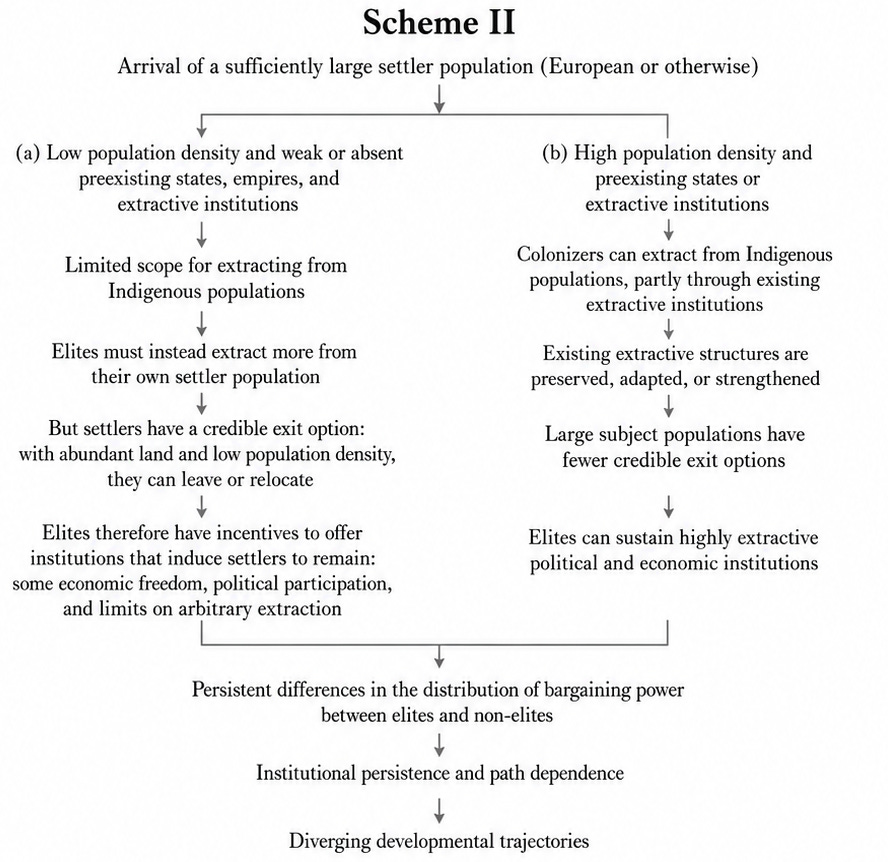
Now, it might be said that I’m drawing too much on Acemoglu et al.’s “later” work here, like Why Nations Fail. (Though why would that be bad? They got the Nobel for all the work they did, not just a few early papers). But the rich institutionalist theory in fact comes much before that, already in their celebrated 2005 Handbook of Economic Growth chapter. Interestingly, Reddy cites the 2005 chapter in his critique, but doesn’t engage with it and its theoretical substance at all.
This famous scheme below comes from the 2005 Handbook. Where is the ostensible reduction of everything to “property rights?” What is ad hoc about the inclusion of political institutions in the theory here? They fit in quite elegantly and are nicely theoretically elaborated in the piece. It also makes a whole lot of empirical sense to include them.
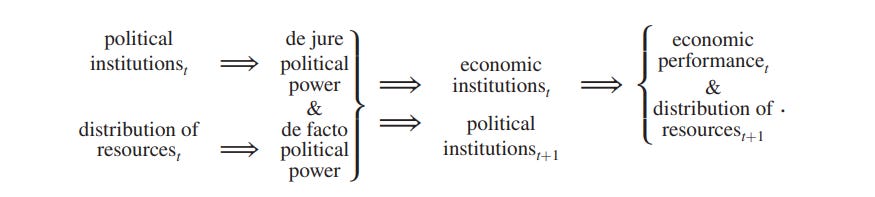
Notice also that the overarching argument about development (as I’ve laid it out above) has nothing to do with the identity of the settlers. Acemoglu et al. are (or, were1) rational choice and game theorists, for whom everyone primarily maximizes material interests like power and wealth, given environmental incentives and strategic interactions. The upper classes try to pump surplus out of subordinated classes. It’s simply that in some places, for contingent reasons, the best way of going about that was building more inclusive institutions, while elsewhere extractive institutions made more sense (in light of the material circumstances on the ground).
Whatever the merits of this argument, it’s not chauvinist, it’s not normative, it’s got nothing to do with British people being culturally superior or having superior institutions at home, it’s not logically wedded to only secure property rights mattering (to the exclusion of any other institution), and it’s a fairly plausible argument at an abstract level at least.
The famous comparison between Jamestown and Latin America from the 2012 book is explicitly about colonizers encountering different (and complex) possibilities for coercion. Both Spanish and English colonizers initially wanted gold and labor. But in densely populated societies with centralized political and tributary structures, the Spanish could capture the indigenous elite and appropriate existing systems such as the encomienda and mita. In Virginia, by contrast, neither indigenous people nor European settlers could easily be forced to work because land was plentiful and population density was low (with non-elite settlers having credible opportunities to escape if coerced by the elite settlers). So, ostensibly, the Virginia Company had to abandon its coercive system and offer land and economic incentives, and eventually even political representation to keep the non-elite settlers in place and work them.
The English were, on the Acemoglu et al. view, just as brutish and non-enlightened as the Spanish or anyone else. They go out of their way in the book to show how English elites repeatedly attempted to create hierarchical and coercive colonial systems. Where’s the chauvinism in that? Also, the theory which postulates that colonizers from different metropoles acted differently due to the culture they brought over is an alternative to the standard Acemoglu et al. story.
Now, where I think Reddy is on firmer ground is in his questioning the empirical proxy for good institutions Acemoglu et al. used initially in their work. He says they were mostly reliant on “protection against expropriation” and “constraints on the executive.” This is still not “just secure private property,” like Reddy charges, but it’s definitely lacking as a broad measure of good institutions. Still, this was work being done in the 1990s and early 2000s, when better and broader measures of institutional quality weren’t readily available. With some charitability, Acemoglu et al. could be excused for focusing on relatively narrow measures of institutional quality and using them as proxies for something broader. Moreover, if we obtain more or less the same result with better data and measures, the critique definitely loses some of its core force and substance. And even Acemoglu et al. in that original paper did robustness tests with additional measures, such as law and order, rule of law, and judicial efficiency. This is not just “private property.”
I also feel his “Kith and Kin” alternative explanation for diverging patterns of development after colonialization is in principle fine and hasn’t been ruled out. His argument is that colonies containing large populations descended from the colonizing country enjoyed relationships with the metropole that other colonies didn’t, like preferential access to markets and capital and such. Colonies populated primarily by Indigenous peoples were more often treated as territories to be taxed and exploited. So, because a large population of European descent was itself correlated with low settler mortality and low precolonial population density, the apparent effect of settler mortality on institutions and development might partly capture the advantages produced by these preferential external relationships.
This is fair in principle, but again Reddy should know that Acemoglu et al. obviously don’t just ignore possibilities like this. For instance, they include dummies for British and French colonial origin and a control for French legal origin, after which the estimated institutional effect changes very little. They also control for the contemporary proportion of the population of European descent precisely because, as they put it, a large European-descended population might capture European culture or “special relations with Europe.” The control is statistically insignificant and the estimated effect of institutions remains significant, so at least a simplistic test of Reddy’s objection shows things might be fine. (They also show that their results are not driven solely by the United States, Canada, Australia and New Zealand.)
Yes, all of this is fairly crude, so Reddy’s critique still has bite, but Acemoglu et al. weren’t simply oblivious to such confounding, as is wrongly intimated by him.
Also, Reddy does nothing to empirically establish this alternative. And even if he were to do so, the alternative explanation is not necessarily completely incompatible with the original settler mortality/institutions findings. Why not have both? The way in which places were settled and which attendant institutions sprang up might have mattered alongside (not in contrast to) how colonies and metropoles were linked together. We even have some (relatively crude) indication that this might have been so.
Easterly and Levine’s 2016 study is relevant here. They construct a direct measure of the European share of the population during the colonial period and find that it is strongly positively associated with present-day income. The relationship survives controls for a plethora of confounders, and it persists when the “Neo-Europes” are removed and when attention is restricted to colonies in which Europeans formed only a small minority. To the extent that the colonial European population share can be taken as a proxy for the density of “Kith and Kin” connections (which it obviously can be only and at most in part), the Easterly and Levine paper provides some evidence that’s congenial to Reddy’s objection. European settlement appears to predict later development through channels not exhausted by Acemoglu et al.’s institutional measures.
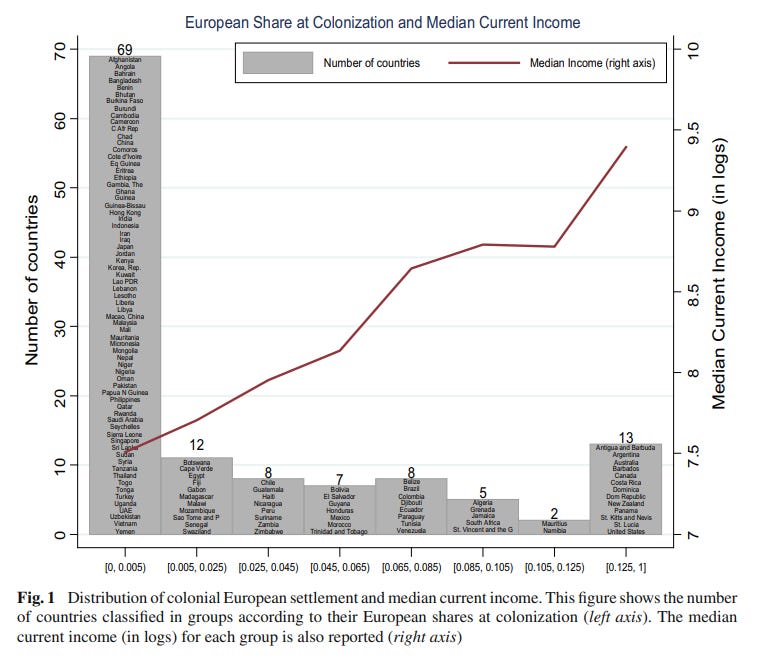
(Of course, this really is crude. The Euro share finding doesn’t allow us to disentangle European human capital/culture from preferential colonial treatment.)
Importantly, Easterly and Levine rightly say their story is still compatible with Acemoglu et al.’s. That’s because when current government quality and colonial European share are entered together in the models, government quality (as a proxy for institutional quality) remains strongly associated with current income. It doesn’t collapse. That’s no proof of the Acemoglu et al. story, but it’s at least consistent with it.
Reddy opens Why Nobelists Fail with this:
Readers of the work leading to the 2024 Nobel Prize in Economics, awarded to Daron Acemoglu, Simon Johnson and James Robinson, generally fall into two camps. One perspective sees their work as helpfully drawing attention to the role of institutions, and of colonial legacies in particular, in shaping long-run economic outcomes. Another sees their framework as being neither original nor revelatory, considering it excessively reductionist, starkly ideological and wholly inadequate for understanding a complex global reality. It will be argued here that despite the imprimatur these ideas have now received, these charges remain pertinent …
I’m not sure that most readers fall just in the one camp or the other, but if we’re framing the debate in this polarized way, then I’d say the first camp is clearly closer to the truth than the second one. According to Reddy, the first camp just says Acemoglu et al. were helpful in drawing attention to institutions for long-run economic outcomes. The first camp is not, in Reddy’s presentation, wedded to the idea that they did so perfectly or even very well. We don’t have to insist that their measures were very good or even satisfactory. Ditto for methods. If this is really the position of the first camp, then it’s very secure. No overstatements are made.
(Relatedly, see my more critical but also appreciative piece on the “original sin” of Why Nations Fail.)
But the second camp, as Reddy describes it, clearly overstates the criticism. The second camp is committed to seeing the Acemoglu et al. work not merely as imperfect, somewhat problematic, or even outright reductionist, but as “excessively reductionist, starkly ideological and wholly [wholly!] inadequate.” That’s a very silly thing to say, especially when we consider the decades of research by Acemoglu et al. and all of the other institutionalists doing similar and good work.
Nowadays, and at least since 2019 (The Narrow Corridor), Acemoglu et al. explicitly emphasize a role for norms and ideology as explanatory factors. That’s not necessarily incompatible with rational choice theory and game theory, but stricter materialism was the standard way in which these tools were used by Acemoglu et al. (and other) in the past.
No posts
Comments
Nothing yet. Say the first thing.
Sign in to join the conversation.